

As underground mines continue to push deeper, ground stresses rise, and so do the safety challenges that come with them. Operators are increasingly looking for monitoring solutions that are not only accurate and dependable but also simple to deploy and safe to operate in demanding environments.
At Agnico Eagle's Fosterville Gold Mine in Victoria, Australia, this need is particularly acute. The mine is known for its challenging geological conditions, where the rock mass can experience significant shear deformation, often leading to buckling or bulking of the excavation.
To stay ahead of these deformation trends, Fosterville Gold Mine trialed Sandvik's xCell Cyclops — a compact, laser-based monitoring system that provides automated and continuous convergence measurements. The solution replaces manual and episodic monitoring with real-time insights streamed wirelessly to the surface, giving engineers immediate visibility into changing ground conditions.
Seamlessly integrated into underground operations
Three xCell Cyclops sensors were installed in an area known for elevated convergence activity. Mounted directly to existing MD bolts, the sensors were straightforward to install and were set up within minutes without disrupting production or requiring specialist equipment. Configured to take measurements at one-hour intervals, the sensors automatically transferred their data to the cloud via the xCell Professor vehicle-mounted gateway, eliminating the need for manual downloads or cable access in the drive.
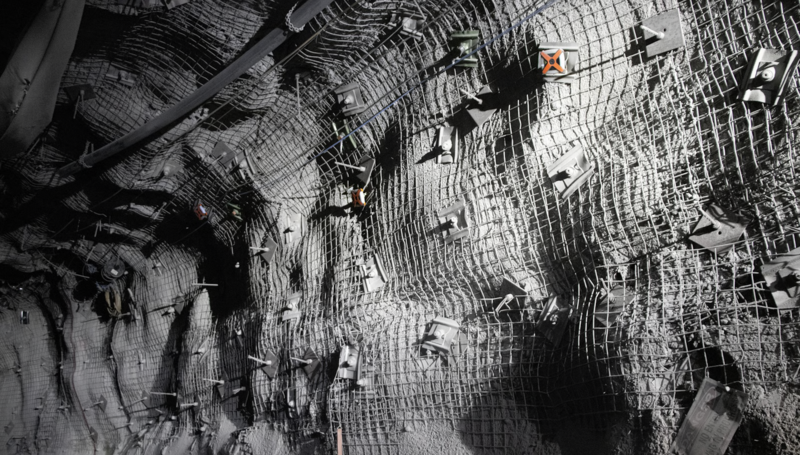
Within the first month, the mine team was already seeing value. The sensors captured a consistent convergence trend and later detected a sharp deformation spike following a stope blast just 20 metres away. This post-blast movement was immediately visible on the dashboard, helping engineers understand how the ground was reacting in near real time. After several days, the convergence rate stabilized — a clear indication that the excavation had reached a new state of equilibrium, confirming the effectiveness of the installed ground support.
Complementing LiDAR with continuous early warning
To validate the trial, Fosterville Gold Mine compared xCell Cyclops data with LiDAR scans taken over the same period. The results aligned closely: both methods recorded deformation in the range of 10–30 mm. However, while LiDAR remains the gold standard for detailed spatial analysis, it is resource-intensive and typically performed only once a month. By contrast, xCell Cyclops provided a live data feed, acting as a real-time trigger for when detailed scanning should be prioritized.
A step toward safer, data-driven operations
The trial at Fosterville Gold Mine proved how continuous convergence monitoring can enhance both safety and decision-making underground. With xCell Cyclops, engineers gain round-the-clock context without sending personnel repeatedly into high-risk areas.
By closing the gap between observation and action, xCell Cyclops is helping mining teams work smarter, respond sooner and operate more safely — even in the most challenging geological conditions.


