President Ferdinand Marcos Jr. delivered his fifth State of the Nation Address (SONA) on July 27, 2026, at the House of Representatives in Quezon City.
During his 2026 SONA, President Marcos Jr. emphasized the administration's aggressive infrastructure initiatives, focusing on the rehabilitation and reopening of vital bridges, namely: the San Juanico Bridge, Liloan Bridge, and Calbiga Bridge. The three bridges are part of the Maharlika Highway (Pan-Philippine Highway) which is the country’s principal land transportation pathway that connects Luzon to Mindanao.
The rehabilitation of these bridges had subjected motorists, travelers, and business to travel restriction for months. Currently, the bridges have resumed operations after major strengthening works were completed. Looking ahead, the restored bridges will ensure efficient travel for everyone for several years, boosting connectivity, trade and economic growth for the country.
While continuing to develop new infrastructure projects, the administration emphasized a renewed commitment to maintaining and structurally rehabilitating existing public assets. [1]

Back Story of the Three Bridges
The “Build Better More” program remains a primary economic catalyst, maintaining strong public infrastructure investment to drive national growth. [1]
The rehabilitation of the country’s longest bridge over a body of seawater, the iconic San Juanico Bridge, spanning 2.16 kilometers, was a priority of the Marcos administration due to its important function. It is the only permanent land link between Samar and Leyte.
After an assessment in May 2025, the bridge’s deteriorating quality raised some concern, and DPWH implemented load restrictions while undertaking one of its most extensive rehabilitation programs.
The President also personally inspected the bridge in Tacloban City in December 2025. He assured residents that the structure would regain its full capacity this year.
And true to his word, the bridge today can accommodate two-way traffic for vehicles weighing up to 15 tons, while permanent strengthening works are ongoing.
DPWH Regional Director Engr. Edgar B. Tabacon stated that the agency remains on schedule to restore the bridge’s original 33-ton load capacity by October 2026. [2]
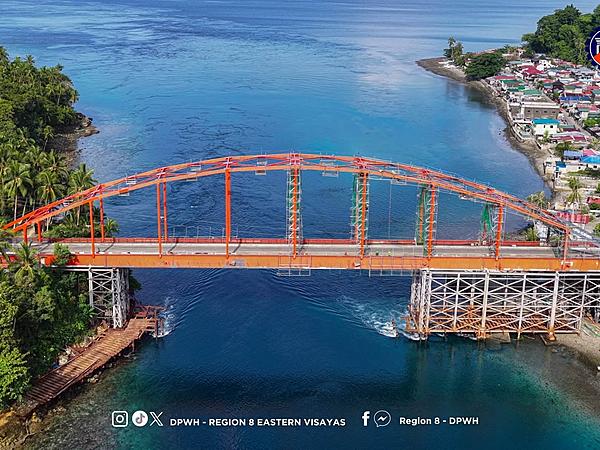
Another notable achievement this year is the reopening of the Liloan Bridge in Southern Leyte. In the past year, the bridge can only accommodate a five-ton load limit. Today, the bridge can now hold 15-ton vehicles under a two-way traffic scheme after the completion of the structural strengthening works that was ordered by President Marcos Jr.
Director Tabacon stated that the upgrade now allows buses and cargo trucks traveling from Surigao City’s Lipata Port to pass directly through the bridge. This pathway prevents the need for expensive barging services and it provides a shorter route to shorten travel time and lessen logistics costs.
Lastly, the first phase of the Calbiga Bridge strengthening operation in Samar was completed two months ahead of schedule. As a result, the bridge is now reopened to heavier vehicles.
Director Tabacon reported that the bridge can now accommodate 15-ton vehicles under a two-way traffic scheme, while trucks weighing up to 30 tons may cross during designated nighttime one-way operations.
From the report of the Philippine Information Agency, “the accelerated completion followed directives from President Marcos and DPWH Secretary Vince Dizon to immediately reinforce the bridge, reducing long detours that previously forced truckers to pass through the Wright–Taft–Basey route before reaching Tacloban City.”
“For transport operators, farmers, traders, and ordinary commuters, the rehabilitation of the three bridges represents more than completed infrastructure projects. It restores faster travel, lowers freight costs, strengthens supply chains, and improves access to markets, schools, hospitals, and government services.” [2]
A Time to Toe the Line
The President’s SONA highlighted quality, accountability, and compliance to public infrastructure standards.
To enhance public safety and ensure infrastructure lasts longer, the administration prioritize strict compliance with engineering standards in construction and structural longevity through the creation of durable structures.
The SONA greatly emphasized that government-funded infrastructure must deliver lasting value to the Filipino people, and that structural projects should be built to last for several years and strong enough to withstand harsh environmental forces.
President Marcos Jr. stated that this year, the South Luzon Expressway-TR4 will reach its completion. This spans from Sto. Tomas City, Batangas to Lucena City, Quezon. He stated that around 17,000 motorists daily will benefit from this route.
He said that aside from the 137 evacuations centers that were established in different locations in the Philippines, several buildings called “Ligtas Pinoy Centers” will be built this year, particularly in locations that are frequently experiencing harsh weather and storms, namely: Bicol, Eastern Samar, Bukidnon, and Davao de Oro.
These structures are designed to withstand severe calamities like super typhoons with wind velocity of 340 kilometers per hour and earthquakes with magnitude 8.4.
The President said that all other structures in the private sector should follow this high standard, and that all buildings in our country should be ready and strong enough to withstand these extreme conditions and natural calamities.
He gave a reminder to give importance and to focus on the amendment of the National Building Code so that it will be in accordance to modern standards.
In relation to countering corruption behind the flood control projects, the government has established the “Oplan Kontra Baha” (Operation Plan Against Flooding) for the whole country.
Conclusion:
This year’s SONA of President Marcos Jr. and his administration’s progress report features the government’s focus on infrastructure, the continued implementation of major projects and the maintenance and rehabilitation of existing public assets. [1]
The SONA highlights the importance of infrastructure as an economic driver for progress as it provides connectivity and delivery of vital public services.
According to “The President’s report to the people 2022-2026: A primer. Bagong Pilipinas”, these priorities underscore the role of infrastructure in improving connectivity, supporting economic activity, and enhancing the delivery of essential public services. As these initiatives progress, their long-term impact will depend on sustained implementation, effective resource management, and continued oversight to ensure that public investments deliver meaningful benefits to communities across the country. [1]
---
Photo credit:
Top Photo – Philippine News Agency – State of the Nation 2026
Liloan Bridge - courtesy of DPWH-8
---
Reference:
[1] Garde, Mark Joseph (July 29, 2026). Advancing the Nation's Infrastructure Agenda: 2026 SONA Highlights. Pinoy Builders PH.
https://pinoybuilders.ph/advancing-the-nations-infrastructure-agenda-2026-sona-highlights/?utm_source=mailchimp&utm_medium=email&utm_content=cta-link
[2] Arinto, Reyan L. (July 28, 2026). PBBM’s 2026 SONA cites infrastructure resilience with restored Eastern Visayas bridges. Philippine Information Agency.
https://pia.gov.ph/news/pbbms-2026-sona-cites-infrastructure-resilience-with-restored-eastern-visayas-bridges/