
There is, apparently, one reliable way to get people to drive less: start a war near the oil.
That is not an energy policy. It is just the sort of grotesque lesson modern conflict keeps teaching with terrible efficiency. In March, the International Energy Agency urged governments and households to cope with rising fuel prices by doing the very things climate advocates have been pleading for years: work from home when possible, avoid unnecessary flights, slow down on highways, and take public transport. Six months later, the vulnerability behind that advice remains. Reuters reported on September 22 that Saudi Arabia’s East-West oil pipeline had restarted after a drone attack forced its closure earlier in the month. Even the route used to bypass the Strait of Hormuz had proved vulnerable.
And that is where the bitter comedy begins.
In peacetime, if you suggest that maybe we should fly less, drive less, burn less, and generally stop treating the atmosphere like an ashtray with weather, people call it moral vanity. Elitist. Anti-growth. Anti-car. Anti-fun. Suggest biking and someone will act as though you have proposed monasticism. Tell people to take the bus and they look at you as if you have personally outlawed joy.
But let missiles land near refineries. Let shipping routes wobble. Let prices climb until every trip to the gas station feels like a mugging with receipt paper. Then, suddenly, restraint becomes sensible. Even patriotic. What years of environmental argument could not make attractive, war can make unavoidable in a week.
War, in other words, is a very effective conservation campaign. Its problem is branding. Also, the blood.
The irony has a limit, of course. Burning less because a journey has become unaffordable is a measure of hardship, not necessarily of environmental progress. A family skipping a trip, a driver losing passengers, a household stretching its cooking fuel: these are people absorbing a shock. Any honest accounting must distinguish the fuel saved from the life diminished.
That is only one obscenity among many. The larger dishonesty is the way war is still described in the inflated vocabulary of action and force: targets struck, positions taken, deterrence restored, capabilities degraded. The verbs are always so proud of themselves. They sound fine on a lectern. They sound less fine beside a darkened hospital, an empty tap, a dead refrigerator, a pharmacy with no power, or a child with diarrhoea because the pipes gave out three weeks ago. In March, International Committee of the Red Cross President Mirjana Spoljaric said it plainly: “War on essential infrastructure is war on civilians.” That sentence is so clinically worded it almost hides the cruelty inside it. Almost.
Because that is what war does when it outgrows the battlefield. It does not just kill people. It damages the conditions that let people go on being people. It turns ordinary life into a chain of failing systems. One blown transformer becomes spoiled medicine. A damaged water line becomes disease. A fuel shortage becomes a stalled ambulance. A crater is never just a crater for long. It becomes a timetable.
Take Tehran. In March, strikes on oil facilities sent toxic plumes over the capital. The World Health Organization warned about the health risks from toxic air and “black rain.” There is something especially sinister about that phrase. It sounds poetic until one remembers that poetry is not supposed to burn your lungs. A city does not have to be flattened to be attacked. Sometimes it is enough to make the air itself untrustworthy.
Gaza shows how destruction keeps working after the strike itself. In September, a war-damaged apartment building collapsed on families sheltering inside. Reuters reported that at least 20 people, including children, had been killed. Rescuers searched the wreckage without adequate machinery. Families had taken shelter in damaged buildings because safer alternatives were scarce. A damaged building is not simply a record of what happened. For people with nowhere else to live, it is a danger still unfolding.
The rubble is both an environmental burden and the remains of homes. Reporting this month continued to cite a United Nations estimate of roughly 61 million tonnes of wreckage and debris. The number describes a landscape through which people must still find shelter, reach help and attempt to live. War begins with fire and noise. Its aftermath can kill without either.
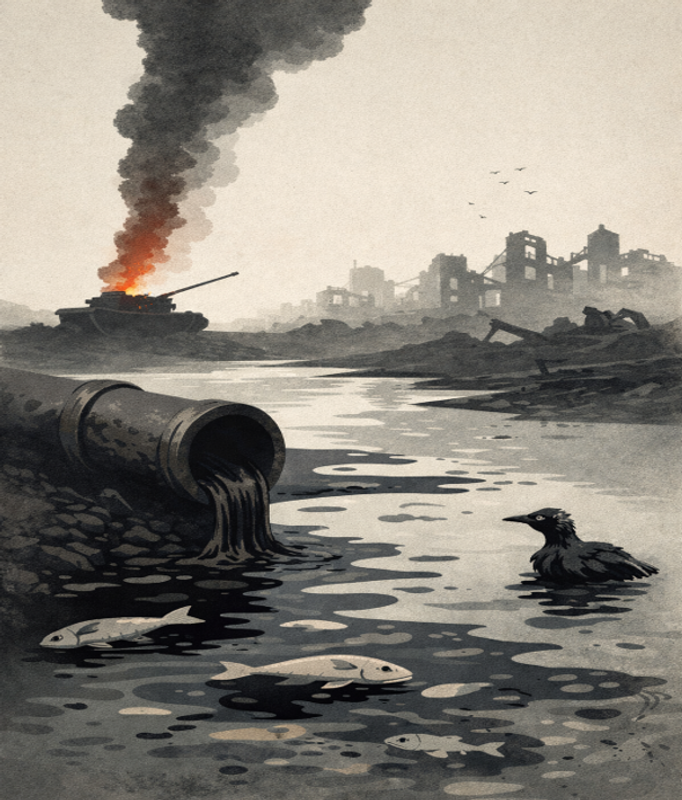
Ukraine tells the same story in a colder, more industrial register. Its devastation also raises a question that survives every damaged building: What will it take to put this back? Reconstruction requires materials, transport, and energy. War’s carbon account extends beyond the fuel burned by military vehicles and the smoke from the targets they strike. First the missile. Then the cement mixer. First the fire. Then the diesel-powered recovery plan. It is the circular economy, if the circular economy were run by arsonists.
And then comes the insult dressed up as wisdom. Officials return to the old conservation sermon, now delivered with the urgency of a fuel shortage. The sermon was never wrong. It is just that, in peacetime, people found it easier to sneer at than to practise. Peace asks nicely and gets mocked for nagging. War imposes the lesson with a crater.
For the Philippines, this is not a remote morality tale performed somewhere else for the benefit of experts with maps. It arrives in familiar domestic scenes. The LPG tank gets heavier in the imagination before it gets lighter in the hand. The tricycle driver does the math twice. The delivery fee changes the price of dinner. The cashier says the total and there is that small pause—that quiet Filipino pause—when you pretend you are not surprised because surprise is not legal tender.
In April, the government announced the suspension of taxes on kerosene and LPG to cushion households. Such relief recognizes how quickly a distant war can rearrange the contents of a Filipino kitchen. The harder question is what we build beyond emergency relief: public transport people can rely on, streets where walking and cycling are safe, and working arrangements that spare an unnecessary commute.
It is easy to advise people to take a bus if you never have to wait for one. A tricycle driver cannot work from home. A worker cannot cycle safely through a road designed as though cyclists were a clerical error. Conservation becomes credible public policy when people have practical ways to practise it. Otherwise, the advice asks households to solve, through personal sacrifice, what governments have failed to make possible.
We are an archipelago, but not nearly as insulated as the word sounds.
This is why the environmental cost of war should stop being treated as a side issue, a soft concern, a specialist’s footnote to the “real” business of geopolitics. It is one of war’s main products. Armies count advances, sorties, and payloads. The earth counts smoke, contaminated rubble, poisoned water, ruined harvests, stressed power grids, disease outbreaks, and carbon loads. One ledger is made for the press briefing. The other is made for the next century.
War’s harshest indecency is that it can make societies look more “sustainable” only by first making the world less habitable.
Atty. Noel B. Lazaro is Chief Legal Counsel and Keziah Aizelle P. Sy is Research Associate at Global Ferronickel Holdings, Inc. Gian Paolo M. Comia is a law student at the Ateneo de Manila University School of Law. Their team has been named In-House Team of the Year by Asian Legal Business–Southeast Asia and Legal Team of the Year by the In-House Community.