The Philippine Mineral Reporting Code or the “Code” was created to set out minimum standards, recommendations and guidelines for Public Reporting in the Philippines of Exploration Results, Mineral Resources and Ore Reserves.
Philex Mining Corporation, one of the oldest and largest gold and copper producers in Southeast Asia, has, after the completion of confirmatory drilling and related technical studies on the mining methodology and Tailings Storage Facility (TSF) No. 3, successfully identified from the end of 2022 additional mineable reserves in its Padcal Mine that are feasible for mining.
The updated remaining mineable reserves as of end March 2021 are estimated at 30.2 Million tonnes with average gold and copper grades of 0.23 grams per tonne (g/t) and 0.18%, respectively.
This new estimate includes additional reserves of 16.2 Million tonnes from the previously declared estimated mineable reserves as at end 2020 of 17.4 Million tonnes with an average gold and copper grades of 0.27 g/t and 0.18% that was reported in February 2021.
The additional mineable reserves are expected to be mined over two years, extending the life of Padcal Mine until December 31, 2024.
The latest mineable reserves estimate was undertaken by Engineer Ricardo S. Dolipas II, an accredited Competent Person by the Philippine Society of Mining Engineers (PSEM) under the Philippine Mineral Reporting Code (PMRC) Guidelines.
More importantly, the extended Life of Mine will ensure the continuous employment of 1,831 Padcal employees and support the social development of the Host Local Government Units (LGU) and neighboring communities especially in this time of COVID 19 Pandemic.
It will also give more time for the Company to bring the Silangan Project to development and commissioning stages. The Company is currently processing all required permits and other regulatory requirements in connection with this impending Life of Mine extension.
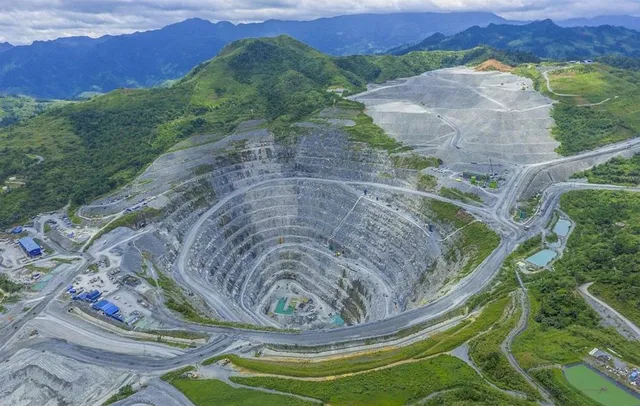
The Department of Environment and Natural Resources (DENR) is still studying the possible lifting of the ban on open-pit mining, Malacañang said on Thursday.
Presidential Spokesperson Harry Roque clarified that Executive Order No. 130, signed by President Rodrigo Duterte on April 14, does not include a lifting of the ban on open-pit mining.
EO 130, which lifts the nine-year moratorium on mineral agreements, is to spur economic growth and support projects and programs of the government.
“There is nothing in the executive issuance on mining which is EO No. 130 which lifts the ban on open-pit mining. I have conferred with [DENR] USec. Benny Antiporda and he says the matter is still being studied by the DENR,” Roque said in a Palace press briefing.
He, however, reiterated that open-pit mining remains unacceptable for Duterte.
In November 2017, Duterte said he agreed with the open-pit mining ban given the environmental damage it causes.
Duterte, in his third State-of-the-Nation Address (SONA) on July 23, 2018, also warned the mining industry not to destroy the environment, saying environmental protection is one of his government’s priorities.
“To the mining industry, I say this once again and maybe for the last time, do not destroy the environment or compromise our resources; repair what you have mismanaged,” Duterte said.
Roque reiterated Duterte’s call to the mining industry to find other ways to extract minerals without destroying the environment.
“But I understand from USec. Benny Antiporda that both the President and Secretary [Roy] Cimatu agreed that the mining industry must reinvent mining in a manner that would ensure that it is sustainable and would cost the least damage to the environment,” he added.
Open-pit mining is allowed under Philippine law, but Duterte has rejected previous recommendations to lift the ban.
The Philippines is the world’s biggest supplier of nickel ore and also among the top producers of copper and gold.
- 12 May 2021- MGB Director, Atty. Wilfredo G. Moncano, presented mining industry updates during a virtual meeting of the Philippine Mining and Exploration Association (PMEA).
- Executive Order No. 130, Section 1 which is lifting of Section 4, EO No. 79 - The moratorium on mineral agreement.
- Moncano announces new MGB Regional Directors
The Department of Environment and Natural Resources (DENR) is targeting to facilitate the continuity of mining exploration projects in the country, the Philippine News Agency reported June 9.
A still-unnumbered and soon-to-be-published DENR Administrative Order (DAO) will provide guidelines for automatic renewal of the exploration period covering such projects and timely declaration of mining project feasibility under various mining tenements, noted Mines and Geosciences Bureau (MGB) Mining Tenements Management Division OIC chief Danilo Deleña.
He said the DAO will cover all exploration permits and mineral production sharing agreements, financial or technical assistance agreements, and other similar mining tenements under the exploration stage.
"That DAO's issuance aims to ensure continuous conduct of exploration activities by all permittees, contractors and other holders of mining tenements,' he said Tuesday during the virtual MGB stakeholders' forum on government mining policies.
The existing renewal process is for parties concerned to submit all required documents and pay the renewal fee so MGB can evaluate their applications and approve these if justified, he noted.
He said MGB has been studying how to facilitate the process as several mining stakeholders already clamored for this, citing difficulty in complying with renewal requirements. "The DAO answers their clamor," he said.
Such DAO will still require mining stakeholders concerned to pay the renewal fee and MGB to review their applications, he added.
Unlike the existing renewal process, he said documentary requirements in the DAO are minimal but stakeholders must submit these 60 days before their respective exploration periods expire.
"If all's well with their applications, they'll be automatically renewed," he said.
According to Deleña, preparations are already underway for the DAO's publication in a newspaper of general circulation and submission to the University of the Philippines Office of the National Administrative Register.
"We're hoping to have the DAO published in a few days," he said.
MGB said of the Philippines' total land area of 30 million hectares, some nine million hectares have high mineral potential.
However, only 2.42 percent of the country's total land area was covered by mining tenements as of May 31, 2020, noted MGB.
The country's primary mineral commodities are gold, nickel and nickel products as well as copper, MGB said.
Available MGB data showed mining contributed some PHP102.3 billion to the country's gross domestic product last year.
National and local taxes, fees, and royalties from mining totaled PHP25.52 billion during the said period, MGB added.
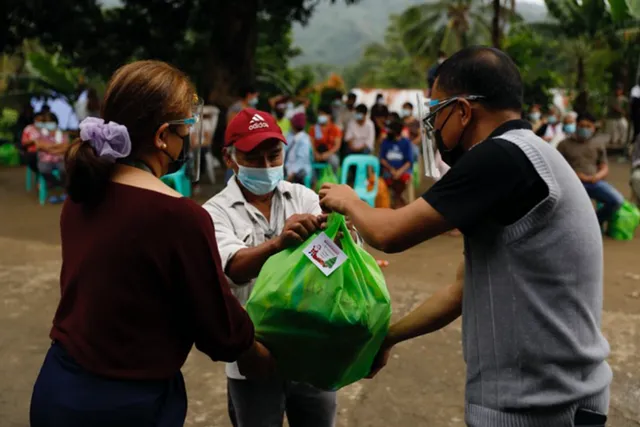
Philex Mining Corp. distributed noche buena packs to PWDs, senior citizens, and front liners the company’s host communities in Barangay Tabaan Norte in Tuba, and Barangay Gumatdang in Itogon, both in Benguet province.
After mining firms heeded the government’s call last year to help ease the nation’s burdens from the Covid-19 pandemic, over a million families and hundreds of thousands of front liners nationwide felt the industry’s all-out support in addressing their most pressing needs. From food, medicines, and PPEs in the early months of the lockdown, to healthcare infrastructure, education, and livelihood assistance, host and neighboring communities of mining projects continue to find solace in the industry amidst the lingering contagion.
All told, the industry spent over P380 million in 2020 for Covid-19 initiatives from mining companies’ Social Development and Management Program (SDMP) funds, realigned to buttress the government’s pandemic response. A total of 1.1 million households and nearly 300,000 front liners all over the country benefitted from the effort.
The SDMP is a 5-year budgeted plan for development programs in mining communities, which the Mines and Geosciences Bureau (MGB) has allowed to be realigned during this pandemic. Some companies even complemented their SDMP spending with Corporate Social Responsibility funds to ensure greater positive impact and to reach more beneficiaries.
RELIEF, MEDICAL and LOGISTICS SUPPORT
According to the MGB, the industry distributed nearly 390,000 relief packs and goods, over 6,000 boxes of medicines, some 1,600 hygiene and medical kits, 11,000 PPEs, 194,000 face masks, 5,000 face shields, 3,000 gallons of alcohol, 2,000 gallons of disinfectant and other cleaning supplies, as well as 4,000 units of other medical supplies. Mining firms also provided isolation units for communities, as well as food and logistics support for medical front liners, checkpoints personnel, rescue personnel and volunteers, Indigenous People (IPs), senior citizens, solo parents, and other vulnerable sectors.
In the provinces of Nueva Vizcaya and Quirino, for instance, almost 19,000 households received medicines, PPEs and food supplies from OceanaGold Phils., Inc., whose Didipio copper-gold project has not been operating since July 2019 as it awaits the renewal of its contract with the government. Also in Nueva Vizcaya, FCF Minerals Corp. provided food supplies to 10,500 households in the towns of Quezon and Kasibu.
Filminera Resources Corp. and PhilGold Processing and Refining Corp., for their part, capped their Covid-19 efforts in their host province of Masbate with a Christmas food distribution drive in nearby Albay for some 400 families – about 100 of them IPs – who were among the hardest hit by Typhoons Rolly and Ulysses. The companies also donated P5 million to help rebuild damaged houses and distribute relief goods following the 6.6 magnitude earthquake in Masbate.
In Benguet, Lepanto Consolidated Mining Corp. (LCMC) and Far Southeast Gold Resources, Inc. opened their Casubigan camp to serve as the town’s temporary Covid-19 quarantine facility following the request of town mayor Frenzel Ayong. In addition, the company equipped its Lepanto hospital staff with complete PPEs, isopropyl alcohol, disinfectants, vitamin C, and other medical supplies. With the help of Lepanto weavers, LCMC provided all its 1,600 with face shields and 3-ply face masks. To stem the transmission of the virus, LCMC rolled out mass testing to over a thousand mine employees. Those who were found positive were sent to the company’’s temporary isolation facilities, with free meals for the entire quarantine duration.
Also in Benguet, Philex Mining Corp. (PMC) lent support for the purchase of medicines by several barangays and to augment the government’s Social Amelioration Program (SAP). Aside from the SAP, the company gave cash assistance to families in Barangay Camp 3, Tuba. PMC, via its subsidiary Silangan Mindanao Mining Co. Inc. (SMMCI), likewise allowed the use of Silangan’s stockyard in Barangay Macalaya as temporary isolation facility of Placer town in Surigao del Norte.
Cagdianao Mining Corp. (CMC) bankrolled the cost of materials and labor for the “Katre-Karpintero” program of Dinagat Islands Governor Arlene “Kaka” Bag-ao who sought to address the need for more beds in the province’s quarantine facilities in the province. “Equipped with sufficient materials,” she said, “150 beds were completed in record time (5 days). Of course this also provided extra income for our (21) carpenters.”
The industry likewise supported the establishment of two molecular technology laboratories and a COVID-19 testing center, as well as the procurement of over 17,000 rapid test kits. Taganito HPAL Nickel Corp. (THPAL) partnered with Nickel Asia Corp. and its affiliates CMC and Taganito Mining Corporation (TMC) in donating P18 million to the Philippine National Red Cross that, in turn, will build a P28-million molecular testing lab in Caraga. The lab can help boost pandemic response in the region through faster diagnostic results, rapid identification of infected patients, and faster contact tracing to limit the spread of the virus.
TMC donated some 5,000 rapid anti-body test kits (RATs) to Surigao del Norte to help detect possible cases of Covid-19 throughout the province. THPAL, on the other hand, provided the Claver town LGU with RATs, antigen test kits, a multicab and motorcycle, and an iChroma II antigen device, which has a higher accuracy rate in detecting Covid-19 than the standard rapid diagnostic equipment. Moreover, THPAL joined the Army 30th Infantry Battalion in providing relief goods to 489 IP families in Gigaquit town. Lt. Col. Jeffrey Villarosa, 30th IB commander, said the effort will help save the IPs from exploitation by rebel groups.
Meanwhile, Platinum Group Metals Corp. (PGMC) provided 6,000 RATs and PPEs to the Caraga Regional Hospital, Surigao del Norte Provincial Hospital, Surigao City Health Office, and Claver Rural Health Unit. TVI Resource Development Phils., Inc. (TVIRD) turned over several boxes of PPEs to the Zamboanga Sibugay Provincial Hospital, while PMC donated PPEs as well to at least 5 hospitals in Baguio and 3 in Benguet.
Face masks, face shields, disposable gloves, isolation suits, and goggles were turned over by PMC to Benguet governor Melchor Diclas and Baguio City mayor Benjamin Magalong. The same equipment were also distributed to the municipalities of Tuba, Itogon, Sablan, and Tublay for use by front liners. At the PMC corporate office, face masks were distributed to medical front liners at the Philippine Children’s Medical Center through the Alagang Kapatid Foundation Inc. Drums of alcohol were donated to the Philippine National Police – Cordillera Autonomous Region and wash stands were provided for the Benguet provincial government as well as to Barangay Ampucao in Itogon. Food assistance was also given to Barangays Ampucao and Dalupirip in Itogon. Various cash and rice donations were also given to the municipalities of Tuba, Itogon, and Sablan.
While SMMCI’s copper and gold project is currently placed on extended pre-mine care and maintenance status, the company still donated PPEs to medical front liners within its host and neighboring communities. It also distributed surgical PPEs to the Caraga Regional Hospital in Surigao City, the Provincial Hospital in Placer, and the Municipal Health Offices of Placer, Tagana-an, and Mainit.
To improve the Cagdianao town’s emergency response and speed up relief operations, CMC provided the LGU here an ambulance unit and a service truck. For its part, Sagittarius Mines, Inc. (SMI), which has not even extracted minerals in Tampakan, South Cotabato since the company’s inception in the 1990s, turned over a four-wheel drive truck to the LGU for its relief efforts in remote mountainous barangays. LCMC also donated a service vehicle to the Mankayan municipality. Local officials who received the donations for their respective towns said the transport equipment would drastically improve their logistics capabilities.
PMC, on the other hand, provided funds for diesel fuel used by barangay emergency vehicles in hauling goods and ferrying medical patients and front liners to and from Baguio.
Over in Cebu, Carmen Copper Corp. distributed health kits to 175 journalists from different media outlets in recognition of their contributions to the fight against Covid-19.
LIVELIHOOD and FOOD SECURITY
Mining projects also distributed some 92,000 sacks of rice to communities all over the country. Rio Tuba Nickel Mining Corp. (RTNMC) and Coral Bay Nickel Corp. (CBNC), for instance, donated P30 million worth rice for Palaweños following the call of Palawan Governor Jose Ch. Alvarez for a joint public-private sector effort to address the food security threat posed by the pandemic. PMC, meanwhile distributed sacks of rice to families in Barangays Camp 1, 3, and Ansagan in Tuba, Benguet, as well as in Barangays Ampucao and Dalupirip in Itogon.
PGMC allocated P12 million of its P31-million Covid-19 assistance initiatives for the company’s Food Security Project, which aims to provide food on the table and, at the same time, a livelihood source for partner communities. Portions of the workforce that were displaced since the onset of the pandemic compelled the inception of this project, which is jointly funded by PGMC’s SDMP and Annual Environmental Protection and Enhancement Program budgets.
Most of the produce from the project’s communal gardening-cum-organic vegetable farming, egg machines, and aquaculture components are bought and consumed within the community; some are bought by PGMC and its employees. The project, implemented in close coordination with the Claver municipal government and the Surigao del Norte Agricultural Office, has been lauded by the Department of Environment and Natural Resources as “one of a kind”.
On the other hand, a bangus farming project sponsored by Hinatuan Mining Corp. – another Nickel Asia Corp. subsidiary based in Tagana-an, Surigao del Norte – yielded more than 1700 kilos of bangus in the project’s first harvest ever. Lilibeth G. Becera, President of the 90-strong United Fisherfolk Association of Bagong Silang said the harvest “is a big achievement for us small fisherfolk because the lockdown has limited our movement in the community and the bangus helped many of us during this quarantine.”
Agata Mining Ventures, Inc. (AMVI), a subsidiary of TVRD, distributed more than 5,000 relief packs that included over 11,000 kilograms of organic vegetables from AMVI’s Mabakas Farm School – certified by the Technical Education and Skills Development Authority (TESDA) – and some of its 1,300 graduates. The recipients included the company’s employees in the its Agusan del Norte mine site and Mamanwa IPs, many of whom are farmers themselves who would have otherwise faced the risk of spoilage of their produce due to quarantine restrictions on transportation.
In Carrascal, Surigao del Sur, meanwhile, Marcventures Mining and Development Corp. distributed vegetable seeds to urge residents to start their home garden and grow their own vegetables amid the ongoing health crisis. Dubbed “Gulayan sa Panimalay,” the program is part of the municipality’s food sufficiency strategy, where residents are encouraged to produce fresh and healthy food from their backyard to their tables, save on food expenses during the pandemic, while enjoying a steady supply of fresh produce from their own backyard. A project of the Department of Agriculture, the program also supports local rice farmers through financial assistance, free hauling services and direct purchase of their rice products at a competitive farm gate price.
EDUCATION and SKILLS TRAINING
SMI helped procure 642 transistor radios for students of Columbio Central Elementary School in Sultan Kudarat as part of the LGU efforts to promote the Department of Education’s distance learning program during this pandemic. Columbio town mayor Edwin Bermudez said the local radio station that SMI also helped establish is now being utilized for distance learning. Barangay Datalblao chair Bai Naila Mamalinta likewise attested that SMI has been providing support not only in the area of education, but also for the health and socio-economic well-being of her Blaan constituents for many years now.
Back in Surigao del Norte, Taganito Mining Corp. recently turned over some 7,172 workbooks worth P2 million to the provincial government for the use of public schools in the province. The workbooks were handed over to provincial governor Francisco Matugas.
Looking beyond the pandemic, Rio Tuba Nickel Mining Corp. and Coral Bay Nickel Corp. are poised to provide residents of Bataraza in the southern part of Palawan the opportunity to shape a brighter future when the company’s P42 million state-of-the-art training center opens after Covid-19. Once fully operational, the center will offer training courses, such as driving, scaffolding, welding, bread and pastry production, among others. The new facility will have audio-visual rooms and dedicated areas for various workshops, and will be equipped with conveyor belts, overhead cranes, vertical structure platforms, and electrical simulators for the training sessions. It will host classes for skills education and job-preparatory training based on the courses that TESDA offers.
VACCINE
In 2021, mining firms have been allowed again by the MGB to realign their SDMP and Safety and Health Program funds to procure Covid-19 vaccines for critical stakeholders.
The Chamber of Mines of the Philippines welcomes the MGB decision as this will help support the vaccination of employees and members of host communities. More significantly, this will provide a big boost to the government’s Covid-19 vaccination program and help hasten the nation’s recovery from this pandemic.
Article Courtesy of the Chamber of Mines of the Philippines
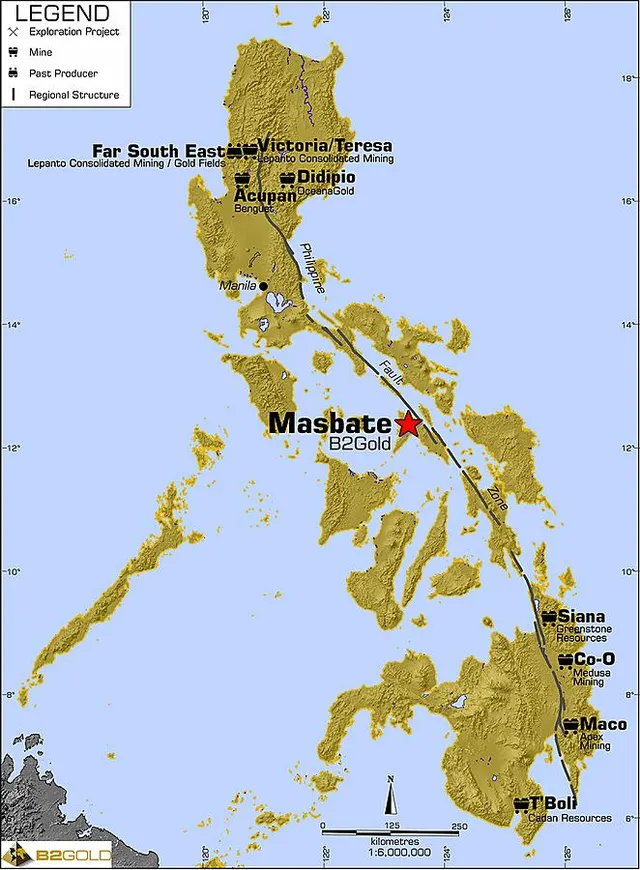
Two Masbate-based companies Filminera Resources Corp. and Phil Gold Processing & Refining Corp., are poised to donate thousands of doses of COVID-19 vaccines to the workers of local government units in Masbate province, and will proceed further to vaccinate all Filminera and PhilGold employees.
This is the latest of the firm’s set of resolute responses, which had already allocated P38 million wholly for anti-Covid 19 health defenses for their workers and residents of local government units in Masbate province.
Earlier this year, Filminera and PhilGold had turned over two sets of CMAC video laryngoscope to the Masbate Provincial Hospital to enable the health facility to enhance the hospital’s success rate in treating patients with severe Covid-19 symptoms, leading to the patient’s recovery.
Provincial Health Officer Dr. Luisito Co acknowledged the firm’s community commitments, saying: “The Filminera and Phil Gold medical equipment donations have made the Masbate Hospital the only medical facility in the entire Bicol region that has the CMAC laryngoscope.”
A total of P38 million was reallocated from the two firms’ 2020 Social Development and Management Program funds for Covid assistance meant for the province of Masbate, municipality of Aroroy, and selected institutions in the Bicol Region.
Of the P38 million total budget, P11.2 million was taken from Filminera’s SDMP funds, while P21.9 million was from PhilGold’s SDMP funds, and P5 million from PhilGold’s CSR funds was allocated to buy the ambulance unit, including the equipment. It will be recalled that an ambulance unit plus more medical equipment were donated to Masbate.
At the height of the lockdown last year, the frontliners in the medical field, as well as the police force and municipal risk reduction and management office, received two months worth of food support through the mine site's catering services, PPEs and disinfectant materials
A total of 21,320 families in the eight impact barangays and the 33 neighboring barangays in Aroroy received food packs. Weekly supply of food packs were given to those within the impact barangays, and two tranches of food pack distribution were donated to families living in the remaining 33 neighboring barangays.
Other municipalities in Masbate province received 800 sacks (containing 50 kilos each sack) of rice to augment their relief food packs distribution. Medical supplies and disinfectants were also given to the Rural Health Unit of Aroroy.
Filminera is the holder of the mining tenements and environmental compliance certificate, while PhilGold, wholly owned by Vancouver-based gold producer B2Gold, operates the processing plant.
The Mines and Geosciences Bureau (MGB) is updating the mineral resources and mineral reserves database on state-owned mining assets in preparation for their sale.
About P21 billion in revenue can be generated by 100 mining projects in the pipeline, which can be used to help support economic recovery from the coronavirus pandemic, the MGB said in a BusinessWorld report.
Updating the list of state-owned mining assets for sale will support government revenue, Environment Secretary Roy A. Cimatu said.
“This is in preparation for the bidding and sale of mining assets to gain revenue and help the country recover from the economic devastation of the coronavirus disease 2019 (COVID-19) pandemic,” Cimatu said.
MGB Director Wilfredo G. Moncano said some assets under the Privatization and Management Office (PMO) of the Finance Department have sufficient data and can be put up for auction soon.
According to the MGB chief, the PMO and the Philippine Mining Development Corp. are responsible for the sale of the government-owned mining assets via auction.
PMO mining assets include Pacific Nickel Philippines, Inc. in Surigao del Norte; North Davao Mining Property in Davao del Norte; Maricalum Mining Corp. in Negros Occidental; and Marcopper Mining Corp. in Marinduque.
President Rodrigo R. Duterte signed Executive Order No. 130 on April 14, which removed the nine-year ban on new mineral agreements and allowed the review of current mining deals for potential renegotiation.
MGB Director Wilfredo G. Moncano said some of the information required for a possible sale is the volume of mineral resources and reserves, and the technical basis for the estimates.
“A mineral resource refers to the concentration of materials of economic interest found in the Earth’s crust, while a mineral reserve is the economically mineable portion of a mineral resource,” Moncano said in a statement.
He identified Basay Mining Corp. in Negros Oriental, which ceased operations in 1983, and the Marinduque Mining and Industrial Corp. in Samar, which was foreclosed by the Development Bank of the Philippines and the Philippine National Bank in 1984, as some of the idle government mining assets to undergo the review.
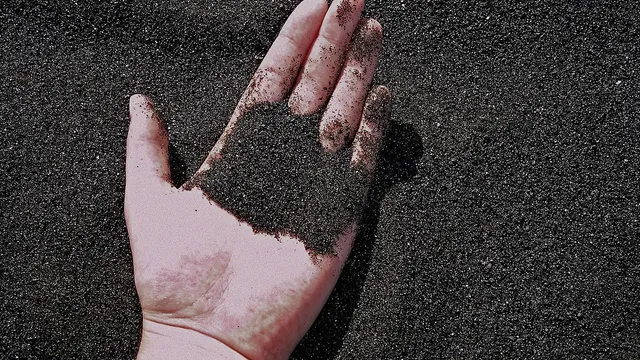
Black sand mining has been “massive” along the Luzon coastline with Chinese miners extracting the mineral with heavy equipment and shipping them out in barges, Probinsyano Ako party-list Rep. Jose “Bonito” Singson Jr. said during a House committee hearing last week.
The situation warrants the imposition of a ban against exporting black sand ore, or magnetite, an ore of iron used in steel production, the lawmaker from the Singson clan of the Ilocos region said in a CNN Philippines report.
Singson authored House Bill No. 6321, which seeks to prohibit the exportation of black sand and its derivatives in its raw form to other countries.
“[Chinese miners] would bring their barge and then they would use massive machinery to extract the black sand from our shoreline,” Singson told the House Committee on Natural Resources in a CNN Philippines report.
Ronald Recidoro, Chamber of Mines of the Philippines executive director who attended the virtual hearing, shared a similar observation.
“It appears the contractor is helping by dredging the river, but why does the contractor cart out black sand? When you dredge, you just put it aside,” he said in a separate interview.
Recidoro added that the regulatory regime for magnetite black sand really needs to be reviewed, since the national government currently has no oversight function on this.
Black sand mining should be covered by national policy, such that the national government should keep watch over black sand miners whose operations span as far as Cagayan province, which is prone to massive flooding, both Singson and the Chamber of Mines said.
Raw black sand should first be processed locally to create a domestic industry that generates jobs, they added.
“We have steel manufacturing plants in Iligan that use only recycled steel/iron and imported iron as raw materials,” Recidoro said.
Industry data show black sand mining exists in the Ilocos Region, including Cagayan province, as well as in Leyte.
The Ilocos Region faces the South China Sea or the West Philippine Sea that China increasingly has been trying to militarize.
China’s huge appetite for steel has brought it closer to Philippine shores, which Singson said is a red flag as Luzon’s coastlines are receding.
Benguet Corp. reported on June 2 that its net income jumped over nine times in the first quarter from a year ago.
The listed miner is riding high on the momentum of "exceptional operating performance" in 2020 after the Department of Environment and Natural Resources lifted the suspension of its nickel operation in Zambales province.
Benguet said it registered consolidated net income of P518.6 million in the first quarter of 2021, up from P56.7-million net income in the same period last year.
The company said consolidated revenue also grew by more than three times in the three-month period from a year earlier.
“The 915-percent increase in after-tax income was the result of combined earnings from its gold, nickel and lime projects which accounted for total consolidated revenue of P1.3 billion in the first quarter of this year or over three times of last year’s revenue of P408 million,” the company said in a statement.
While cost and operating expenses unavoidably went up by 68 percent year-on-year to P571.1 million on higher corresponding production,
Benguet said selling expenses and payment of excise taxes and royalty fees to the government, prudent cost management, substantial nickel export, and improved gold production volumes supported the big positive variance.
“Amidst the pandemic, the company is steadily pursuing a growth strategy as it continues to implement precautionary measures to protect the health and safety of its employees, contractors and the host communities,” Benguet Corp. said.
Last December, Apollo Global Capital’s (PSE: APL) subsidiary, JDVC Resources Corporation, announced that Department of Environment and Natural Resources granted them a permit to start the commercial operations of the country’s first offshore magnetite iron mining project.
According to JDVC and APL consultant, Jun Herrera, the mining operations in Cagayan are expected to start by mid or end of February. He said that the first newly-built deep sea mining vessel arrived in Cagayan and needed to take shelter for now due to strong sea currents.
In relation to this project, they assured the government that there will be minimal impact on the marine ecosystem as per the studies and survey conducted by a Singapore-based company. Their study shows that there is no coral or aquamarine life within the mining area which is located 150 meters below sea level.
Herrera stated that three more vessels are expected to arrive this year. The vessel is capable of commercial extraction, sampling, testing and production of magnetite iron. [1]
With regards to the apprehension of some residents of Ballesteros in Cagayan that this offshore mining operation will destroy the coral ecosystem, APL addressed the issue by stating that such assumption by the locals has no basis.
APL stated last January, “We won’t even be mining in their waters. In the first place, our mining operation will be in the waters of Buguey and Gonzaga towns, and at a distance of over 14 kilometers. That’s more than two horizon lengths away from the shoreline.”
Lazaro Ramos, a resident of Ballesteros, sent a formal complaint to DENR Secretary Roy Cimatu. Ramos warned them of the possible “catastrophe” that the offshore mining will bring about should it resumes. He mentioned in comparison a study conducted by Craig Smith from the University of Hawaii regarding the ocean seabed in the NE Pacific abyssal waters. APL, however, contradicted this argument by Ramos and said that the study by Craig Smith is applicable to a different part of the ocean and not necessarily comparable with the mining site in Cagayan.
“That’s a different part of the Pacific. It looks at the ocean bed more than 200 meters below sea level, whereas we can only go down to 150 meters with current technology. Moreover, the Smith study did not look at magnetite iron reserves. From the experience of countries like Indonesia, Japan and New Zealand, magnetite iron is known to be toxic to corals, fish and other aquamarine life.”
Moreover, JDVC emphasised on the study results done by the Singapore-based survey company whom they commissioned to conduct a full “sea bottom profile” of its mining tenements off Cagayan. As mentioned, their study reveals no corals or aquamarine life in the area.
APL also reported that they have done their part in coordinating with the locals and providing corporate social responsibility activities for the residents of Buguey and Gonzaga. “We’re proud to say that over 90 percent of the residents support us and are even anxious for us to get started.”
According to Herrera, the municipalities of Aparri, Buguey and Gonzaga received funding from the Development Bank of the Philippines. These are the municipalities covered by the mining project. DBP grated JDVC a grant worth $8-million credit line for the magnetite iron mining project.
Herrera said, “We have proven to them [DBP] that it’s environmentally safe.”
He added, “The DBP loan has zero borrowings yet as of now, hence, our company remains to be zero debts and internally funded by our shareholders. The DBP loan will only kick off once we have the letter of credit presented to the bank for the discounting the letter of credit of export buyers, to obtain a 90-day working capital, to fund the production of the ordered iron ore.”
This project is seen as profitable, because magnetite mining has a strong market globally. In China, for example, they consider the steel industry as their “roadmap for their economic recovery”.
Herrera mentioned that JVDC is an ISO-certified company. This means that there is an assurance that they shall comply with environmental standards.
With all these assurances of a promising mining project ahead, some still have apprehension about it, perhaps rooting down to past incidents. In November 2020, the Cagayan Valley region was greatly affected by the Super Typhoon Rolly and Typhoon Ulysses. The two simultaneous typhoons are classified as category-5 and category-4 tropical cyclones respectively. As an effect, the devastation was great marked by massive flooding in Isabela and Cagayan provinces. [2]
The residents in those areas blame the National Irrigation Association (NIA) for the flood when they opened the floodgates of the nearby Magat Dam on the last minute. The two provinces were submerged in high waters as high as a two-storey building. NIA on the other hand firmly contradicted such claim and explained that the release of water from Magat Dam was not the main cause of flooding. NIA points out that proper and sufficient warnings were given to those communities in low-lying areas. Additionally, they stated that the volume of water released was only 25% of the carrying capacity of the Cagayan River. The river is the longest stream in the Philippines that serves as the catch basin of the nine provinces in three regions. [2]
Aside from the two typhoons, a second issue related with the river was about the illegal magnetite mining at the mouth of the Cagayan River in the municipality of Aparri. The provincial board of Cagayan appealed to President Rodrigo Duterte in 2019 to stop the dredging operations of Pacific Offshore Exploration, Inc. (POEI) due to potential threat to the environment and the livelihood of the locals. The Chinese company Zhong Hai Gravel Group headed by Dong Biao Su is POEI’s partner in that operation. The company was controversial recently after the Bureau of Customs and the Philippine Coast Guard raided its Zhonhai 68 dredging vessel during a maritime security patrol off the Bataan coast. “Bureau of Customs are poised to issue a warrant of seizure and detention against the undocumented vessel.” However, the Chinese Embassy in Manila claimed that the vessel is technically non-Chinese because it is registered under an African flag of convenience. [2]
Currently, JDVC Resources Corp. is the first and only company that was granted a declaration of mining project feasibility by Department of Environment and Natural Resources (DENR) to extract magnetite sand and other minerals in Cagayan.
In response to Cagayan’s decade-old black sand mining problem, the launching of Cagayan River Rehabilitation Project last February 2 is seen to solve the problem. DENR stated early in February that mining regulations will strictly monitor the extraction of magnetite or black sand in the coastal waters and rivers of Cagayan province. [3]
With regards to APL’s/JDVC Resources Corp.’s offshore magnetite iron mining, MGB Director Wilfredo Monaco stated the project has gone through an environmental impact assessment system processes and the company has secured an environmental clearance certificate (ECC) from the Environmental Management Bureau (EMB). [3]
“JDVC has undergone environmental impact assessment and the company was issued an ECC, which means environmental issues have been considered by the EMB,” Moncano stated.
Magnetite or black sand mining is supposed to be banned in the Philippines, but Moncano explained that the extraction of the said mineral offshore is allowed. He said, “Mining in shoreline is prohibited but offshore mining is allowed. If it is at least 1,500 meters from the shoreline going out to the sea, it is allowed.” He also assured that the company’s operation will be monitored by the MGB and EMB, that in case of any destruction or damage to the coastal or marine ecosystem by JDVC Resources Corp., there will be a corresponding penalty under the mining law.
“What is important is that the JDVC will not cause damage to the coastal or marine ecosystem,” he said.
As for mining in rivers like in the Cagayan River, it is also allowed as long as the primary purpose of the project is river rehabilitation or restoration. One example is their plan to extract some 7 million metric tons of sand to remove three of the 19 sandbars along is stretch. Moncano said that the DENR-MGB will also monitor the dredging operations because while the activity is primarily flood mitigation, the minerals to be extracted include magnetite sand. [3]
Moncano stated, “Black sand mining is also part of the purposes that’s why we will assess the mineral content of the river channel. If the magnetite sand contained surpasses the threshold of 6 percent, we will charge the company of 4-percent excise tax.” He said that every shipment will undergo mineral assessment. (--Marcelle P. Villegas, PRJ)
References:
[1] Flores, Alena Mae S. (31 Jan. 2021). Manila Standard. "Apollo Global announces subsidiary’s start of magnetite mining operations in Cagayan".
[2] Gamboa, J. Albert (5 Feb. 2021). Business World. "Building back better in Cagayan Valley".
[3] Mayuga, Jonathan L. (4 Feb. 2021). Business Mirror. "MGB exec vows to keep tabs of Cagayan River magnetite quarry operations set to start in February".
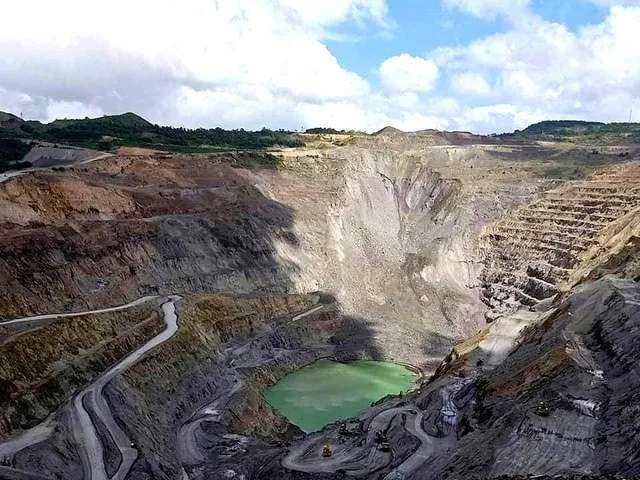
After the tragic landslide that occurred at the open pit’s north wall at around 4:15 p.m. on Monday, 21 Dec. 2020, Mines and Geosciences Bureau (MGB) 7 ordered the immediate suspension of the mine operations in Carmen Copper Corporation (CCC). According to MGB’s report last 22 Dec. 2020 on their official website, they stated “Initial investigations revealed there was no mining activity in the area on that day.” [1]
On that day, landslide debris fell on the water at the pit bottom. This has an elevation of 41m above sea level. The landslide created a tsunami-like wave that reached an elevation of 105m in the southern portion of the pit where the workers were located. On 22 Dec. 2020, four fatalities were recorded along with six missing. [1]
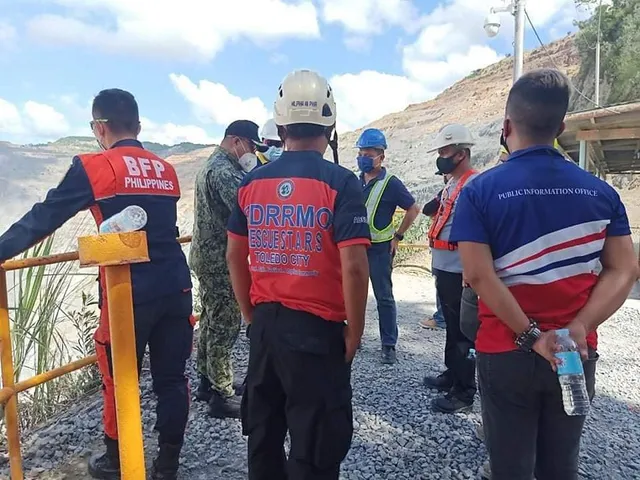
Further on, an assessment of the area was conducted by Director Pacquito Melicor Jr. (DENR Central Visayas Regional Executive Director), Director Armando Malicse (MGB 7 Regional Director), MGB Region 7 team, and Mine Safety, Environment and Social Development Division.
CCC and Toledo City Disaster Risk Reduction and Management team continued their search and retrieval operations on a limited scale due to unstable condition. MGB 7 technical personnel continues its on-site inspection and investigation in accordance with R.A. 7942 (Philippine Mining Act of 1995) and the DENR Administrative Order Nos. 2010-21 (Consolidated IRR of RA 7942) and 2000-98 (Mine Safety and Health Standards). [1]
A list of names of workers who died was given by CCC to the Toledo Police Station Chief, Lt. Col. Junnel Caadlawon. The second list contains the names of those who are still missing. [2]
Those who died from the landslide are the following:
Those who are still missing are the following:
Carmen Copper Corp. (CCC) expressed their support and commitment to provide free education until college and allowances to all the children of its employees who died or are still missing after the tragedy last December. Based on a press statement of the company last 27 Dec. 2020, they have provided various forms of financial and other assistance to the immediate families of its deceased workers. [3]
Additionally, CCC also offered employment opportunities for the victims’ next of kin, spouse and children.
“CCC has given the same attention to the immediate family of the missing CCC employees and will afford them of the same commitments CCC provided to the family of the deceased,” according to the company’s statement.
CCC also extended support to the family of the contractor who was among the victims. [3]
On 8 Feb. 2021, Toledo City Mayor, Hon. Marjorie Piczon-Perales along with Vice-Mayor Jay B. Go met the families of the victims at the open shed of the City Hall Garden to provide them with “ayuda” or financial assistance. This was posted on the Toledo City Public Information Office social media page. The mayor granted the families of deceased workers the amount of Php15 million. For the victims who are injured, they were given Php5 million. Additionally, they were all given food packs. [4]
On 29 Jan. 2021, the Office of Senator Christopher “Bong” Go distributed assistance to the Toledo City residents who were affected by the landslide in CCC mine. This was held at the Carmen Copper Recreation Center, Toledo City, Cebu. During the distribution, 248 families received meals, financial assistance, food packs, vitamins, face masks and face shields. Senator Go also gave bicycles and shoes to selected recipients, and computer tablets for their children to be used for online classes. Health and safety protocols were strictly implemented to avoid the further spread of COVID-19. The Senator was not present during the distribution but he sent them a video message with words of encouragement. [5]
Senator Go also offered assistance to those who needed major medical operations such as heart surgeries. He urged those in need of such medical attention to seek assistance from any of the Malasakit Centers in the province. [5]
While the local and national government along with CCC are busy sending assistance to the families of the victims of the December landslide, mining industry in general received backlashes from various groups who believe that the deaths and injuries could have been prevented.
Barely a month before the landslide, there had been reports from residents of Barangay Biga in Toledo City who claim they warned officials of the MGB Central Visayas and CCC as well about large cracks in the village prior to the landslide. However, they said that their appeal was not properly addressed. [6]
Biga Barangay Captian Pedro Sepada Jr. told a local newspaper in Cebu last 29 Dec. 2020 that prior to the landslide, barangay officials called for an emergency consultative meeting on 26 Nov. 2020 with representatives of CCC, MGB 7 and Biga residents to talk about the possible measures to be done after the cracks were discovered. Sepada said that MGB 7 Director Armando Malicse and CCC Vice President for Safety, Ignas Alburo were present. No representative from the Toledo City government was present. Sepada noted that during the meeting, they were not given a concrete response or alternative solution by CCC or MGB to provide assurance to the residents that they will all be safe while mining operations are ongoing. But Sepada said that they were simply told by MGB 7 and CCC officials that their place remained safe. [6]
According to the local news reports in Toledo City, residents now believe the huge cracks caused the fatal landslide. “It was only after the landslide last Dec. 21, that they declared our area to be unsafe within a radius of 600-meter distance from the pipeline of Carmen Copper. They now say it’s unsafe. What happened to their guarantee of safety before?” [6]
Governor Gwendolyn Garcia said last December that they shall leave the investigation to MGB before implementing any course of action. She mentioned that she will leave it up to the MGB 7 to decide whether or not CCC has any liability.
Garcia said, “The investigation is not our expertise nor is that our mandate. MGB has already issued a suspension of operations and MGB is going to undertake the investigation. So let’s put things in proper perspective. While the investigation is ongoing, perhaps it is best to wait for the results.” [6]
“I am not taking any sides. I want to be as objective as possible. However, there are some personalities who are not as objective because they have their own interest in Carmen Copper. They want to control so that they can do business with Carmen Copper. This is a warning to those who want to make it difficult.”
Garcia also noted that CCC mining operations have given so much to Toledo City in terms of employment and the city’s development. She said that a thorough investigation is needed in order to prevent those with “personal interest” in the mining operations of CCC from ruining the lives of so many people working there. [6]
Garcia assured the Province will provide assistance and support to the families of miners who died and those who remain missing after the landslide. [6]
Renester P. Suraltra, a college professor wrote a commentary last December on SunStar Cebu with the title “Toledo tragedy: The untold story”.
He wrote, “Who is always responsible for any mining accident? Is it nature or man? Who is at fault? Is it the bad weather or the safety engineer?” “Accidents may happen in the workplace but it can also be avoided. We can’t discount the fact that accidents can happen because of unsafe supervision, lack of situation awareness, and failure to identify the potential threat. That’s the job of the safety engineer under the direction and supervision of sympathetic and responsible management. If workers are dying frequently then responsible mining is a big issue.” “There is another lesson to be learned in the Toledo mining tragedy. We should never compromise safety and security. We can’t always blame nature out of man’s folly. One should think that the mining industry provides short-term revenue but long-term harmful effect on nature and the environment. Life is much precious than copper and gold.” [7]
Acknowledgement:
Ryan Peter Vivo Penaranda for Cebuano to English translation from some news articles
Reference:
[1] Mines and Geosciences Bureau Press Release (22 Dec. 2020)."Carmen Copper Mine In-Pit Landslide Incident".
[2] ANV (23 Dec. 2020). SunStar Cebu. "Listahan sa namatay, missing sa Carmen pit gipagawas".
[3] WBS and PR (27 Dec. 2020). SunStar Cebu. "Carmen Copper Corp. commits to help landslide victims' families".
[4] Toledo City Public Information Office Facebook Page (8 Feb. 2021). "Families of the victims of the land in Biga Pit Gitagaan ug ayuda in Toledo".
[5] Office of the Presidential Assistant for the Visayas Facebook Page (31 Jan. 2021). "Hundreds of Toledo City, Cebu residents affected by a copper mine landslide receive assistance from Senator Bong Go".
[6] Sabalo, Wenilyn (30 Dec. 2020). SunStar Cebu. "Biga chief claims please ignored before landslide". Retrieved from - https://www.sunstar.com.ph/article/1881418/Cebu/Local-News/Biga-chief-claims-pleas-ignored-before-landslide
[7] Suralta, Renester P. (27 Dec. 2020). SunStar Cebu. "Tell it to SunStar: Toledo tragedy: The untold story". Retrieved from - https://www.sunstar.com.ph/article/1881194
A rare piece of volcanic agate rock was discovered in the Rio Grande do Sul region near Soledade in Brazil last November 2020. It is an oval-shaped rock with a hard, white pitted outer shell. On the outside, it looks like a perfect egg. When you split the rock at the center, you will see in each of the two halves a strange resemblance of Cookie Monster, a character from the famous children’s television show “Sesame Street”.[1]
At first look, the rock’s photos and video which went viral on the internet seems surreal, but it is actually a unique piece of rock that was naturally formed in a volcanic environment, according to its owner. The rock is a deep blue quartz crystal and was discovered and found by Lucas Fassari, a gemologist and explorer in Brazil. [2][3] It was sent to Mike Bowers in California. Bowers is an American geologist and specializes in these types of rocks. He said that it could be worth as much as $10,000 due to its rare features. [1]
Bowers uploaded on his personal social media account a video of the rock with the caption “Cookie Monster agate from Brazil” with a background music of Cookie Monster singing about the letter “C”. His post immediately became viral online. The actual cost of the rock when bought from Fassari was not revealed by the current seller. [3]
“I think this is probably the most perfect Cookie Monster out there. I have seen others but here you have it complete on both sides. This is very unusual. There are a few famous agates out there: the owl, the scared face. There are many approximate ones but it is rare to find one so well defined like this,” Bowers said. “Prices can be very high. I was proposed over $10,000 by five different buyers. Rare.”
While his viral video of the Cookie Monster agate is fascinating, it also brought some doubt to most people. Is it really possible for nature to produce a semiprecious stone with such strange appearance? What are agates and how are they formed in the first place?
Geology.com described the agate as a translucent variety of microcrystalline quartz. It is formed by the deposition of silica from groundwater in the cavities of igneous rocks. Agates are formed by the deposits of silica from groundwater in the cavities of igneous rocks. The agate deposits in concentric layers around the walls of the cavity or in the horizontal layers building up from the bottom of the cavity. As a result, layered patters are then formed. In some agate formations, these cavities are lined with crystals, therefore called geodes. A geode is a round rock with a hollow space lined with crystals, just like the Cookie Monster agate.
Agates come in a wide range of colours such as brown, red, yellow, gray, black, pink and white. The colours are produced by the impurities during its formation and they are formed in alternating layers within the agate. Now, the variations in colours are produced once groundwater of different compositions leak into the cavity. The banding within a cavity is a manifestation of change in water chemistry. As an end result, agates end up having interesting colours and patterns.
Based on this general description of agate, the authenticity of the Cookie Monster agate seems legitimate. Bowers reported to Daily Mail UK that the rock is indeed real. [1] A fact-checking website, Snopes.com. also claimed that rock is authentic. [3] TechnologyTimes.pk on the other hand stated, “As of the moment, there are no news yet as to whether Bowers actually intends to sell the rock or not, and about its current value as of the moment. Furthermore, no authorities have confirmed whether the rock is real or fake. If it is, sure enough, its value will increase over time as more and more people take interest in the unusual rock. Who would’ve known Cookie Monster would make so much numbers in a rock?” (--Marcelle P. Villegas, PRJ)
[1] Boyle, Darren (19 Jan. 2021). Daily Mail UK. "What a muppet! Geologist finds incredibly rare lump of volcanic agate rock which looks exactly like Sesame Street's Cookie Monster". Retrieved from -
https://www.dailymail.co.uk/news/article-9162441/What-muppet-Geologist-finds-rock-looks-like-Sesame-Streets-Cookie-Monster.html
[2] Hart, Matthew (26 Jan. 2021). Nerdist. "Gemologist Cracks Open Rock, Finds Cookie Monster's Face".
[3] Evon, Dan (26 Jan. 2021). Snopes. "Is the 'Cookie Monster Rock' Real?".
[4] Noor, Mufliha (25 Jan. 2021). Technology Times.pk. "'Cookie Monster' Rock From Brazil: Real or Fake?".
21 Dec. 2020 – Landslide at Carmen pit -- A screenshot from the video sent to SunStar Cebu
Amid the holiday festivities in Toledo City in Cebu, a sudden tragedy happened last Monday afternoon in a mining pit in Barangay Biga.
21 Dec. 2020, Monday -- Carmen Copper Corporation (CCC) said that the landslide happened at around 4:15 pm at the Carmen Pit. The day after, it was reported that 4 employees died while 6 are still missing. Several miners were also rushed to the Carmen Copper Hospital following the landslide. [1]
From a public statement released by CCC, they said: “The incident was traceable to the incessant rains for the past several months and aggravated by Typhoon Vicky which hit parts of the Visayas, including Toledo City last Friday, December 18, 2020.”
“The Management of CCC is doing all the necessary action to assess and address the overall situation. We will continue to inform the concerned agencies as well the general public of further developments.”
CCC suspended all mining operations in the area to ensure the safety of its employees and contractors. [1]
“We humbly ask the general public to exercise caution and responsibility in distributing information out of respect to the affected families. We would like to extend our utmost gratitude to private groups and the Toledo City Government Emergency Response team for extending valuable assistance in our search and rescue operations.”
“We are also in close coordination and communication with concerned government agencies as we continue to conduct all necessary actions to assess and address the situation.” [2]
22 Dec. 2020, Toledo City, Cebu – Search and Rescue Operation at Carmen Copper Corp. -- Establishment of Incident Command Post with Carmen Copper Corporation and Mayor Marjorie “Joie” Piczon-Perales (Photo credit: Chile Perolino, Toledo City Public Information Office FB page)
The Mines and Geosciences Bureau (MGB) said last Tuesday that they will do an investigation on the landslide incident. The mining operation is temporarily suspended pending the result of the investigation, according to MGB Director Wilfredo Moncano. He emphasised that the Toledo copper mine passed the Mining Industry Coordinating Council’s independent audit for 2020. [1]
CCC is a subsidiary of Atlas Consolidated Mining and Development Corporation (or “Atlas Mining”). They have an operating agreement with Atlas Mining and has exclusive operating rights over the in situ mineral resources and ore reserves of Carmen, Lutopan and Biga mineral deposits. These are collectively known as Toledo copper mine which covers 1,674 hectares. Currently, 276 hectares out of the total operating area is an active mining site. The Atlas Copper Complex is located in Don Andres Soriano (Lutopan), Toledo City, in the province of Cebu which is 365 miles or 570 km south of Metro Manila. [3]
Moncano said via a text message to reporters, “Initial findings indicate that Typhoon Vicky exacerbated the already waterlogged limestone and mudstone layer from the prior typhoon that weakens its contact with the intrusive rock base. This is the material that went down to the pit bottom. A fault line called the Barot fault was also observed in the slide area and may have contributed to the landslide.” [1]
Rocky Dimaculangan, Vice President for Communications and National Coordinator for Towards Sustainable Mining sent this message to the media, “The important thing is for the industry to learn lessons from incidents such as this to continue to improve on its protocols and practices. Undoubtedly the industry as a whole will absorb the lessons from this incident.” Last 4th of Dec. 2020, Dimaculangan was a speaker at the Philippine Mining Club Webinar on “Towards Sustainable Mining: Beyond Compliance”.
As for the host communities where the mine site is located, they have their own issues against the mining operations of CCC. According to Biga Barangay Captain Pedro Sepada, CCC’s mining activities were the subject of complaints filed by its host barangay since 2019. Their complaints were forwarded to MGB Central Visayas (MGB-7).
Sepada stated in a phone interview by Rappler, “During our consultative meetings, we really asked what exactly was the standard distance between the mining operations area and the residential area. MGB said there is no standard distance.” [4]
Sepada also said that this was not the first time an incident had occurred. He said that the mining pit had collapsed in 2013, which claimed the life of his relative. [4]
In response to the recent tragedy, Toledo City government’s emergency response team extended their assistance in the ongoing search and rescue operation. Toledo City Mayor Marjorie “Joie” Piczon-Perales is also coordinating with CCC. [4]
According to Toledo City Information Officer, John Layan, Toledo City will be providing financial assistance to the families of the victims. “As per information from our mayor, our assistance is now in place. We are just finalizing some documentary requirements.” [5]
Layan also stated that the other than the City Government’s logistical support to CCC for the search and rescue operation, Mayor Perales requested the help of Philippine Coast Guard for divers and boats for the search and rescue operation. [5] – (Marcelle P. Villegas, PRJ)
[1] Mayuga, Jonathan L. (23 Dec. 2020). Business Mirror. "Carmen Coper halts mine operations". Retrieved from - https://businessmirror.com.ph/2020/12/23/carmen-copper-halts-mine-operations/
[2] Press release from Carmen Copper Corp. (22 Dec. 2020)
[3] Carmen Copper Corp. company website - https://www.atlasmining.com.ph/about-us/carmen-copper-corporation
[4] Sitchon, John (22 Dec. 2020). Rappler. "At least 4 dead, 6 missing after collapse of Cebu mine". Retrieved from - https://www.rappler.com/nation/death-toll-collapse-toledo-cebu-mining-pit-december-22-2020
[5] MVG, WBS, JOB (22 Dec. 2020). SunStar Cebu. "Carmen Copper mine landslide death toll now at 4". Retrieved from - https://www.sunstar.com.ph/article/1880861/Cebu/Local-News/Carmen-Copper-mine-landslide-death-toll-now-at-4
By Marcelle P. Villegas
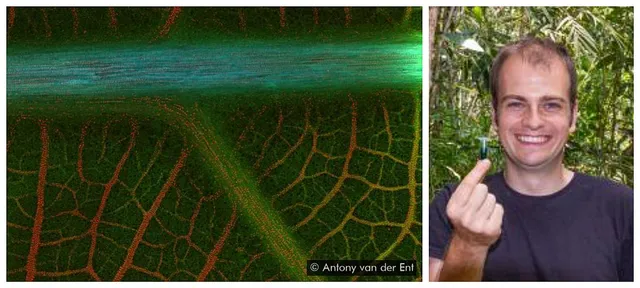
Rare plants that naturally accumulate large quantities of nickel are believed to be hiding in Indonesia’s forests. (Photo credit: Dr. Antony van der Ent, University of Queensland)
Previously, on Part One of our featured story, we shared the findings of a group in Indonesia that studied rare plants that absorb high concentration of nickel. The group published their study in May 2020 where they identified the species of rare, nickel-loving “super plants” in Sulawesi. What is the significance of their study in nickel mining? Is phytomining a viable method of nickel mining?
For the past years, Dr Antony van der Ent and his colleagues researched about phytomining of nickel hyper-accumulator plants. These are “super plants” that can accumulate at least 1000 micrograms of nickel per 1g of dried leaf. In nature, most plants need a little bit of heavy metals to activate some essential enzymes in their flower process. However, too much of these metals can kill most plants. Therefore, most hyper-accumulator plants are rare due to their ability to survive despite absorbing high amounts of metals. Nickel is stored in their shoots, leaves, roots and sap.
“If the nickel within these rare plants could be tapped, it would provide a sustainable source of nickel for use in electric vehicle batteries,” said, Dr van der Ent.
Dr van der Ent is a plant ecophysiologist and biogeochemist from University of Queensland who does research on biopathyways of trace elements in soil and plant systems. “I have a specific interest in the application of phytotechnologies that utilize hyperaccumulator plants. My research bridges systematics, ecology and physiology of plants and is highly collaborative in nature.” [1]
Indonesia is a good place to look for plants that are nickel hyper-accumulators. Their forests are rich in biodiversity and the soil is rich in nickel. (Photo credit: Dr. Antony van der Ent)
In 2004, Aiyen Tjoa from Tadulako University in Central Sulawesi searched for these plants in Sorowako. Sorowako is known for its rich biodiversity of rare plants but the area was cleared of its green landscape to make way for one of the largest nickel mining sites in the world. There were, however, some bushes and trees that survived the clearing of the forest. She studied these plants to understand how “super plants” are able to withstand such harsh nickel-rich soil, while it is toxic for other organisms. She notes that if these plants can be “mined” as well, then this could be a new method of gathering nickel without destroying the ecosystem.
Tjoa found two species of nickel hyper-accumulators in 2008. These are Sarcotheca celebica and Knema matanensis which could store between 1,000 and 5,000 micrograms of nickel per 1g of dried leaf.
“We’re looking for plants that could accumulate at least 10,000 micrograms [per gram]. At that threshold, it becomes economically viable to cultivate the plant for mineral extraction – or ‘phytomining’”.
Dr. van der Ent established two methods in detecting hyper-accumulator plants. First is through the use of detection paper. He reported that if a plant has nickel content, the white detection paper turns pink when leaves are pressed against it. [2]
Another detection method he uses is via a hand-held device that emits x-ray beams at the plant sample. Plants that are positive for nickel content reacts by emitting a specific amount of energy that is characteristic of nickel atoms. [2]
A third technique is by using magnetism, as developed by researcher Professor Satria Bijaksana from Bandung Institute of Technology. This technique is faster and saved time because it only detects high concentrations of nickel. Using this method, Tjoa and Dr. van der Ent were able to conduct a successful experiment on 10 indigenous plants in Sulawesi and Halmahera in comparison with two hyper-accumulators (Alyssum murale and Alyssum corsicum). Findings show one of the native plants was high in both iron and nickel.
The group published their study in May 2020 where they identified two further species of nickel-loving plants in Sulawesi.
Of note, they discovered that the plant species Casearia halmaherensis and another that was a type of pepper, have the ability to accumulate 2,600-2,900 micrograms in 1g of dried leaf.
Is phytomining a new way to mine?
“The beauty of nickel hyper-accumulators is that they collect something that is both a toxic pollutant if left in the soil, and a valuable material – nickel is used in making products from kitchen taps to electric car batteries. Collecting the nickel from plants is a relatively easy process,” writes science journalist, Dyna Rochmyaningsih, who published the article “The rare plants that ‘bleed’ nickel”, for “Future Planet” of the BBC website. [2]
Among the various “super plants” that the three researchers found, Dr van der Ent has calculated that the plant species Phyllantus balgoyii can produce an estimate of 120kg of nickel per hectare every year. That is equivalent to a market value of around $1,754 per hectare. [2]
How is nickel extracted from the plant? The shoots will be pruned, and then burned. Nickel can be separated from the ash. The shoots of a plant have the highest concentrations of nickel. Burning is necessary to release carbon dioxide.
According to Rochmyaningsih’s report, phytomining has considerable environmental advantages compared with traditional forms of mining. “In Sorowako, nickel is extracted through open-pit mining, to access nickel embedded inside laterite rocks. To get the nickel, the rocks need to be crushed, which can release radioactive elements, naturally occurring asbestos-like substances, and metallic dust. Open-pit mining also produces waste materials in the form of a toxic semi-liquid waste known as tailings. If not properly managed, arsenic and mercury-laden tailings can leak in the surrounding environment. More broadly, traditional mining as a whole is a considerable carbon emitter, releasing at least 10% of greenhouse emissions in 2017.” [2]
Nickel hyper-accumulators are also a choice of plant type to use for revegetation of mined out land areas. Tjoa says that in most mining companies in Indonesia, they often use ordinary plants rather than nickel-loving species. Dr van der Ent said that nickel hyper-accumulators could do a better job in revegetation because they improve soil health by removing nickel and brining back the major nutrients needed by normal plants. It could also give an economic benefit for the mining company because the nickel residue that has been accumulated in the plant’s shoots could be harvested.
Dr van der Ent has been conducting phytomining field trials in Sabah, Malaysia since 2014. “We found out that phytomining really works.” This can be applied in soils that have not been mined but have naturally have high levels of nickel. However, Dr van der Ent points out that the technology of phytomining is not aimed at replacing open-pit mining. Instead, phytomining could be done in parallel. He said that it can be an alternative form of agriculture in rural communities living on nickel-rich areas. [2]
Although phytomining has a good potential and viability, Tjoa said that there is a slow pace of development of phytomining in Indonesia as no one seems to pay attention to this potential. “The firm PT Inco once supported her research on phytomining when she did a field trial on the adaptation of Alyssum murale in Sorowako. But the collaboration was terminated partly because the company was restructuring,” according to the BBC article. There was no collaboration since then. [2]
The irony is, “No other country has a greater potential for phytomining than Indonesia,” said Dr van der Ent. With the extraordinary plant diversity and geological history, he believes that the Indonesia has a great potential for the discovery of nickel hyper-accumulators. Between 1990 and 2018, Sulawesi lost nearly 19% of its forest cover. Tjoa said, “We have lost such a big chance to find these plants.”
On the bright side of the story, in central Sulawesi, “a pristine rainforest sits on nickel-rich soils that make up the mountainous region in Morowali natural reserve.” The soil is greyish and forms above a bedrock called serpentinite. Most likely, it is a perfect place to find nickel-loving plants.
Also, a foreign mining company showed their interest in phytomining studies and experiment, according to Tjoa. She was in touch with a US-based investor in 2017 who wanted to fund her 5,000-hectare trial in Sulawesi. She plans to use Alyssum murale for the project. This is a nickel-hyperaccumulator from Italy. She said that maybe if we can prove that phytomining works, then perhaps the Indonesian government will finally be convinced about it. From their study, we find that using plants instead of heavy machinery to mine would create less waste, preserve the ecosystem and produce less toxic waste.
[1] https://www.researchgate.net/profile/Antony_Ent
[2] Rochmyaningsih, Dyna (26 August 2020). “The rare plants that ‘bleed’ nickel”. Future Planet, BBC.
Retrieved from -
https://www.bbc.com/future/article/20200825-indonesia-the-plants-that-mine-poisonous-metals
Photo credit:
1. Antony van der Ent - https://smi.uq.edu.au/profile/1400/antony-van-der-ent
2. https://www.bbc.com/future/article/20200825-indonesia-the-plants-that-mine-poisonous-metals
No business, no industry sector has been left unscathed by the worldwide coronavirus pandemic, nearly a year since the COVID-19 disease was first detected in China -- and that includes mining. A recent report said that in the Philippines, as many as 138,000 jobs in the mining sector were lost during the pandemic, according to Mines and Geosciences Bureau (MGB) Director Wilfredo Moncano. Despite that, Moncano revealed that his bureau is seeking the approval of President Rodrigo Duterte for a mining sector program, with specific recommendations on how the extractive industries could help the economy recover from the pandemic-triggered recession. What the MGB is proposing, he said, is for the Duterte administration to allow the potential of the mining industry to help the economy recover, as the bureau submitted its sector program to the Office of the President and the Department of Environment and Natural Resources, its parent agency. Asked to provide a gist of the program, Moncano told the Manila Bulletin: “It will be premature to trumpet its content when it has not yet been seen by the addressee.” “Safe to say that the mining sector proposed and believes that the mining industry sector can help during these times that there is a serious drop in economic activity because of the pandemic,” he added, noting that the memo contains recommendations from the mining sector. By now, the benefits of responsible mining are no mystery to Filipinos, as the industry has faithfully trumpeted its positive effects to the economy over the years – and especially now that the country will need every bit of reinforcement to get back to pre-pandemic levels. Businessman and columnist Peter Wallace laid out these benefits in his recent article for the Philippine Daily Inquirer. His point, at the end of his column, was: “Mining is one way to give Filipinos jobs and make some money for the government.” Wallace mentioned the following: “Large-scale mines employ lots of people. A responsible miner provides jobs for people who had none.” Of the jobs lost by the mining sector this year, MGB’s Moncano said this does not include the jobs lost from the small-scale mining industry. “Similar to other industries, the mining sector lost export production values, taxes not raised, employment losses, undelivered supplies, among others, for the three months that the mining companies were prevented from operating,” Moncano told the Bulletin. While they have been allowed to resume work now, mining companies “have to bear the strict health protocols issued by the IATF [Inter-Agency Task Force on Emerging Infectious Diseases],” he added. Meanwhile, Wallace said: “In 2015, an estimated 236,000 Filipinos were working in mines. This had dropped to 184,000 by 2019. I am sure the 7.3 million Filipinos unemployed as of April 2020 (a record high currently), including the estimated 4.9 million Filipinos laid off by COVID-19, would welcome getting a decent income again. And the major mining companies do pay well, as pointed out by MGB.” “While estimates vary, it is conservatively estimated that for every job in the industry, about four indirect jobs may be generated in the upstream and downstream sectors. As in tourism, there is a substantial multiplier effect. These jobs include the mining’s forest and environmental protection and rehabilitation activities that large mining firms undertake.” In economics, a multiplier effect is defined “as a phenomenon whereby a given change in a particular input, such as government spending, causes a larger change in an output, such as gross domestic product.” Large-scale responsible mines bring wealth to rural communities “where it is most needed and develop those communities,” Wallace said. He noted that according to the MGB, the mining firms’ social development and management programs currently benefit more than 800 barangays (villages). “This is something we need during the pandemic, especially with the government needing to allocate funds to other poverty alleviation and public health services programs.”
A responsible miner builds rural roads. “Yes, the company uses them, but so does the community. They are local roads they never had,” Wallace said. A responsible miner “provides scholarships for deserving students, often builds a school, and establishes a clinic for all,” he said. Mines pay considerable taxes and boost a country’s international reserves through exports. “With the loss of tourists and OFW (Overseas Filipino Workers) income in decline (because they have been sent home from other COVID-afflicted countries), we need all the dollars we can get,” Wallace said. “In 2016, these companies paid P22.6 billion in taxes, fees, and royalties. In 2017, the excise tax was doubled to 4 percent of gross sales, so in 2018 the total government take increased to P31.3 billion,” he added. This can go up much more “if policy restrictions are removed,” Wallace noted. “Just three pending projects, if approved, can increase total government take by P13 billion per year and add P1.3 billion annually in social expenditures. That is money not to be sneezed at for an economy that is going to desperately need more funds to finance its anti-COVID-19 measures and social protection programs.” According to MGB’s Moncano, the estimated export revenue lost during the lockdown period so far was P14.1 billion. This is money that could have gone to funding for coronavirus vaccines, quarantine centers, face masks, shields and other personal protective equipment (PPEs), disinfectants and other tools used to fight the pandemic – many sectors, not just mining, have noted. Now if the country was able to fully tap into its mineral deposits -- worth an estimated US$1.4 trillion (Php.67.74 trillion), making the Philippines the fifth-most mineral-rich country in the world – the government and the people would have a lot more resources to use for its pandemic response. Wallace noted that because of slower annual growth, mining’s contribution to GDP (gross domestic product) has slid from nearly 0.8 percent in 2016 to 0.5 percent in 2019. “Its share would have grown steadily had mining been supported,” he said. Sadly, the columnist’s words are an old refrain. Seven years ago, renowned economist Bernardo Villegas said there is more to mining “than just tax revenues and export earnings.” As founder and director of the Center for Research and Communication and member of the University of Asia and Pacific, Villegas headed a study of all the country’s major industrial sectors, and it shows that the mining industry “makes a significant contribution, not just to the Philippine economy but also to the common good.” “The common good is not just the taxes paid by mining firms but employment generation, nurturing of small and medium scale industries through the multiplier effect, and the stimulation of consumption in the communities where various establishments, whatever they are, are located,” he said in a 2013 forum sponsored by the Chamber of Mines of the Philippines. Today, with the raging coronavirus disease collapsing big and small economies alike, it is obvious the Philippines needs a lot of common good – and, Inquirer’s Wallace notes, it would only take about 3 percent of Philippine land to be mined “if ALL potential mines were exploited. And it would never be ALL.” “All of this is conditioned on mining being responsibly done. This is the key and is critical, and recent rules enforce this,” he said. Thus, mining just might be the boon the Philippines needs to recover from the COVID-19 pandemic – if only the government would try.
Follow on LinkedIn:
Philippine Resources Journal
Be the "First" to get our exclusive Digital Magazine & Weekly Newsletter.