“If the nickel within these rare plants could be tapped, it would provide a sustainable source of nickel for use in electric vehicle batteries.” (Credit: Antony van der Ent)
By Marcelle P. Villegas
Science journalist, Dyna Rochmyaningsih, recently wrote a feature about three scientists who published their research about the existence of rare plants in Indonesia that “bleeds nickel”. Rochmyaningsih is a freelance journalist based in Deliserdang, North Sumatra. In her article “The rare plants that ‘bleed’ nickel”, published on “Future Planet” on BBC website, her introduction goes, “Rare and valuable plants that naturally ‘mine’ large quantities of nickel are thought to be hiding in Indonesia’s forests – but it is a race to discover them before they are wiped out.” [1]
While it is natural for certain plants to absorb some elements present in soil, this particular science report is noteworthy because it explores the existence of “super plants”, which are yet to be discovered.
A related study in the Philippines was reported a few years ago. A team of environmental scientists headed by Assistant Professor Rene Claveria of Ateneo De Manila University reported that a native fern Pteris melanocaulon has the ability to grow in soil despite high concentrations of metals. Thus, the plan is classified as a metallophyte. From their study in a copper-gold mining area, they discovered that the fern was able to accumulate copper and high levels of arsenic. Their discovery is a breakthrough and useful in helping the mining industry and the local government in the removal or prevention of soil contamination, making areas near and within mine sites suitable for other plants to grow. The study can also help prevent toxic elements from causing health problems to those living nearby. Their findings were published in international scientific journals such as International Journal of Phytoremediation in 2015 and Chemosphere in July 2019. [2]
Similarly in Indonesia, a team of researchers discovered some plants that can absorb high concentrations of nickel from soil. In 2004, a soil biologist and lecturer in Tadulako University in Central Sulawesi named Aiyen Tjoa visited Sorowako. Sorowako used to have a rich biodiversity of rare plants before it became the location of one of the largest nickel mining sites in the world.
However, by 2004 the area was cleared for mining and much of the green vegetation became barren soil and dusty roads [1]. There were some bushes and trees that survived the mining transformation. With that Tjoa was inspired to search and study those rare plants that adapted well in the nickel-rich environment. She noted that these could be “super plants” that have the ability to absorb high levels of nickel from the soil. If these plants can be “mined” as well, then this could be a new method of gathering nickel without destroying the ecosystem.
These plants are known as nickel hyper-accumulators and are rare plants that can accumulate at least 1000 micrograms of nickel per 1g of dried leaf. Although most plants need a little bit of heavy metals to activate some essential enzymes in their flower process, too much of these metals can kill most plants. Plants that are classified as hyper-accumulators are unusual and rare due to their ability to survive despite absorbing high amounts of metals. They store nickel in their shoots, leaves, roots and sap.
In Rochmyaningsih’s article in BBC, she noted, “Curiously, very few of these plants have been found in Indonesia, which is one of the most biodiverse regions in the world and also has the largest nickel deposit in the world – just where you might expect to find a nickel hyper-accumulator. Tjoa says that this is largely because very few people have spent the time looking.”
Finding these plants is difficult, according to Tjoa based on her experience in searching, where she funded her own explorations. She recounts that the process can be slow and frustrating.
Antony van der Ent also did studies and research about nickel hyper-accumulators. He is a plant ecophysiologist from the University of Queensland. He uses a white circle of detection paper to test for nickel. “The paper instantly turns pink when leaves are pressed against it. It’s foolproof, easy to do and fast,” he says. [1]
However, not all plants with nickel are hyper-accumulators. Further analysis is done to determine the level of nickel concentration a plant can tolerate. One technique is by using a hand-held device that shoots an X-ray beam at the sample, which reacts by emitting a specific amount of energy that is characteristic of nickel atoms. [1]
After four years of exploration, Tjoa eventually found two species of indigenous nickel hyper-accumulators in 2008, namely: Sarcotheca celebica and Knema matanensis which could store between 1,000 and 5,000 micrograms of nickel per 1g of dried leaf.
What is special about these two species is that they have shown fairly modest powers of hyperaccumulation. “We’re looking for plants that could accumulate at least 10,000 micrograms [per gram]. At that threshold, it becomes economically viable to cultivate the plant for mineral extraction – or ‘phytomining’”.
Another researcher, Satria Bijaksana, a professor of rock magnetism from Bandung Institute of Technology, used magnetism as a technique that could speed up the search for these hyper-accumulator plants. He was able to connect that since most hyper-accumulator plants have high amounts of metals that are magnetic, then using magnetism in detecting hyper-accumulators might help Tjoa’s and van der Ent’s research. With this new technique, they were able to conduct a successful experiment on 10 indigenous plants in Sulawesi and Halmahera in comparison with two hyper-accumulators (Alyssum murale and Alyssum corsicum). Findings show one of the native plants was high in both iron and nickel.
“No other country has a greater potential for phytomining than Indonesia,” said van der Ent.
“We think using magnetism could speed up the process because it only detects high concentrations of nickel,” says Bijaksana. He also said that using this technique results in fewer false positives.
The group published their study in May 2020 where they identified two further species of nickel-loving plants in Sulawesi.
The species Casearia halmaherensis and another that was a type of pepper, have the ability to accumulate 2,600-2,900 micrograms in 1g of dried leaf.
“While the research is still preliminary, Bijaksana hopes it could convince people to take phytomining seriously in Indonesia.” [1]
-----
Reference:
[1] Rochmyaningsih, Dyna (26 August 2020). “The rare plants that ‘bleed’ nickel”. Future Planet, BBC.
Retrieved from -
https://www.bbc.com/future/article/20200825-indonesia-the-plants-that-mine-poisonous-metals
[2]
https://www.ateneo.edu/ls/sose/environmental-science/news/features/ateneo-led-research-team-discovers-fern-absorbs-arsenic
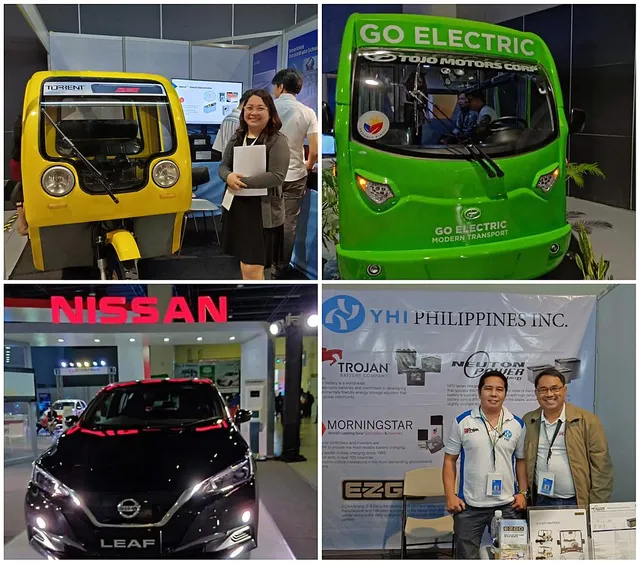
Electric vehicles and battery manufacturers - Exhibitors at the 7th Philippine Electric Vehicle Summit - July 2019, SMX Convention Center, Pasay City (Photo by Marcelle P. Villegas, Philippine Resources Journal)
While most environmentalists believe that mining is bad for the environment, they somehow encourage or even demand from car manufacturers to resort to eco-friendly technologies. Thus, the emergence of electric vehicles (EV) enters the picture as the solution. EVs have less carbon emissions and use greener fuels, therefore, this will help improve the air quality on the planet. But with this trend in transportation technology, manufacturers will now require a large and steady supply of specific elements. How to acquire these elements now goes back to mining.
Last July, Elon Musk, CEO and product architect of Tesla Inc. emphasised the importance of nickel and its rising demand. The American electric vehicle and clean energy company, Tesla Inc. ranked as the world’s best-selling plug-in and battery electric passenger car manufacturer in 2019. [1] Musk encourages mining companies to produce more nickel since it is the key ingredient in the manufacturing of batteries for electric vehicles. He mentioned that the current cost of EV batteries remained a big hurdle to the company’s growth. [2]
He stated, “Tesla will give you a giant contract for a long period of time if you mine nickel efficiently and in an environmentally sensitive way.”
Nickel in batteries provides much energy for an EV on a single charge. Tesla Inc. now has a rising demand for nickel in order to boost the production of trucks and solar projects. [2]
Here in the Philippines, we have the implementation of the Public Utility Vehicle Modernization Program (PUVMP), thus more electric cars are now plying on the streets of Metro Manila. PUVMP is a flagship program of the Duterte administration which envisions restructured, modern, well-managed, and environmentally sustainable transport sector, ensuring drivers and operators have stable, sufficient and dignified livelihoods while commuters get to their destinations quickly, safely and comfortably. [3]
Aside from nickel, there are other elements like iron, cobalt, copper, and more that are essential in the production of EVs and their batteries. Because of mining, manufacturing of EVs and their efficient batteries is possible.
Here are some facts about the elements that are needed in EVs. [3]
Electric car batteries require 15 kilograms of cobalt.
Lithium is used to create rechargeable lithium-ion batteries that power electric and hybrid vehicles.
Lithium-ion batteries used by many of the major electric vehicles manufacturers use a cathode that is primarily composed of nickel.
Iron is used to make the protective bodies of electric vehicles.
Molybdenum is an essential component of airbags.
Electric cars use twice as much copper as internal combustion engines.
The development of green technologies and the manufacturing of EVs and batteries are all dependent on mining. In order to successfully protect the environment in the long run, proper management of mineral resources, eco-friendly strategies and responsible mining are needed.
[1] Pontes, Jose (Feb. 4, 2020). “EV Sales: 2019 sales by OEM”. EV Sales.
[2] Sun, Yilei and Burton, Melanie (July 23, 2020). Reuters. “‘Please mine more nickel,' Musk urges as Tesla boosts production”. Retrieved from - https://www.reuters.com/article/us-tesla-nickel-idUSKCN24O0RV
[3] “The Anatomy of an Electric Car: All Thanks to Mining” (September 2019). Mining Philippines Programme Report. Retrieved from -
https://www.spglobal.com/marketintelligence/en/news-insignts/research/nickel-supply-energized-by-electric-vehicles
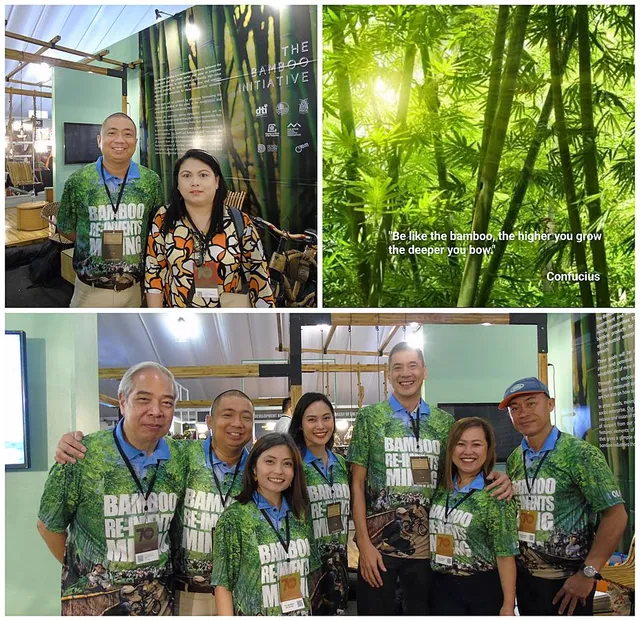
2019 Manila FAME at World Trade Center - (Top photo) Joseph Castillo (a.k.a. Joe Green) with the author. (Lower photo) Joseph Castillo (second from left) with his teammates in The Bamboo Initiative -- Jose Camus, Stephen Araneta and Aisa dela Cruz of OLLI, Larissa Alivio of Bamboo Initiative, and more. (Photo by Marcelle P. Villegas, Philippine Resources Journal)
From bamboo charcoal to raw material for antibacterial fabric, environmental advocate Joe Green shares the unique and fascinating ways the bamboo plant helps mining companies and local communities. Plus with bamboo around, the cutting of trees will be lessened.
During the formal launching of The Bamboo Initiative last year at the Manila FAME, it was stated that “The Bamboo Initiative is a nationwide campaign aimed at revegetating mined-out areas with fast-growing bamboo, thereby increasing bamboo production and creating lucrative enterprises for mining communities.” [1]
The Bamboo Initiative was inspired and co-established by OLLI Consulting Group, Inc. under its CSR component “OLLI Cares” led by their President and Principal, Atty Leo Dominquez. The initiative is supported by and is a collaboration among the Chamber of Mines of the Philippines, Philippine Nickel Industry Association (PNIA), Department of Environment and Natural Resources (DENR), the Department of Trade and Industry (DTI) and its Philippine Bamboo Industry Development Council, and the Department of Agriculture.
So how does The Bamboo Initiative directly help mining companies? We interviewed Mr Joseph Castillo of OLLI Consulting Group, Inc. to elaborate on the various strategies of The Bamboo Initiative in promoting ecological and industrial use of bamboo for mining companies.
Mr Joseph Castillo is from Davao City. “People call me ‘Joe Green’ because I have other green initiatives like about plastic pollution and this bamboo campaign. The Bamboo Initiative has identified a need for the supply of bamboo planting material. In this regard, I now manage a bamboo nursery that is helping to supply the needs of the mining industry for bamboo seedlings and propagules ” he stated.
Primarily, they help mining companies in planting bamboo, because most mining companies need guidance on which bamboo varieties will successfully grow in their mine site. Each mine site has a unique soil composition and soil condition after mining. The Forest Management Bureau noted that the Philippines has over 70 bamboo species where eight species are highly useful commercially. They have the local names Kauayan Tinik, Kiling, Bayog, Laak, Giant Bamboo, Bolo, Kayali and Buho. [2]
Joe mentioned, “I am focused on growing the seedlings and the bamboo propagules so we have a facility in Baracatan, Davao. There we grow the seedlings and sell them to mining companies who then use them to re-forest their mined-out areas, especially in the nickel mining industry.”
“Right now, we are supplying for the nickel mining company, CTP Construction and Mining Corporation, headed by Mr Carlo Pimentel. We are partnering with them now and supplying them 35,000 seedlings to start with. We just started so we are in the process of delivering the first few thousands to them and we're helping them plant also.”
“Before this project even started, we did our own research together. So we studied and introduced them to people who know better about bamboo. Right now they [CTP] have enough knowledge on how to grow the bamboo successfully in their mining area. CTP is a very progressive company. They listen and they are very open to new things especially with bamboo.”
Mr Joe explained why they recommend planting bamboo instead of trees. “It is common that mining companies plant trees on the land area they have finished mining on. Planting trees is still environmentally sound but after you're gone, what will the people do with the trees? If the trees planted are not fruit-bearing, most likely the people in the area will just cut them eventually.” Mr Joe added, “There is no industry around it, and with no livelihood in place, thus they will just cut the trees.”
“On the other hand, with bamboo planted in the area, there are so many industries behind it that people can benefit from even after the mining company has left the area.”
“Firstly, bamboo itself can create crafts. Secondly, the bamboo fruits are edible. Thirdly, bamboo has many uses that we are also concentrating on, like the ‘bamboo uling’ or charcoal.” He explained that by having bamboo charcoal around, people will cut less trees that they normally use for firewood. “Therefore, it is very sustainable. The manufacturing of bamboo charcoal is an industry in itself.”
He also mentioned that in terms of carbon sequestration in the atmosphere, the bamboo can clean the air four times more than regular trees. Generally, both mining companies and the community around the mine site will benefit from bamboo.
“Bamboo has a lifespan of 80 to 100 years, but it depends on the mother plant where it came from and it also depends on the species.”
I asked Mr Joe about his views on the bamboo’s growing popularity in the manufacturing of anti-aging cosmetics. “Yes, they are now being used in anti-aging beauty products because bamboo has a high level of silica. Silica is used in many ways in the cosmetic industry as well as in the medical industry, plus food supplement and vitamins industry.”
“As I know, other than for cosmetics and medical use, bamboo is also used to make fertilizer and even beer.”
In terms of time-saving choice for reforestation and revegetation, Mr Joe mentioned that bamboo is the fastest growing plant on earth. How fast does one small propagule grow to become useful or before it can be harvested? Mr Joe answered, “It depends on the species but by rule of thumb, we wait 2 to 3 years before we can harvest it. But if you say will it grow in a year’s time? Yes, it will grow very tall within a year.”
The bamboo is known to be resistant to strong winds and typhoons due to its ability to sway with the wind. Mr Joe mentioned that its unique root system adds to this survival factor. “The roots of the bamboo are very deep and are scattered. It anchors itself really well on the soil, like most grass species, so it sways with the wind. The bamboo’s stalk is also bendable and flexible, thus it doesn’t break easily during a typhoon.”
“You would hear Confucius quotes and other Asian quotes that are ancient that talk about the bamboo’s flexibility and resilience, and comparing it in real life.”
In one ancient Chinese proverb, Confucius said, "Be like the bamboo, the higher you grow the deeper you bow."
Furthermore in our discussion, Mr Joe mentioned the bamboo’s antibacterial qualities. “I know some bamboo species have antibacterial properties. I have two mentors who are well-versed with bamboo, Coach Rey Millian from Davao and Father Vic Labao of Cebu. They're the ones who told me the species that has a high antibacterial property is locally called bagakay which is endemic in the Philippines.”
“As I know, there are local underwear brands that are tagged as odor-proof because it has antibacterial fabric. They used bamboo cloth for it.”
He is referring to the bamboo genus Schizostachyum lumampao, locally known as buho or bagakay. According to “Useful Tropical Plants” website, bagakay is known for its slim and lightweight bamboo pole that can grow up to an average of 12.50 meters high. This variety is an evergreen bamboo that forms dense clumps of culms as long as 10 meters to 15 meters tall from short, woody rhizomes, with internodes measuring 25 cm to 50 cm in length. The bagakay is one of the economically important bamboos in the Philippines providing material for a wide range of uses. It grows in the wild with the wind as its main pollinator. [3]
On a final note, Mr Joe and his team in The Bamboo Initiative helps out mining companies by providing advice and hands-on support on how to successfully plant and grow bamboo in the mined-out land area . “How do we help them in the mine sites? We find out the soil composition in the area, especially for nickel mines. Some of the nutrients in the soil might be depleted due to mining. Thus we choose and recommend the right bamboo species that are drought resistant or species that are good with lime, for example. It depends on the condition of the soil in the area to be rehabilitated. We conduct studies in order to provide the best advice in choosing the right bamboo variety.”
For more information about The Bamboo Initiative, please contact Ms Maria Paula Tolentino at paula.tolentino@olli.ph.
Reference
[1] Tolentino, Maria Paula (17 October 2019). "Mining industry launches bamboo development campaign at Manila FAME". The Bamboo Initiative press release for Manila FAME 2019.
[2] Tolentino, Maria Paula (27 April 2019). SEM Scribe Publishing House. "OLLI Cares Spearheads The Bamboo Initiative". Retrieved from - https://semscribepublishing.com/
[3] “Useful Tropical Plants”. Retrieved from - Schizostachyum lumampao, http://tropical.theferns.info/)
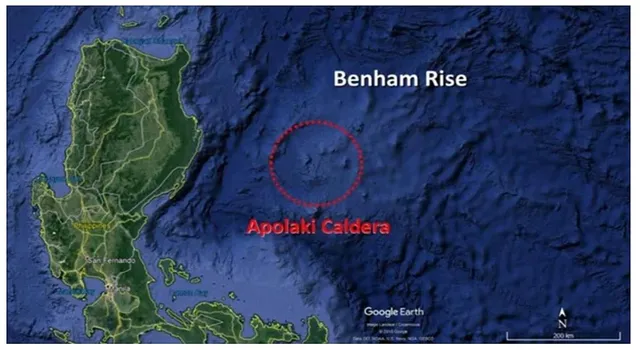
The Apolaki Caldera is currently considered as the world's largest caldera. It was discovered in Benham Rise by marine geophysicist Jenny Anne Barretto and her team. Last June 5, 2020, an online talk show and forum in New Zealand titled "NetKapihan" had Ms Barretto as their special guest for their Philippine Independence Day special episode. The show's host and producer, Mr Rene "Nonoy" Molina also invited Marcelle Villegas, journalist of Philippine Resources Journal, as panelist for this live broadcast. Here is an exclusive interview with Ms Barretto and how she and her team came about with the discovery of the Apolaki Caldera during one of their expeditions.
The fascinating discovery of the world's largest caldera in Benham Rise made headlines last year in October. Ms Jenny Anne Barretto is a Filipina geologist and marine geophysicist who works in GNS Science in New Zealand. She is a graduate of MSc Geology from the National Institute of Geological Sciences - University of the Philippines where she was also an instructor for five years. Since 2007, she has been assisting coastal States like the Philippines and the Sultanate Republic of Oman in delineating their continental shelves as defined in UNCLOS Article 76. She was a key scientist of the technical working group that successfully confirmed the continental shelf of the Philippines in the Benham Rise region. [1] In 2019, Ms Barretto and two colleagues published a paper in Marine Geology Journal where they reported the discovery of the largest caldera in the world. They named this the Apolaki Caldera, a tribute to the "god of sun and war" in Philippine mythology. (The Filipino word "Apolaki" means "giant lord".) This caldera has a diameter of ~150 km, which is 90 km bigger than the Yellowstone Caldera in Wyoming, U.S.A.
Ms Barretto’s paper, "Benham Rise unveiled: Morphology and structure of an Eocene large igneous province in the West Philippine Basin" provides the details of the morphology and formation of the underwater feature of the Apolaki Caldera. The paper is co-authored by her colleagues Mr Ray Wood and Dr John Milsom.
There are many notable Filipino achievers around the world and it is often customary in most events among overseas Filipino communities to honour them during Philippine Independence day every June 12 of the year. For this reason, Ms Barretto was featured as a special guest in New Zealand’s "NetKapihan" last June.
"NetKapihan" is an online talk show, forum and panel discussion that features the Filipino community in New Zealand. The show’s founder and producer is Mr Rene "Nonoy" Molina, a Filipino-Kiwi digital storyteller and filmmaker who is based in New Zealand.
Mr Molina stated, “It was one of the most memorable Philippine Independence Day celebrations I’ve ever had -- a tribute by NetKapihan to our 'Araw ng Kalayaan' via an exclusive info session with Filipino-Kiwi scientist Jenny Anne Barretto who was part of the team that discovered the Apolaki Caldera in Benham Rise! Many thanks too to Manila-based journalist and my former CSA-Makati student Marcelle Villegas for joining the info session. We are not a big organisation with limitless resources, neither are we a news-gathering company. We are a small, online talk show and we try our very best to be a trailblazer! That is our commitment with you! Mabuhay ang sambayanang Pilipino!”
Here is our interview with Ms Jenny Anne Barretto:
PRJ: From the beginning, what inspired you to pursue a career in geology and marine geophysics?
Ms Barretto: Like many children, I wanted to be an astronaut, dreaming of exploring and conducting experiments in space. I initially pursued a metallurgical engineering course in UP Diliman. But when I realized I didn’t like chemistry, I shifted to Geology which was quite popular in the university at that time because of the 1990 Luzon earthquake and 1991 Pinatubo eruption.
Working as a student assistant with the Zambales Lahar Scientific Monitoring Group and with UP NISMED’s Science Teacher Training Center inspired my early Geology career of simultaneous research and teaching at the UP National Institute of Geological Sciences.
The journey in marine geology and geophysics started when I participated in a JAMSTEC-led marine survey in the Philippine Sea back in 2000. Then in 2008 I became part of the NAMRIA-led Technical Working Group that prepared the continental shelf submission for the Benham Rise and Reed Bank-KIG regions. Among my tasks were to put together the data and arguments relating to morphology and geophysics of the said regions, so the Philippines can extend its continental shelf beyond 200 nautical miles.
PRJ: Please share with us how you and your team came about with the discovery of the Apolaki Caldera in Benham Rise.
Ms Barretto: My co-authors and I were part of the Benham Rise continental shelf technical working group. Back in 2008, we only analysed the bathymetric, geological and geophysical data for the purpose of proving that Benham Rise is part of the Philippine continental shelf. That is by showing that Benham Rise is physically connected to Luzon.
Then in 2014, I looked at the bathymetric data again and started describing the different features on Benham Rise in more detail. It was then that I noticed the caldera-like feature on the summit of the rise. But because of its enormous size (~150 km diameter) I was unsure. I showed the image to Ray Wood and he agreed that it looked like a caldera, but suggested to ask other scientists’ opinions, all of whom advised me to do more analyses before making any conclusion.
I went through all the data we have from 2008 and availed of other data in the public domain. Reading John Milsom’s previous interpretations of seismic and gravity data in Benham Rise, I realized that a way to explain the relatively thick pocket of sediments on the summit that he pointed out was the presence of a caldera.
So that began our work together to prove or disprove the presence of a giant caldera on Benham Rise.
PRJ: How long did you research and investigate on the caldera before the actual discovery and verification of its presence?
Ms Barretto: The research and writing the paper spanned 2014 - 2018. It took a while because it was not part of our jobs and we were working remotely from each other. I was in Lower Hutt, Ray was in Hawke’s Bay, and John was in Wales.
Then there was the paper review process of the Marine Geology Journal. There were three reviewers, who although agreed that the feature looked like a caldera, asked us to make the presentation of evidence more robust. The paper was finally published in October 2019.
PRJ: What are the possible mineral resources available in the area? Do you think our country may be able to extract or mine these minerals from that depth (>-2500m) with the mining technology we have available?
Ms Barretto: With the presence of the caldera, exploration geologists will say that the possible mineral resources are volcanogenic massive sulfide (VMS) deposits which are significant sources of metals (largely Cu, Zn, Pb, ± Au).
I believe the existing technology is for deep sea mining of seafloor massive sulfide (SMS) deposits and not VMS deposits. SMS deposits are the modern equivalent of the ancient VMS deposits. Since rock samples from Benham Rise returned ages between 35 to 38 million years and there is no known active volcanism on the rise and vicinity, it is most unlikely to find active hydrothermal vents or chimneys which are targets for mining SMS deposits.
PRJ: Is the existence of the large Apolaki Caldera still an interpretation of existing observations or may we assume it as a geological fact?
Ms Barretto: The available data supports our interpretation of the existence of the caldera. However, it is not impossible that other scientists or even us (me and my co-authors) may find later evidence refuting it. It’s just how science works.
--- To be continued ---
Acknowledgement:
Thank you, Ms Jenny Anne Barretto and GNS Science, for this interview and for sharing with us your studies and discovery.
Thank you, Mr Rene Nonoy Molina of NetKapihan, for the opportunity to join the discussion with Ms Barretto.
Thank you, Dr Friedrich-Karl Bandelow who is my technical adviser for this interview.
[1] Retrieved from Jenny Barretto’s LinkedIn page
[2] Yang, Angelica (22 October 2019). GMA News Online. "After Pinay marine geophysicist discovers world's largest caldera: What is a caldera and how does it form?". Retrieved from https://www.gmanetwork.com/news/scitech/science/712584/after-pinay-marine-geophysicist-discovers-world-s-largest-caldera-what-is-a-caldera-and-how-does-it-form/story/
Photo credits
[3] Benham Rise - by Google Earth and UP MSI Geological Oceanography Laboratory
[4] NetKapihan Zoom session, June 5, 2020 - by Rene Nonoy Molina and Marcelle Villegas
NetKapihan’s Facebook page is at http://www.netkapihan.com/
Previously, we featured an update on the mining regulations in the Philippines. We also examined the export volumes of nickel ore from the Philippines and how these had been affected by Indonesia's exports. Lastly, we discussed the viability of the Philippines' laterite ore deposits and what this could mean for future production. These were the scope of a presentation by Mr George Bujtor last September at the 7th Asian Nickel Conference in Jakarta, Indonesia. His report is titled “Philippines: Regulatory Update and the Potential of the Philippine Laterite Ore” - “How the Philippines was Surpassed by Indonesia in the Laterite Nickel Industry”.
Mr Bujtor is the CEO and owner of private companies, namely Electric Metals Limited (EML) in Hong Kong and PT Electric Metals Indonesia. These are companies which are developing the innovative EML Process for the low-cost leaching of nickel laterite ores. The EML Process is the first of its kind in green technology in nickel processing, and he introduced this at the Asian Nickel Conference in Indonesia last September.
Mr Bujtor is an expert in the technical, financial and commercial aspects of mining operations with over 35 years of experience in the industry. He has extensive work experience in the past as General Manager and Managing Director in Rio Tinto, Australia. In the Philippines is the former CEO of Toledo Mining Corporation and Berong Nickel Mine in Palawan, as well as CEO of Atlas Mining Corporation.
As a review from Part I of our article, we learned from Mr Bujtor that the Philippines is currently Asia's leading supplier of nickel and cobalt which are raw materials for the battery sector. He stated that with the right policies, the Philippines could become one of the world's leading suppliers of battery raw materials, including battery manufacturing. [1]
He said, "Both the Philippines and Indonesia have the resources to dominate the nickel industry. The future growth will be in stainless steel and the battery sector. "
"Over the next 4 to 5 years, nickel demand growth will be in the stainless steel and battery sectors. Indonesia will continue to dominate the NPI growth and investment. The Philippines will only be able to compete in the battery sector."
Now, what is the future of the Philippine laterite nickel ores? With regard to the competitiveness of Indonesia versus the Philippines, he mentioned that, "Relative to Indonesia, the Philippines has NO competitive advantage in ferro-nickel production." He gave the following key points:
Indonesia has built, and continues to build, power stations to provide the electricity to its ferro-nickel industry. The Philippines has limited coal resources and a negative view of coal-fired power stations.
With past high grading and sales of saprolite ores, little high-grade saprolite tonnage remains in the Philippines to produce low cost ferro-nickel/NPI.
Indonesia has the advantage of having considerably higher saprolite ore grades and lesser environmental controls. These are key cost drivers.
The future for the Philippines is not in ferro-nickel or NPI.
He concluded, "The future of the Philippines lies in the processing of its laterite ores as battery raw materials…” Here is why:
The Philippines is currently one of two producers of battery raw materials in Asia, through the Nickel Asia/Sumitomo JV.
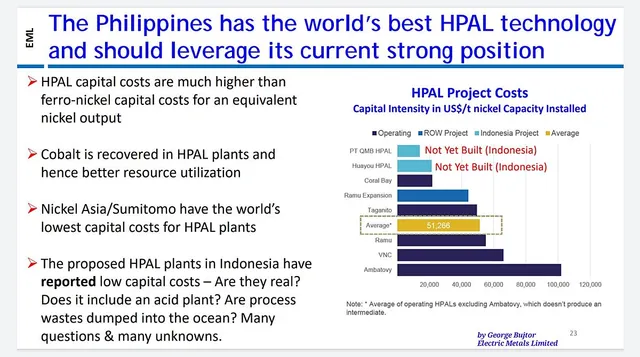
Sumitomo has the world’s leading technology for HPAL.
The Philippines has large resources of laterite ores with medium to high Ni, Co & Sc grades.
Hydrometallurgical processes like HPAL require very little electricity relative to ferro-nickel production.
The Philippines leads the world in an innovative atmospheric leaching process adapted for the tropics – ‘The EML Process’ –a low cost atmospheric leaching process.
Green products for a green future
As mentioned earlier, The EML Process is the first of its kind in green technology in nickel processing. "The low environmental impact either locally or globally of the EML process not only produces products green in colour (nickel), but green in nature to promote the ever-increasing demand for battery and related metals to combat the continued burning of fossil fuels and consequent global environmental pollution." [2]
The EML Process was developed in the Philippines. It is an atmospheric leaching process (done at room temperatures and pressure) adapted to treat all laterite nickel ores. (The two methods of atmospheric leaching done by EML are vat leaching and tank leaching.) Here are some key points:
Test work undertaken in the Philippines leveraging off Cu, Au, Li and Ni experience
“Closed system” with leached ore placed back into mined-out areas –no emissions to land, air or water
Lowest carbon footprint and environmentally the “greenest” of all Ni technologies
Disruptive technology with lowest capital cost in the industry at
Does not require a power station [1]
"The EML Process is not only simple and safe but provides an environmental solution to the laterite nickel industry hitherto much maligned for its poor environmental rehabilitation performance, excess CO2 emissions and excess waste generated."
“The principals behind Electric Metals Limited have developed an innovative leaching process to treat tropical nickel laterites, both saprolite and limonite ores. The process can also be applied to other ores of lithium, copper gold, uranium etc.”
“The leach process has industry lowest capital costs and is environmentally far superior to the more complex and expensive technologies such as the High Pressure Acid Leach (HPAL) and Rotary Kiln Electric Furnace (RKEF) processes.” [3]
The three essential steps in the EML Process include:
1. Leaching of the laterite ore: Mined ore is contacted with dilute sulphuric acid to dissolve the nickel & cobalt (as well as other metals like aluminium, scandium, manganese, etc).
2. Metals Recovery: Solutions containing the metals of interest are treated to recover the contained nickel & cobalt initially, as a mixed hydroxide product containing 35% to 55% nickel and 1% to 3% cobalt.
3. Neutralization: Leached ore is washed and neutralised prior to being returned to the mined-out open pit. The leached ore residue is non-toxic and chemically inert and suitable for revegetation or agriculture.
In summary, while the issue of nickel processing and environmental concerns may be a topic of debate among environmental activists and industrialists, the solution lies in having a gamechanger in the nickel processing arena. Today, we now have a low-cost and environment-friendly nickel processing method called The EML Process. This offers a promising future in the industry and for the environment as well.
Thank you to Mr George Bujtor of Electric Metals Limited.
[1] Bujtor, George. (11 Sept. 2019). “Philippines: Regulatory Update and the Potential of the Philippines Laterite Ore -- How the Philippines was Surpassed by Indonesia in the Laterite Nickel Industry”. Presented at Asian Nickel
Conference 2019, Jakarta Indonesia
[2] Retrieved from Electric Metals Limited website - https://electricmetalsltd.wordpress.com/
[3] Bujtor, George and Wallwin Peter. (02 May 2020). “The EML Process”. Electric Metals Limited investor flyer.
Photo credit: Marcelle P. Villegas, Philippine Resources Journal
Atty. Dennis A. Quintero, PABC Chair - Presenting the Brief History of Philippine Mineral Reporting Code (PMRC) at the "Focus Group Discussion on the Philippine Mineral Reporting Code and Its Relevance to the Philippine Mineral Industry", Sofitel Philippine Plaza Manila - 10 Sept. 2019 (Photo by Marcelle P. Villegas, Philippine Resources Journal)
When the Chamber of Mines of the Philippines organised their annual Mining Philippines last year in September, one of the most important parts of their three-day international conference and exhibition took place on its first day at the Sulu Room of the Sofitel Philippines Plaza Manila. It was a small gathering in a separate venue outside of the main conference -- the “Focus Group Discussion on the Philippine Mineral Reporting Code (PMRC) and Its Relevance to the Philippine Minerals Industry”. Although the discussion took place last September, the further development of the PMRC is something to look forward to this year and perhaps even the following year.
The Philippine Mineral Reporting Code or the “Code” was created to set out minimum standards, recommendations and guidelines for Public Reporting in the Philippines of Exploration Results, Mineral Resources and Ore Reserves. “The Code was formulated with the intent of setting minimum standards for public reporting on minerals that is compatible with global standards. The formulation of the PMRC relied on the international codes from Australia, South Africa, European Union and Canada,” according to the Philippine-Australia Business Council (PABC).
The closed-group discussion was moderated by Atty. Ronald S. Recidoro, COMP Executive Director. Atty. Dennis A. Quintero (PABC Chair and Meeting Chair) started the event with an “Introduction of Meeting Attendees and Brief History of PMRC”.
"The idea of having a Philippine Mineral Reporting Code started during one of the mining roadshows in Australia, participated in by representatives from the Philippine-Australia Business Council. Back then, the Chairman was Atty. Leo Dominguez and the delegation was composed of the various mining industry stakeholders like the Chamber of Mines and also the Philippine Stock Exchange. And the idea came up that if Australia has its JORC (Australasian Joint Ore Reserves Committee), and [thought of] the idea for the Philippines to have its own as well. And that's how the idea of having PMRC came about,” said Atty. Quintero.
Organizations that were involved in the promulgation of the PMRC back in 2007 were Philippine Minerals Development Institute Foundation, Philippine Society of Mining Engineers, Geological Society of the Philippines, Society of Metallurgical Engineers of the Philippines, Mines and Geosciences Bureau, Philippine Stock Exchange, Board of Investments, Chamber of Mines of the Philippines and Philippine-Australia Business Council.
The Secretariat Head of the Geological Society of the Philippines CPAC, Engr. Ramon N. Santos reported on the “Basics of the Philippine Mineral Reporting Code 2007 and Its Implementing Rule and Regulations”.
Mr. Joey Nelson R. Ayson (PMEA President) reporting on “PMRC: Updates and Relevance to the Mineral Industry”. Other speakers were (top left - right) Engr. Roger A. De Dios (PSEM National President) and Mr George B. Baquiran (GSP CPAC Chair) (Photo by Marcelle P. Villegas, Philippine Resources Journal)
Engr. Juancho Pablo S. Calvez, Chief Metallurgist of the Mines and Geosciences Bureau and Member of the PRC Board for Metallurgical Engineering gave a rundown of the PMRC Committee Role and Composition. This was followed by a discussion on the Committee for Mineral Reserves International Reporting Standards (CRIRSCO) and International Reporting Codes by Mr George B. Baquiran. He is the Chairperson of the Geological Society of the Philippines - Competent Person Accreditation Committee (GSP CPAC) and PMRCC Standards Committee Chair.
PMEA President, Mr Joey Nelson R. Ayson reported on “PMRC: Updates and Relevance to the Mineral Industry”. Included in his report is the CRIRSCO Membership Update (Task Force of International Council for Mining and Metals - ICMM):
● Feb. 23, 2019 - CRIRSCO-PMRCC MOU signed
● March 2019 - PMRCC-CRIRSCO Working Group formed
● Sept. 9-11, 2019 - Annual CRIRSCO Meeting in Washington D.C., U.S.A.
○ PMRCC Executive Committee attended (Jun Angeles and Jake Foronda)
● Proposed Timeline for PMRCC to become a CRIRSCO member
○ Aim by third quarter of 2020
● Upgrading PMRC 2007 according to the CRIRSCO Reporting Template 2019
○ Approved PMRC Code aim by second quarter of 2020
Mr Ayson also reported the “Bases for PMRC Review/Upgrade” wherein the primary basis is the CRIRSCO International Reporting Template 2019, and the secondary bases are JORC 2012 and NI 43-101.
In conclusion, he stated the PMRC and PMRCC relevance to the Philippine minerals industry, namely:
● To protect investors in mineral exploration and mining
● To protect the capital markets from fraudulent practices
● To promote a common understanding in reporting mineral assets
● For our Philippine Stock Exchange (PSE) to be world class in attracting mineral investments, both domestically and internationally.
PMRC Committee’s Relevance:
● Need for a Philippine-wide National Reporting Organization (NRO) to monitor the effectiveness and relevance of the PMRC and subject the PMRC to periodic reviewers
● Growing importance of compatibility and substantial equivalency with other international reporting codes
○ It is important to be a CRIRSCO member to ensure that PMRC Code will always be at par with the CRIRSCO family of internal reporting codes.
Finally, the Open Forum was conducted by Engr. Roger A. De Dios, PSEM National President.
2 March 2020, PMEA Monthly Membership Meeting, Manila Elks Club, Makati City - "Sustainability Management" by Mr. Ian Moller, Country Manager, General Manager Sustainability, FCF Minerals (Photo by Marcelle P. Villegas, Philippine Resources Journal)
Early in May, FCF Minerals Corporation joined the national and local government in Bayombong, Nueva Vizcaya with efforts to help the locals in the province during the COVID-19 pandemic. FCF workers distributed the company’s donations of sacks of rice to the LGU of Quezon, Nueva Vizcaya. According to Country Manager and Acting General Manager, Mr Ian Moller, they have funds for their Social Development and Management Programs (SDMP) to support the Bayanihan to Heal as One Act of the national government. “This is in response to the advice of the MGB for mining companies to use our remaining funds from our SDMP to support the affected impact and non-impact communities due to the COVID-19,” according to Mr Moller. [1]
FCF Minerals Corporation has initially donated 2500 face masks and 25 gallons of alcohol to the provincial government, 20 pieces of Tyvek suits and goggles to the Municipal Health Office of Quezon town and 50 sacks of rice to the Quezon LGU. [1]
Two months ago, (2 March 2020), Philippine Mining and Exploration Association invited Mr Ian Moller as their guest speaker for the March Monthly Membership Meeting. This was held in Manila Elks Club in Makati. Mr Moller presented with the topic "Sustainability Management".
Mr Moller has been the Country Manager and Acting General Manager of FCF Minerals since August 2016. He has a diverse background in consulting and site operations, project development and project management of major developments global projects in mining, energy, manufacturing facilities, infrastructure and natural resource utilization.
FCF Minerals Corporation is a mining company that engages in exploration, development, and commercial operation of mineral claims of gold and molybdenum mining projects. [2] Their mine site in Nueva Vizcaya is 300 km from Manila or a 6-hours drive, according to Mr Moller..
“Sustainability is a word that's often used and abused, but in the context with what I will share with you tonight, it is sustainability in terms of staying in business. In the PH mining industry, that is a serious challenge to stay in business,” said Mr Moller.
He describes their mines as a Surface Mine which is an open terracing-type development. “The tailings dam or residual storage impoundment as it's called is continuing to be developed in another valley, and that is constructed using some of the waste rock from the mine.”
“We have a processing plant which is a biological oxidation process, the only one in the Philippines together with a cyanide destruction technology which is also biological, which is the largest and most efficient in the world in this application. We also have a number of other dump sites.”
“One of the features of the project is we have a very high proportion of females in the work force and they do all kinds of jobs. They're really good people -- the locals of Runruno… the ladies and mothers.”
He further describes the mine site, “The residual storage impoundment is built up in an adjacent valley” It has a vertical rising of the wall and a spillway. “To date in the four years of operation, the spillway has not operated. The free board is maintained to 5 meters so even two successive typhoons have not resulted in any discharge through the spillway from the impoundment.”
With regards to environmental rehabilitation, he stated, “One of the aspects of mining in the Philippines is that for every tree that you cut related to mining, you need to plant 100 additional trees somewhere. For every hectare that you disturb, you have to replace that area by 2 hectares somewhere. So we have quite a lot of offsite tree planting and reforestation of areas that have got nothing to do with the mine at all. And to date, we have planted over 3 million trees in the first four years of the operation, because of the appropriate requirements of 100 trees to 1.”
“So the logical conclusion is that if you want to rehabilitate the Philippines, you need more mining, because for every tree that we cut, we plant another hundred trees somewhere. Every hectare that we disturb, we rehabilitate two hectares somewhere else and it's all offsite. We simply do not have enough land that we've actually disturbed for mining to consume all of that.”
In his presentation, he discussed the Mine Environment Protection and Enhancement Office with the following points:.
Mining Forest Program:
To date, a total of 392.783 hectares were planted under the Mining Forest Program (MFP) of the company.
As against the total disturbed areas to date (182.52 hectares) and with regards to the compliance obligation of two hectares replacement for every hectare of area cleared / disturbed, FCF Minerals Corporation is at 107.60% compliant.
A total of 175 surface owners benefited from the Care and Maintenance Program of Mining Forest plantation areas.
Special Tree-Cutting and Earth Balling Permit - As of Q4-2019, under the three Special Tree Cutting Permits used to FCF Minerals Corporation, the company increased its compliance to 62.53% with regards to its obligation of one hundred seedlings replacement for every tree cut (1:100). Also todate, tree clearing continues with a 7-year extension of its STCEP No.3 last December 18, 2018 denoted as STCEP No. RII-21-2018.
Mr Moller also gave a rundown of some of the company’s latest accomplishments, namely:
Community Relations Office - Progress the implementation of the remaining PPAs under the 2017, 2018 and 2019 ASDMP budget:
2019 SDMP Financial Accomplishment: 77.00%
Physical Accomplishment: 95.08%
Infrastructure Projects - K to 12 workshop building of Runruno National High School, Multi-Purpose Hall of Runruno Elementary School, flood control structures, water system, irrigation canals, farm-to-market roads and improvement of daycare buildings
Education - Participation of FCF to the National Literacy Forum sponsored by the Literacy Coordinating Council for the presentation of the award-winning Best Practices of the Program: Handog-Aral sa Ikauunlad ng Buhay.
Enterprise Development - Partnership with TESDA and Tam-an for skills training program. 8 ALS Learners and OSY's from Runruno competed Automotive Servicing with NCR Certifications.
Access to Health Services, Professionals and Health Facilities - Support to the Construction of Municipal Sanitary Land Fill (funded from the SDMP shares of the 12 Barangays of Quezon), purchase of ambulance for Barangay Runruno.
Safety and Environment - CFC Minerals Corporation won the National Best Mining Forest Award (2nd time), Achieved 10M hours LTI free in Feb. 2020, and their Emergency Response Team won 2nd place in the Fire Olympics/5th in PMSEA Fire and Rescue Competition. Notably, there was no lost time in 10 million man hours. Mr Moller said, “We can't remember the last time somebody had an accident and didn't come to work the next day.”
With regards to Sustainability Management, he said, “Four years ago when Ian Holzberger, the former CEO, Chairman and President, invited me to consider joining FCF to actually put into place the first sustainability report. He did that in the knowledge that FCF would be placing some significant challenges in Nueva Vizcaya.” By the “challenges” that time, he was referring to the history of Oceanagold and also actions of some of the anti-mining groups.
“So his foresight is well and truly validated. The challenge to me at the time was just ot prepare the sustainability report at which we've done to prepare. We took the global initiative guidelines. It requires you to go through an arduous process and it is very time-consuming.”
The Global Initiative Guidelines for Sustainability Management covers 33 topics, 76 disclosures and the Progressive Disclosure can help drive performance in the value-creation area. Here are the steps he mentioned on how to make a Sustainability report:
1) Prepare - Plan your reporting process.
2) Connect - Input from key stakeholders
3) Define - Define your report content.
4) Monitor - Gather and analyze information.
5) Report - Finalize and distribute your sustainability report
References:
[1] Ebreo, Benjamin Moses M. (3 May 2020). “Vizcaya mine firm joins fight vs. COVID-19”. Philippine Information Agency
[2] FCF Minerals Corporation company profile by Bloomberg.com
2019 Manila FAME at World Trade Center - (L-R) Atty Leo G. Dominguez (President, OLLI Consulting Group, Inc.) and H.E. Gerard HO Wei Hong (Singaporean Ambassador to the Philippines) (Photo by Marcelle P. Villegas, Philippine Resources Journal)
By: Marcelle P. Villegas
The Bamboo Initiative is more than just a campaign that promotes the use of bamboo for ecological and industrial use. It is a brilliant solution that addresses the many challenges and hurdles of the Philippine mining industry. How can The Bamboo Initiative solve these problems?
“The Bamboo Initiative is a nationwide campaign aimed at revegetating mined-out areas with fast-growing bamboo, thereby increasing bamboo production and creating lucrative enterprises for mining communities.” [1] This is how The Bamboo Initiative was defined and introduced during the Manila FAME event last year in October. During this event, the mining industry formally launched the campaign, represented by the Chamber of Mines of the Philippines, and the Philippine Nickel Industry Association (PNIA). Other supporters of The Bamboo Initiative are the Department of Environment and Natural Resources (DENR), and the Department of Trade and Industry (DTI).
So, what are the proposals or strategies of The Bamboo Initiatives in addressing some of the major issues of the mining industry? First of all, bamboo is a solution in rehabilitating lands after a mining operation. While there are many tree options that are traditionally used in reforestation and land rehabilitation, the bamboo is a grass that is fast-growing compared with most trees. It is also low-maintenance and the survival rate is high. In reforestation projects, time is an important aspect in measuring its success rate, and this is where the bamboo excels being a fast-growing plant.
The campaign is a response to President Duterte’s order to revegetate mined-out areas. DENR Secretary Roy Cimatu mentioned, “In his State of the Nation Address, the President said that the mining industry should repair the environment which has been mismanaged. The DENR and the DTI are initiating the rehabilitation of mined-out areas using bamboo to address this matter, while also helping expand the country’s bamboo resources.” Secretary Cimatu noted that the group chose bamboo in rehabilitating used up lands because it grows fast and releases 30% more oxygen than conventional trees, and is efficient in absorbing heavy metals from contaminated soil or water. [1]
Second, bamboo is also an effective tool for economic growth. Mr Ramon Lopez, DTI Secretary and Philippine Bamboo Industry Development Council Chairman, stated that “the potential for bamboo is limitless, given the variety of its use.” Mr Lopez praised Secretary Cimatu and mining companies who have initiated the planting of bamboo in their mine sites. He said that such action will help increase the supply of bamboo as raw materials for other high-value products in the future.
Bamboo is useful in creating furniture, housing materials, window shades, flooring material, and more. When it comes to innovative uses of bamboo, on top of the list are bamboo used for health and wellness products, such as ingredient for essential oils and anti-aging cosmetics, light-weight frame for bicycles (like Bryan Benitez McLelland’s revolutionary “Bambikes”), and fashion industry’s bamboo frame for sunglasses (which float in water and non-toxic unlike plastic). And let us not forget how bamboo helps protect the environment by replacing plastics in the manufacturing of drinking straws and toothbrushes. Bamboo charcoal is an efficient fuel and an effective room deodorizer. Bamboo is a raw material that never fails to impress the innovative and creative people. Therefore, it can offer so much for economic growth.
According to Mines and Geosciences Bureau, there are 12 mining companies that are planting bamboo in 12 provinces across nine regions all over the Philippines.
Finally, bamboo can help communities become sustainable. According to Mr Butch Alcantar, Chairman of PNIA, planting of bamboo was more than just for rehabilitation. It is also the long-term economic development of their communities. [1]
“What sustainable livelihood do we leave our host communities, especially the indigenous peoples when the mining stops?” Mr Alcantara explained that a 10-hectare plot of bamboo can help a worker earn five to six times more income than their salary. “The bamboo industry is a $60 billion industry where our communities can participate by manufacturing and supplying high-value products globally.”
Atty Ronald Recidoro, Executive Director of the Chamber of Mines of the Philippines said that The Bamboo Initiative emphasises the significance of the mining industry’s role in creating opportunities and social enterprise. [1]
Atty Leo Dominguez, a proponent of The Bamboo Initiative and a prominent mining lawyer stated, “The Bamboo Initiative will boost the development of the bamboo industry, create sustainable livelihood projects for mining communities and thereby re-invent mining as a social enterprise. This will help change the conversation about mining.”
For more information about The Bamboo Initiative , please contact Ms Maria Paula Tolentino at paula.tolentino@olli.ph.
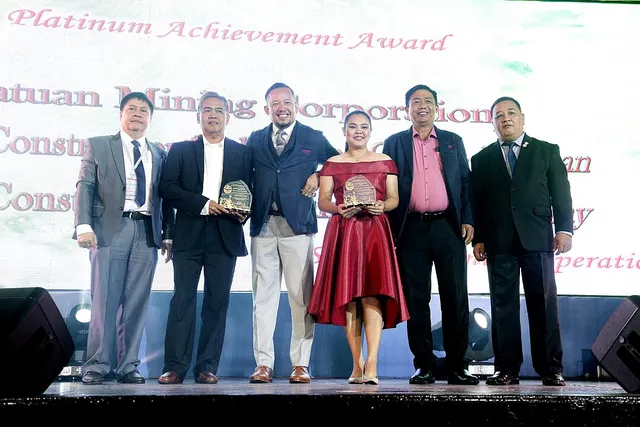
Baguio City -- During the 66th Annual National Mine Safety and Environment Conference (ANMSEC) last November 2019, CTP Construction and Mining Corporation (CTPCMC) was among the winners of the Platinum Achievement Award for Surface Mining operations.
During the prestigious PMIEA or Presidential Mineral Industry Environmental Awards Night and Testimonial Dinner which was held on the last day of the ANMSEC, CTPCMC received two Platinum Achievement Award for their surface mining operations in the Barangays of Dahican and Adlay, Carrascal, Surigao del Sur. Each year, PMIEA is hosted by the Philippine Mine Safety and Environment Association (PMSEA), which promotes occupational safety and health, sound environmental management and social responsibility in the minerals industry. [1]
Early last year, CTPCMC was also awarded as the Gawad Kaligtasan at Kalusugan (GKK) Champion for the Caraga region. The award was given by the Philippine Department of Labor and Employment (DOLE) for CTPCMC’s “commendable achievements of their initiatives benefiting safety and health of their workers and the community.”
For the past years, CTPCMC has been actively participating in the National Greening Program (NGP) of the Department of Environment and Natural Resources (DENR). Other than planting endemic and fruit-bearing trees in the rehabilitation sites, they also launched in 2018 their Bamboo Plantation as part of the reforestation program. In 2017, the company initiated the Project Gaia to empower women from Barangay Adlay as they take the lead in reforestation activities such as taking care of the plant nursery, planting, landscaping and maintenance.
CTPCMC has been operating since 2007 and is one of the top 5 nickel mines in the Philippines. A 100% Filipino-owned company, CTPCMC is the second nickel mine in the Philippines that was awarded a triple ISO certifications namely, ISO 9001, ISO 14001, and OHSAS certifications last 2016 and in February 2018. It upgraded to latest versions namely ISO 9001:2015 (Quality Management System) and ISO 14001:2015 (Environmental Management System) along with its existing OHSAS 18001:2007. They were assessed and certified by TÜV Rheinland.
[1] Simeon, Louise Maureen (29 November 2019). “Six Firms Bag Top Awards for Responsible Mining”. The Philippine Star.
A fine day Friday, the 54th Philippine Mining Club Luncheon is back at the Manila Polo Club in McKinley, Makati City. The Luncheon was attended by guests from different mining companies, organizations, and other sectors continuously supporting the Philippine Mining Club.
Also in attendance were the marketing partners, one of which is new, the Philippine Youth Association for Responsible Mining and Natural Resources or known as YAMAN Philippines. Mining Engineering students from the University of the Philippines – Diliman were also present that day. Some notable individuals were also present during the 54th Luncheon; Director Wilfredo Moncano of the Mines and Geosciences Bureau of the Department of Environment and Natural Resources, CEO and Chairman Mr. Gerard Brimo of Nickel Asia Corporation, and South African Ambassador to the Philippines, H. E. Bartinah Ntombizodwa Radebe-Netshitenzhe.
The event started past twelve noon with an introduction from Mr. Kevin Lewis, General Manager of the Philippine Mining Club. Mr. Lewis mentioned all the Sponsors and Partners of the Club and was grateful to all the guests present. Mr. Lewis introduced the emcee for that day, Atty. Patricia Bunye. Atty. Bunye acknowledged the presence of ten lucky students; five coming from the University of the Philippines, three from Adamson University, and two from Mapua University. The students from Adamson and Mapua also represents YAMAN Philippines, an affiliate partner of PMC. This is a big opportunity for the students to experience a professional networking forum bringing industries together and mingle with the guests who might be their future employer.
Mr. Joey Nelson Ayson from the Philippine Mining and Exploration Association gave an
industry update such as tenement statistics, DENR-MGB staff movement, MICC second audit, and others. The Philippine Mining and Exploration Association represents the mineral exploration industry including local companies and investors. His presentation was followed by the Stock Market Speaker, Mr. Alexander Gilles. Mr. Gilles gave the guests of PMC a stock watch. Mr. Gilles is a regular lecturer at seminars of the Philippine Stock Exchange. He works as consultant for market education, at First Metro Securities. He explains to newcomers, how to get started in stock markets and mutual funds.
The highlight of the 54th Luncheon is the presentation of Mr. Koji Hirai, Director of Planning Division – Metals Environment Management Department of the Japan Oil, Gas, and Metals
National Corporation (JOGMEC). He presented JOGMEC’s activities and cooperative relations between the Philippines and Japan in the mining industry. On August 16,
2019, The Department of Environment and Natural Resources (DENR) signed today the
Memorandum of Cooperation (MOC) with the Ministry of Economy, Trade and Industry (METI) of Japan to promote cooperation in the mining and mineral resources sector.
The MOC signing was followed by the signing of the MOU between the MGB and JOGMEC. The MOU states the terms of the cooperation or commitments between the two agencies for the conduct of mine rehabilitation training. The training, to be provided by JOGMEC, is slated to be conducted in two batches in October 2019 and January 2020. Mr. Hirai’s presentation was followed and ended by a q & a. At the end of the event, networking starts and students grabbed this opportunity to talk to some of the guests. Students had a chance to talk with Mr. Hirai from JOGMEC and Mr. Alexander Gilles as well.
We in YAMAN Philippines are grateful to PMC for accepting us as an affiliate partner.
We are so glad to have this chance and we are very excited about the partnership. This will surely open a lot for doors to the students especially the members of YAMAN Philippines.
The next PMC Luncheon will be on April 3rd at Turf Room, Manila Polo Club.
Article courtesy of YAMAN: https://www.facebook.com/yamanphilippines/
In 2015 the UN adopted a new set of aspirations for the next 15 years; the Sustainable Development Goals (SDGs). The UN defines 17 SDGs, which are broken down into 169 targets, for outlining an agenda for nations, NGOs and business leaders. These goals are intended to end poverty, protect the planet, and ensure prosperity.
It is good to see some mining companies are already driving SDGs. However, others are still considering this. Most of the mining companies start to map these 17 SDGs to mining content in order to cover social, economic and environmental sustainability. Other mining companies use corporate social responsibility (CSR) reports as an item to check on their compliance checklist. Generally most mining companies unfortunately wouldn’t gain much value added in running social, economic and environmental initiatives in support of the SDGs for the following reasons:
The lack of a clearly articulated sustainability strategy; no idea where to start
Complexity, and a lack of priority, focus, and deliverable milestones
Limited ambition, and a limited budget
A lack of leaders in the organization, who are not brave enough to go the extra mile
The lack of talented or motivated people in the organization
A lack of cross-business activity and communication
The absence of business and senior leadership in sustainability strategies, formulation, and execution
Poor change control and lag
A lack of skills and expertise to realize the sustainability strategies
Two initiatives that help to drive the UN SDGs in mining are now further discussed.
Circular economy in mining
Apple has installed Liam, a line of robots that can quickly disassemble iPhone 6. Apple claims that with two Liam lines up and running, they can take apart up to 2.4 million phones a year. These types of recycling mechanisms can be used in other industries such as manufacturing, automotive, building and construction, chemicals and plastics. However, you need to modify your plant infrastructure to enable these capabilities. Even though there are upfront costs involved with building these capabilities, it pays off in the end.
This raises the question; what would happen if other giant companies similar to Apple were to prioritize recycling and stop buying minerals from mining companies?
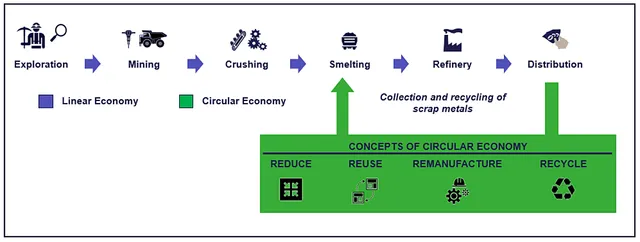
Apple is one business model which could be followed by mining companies to drive concepts of circular economy, and to use secondary materials by re-smelting them. This would help to protect our environment by preventing the stacking of unwanted waste in waste yards.
Figure 1 shows the mining value chain of a mining company that is driven by linear economy and circular economy. Having a recycling plant in a mine site would help to manage day to day waste that is generated in mining operations.
Here are some of the quick wins that help to make an impact as a result of driving the circular economy in mining; recycling old tires from mining trucks & dozers, recycling waste lubricants, using mine waste for backfilling, refurbishing and recycling mining equipment. In the future, mining companies will be able to leverage 3D printing and additive manufacturing methods to reduce excess waste in production during mining operations.
Renewable energy in mining
There is a big push from the mining industry towards renewable energy for many reasons. Energy usually accounts for 33% of a mine’s operating costs. Therefore, a rapid fall in the cost of solar and wind power would be highly lucrative if a mining business were to use renewables. Not only that, the stability of renewable energy, which would reduce exposure to volatile diesel prices, is another reason why renewables are becoming popular in the mining sector. Most importantly, powering renewable energy sources in mining would help to reduce CO2 emissions to mitigate against the effects on climate change, reduce emissions from blasting explosive and diesel-powered generators, and help to minimize the carbon footprint and carbon tax payments. Finally, renewable energy predominately helps to drive SDG7 (affordable and clean energy) and SDG13 (climate action) under the UN SDGs. In short, there is a huge demand for renewables in the mining sector due to such things as cost reduction, environmentally friendly considerations and reliable power sources. Energy companies will help and support mining companies to facilitate this huge demand by having lucrative business models, such as investing in co-investor, build-own-operate-transfer and off-take agreement models. Here is what mining CEOs have to say about renewable energy in mining.
“We are working on increasing our use of renewables at all of our operations at competitive prices.” (Iván Arriagada, Antofagasta CEO); “The use of solar energy will reduce Essakane’s carbon emissions by 255,000 tonnes over 15 years, will save on energy costs and will be our legacy long after we are gone, as the community will be left with a low-cost power source.” (Stephen Letwin, CEO of IAMGOLD).
My prediction is that in the next decade, the mining industry will focus on reaching zero greenhouse gas emissions and will be heavily involved in driving the UN defined sustainable development goals (SDGs).
In conclusion, driving concepts of a circular economy and renewable energy would positively impact on the sustainable development goals (SDGs) defined by the UN. Concepts of circular economy and use of renewables can be applied to any organization thinking about how to manage its own waste, how to build a recycling unit, and how to use green-power sources. Driving these concepts would be a step towards a greener economy and a better environment for the next generation.
About the author:
Kash Sirinanda has a doctorate in mine planning and optimisation from the University of Melbourne, Australia. During his PhD studies and post-doctoral work at the University, Kash developed algorithms for generating designs that maximise the NPV of a mining operation. That work provides the basis for software that assists mine planners to design more profitable mines. Kash was also a visiting scholar at the Colorado School of Mines, USA.
He has worked on various mining projects which include due diligence, operation, analytics, optimisation and digital in different commodities around the globe. He is a keynote speaker and provides mining leaders with strategic direction, and visionary leadership.
Kash´s vision is to engage, partner, and collaborate with leaders and decision makers to transform a business into a best-in-class, advanced digital and sustainable-enabled competency company.
Founder of www.mineconnector.com & www.elitefuturists.com
This article is bought to you by www.secondchanceevents.com Mining Towards 2030, Applying the United Nations SDG’s to Mining
https://www.ft.com/content/b3b7fe4a-a5fc-11e8-a1b6-f368d365bf0e
http://worldcongress.energyandmines.com/files/Feature-Article-x-4-v3-ia-opt.pdf
“The Philippines is currently the leader in the hydrometallurgical leaching of laterite ores but will lose its leadership position in the battery raw materials sector if supportive mining policies are not put into place quickly... or if an export ban is not implemented quickly.”
(George Bujtor, 11 September 2019, Jakarta, Indonesia)
Last September, during the Asian Nickel Conference 2019 in Jakarta, Indonesia, Mr. George Bujtor (CEO of Electric Metals Ltd.) represented the Philippines through his report titled “Philippines: Regulatory Update and the Potential of the Philippine Laterite Ore” -- “How the Philippines was Surpassed by Indonesia in the Laterite Nickel Industry”. The scope of his presentation covered the following:
Update on mining regulations in the Philippines
Examining export volumes of nickel ore from the Philippines, and how these had been impacted by Indonesia’s exports
Examining the viability of the Philippines’ laterite ore deposits and what this could mean for future production [1]
The Asian Nickel Conference is now on its 7th year. This year’s conference was held at The Ritz-Carlton Jakarta, Mega Kuningan, Jakarta, Indonesia.
Indonesia is known as the fast-growing hub for the global nickel market. The conference is a venue that brings together nickel, stainless steel and NPI producers, end-users, auto and battery manufacturers and industry experts. [2]
Mr Bujtor is an eminent mining executive with over 35 years of experience in the industry. He is an expert in the technical, financial and commercial aspects of mining operations, and projects across many commodity groups such as gold, copper, lead, zinc, tungsten, nickel, iron ore, chromite, magnetite sands, diamonds, coal, etc. He has extensive work experience in the past as General Manager and Managing Director in Rio Tinto, Australia.
He was CEO of Toledo Mining Corporation and developed the Berong Nickel Mine in Palawan. Currently, he is the CEO of private companies -- Electric Metals Limited (EML) in Hong Kong and PT Electric Metals Indonesia which are developing the innovative EML Process for the low-cost leaching of nickel laterite ores. This is the first of its kind in green technology in nickel processing, and he introduced this at the Asian Nickel Conference in Indonesia last September.
While many are optimistic about how the Philippines shall benefit from Indonesia’s upcoming nickel laterite ore export ban, there are certain angles of this situation that many do not realise. First, let us look into the situation of the Philippine nickel industry and how Indonesia is affecting us.
During his participation as a speaker in Indonesia’s Asian Nickel Conference, Mr Bujtor gave a comparative analysis on how the Philippines and Indonesia differ in handling the nickel industry. The Philippines has the fourth largest resource of nickel in the world, the fourth largest resource of cobalt in the world, and the world’s second largest producer of nickel units in 2017. Both the Philippines and Indonesia have the resources to dominate the nickel industry. How come Indonesia is taking the lead while the Philippines is behind the race?
According to the Fitch Group - Asia Mining Risk & Reward Index, “Philippines mining to remain among Asian’s laggards”. The Philippines ranks as the last (rank 13) among resource-rich Asian countries. The Philippines’ global rating is on the 45th rank. [1] A quote from the Fitch Group analysis states “The Philippines is characterized by weak mining reserves, poor regulatory framework, corruption and increasing resource nationalism… Political uncertainty will continue to impinge on growth and especially foreign investment.”
Furthermore, “The Philippines has been left behind as Asia’s mining sector continues to boast the greatest rewards globally with positive business environments, rich mineral deposits, supportive infrastructure and political stability in the countries holding the top positions in the mining index.”
How did the Philippine mining sector end up in this situation when we have the resources necessary to excel? Let’s take a look at the policies we have. In 2012, we have the implementation of the EO 79 which is still in place today. This is the moratorium on processing new mineral agreements until new legislation rationalizing existing revenue sharing agreements take effect. Then, the 2016 mining audits resulted in the closure or suspension of 28 mining operations. As of today, 13 mineral agreements have been canceled.
On the following year, there was an Open Pit Ban by the late DENR Secretary Gina Lopez.
The ban is still in place today. This entails a national ban on all open pit mining in the Philippines for copper, gold, silver and complex ores. (This excludes quarrying.) In 2018, (DAO 2018-03) DENR lifts the moratorium on the acceptance, processing and/or approval of Exploration Permit applications.
From Mr Bujtor’s presentation, he stated, “The Philippines has already been surpassed by Indonesia in developing its nickel industry, but the Philippines has the fourth largest resource tonnage of Ni-Co laterite in the world, comprising ~28 million tonnes contained nickel (~15% of the world’s total) [Reserves ~14Mt], ~1.35 million tonnes contained cobalt (~12%), and ~0.44 million tonnes contained scandium.”
“Regulatory turmoil and policy indecision has prevented the Philippines from developing its world-class laterite resources, and this is unlikely to change in the short to medium term.” [1]
Compared with Indonesia, “the Philippines has already ‘lost’ the race to Indonesia to become the world leader in Nickel Pig Iron production and stainless steel. Direct shipping of laterite ores has not benefited the Philippines and is not in the national interest.” [1]
However, the Philippines is currently Asia’s leading supplier of raw materials (nickel and cobalt) for the battery sector. Now, with the right policies, the Philippines could become one of the world’s leading suppliers of battery raw materials, including battery manufacturing, according to Mr Bujtor. [1]
Now, over the next 4 to 5 years, nickel demand growth will be in the stainless steel and battery sectors. Mr Bujtor said, “Indonesia will continue to dominate the NPI growth and investment. The Philippines will only be able to compete in the battery sector.”
The Philippines is one of two producers of the raw materials of battery in Asia. The other one is Papua New Guinea. In the Philippines, we have Nickel Asia and Sumitomo that control the Coral Bay and Taganito HPAL Plants for processing of limonite laterite ores. [1]
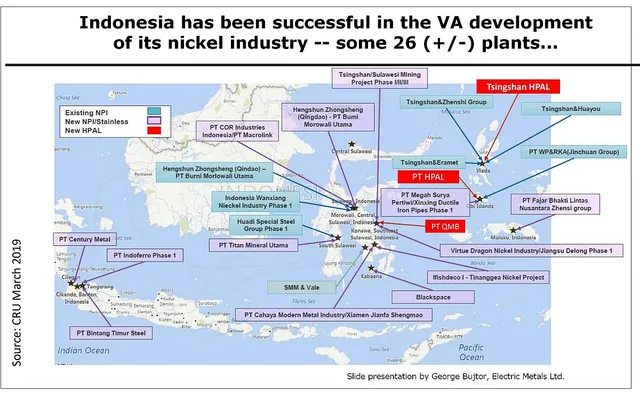
In comparison, Indonesia has benefitted enormously from its nickel laterite ore export ban. How? They have been successful in the value added development of its nickel industry with around 26 plants. [1]
“Tsingshan in Indonesia has invested over US$6B in integrated production facilities since 2014.”
Moreover, “NPI production in Indonesia is forecast to exceed 750kt nickel metal by 2023. Where is the Philippines?”
Indonesia’s export ban introduced in 2014 resulted in large investments in nickel plants due to access to laterite ore, coal and Chinese capital. “Investment to date is estimated at >US$12B with NPI production growing rapidly. NPI technology is readily available ‘off the shelf’. Chinese domestic production will decline for cost competitiveness and environmental reasons.” [1]
He further noted, “The Philippines has ‘missed the boat’ and will now never be able to compete with Indonesia in ferro-nickel production for the stainless steel sector -- an unfortunate missed opportunity.”
With Indonesia’s accelerated progress in the industry, how has that affected the Philippines? “Laterite nickel ore sales from the Philippines have peaked and are now in decline.” Here are some key points:
China is moving its NPI production to Indonesia for reasons of lower cost, higher saprolite ore grades, favourable tax incentives and less uncertain mining policies.
As Indonesia increases domestic NPI production, the need for laterite ores from the Philippines will decline.
No Chinese companies have shown any interest in investing in process plants in the Philippines. Why invest when you can freely export ores and avoid political uncertainty and poor regulatory framework?
The Philippines has permanently lost billions of dollars in investments because of the lack of an ore export ban.
Even though laterite ore is being converted into NPI in China, costs would be much lower in the Philippines without the need to export ores.
Philippine saprolite ores are low grade relative to Indonesia, but limonite ores are of similar grade with respect to nickel, cobalt and scandium.
Indonesia exports average ~1.65% Ni whereas the Philippines grades average ~1.2% Ni.
Much of the Philippine ores have been “high graded” and sold off at ~10% of the London Metal Exchange (LME) price for the contained nickel.
“In-country processing generates much more revenues than DSO exports, which could be worth US$4.1 billion per year.”
Therefore, what is the future for Philippine laterite nickel ores? Let’s look at the competitiveness of Indonesia vs the Philippines.
“Relative to Indonesia, the Philippines has no competitive advantage in ferro-nickel production. Indonesia has built power stations to provide electricity to its ferro-nickel industry. The Philippines has limited coal resources and a negative view of coal-fired power stations.”
Mr Bujtor added, “With past high grading and sales of saprolite ores, little high grade saprolite tonnage remains in the Philippines to produce low-cost ferro-nickel/NPI.”
“Indonesia has the advantage of having considerably higher saprolite ore grades and lesser environmental controls. These are the key cost drivers.” Therefore, in conclusion, the future for the Philippines is not in ferro-nickel or NPI. “The future of the Philippines lies in the processing of its laterite ores as battery raw materials,” he concluded. “The Philippines has the world’s best HPAL technology and should leverage its current strong position.”
For Part II of this article, we shall further discuss Mr Bujtor’s presentation on the Philippine’s potential if we make the right moves in leveraging its current strong position. We shall also discuss his company’s “EML Process” which was developed in the Philippines. This is like a heap leach process but adapted for the tropics and can treat all laterite nickel ores with the lowest carbon footprint. EML’s technology is a low cost breakthrough in leaching being the “greenest” of all nickel technologies with the lowest capital cost in the industry.
Thank you to Mr George Bujtor of Electric Metals Ltd.
[1] Bujtor, George. (11 Sept. 2019). “Philippines: Regulatory Update and the Potential of the Philippines Laterite Ore -- How the Philippines was Surpassed by Indonesia in the Laterite Nickel Industry”. Presented at Asian Nickel Conference 2019, Jakarta Indonesia
[2] Asian Nickel Conference 2019 website - Retrieved from - https://www.metalbulletin.com/events/asian-nickel-conference/details.html
By Marcelle Villegas
The Mining Philippines International Conference and Exhibition 2019 last September presented the many aspects on how the local mining industry affects other industries as well, such are the agriculture, infrastructure, energy sector, petroleum and more.
Change in general is one of the main focus of the conference. “Change is inevitable. In today's fast-changing business landscape, change is the main catalyst for growth.”
It was also emphasised by the various speakers that change is a great equalizer that allows the emergence of new businesses, startups and crowdfunded enterprises in order to compete with bigger and more influential multinational companies. [1]
“Changes has been knocking at the door of the mining industry. Embracing change is no longer an option. It is do or die.”
This explains why the theme of the conference is “Riding The Wave: Capitalizing on Opportunities”. Change creates a wave that shapes the mining industry today, and is an important factor in nation-building.
“The interplay of internal and external forces is creating a wave of change that can bring the industry to new heights. The Chamber of Mines has prepared a diverse program that will give conference attendees a better understanding of the social, geo-political and economic landscape and market trends that have and will continue to shape the mining industry as we know it today.” [1]
“Demand for minerals is projected to increase in order to achieve energy transition. Given that low-emission energy and transportation systems are more mineral-intensive than their fossil fuel-based counterparts, the transition provides a great opportunity for the mining sector.”
Philippine Mining Today
“The Philippines is a leading producer of nickel and is a significant producer of gold, copper, chromium, zinc and silver. We also produce oil and gas. In the 5th Country Report of the Philippines Extractives Industry Transparency Initiatives (PH-EITI), it is reported that there are currently 48 large-scale metallic mines with a total production value of PHP 108.7 billion. [2]”
“The country accounted for 11% of the world’s production of nickel in 2017. Other commodities being produced in the Philippines include chromite, zinc, iron, silver, crude oil and natural gas.”
“Domestic production follows a similar trend as mining - declined from 3 million barrels of oil in 2014 to only 1.5 million barrels in 2016. Production from Galoc oil field has been the main contributor to the total output, producing 1.4 million barrels of oil in 2017.”
“The Philippines has rich deposits of gold, copper, nickel, chromite, and reserves of coal, zinc, iron, molybdenum, crude oil and natural gas. While the Philippines is ranked as the world’s 5th most mineralized country by estimated reserves valued at USD1.39 trillion, only around 2.35% of the 9 million hectares holding mineral reserves are covered by mining permits as of August 2018. As of 2018, the Philippines accounted for 6.4% of the world’s total estimated reserves of nickel.”
Revenue Collection
“The latest EITI disclosures (2017) show that the Philippines received USD 722 million (PHP 37.8 billion) from the extractive industry. This was a 26% increase from the previous year (USD 536 million or PHP 28 billion in 2016). Almost 74% of these revenues came from oil and gas, with the rest from mining.”
“Oil and gas revenues were mainly collected through the government’s share of oil and gas production (63% of oil and gas revenues) and corporate income tax (28%), while mining revenues were mainly collected through corporate income tax (38% of total mining revenues) and excise tax on minerals (24%).”[2]
[1] Retrieved from Mining Philippines 2019 Conference and Exhibition Directory
[2] PH EITI 5th Country Report (FY 2017) vol.1, p.15
The annual Mining Philippine International Conference and Exhibition 2019 (10-12 September 2019) tackled several issues about the mining sector of the Philippines from regulations, audits, environmental concerns and recent changes in global market trends. This year’s theme is “Riding the Wave: Capitalizing on Opportunities”.
Honorable Analiza Teh, Undersecretary, Climate Change and Mining Concerns, DENR, discussed on first two days of the conference some updates about mining permits and audits.
She reported five pending major investments or mining projects that are expected to generate growth for the industry. Undersecretary Teh said, “Our goal now is how to maximize this potential to boost growth without compromising the protection of the environment and ensuring the sustainability of mining practices,"
She also mentioned that there are five mining projects that are expected to increase the contribution of the mining sector to the economy. [1] The following mining companies are:
Tampakan Copper-Gold project in South Cotabato, Sultan Kudarat and Davao del Sur with a total capital investment of USD8.20 billion
Kingking Copper-Gold mining project in Compostela Valley -- USD2.29 billion
Silangan Copper-Gold in Surigao del Norte -- USD40.43 billion
Pujada Nickel project in Davao Oriental -- PHP540.36 billion
Balabag Gold-Silver project in Zamboanga del Sur -- PHP1.04 billion [1]
Undersecretary Teh noted, "These mining projects are expected to bring billions of US dollars worth of revenues during its operations.".
"The government and the industry need to work on improving public perception and enhance public confidence in the industry's capacity to implement genuine responsible mining." [1]
During the morning session of Day One of the conference, a protestor addressed a question to the Undersecretary after her speech. He is Paul Nieves, Media Coordinator of “Alyansa Tigil Mina”, a Phlippine anti-mining group. He later said during an interview by ABS-CBN, "What is DENR doing regarding irresponsible miners? I have shown to Undersecretary (Analyza Teh) the people's mining audit. It shows the environmental destruction." He was questioning the credibility of the government’s audits. [2]
There was also a group of female protestors from the same anti-mining group who did a non-violent, silent protest at the lobby of the hotel where the conference was held. The ladies were arrested and detained by police and hotel security. [2]
Environmental Undersecretary Analiza Teh mentioned that the MICC audit are even stricter than the audits done by the late DENR Secretary Gina Lopez which resulted in closure and suspension orders for some 26 mines. She also emphasised the audits are meant to ensure that miners don't harm the environment and to allow responsible miners to continue operations. [2]
"It really covered several aspects: legal, technical, environmental and social compliance, so this is more thorough.” Additionally, she said that different mining companies have different corrective measures.
The MICC will start another audit of the mining sector within the next two months, and according to Undersecretary, this one will cover 17 mining companies which passed previous evaluations. The second audit aims to ensure all industry players are complying with laws that protect the environment. [2]
She mentioned that despite the completion of the last audit, MICC decided not to publish the results as some of the information are confidential.
In contrast to this, Mr Gerard Brimo (Chairman, Chamber of Mines of the Phils.) said that the audit results should be released. "The fact is the majority of the companies have passed, so it paints a different picture than the results of the first audit when some 26 companies, more than half of the operating mines were serving closure orders." [2]
Mr Brimo said that the mining industry has been “in a tough situation for years now with growth stifled by the ongoing moratorium on new mining permits, the ban on open-pit mining and prevailing uncertainty regarding mining taxation”. [2]
The 17 mining companies covered by the MICC Review Phase II are:
Agata Mining Ventures Inc.
Apex Mining Corp.
Atlas Consolidated Mining and Development Corp.
Cagdianao Mining Corp.
Century Peak Corp.
FCF Minerals Corp.
Filminera Resources Corp.
Greenstone Resources Corp.
Pacific Nickel Phils.
Philex Mining Corp.
Philsaga Mining Corp.
Platinum Group Metals
Rio Tuba Nickel Mining Corp.
SR Metals Inc.
Taganito Mining Corp.
TechIron Resources Inc.
Tribal Mining Corp.
On Day Two of the conference, Undersecretary Teh gave a presentation titled “Where are we going? Government’s way forward for the mining industry”. During the open forum after the first set of speakers, Atty. Leo G. Dominguez, President of OLLI Consulting Group, Inc., asked a question to Undersecretary Teh. The question pertained to her statement the day before that the results of the MICC audit have been forwarded to the Office of the President (OP), for concerns relating to the Privacy Act of the audit results cannot be made public, and therefore matters relating to the audit are no longer in the hands of the DENR. If companies need to follow up on the resolution of appeals pending with the OP as affected by the audit, these companies should not come to the DENR but go directly to the OP.
Atty Dominguez asked whether or not the Undersecretary believed that the OP has the expertise to understand the audit report, because it has been there for 18 months with no action. His concern reflects the situation of the companies being audited and whose operations have been on hold pending government action on the audit results. Because the report has not been released to the mining companies concerned and to the public, then the mining companies have no idea exactly where they stand in respect of the audit, and what actions they need to take to pass the audits, or how long their operations will need to be on hold.
Undersecretary Teh responded to Atty. Dominguez by saying that mining companies subject of the audit could go to her at the DENR and seek the DENR’s assistance. If the meetings indicate that a specific mining company’s position is meritorious, the DENR would forward a favorable endorsement and recommendation to the OP in respect of that company’s pending appeal.
In effect, this is how Undersecretary Teh proposed that the OP’s lack of expertise to understand the audit results could be addressed. So, again, in effect, Undersecretary Teh admitted that contrary to her statement the day before that the audit results were no longer in the hands of the DENR, the DENR’s additional input was in fact still necessary for the OP to act on the audit results vis-a-vis appeals by mining companies of Orders of Cancellation of their operations issued by former DENR Secretary Gina Lopez.
Loss of time is critical in any business operation. Plus a vagueness in process flow of approvals and audits puts the mining companies involved in an awkward position of waiting for the unknown.
The Undersecretary said she would forward Atty. Dominguez’s concern to the Office…
The 3-day conference had many notable speakers such as Director Nestor Arcansalin (Resources-Based Industries Service, Board on Investment) who talked about “Identifying Opportunities Under the Government’s Manufacturing Resurgence Program”, Mr Pierre Gratton (President and CEO, Mining Association of Canada) on “Updates on the Towards Sustainable Mining Initiative”, Atty Dante Bravo (President, Phil. Nickel Association Industry) on “What;s next for the nickel in the face of the looming EV market”, Engr. Eulalio B. Austin, Jr. (President and CEO, Philex Mining Corp.) on “The Silangan Project - Surigao del Norte”, Mr Rob Longey (Technical Director - Tailings and Mine Rehabilitation, GHD) on “Dam Design and Safety”, and more.
On Day One of the conference, a Focus Group Discussion was held to talk about the Philippine Mineral Reporting Code and Its Relevance to the Philippine Mineral Industry. The discussion was led by Atty. Ronald S. Recidoro (Chamber of Mines of the Phils. Executive Director) and moderated by Atty. Dennis A. Quintero (PABC Chair and Meeting Chair).
Presenters for the Focus Group Discussion were Engr. Ramon N. Santos (GSP CPAC Secretariat Head) who reported about the “Basics of the Phil. Mineral Reporting Code 2007 and Its Implementing Rules and Regulations”, Engr. Juancho Calvez (MGB Chief Metallurgical Engineering) on “PMRC Committee: Role and Composition”, Mr George Baquiran (GSP CPAC Chair) on “CRIRSCO & International Reporting Codes”, and Mr Joey Nelson Ayson (PMEA President) on “PMRC: Updates and Relevance to the Minerals Industry”.
The Focus Group Discussion was ended with an open forum that was moderated by Engr. Roger A. De Dios (PSEM National President).
[1] Ison, Lilybeth. (10 Sept. 2019) "5 projects seen to boost growth of PH mining sector". Philippine News Agency
[2] Deguzman, Warren. (10 Sept. 2019). "Environmental groups question PH officials on credibility of mining audits". ANC 24/7, ABS-CBN News
Filminera Resources Corporation (FRC) is currently the largest operating gold mine in the Philippines. For the past years, Filminera greatly contributed in upgrading their host municipality of Aroroy from a fourth class into a first-class municipality. [1]
In order to fully understand the measures on how environmental protection is implemented in Filminera’s mining operation, we interviewed Mr Patrick Paul Mkonyi (AVP Technical Services), Mr Nikko Vanell Dolino (Senior Mining Engineer) and Ms Maureen Rapsing-Bien (Senior Environmental Liaison Officer, Environmental Department).
In the creation of an open pit mine and extraction of ore, the process involves transfer of waste rocks and soil materials to uncover the valuable mineral-bearing material called ore.
The waste materials are dumped strategically to form a landform called waste dump. The size of a waste dump is determined by stripping ratio of the designed pit -- the ratio of the volume of overburden required to be handled in order to extract a unit volume of ore.
Stripping ratio can also be expressed in terms tonnage – tonnes of waste to be handled in order to uncover a tonne of ore.
Mr Mkonyi explained, “You cannot have a mine without a waste dump. It is like having a house without a toilet. You need a space where you can dump the mined waste in order to access the ore, to give you the mineral that you are after. Therefore, waste dumps must be designed to last forever, that means it must be geotechnically stable.”
“Filminera waste dumps are well engineered, geotechnically tested and environmentally confirmed so it must conform with international engineering and geotechnical stability standards.”
How are designs checked to further ensure safety? “We have different third-party bodies that assist us with the designs. They cross-check our designs for the government to accept it,” said Mr Mkonyi. “All our waste dumps are geotechnically approved by third party, environmentally approved by third party and, also we have our in-house team that do the engineering and geotechnical work on much regular basis. Then, our Environmental Department takes over for rehabilitation.”
“We have different parameters for different waste dumps. Let us take Syndicate waste dump as an example. For this waste dump, we started building from the bottom up. We built from the base of the mountain, upwards, and we built in 10-meter lifts. Since we have potential acid rock drainage here, we altered our practice of construction. Instead of doing 10-meter lifts, we changed to 3-meter lifts (or 3-3-4) in order to make sure that the compaction is well-maintained to prevent acid rock drainage to occur.”
Filminera’s Senior Mining engineer, Mr Nikko Vanell Dolino, manages the activities from groundbreaking to the closure of the waste dumps.
“It all starts with area selection,” Mr Dolino explained. “We generally pick an area in which it would be advantageous for creating a waste dump, with lesser disturbance on the environment. Once an area is selected, we make sure that we follow the environmental laws and the standard best practices.”
“When you disturb a vegetation, there are expected silts that will be washed away by running water when it rains. Therefore, we first create sedimentation ponds and other measures that would control siltation and make sure that it does not go to nearby water bodies.”
“Initially, the materials to be dumped will first undergo sampling and testing for potential acid generation. Materials with high percentage of potential acid generation will be placed at the core of the dump. We and our third-party consultants make sure that these materials are isolated in order to prevent leaching.”
Mr Dolino added, “Once we start building these lifts, we also place some controls or testing sites so that even though we have completed the dump site, we are still constantly monitoring the dump from these sites in order to determine chemical reactions that might be taking place within the dump.”
The whole process is done in repetitive checking and in stages. Mr Dolino explained that upon finishing a 20-meter lift, they now proceed with rehabilitation of the slope. The rehabilitation process takes place concurrently with the construction of the dump. This is called Progressive Rehabilitation, and is handled by the Environmental Department.
The Senior Environmental Liaison Officer of the Environmental Department, Ms Maureen Rapsing-Bien, explained progressive rehabilitation. “In a mine site, the disturbed area at the end of the mine life must be rehabilitated or revegetated. This is required by the law. While the operation is ongoing, we start rehabilitation right away [on the portions where mining or construction is finished]. The advantage of progressive rehabilitation is that the end cost of operation is lower because it is done gradually, rather than spending on the whole rehabilitation stage at the last part of the operation.”
She added, “When it comes to environmental protection, almost all companies do the same system such as waste management, water management, land rehabilitation, and others.
They just differ in the implementation.”
Moreover, Mr Dolino added, “It takes time for the plants and trees to grow after revegetation. Thus, gradual revegetation is a smart way to manage time. While we are still working on some portions of the waste dump, somehow the completed spots of the waste dump already have growing trees and plants on it. Revegetation also increases stability of the waste dump.”
“Also, since we are still working on the site while some portions are being rehabilitated, in case of failure in the design, at least the company is still there to immediately rectify it.”
Mr Dolino explained that once they have reached the final layer of the dump, they place a cover that isolates the highly potential acid forming materials. “We have a 20-meter cover of good material (or non-acidic materials), then we revegetate the surface.”
Mr Mkonyi stated, “The final cover must be engineered to meet geotechnical and geochemical criteria. The main purpose is to make sure that it encapsulates the potential acid forming material within the dump by allowing a saturation layer (porous layer) of material within the dump that stops oxygen from reaching the potential acid-forming material that forms the core of the dump.”
“Excessive saturation of the material may cause instability to the dump, so it must allow some drainage to take place, thus we engineered the cover design for to meet this criteria.
We've constructed one on the Syndicate waste dump and we are still testing its performance. The Syndicate cover was designed by a third party consultant in collaboration with a well-known professor from the University of Alberta, Canada. The consultant visits twice a year to test the performance of the cover. So far, we have achieved very good results.
More samples have been sent to the University of Queensland in Australia for more testing.”
On the strict protocols on how to ensure safety during the construction of a waste dump, Mr Mkonyi said, “We have procedures on site and in case we identify a procedure that does not cover all aspects of the activity to be performed, then we supplement the procedure with a tool called Job Safety and Environmental Analysis (JSEA). Safety is our No.1 priority so we don't expose our people to risk. We also have people who review all our safety measures and approve them. So it starts from the level of supervisor, superintendent and mine manager, and lastly to resident manager.”
The capacity of the Syndicate waste dump is approximately 10 million cubic meters of waste. It was completed in 2018 and it took about three years to construct.
According to Mr Dolino, “A waste dump is limited to the maximum height that we can stockpile material. It is usually determined by how much waste material is excavated from the pit. We start with the numbers and then we translate it into a design that can contain volume excavated from the pit.” This refers to the stripping ratio.
During the construction of the Syndicate waste dump, they encountered heavy rains. Mr Mkonyi relayed that at the start of the operation, they had one torrential rain in December 2015 that eroded part of the access that they were constructing. “The effect was not that severe. We were able to control that.”
Mr Dolino added, “It was a good thing that we anticipate events like this so we can come up with controls or measures to prevent the worst from happening.”
On responsible mining, Mr Mkonyi stated, “Being a mining engineer, you might think I am biased, but for me mining is everything, but you have to do it responsibly. If you look around, everything we see, everything we use are mostly from mining. It is how you practice mining that may make it look good or bad, but for us in MGP, we are a responsible mining company. We look after the community around us. We have certifications and we are being monitored. We pass the assessments.”
[1] Filminera Resources Corporation Corporate Brochure 2019
Stock Market speaker, Mr Alexander "Sandy" N. Gilles, CFA, has been involved with the Philippine Mining Club Luncheon since April of 2011. It is a professional networking forum and event that provides a venue for mining industry executives, professionals, students and stakeholders. The club is affiliated with the Melbourne Mining Club and luncheon meetings are held every other month.
Last August, Philippine Mining Club (PMC) celebrated their 50th Luncheon Anniversary. On our previous edition, we featured an interview of its founder and Managing Director, Mr Kevin Lewis. This time, Mr Gilles shares his story about PMC’s early days and the team’s life behind the scenes.
Mr GIlles is a regular speaker and presenter at PMC for for five minutes of “Stock Watch” where he explains how to gain from stock market moves, whether of a mining company who is presenting its operations, or how to profit from any good economic news.
He is a Chartered Financial Analyst (he has passed three exams that are globally-recognized as the board exam for investment analysts) and lecturer on Philippine Stock Exchange seminars. He is a Consultant for Market Education at First Metro Securities where he educates retail investors (mostly beginners) in the stock market and in mutual funds.
Mr Gilles is a graduate of the University of the Philippines, with a cum laude degree in BA Communication Arts in Journalism. He has a Masters Degree in Applied Business Economics in University of Asia and the Pacific. He has been writing about the stock market since 1990.
He used to teach at the graduate school of business at De La Salle University. Every month, Mr Gilles is interviewed on ABS-CBN News Channel (ANC) and One World TV (formerly Bloomberg TV 5).
PRJ: How long have you been part of the PH Mining Club?
Mr Gilles: “From the beginning. Kevin Lewis approached me about setting up the first ever mining luncheon. We brainstormed and we helped one another find the first speakers.”
“The first-ever speaker was Mr Fernando Moya of Vale Exploration Phils. He spoke about the work done by this Brazilian mining company. That took place five in 2011 or 50 meetings ago.”
“I was privileged to be invited to speak on the Stock Watch. I describe the behavior of listed stocks in mining. I show the pros and cons of the Philippine stock market, and whether the audience can make or lose money by buying the shares. Why not do something practical and make a bet that the share prices might go up, assuming the future is bright for the mining company?
PRJ: What is it like being part of the Phililippine Mining Club events? What are the challenges behind the scenes?
Mr Gilles: “Organisationally, the event requires a lot of planning to make it happen. Hard work. We thank the Platinum, Bronze and Gold sponsors for giving their support and making the event possible. They contribute to the good of the industry, the community and society. They also get some advertising value. I wish that their sales go up, as a reward for their efforts.”
“And then the good part is that people are very nice and they have a very good networking and community discussion about the challenges facing the country and the industry.”
“The difficulties or challenges are in the details: sound system, lights, the projector, the food and the service. But we try to improve on these organisational details as we go along.”
PRJ: In the past, do you have any encounter with anti-mining activists?
Mr Gilles: “No, in fact this has been a venue for bringing to light all of the hurts of the mining industry in the hands of other parties and whether the local mining industry can indeed play a part in nation-building. People here tend, for the most part, to be responsible miners who are thinking in terms of working with integrity and also how to do their share in nation-building and improving the exports of the country.”
PRJ: Could you share with us your thoughts about the Philippine mining industry in general and how it is doing in the stock market?
Mr Gilles: “We have about 11 mining stocks listed. I think Nickel Asia Corp. is one of the bigger ones, and Semirara also. There are 8 or 9 relatively inactive stocks. They're in mining and oil index. I think that the more that profits go up, then the more that they can have more attention from stock market investors. The mining companies have to focus on steady, rising growth in net profits and that's how they will be able to promise higher cash dividends and be able to see higher share prices and greater participation.”
“These days, mining stocks are doing poorly in the stock market, just a mirror of their lethargy at the mine sites. Generally, mining company shares are weaker than, say infrastructure stocks, or consumer stocks, or property stocks, or shares of stock of banks.
Those other ones are doing fine. They are experiencing strong demand and good sales. The mining industry is facing declining sales and net losses.”
“Everyone seems to be against mining and sometimes for the wrong reasons because of misconceptions. So the mining industry is dealing with misconceptions, trying to wipe them aside, but along comes a new misconception.”
“Mining industry does not have many friends. You could argue that maybe it deserves it reputation, maybe half of it is true. There have been environmental problems in the past, but the other part, that is also true that there are responsible mining companies.”
“So if you give them the chance to prove themselves, they will not only dig the minerals out of the ground but rehabilitate and reforest afterwards.”
“I understand there are many places where you can mine where the land is no good for agriculture because there are so many rocks in the ground where the plants won’t grow. So when you remove the rocks from the ground and you replace it with topsoil, it does a favor to the environment.”
“A lot more people need to see the many good things mining does so that they don't keep on harping on all the negative things that may have happened to a few of the mining companies in the past.”
PRJ: Do you have a message to the readers of Philippine Resources Journal that you would like to impart to them about supporting further the Philippine Mining Club events?
Mr Gilles: “Dear readers, please keep inviting your influential friends and contacts to the Mining Luncheon. Refer also more sponsors. With better luncheons come better understanding between the mining executives and regulators, between the mining executives and the greater community, meaning all affected parties. I trust that the Luncheon does its share in promoting peace and understanding… removing prejudices and misconceptions.”
“May there be a fair and free exchange of ideas so we can have some nice economic progress and strong mineral exports.”
“Also, I would like the readers to contribute scholarships or provide contacts to help the college students of Geology and Mining Engineering. For the meantime, they might all have to apply for jobs abroad. But one day, when the business environment becomes more than 51% pro-mining in the Philippines, then they might all be able to come back from overseas jobs, and start working in local mines.”
“It might take many years for the local business, opinion-leaders to be pro-mining. I think that due to resistance, not much exploration is being done. If there are explorations being done, they are stuck there. There is not much production. And where there is production being done, there is not much potential for export or refining. Not yet. ”
“So a lot of things have to happen for the mining (and oil) industry to “find its feet” and start running. Lucky for other industries like banking and real estate, they don’t have to suffer public-relations attacks. Their role in the national economy is now respected beyond question. I wish the same for the Mining and Oil industries.”
Follow on LinkedIn:
Philippine Resources Journal
Be the "First" to get our exclusive Digital Magazine & Weekly Newsletter.