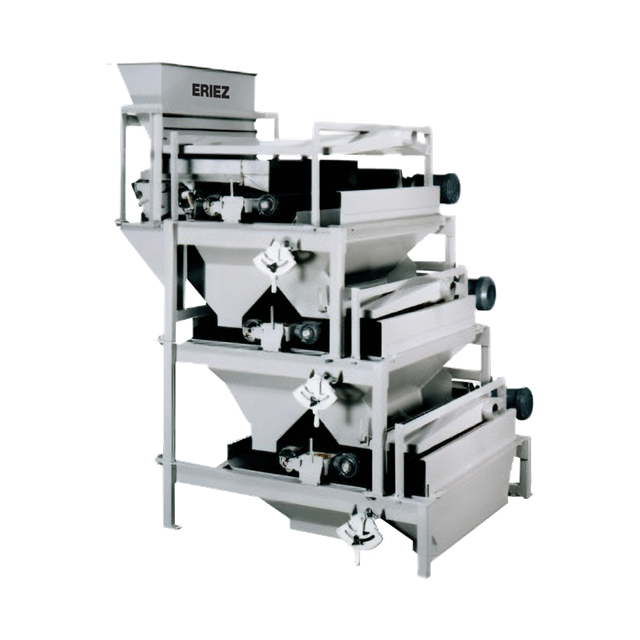
With the ever increasing demand for high-purity feedstocks used in manufacturing, Eriez offers its Rare Earth Roll dry high-intensity magnetic separators. These Dry High Intensity Magnetic Separators (DHIMS) provide maximum efficiency in the separation of weak magnetic particles for product purification applications.
Eriez applied sophisticated finite element analysis in magnetic circuit design to produce an energy-free separator capable of generating the exceptionally high field-strengths needed to remove unwanted fine iron contaminants.
Magnetic cleaning has been applied to the most basic industry foundations such as industrial minerals, metals recycling, glass batch and cullet, abrasives and refractories, chemicals pharmaceuticals, and plastics.
Wide Range of Applications
- Industrial Mineral
- Silica Sand
- Quartzite
- Feldspar
- Nepheline Syenite
- Abrasives and Refractories
- Alumina
- Garnet
- Chromite
- Corundum
- Heavy Mineral Sands
- Illmenite
- Leucoxene
- Chemicals and Pharmaceuticals
- Recycling
The Rare Earth Roll, generating peak magnetic field strengths approaching 24,000 gauss, is very effective for concentrating or removing weakly magnetic minerals from a dry process stream. The Rare Earth Roll magnetic separator is designed to provide peak separation efficiency and is typically used when a high-purity product is required. The roll is constructed of discs of neodymium-boron-iron permanent magnets sandwiched with steel pole pieces. The steel poles are magnetically induced to the saturation point of approximately 24,000 gauss. Magnetic roll diameters are typically 3, 4, and 6 inches, although separators as large as 12-inch diameter are available.
The separator is configured as a head pulley in the separator. A thin belt, usually from 5 to 20 mils thick is used to convey the feed material through the magnetic field.
When feed material enters the magnetic field, the non-magnetic particles are discharged from the roll in their natural trajectory. The paramagnetic, or weakly magnetic, particles are attracted to the roll and are deflected out of the non-magnetic particle stream. A splitter arrangement is used to segregate the two particle streams.
Separation Variables
The magnetic attractive force generated by the magnetic roll is opposed by centrifugal force. The primary variables affecting separation efficiency are the magnetic field strength, feed rate, linear speed of the separator surface, and particle size. An effective separation requires an equilibrium among these variables.
Feed Rate
In assessing the feedrate, a balance must be struck between an economic feedrate, product specifications, and collection of the magnetics. As the feedrate increases, the layered particle bed on the feed belt increases in height and the collection of magnetics decreases.
Linear Speed
The linear speed of the roll is also a primary variable related to the feedrate. As the linear speed is increased, the layered particle bed decreases in height responding with an improved collection of the magnetic particles.
The centrifugal force exerted by the roll surface is the critical factor in providing separation. Beyond the critical speed, the centrifugal force overcomes the magnetic attractive force and the separation efficiency deteriorates.
Particle Size
Particle size will also affect separation efficiency independent of all other variables. Coarse particles provide a relatively high burden depth on the separator surface and respond with a relatively high magnetic attractive force. Coarse particles typically provide high unit capacities with high separation efficiencies. Fine particles with a relatively low mass respond detrimentally to electrostatic forces. As a consequence, precise magnetic separations balancing magnetic forces against centrifugal forces deteriorates.