

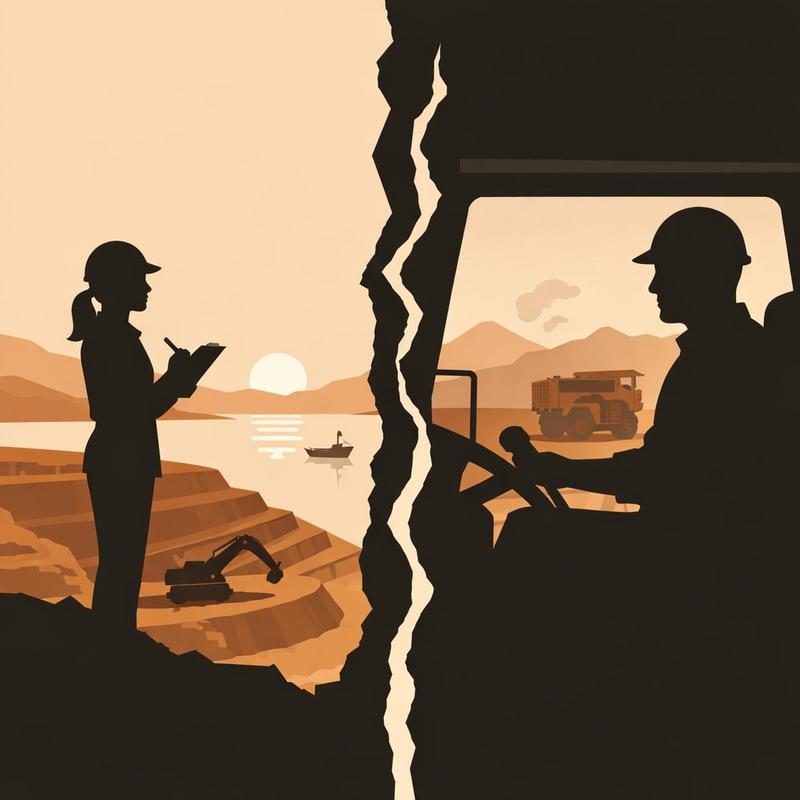
In the nickel provinces along the Pacific coast, the day begins with a quiet defiance of tradition. Before sunrise, a woman heads to a mine site carved into the laterite hills. By first light, she is already in the field—examining rock faces and collecting samples, reading the earth like a story that may reveal whether the deposit holds promise.
At six in the morning, another woman, helmeted and gloved, leads a toolbox meeting before the first haul truck rolls out. As the sun climbs, a planning engineer traces the contours of the pit, imagining haul roads and benches taking shape in the early light. Farther down the haul road, a heavy equipment operator sets tens of tons of ore in motion.
Each of them is a woman.
Not long ago, that fact would have been remarked upon—perhaps even celebrated. Today, it passes without comment, at least on site. Beyond the perimeter of the mine, however, the numbers tell a different story.
For all its fluency in measurement, mining remains strikingly imprecise about one of its most consequential variables: who, exactly, is allowed to do the measuring.
The global gap that refuses to close
Across the global mining industry, women remain a statistical minority. A 2024 joint report by the World Bank and the International Finance Corporation estimates that women make up just 14–15% of the workforce in large-scale mining operations worldwide—a figure that has barely shifted in over a decade.
There are signs of progress, particularly among the largest corporations. The International Council on Mining and Metals reported in 2024 that its member companies—some of the world’s most influential mining firms—have increased female participation to around 20% of their workforce, alongside public commitments to reach gender parity by 2030. In some operations, women are increasingly visible in roles once considered off-limits, including equipment operators, pit supervisors, and metallurgists.
At the leadership level, the picture is cautiously improving. A 2024 McKinsey & Company analysis found that women now occupy roughly 18–20% of senior leadership roles in major mining firms, with board representation rising to about 25%, up from approximately 15% a decade ago.
However, progress has a geography. It is most visible in boardrooms and corporate headquarters, far removed from the dust and noise of extraction. At the operational core of mining—the pit floor, the underground shaft, and the machine yard—the industry remains overwhelmingly male.
A country shaped by extraction
In the Philippines, the imbalance is both familiar and uniquely consequential.
Mining contributes less than 0.5% of total national employment, accounting for roughly 200,000 direct jobs, according to government labor data. By urban economic standards, that is marginal. But mining does not operate on urban terms.
Its footprint is spatial, not statistical. A single mine can redraw the fiscal and physical map of a municipality—reshaping roads, water systems, and local economies, often within ancestral domains where questions of land, identity, and governance intersect. In such places, mining is not merely an industry. It is an architecture of influence.
And who participates in that architecture matters.
Within Philippine mining operations, women remain underrepresented. According to the Department of Environment and Natural Resources – Mines and Geosciences Bureau (2024), women account for roughly 10–15% of employees in large-scale mining, concentrated in geology, environmental management, laboratories, compliance, and community relations.
Figures from the Philippines Extractive Industries Transparency Initiative (2023) suggest an even narrower participation rate of about 12% overall, with women comprising only 9–11% of the workforce in metallic mining operations.
The metaphor often used for gender barriers—the glass ceiling—feels misplaced here. In mining, the ceiling is sedimentary. It is layered over time, compacted by culture, and resistant to sudden change.
The quiet business case
For decades, gender inclusion in mining was framed as a question of fairness. Increasingly, it is understood as a question of performance.
A growing body of research suggests that gender diversity strengthens governance and operational outcomes in extractive industries. According to UN Women’s 2023 analysis, companies with greater female representation tend to exhibit stronger environmental and social governance performance, particularly in areas such as community engagement and compliance.
The financial case is equally compelling. A 2023 study by White & Case, examining large mining companies globally, found that firms with at least 40% female board representation recorded, on average, a 6% higher return on capital employed than their less diverse counterparts.
In a sector where investment horizons stretch across decades and capital expenditures run into billions, six percentage points is not a rounding error—it is a structural advantage.
Operational metrics tell a similar story. Research by the Responsible Mining Foundation, in collaboration with Harvard Kennedy School (2025), found that gender-diverse mining teams reported 12–15% higher safety compliance rates, along with lower injury incidents and improved employee retention.
In mining, where safety culture can determine not just productivity but survival, those differences are consequential.
The absence of women is not neutral. It carries a cost.
Beneath the numbers: culture and constraint
Part of the explanation lies in the pipeline. For decades, women represented only a small fraction of mining engineers in the Philippines—historical estimates place the figure at around 1.5% of registered professionals, reflecting longstanding barriers in technical education and industry entry.
But pipelines do not explain persistence. Culture does.
A 2022 survey by the Australasian Institute of Mining and Metallurgy found that 67% of women in mining reported experiencing sexual harassment, 70% reported bullying, and 85% identified gender inequality as a significant barrier to advancement.
Investigations in multiple jurisdictions have uncovered systemic misconduct in remote mining operations, particularly in fly-in, fly-out environments where isolation, hierarchy, and informality can converge into vulnerability. The details vary by site. The pattern does not.
In these environments, the cost of participation is not evenly distributed.
Hyper-masculine work cultures do not merely exclude—they recalibrate ambition, quietly and persistently, often invisibly.
What the women say
In Philippine mine sites, these dynamics are often expressed with restraint rather than protest.
“Some people still ask if I can handle the job,” one engineer said. “But when you’ve done it every day and done it well, performance answers for you.”
A heavy equipment operator offered a different perspective: “People think women are absent more,” she said. “But when you manage the household budget, you know what one day’s pay means. You show up.”
A senior executive pointed to a subtler calculus: “If a man is assertive, he’s seen as decisive. If a woman is assertive, she can be labeled difficult. That double standard—that’s one of the hardest layers to break.” These are not complaints. They are field notes.
Redrawing the silhouette of power
There are, however, signs of change—quiet, but unmistakable.
Geologist Nympha R. Pajarillaga now serves as chief operating officer of Apollo Global Capital, bringing decades of exploration and environmental expertise into executive leadership. Atty. Joan D. Adaci-Cattiling leads OceanaGold Philippines as president and general manager, shaping the direction of one of the country’s most visible mining operations. At Global Ferronickel Holdings Inc., Mary Belle D. Bituin serves as chief finance officer and head of human resources, influencing both fiscal discipline and organizational strategy.
These roles are not ornamental. They alter the lines of authority. Power in mining has always been visible in physical terms—who directs, who decides, who signs. Increasingly, it is being reconfigured in ways that are less immediately apparent but no less significant.
Law as scaffold, culture as structure
The legal framework for gender equality in the Philippines is already in place.
The Magna Carta of Women (Republic Act No. 9710) and the Women in Development and Nation-Building Act (Republic Act No. 7192) establish the state’s obligation to eliminate discrimination and promote equal participation across all sectors, including those historically dominated by men. But legislation alone rarely reshapes institutions.
As researchers such as Heimann and Johansson (2021) argue, meaningful change in mining requires structural redesign: transparent promotion systems, pay equity monitoring, flexible work arrangements, and workplace infrastructure that accommodates a diverse workforce. Inclusion cannot be decorative. It must be engineered.
Some companies have begun that work—retrofitting facilities, expanding cadetship programs, and embedding diversity metrics into governance systems. These are not trivial adjustments; they are foundational shifts. But they remain incomplete.
The coming expansion
Global demand for critical minerals—nickel, cobalt, and copper—is accelerating as economies transition toward renewable energy and electrification. The Philippines, already one of the world’s largest nickel producers, sits at a strategic inflection point.
The question is not whether mining will grow. It is whether that growth will replicate the past—or revise it.
Mining has always prided itself on uncovering what lies beneath the surface. Geologists read landscapes the way historians read archives. Engineers transform hidden deposits into tangible value. Investors speak, with practiced ease, of unlocking potential.
But the industry’s most underutilized reserve is not geological. It is human. It is present in the laboratory before sunrise, in the safety briefing before the shift begins, in the compliance office where permits are negotiated, in the boardroom where strategy is set, and in the cab of a truck waiting at the edge of the pit.
Women are not waiting to be included in mining’s future. They are already shaping it.
Engr. Marilou C. Celzo is an ASEAN Chemical Engineer and Technical Assistant to the President and Mine Operations and Marketing Services Manager of Global Ferronickel Holdings, Inc. She has over 40 years of experience in mining and environmental compliance. She earned her Chemical Engineering degree from the University of Santo Tomas.
Engr. May Elaine R. Cabilao is a mining engineer, accredited Competent Person, and Senior Technical Officer under the Office of the Senior Vice President for Operations at Global Ferronickel Holdings, Inc. She earned her Mining Engineering degree from Cebu Institute of Technology–University.
Keziah Aizelle P. Sy is a paralegal and research associate at the Legal and Regulatory Affairs Group of Global Ferronickel Holdings, Inc. She earned her Legal Management degree (cum laude) from De La Salle University Manila.


