August 05, 2022

Photo Credit: Arrow Creatives

Nickel Asia Corporation, the Philippines’ largest producer of lateritic nickel ore, reported a 41-percent increase in attributable net income for the first semester this year.

Based on unaudited financial and operating results for the six-month period ended June 30, 2022, attributable net income increased to P3.83 billion from P2.73 billion while earnings before interest, tax, depreciation, and amortization (EBITDA) increased by 19 percent to P6.33 billion from P5.32 billion the year prior.

Despite lower ore volume sold during the period, revenues increased by 7 percent to P11.78 billion from P11.01 billion last year, owed largely to higher nickel ore prices and favorable exchange rates.

NAC’s four operating mines sold a combined 6.95 million wet metric tons (WMT) of nickel ore during the first half of the year, down 16 percent from 8.30 million WMT in the same period last year.

The drop in sales volume was almost in direct proportion to unrealized workable days caused by inclement weather that adversely affected the Company’s mining operations during the period.

The weighted average nickel ore sales price over the first half of year 2022 rose by 18 percent to $30.03 per WMT against $25.54 per WMT in the same period last year. The Company also realized P52.56 per US dollar from these nickel ore sales, a 9-percent increase from P48.25 last year.

Breaking down the ore sales, the Company exported 3.12 million WMT of saprolite and limonite ore at the average price of $42.05 per WMT during the six-month period compared to 4.55 million WMT at $37.62 per WMT in the same period last year.

Likewise, the Company delivered 3.83 million WMT of limonite ore to the Coral Bay and Taganito high-pressure acid leach (HPAL) plants, the prices of which are linked to the London Metal Exchange (LME) and realized an average price of $12.52 per pound of payable nickel. This compares to 3.74 million WMT at $7.92 per pound of payable nickel in 2021. Expressed in US dollar per WMT, the average price for the deliveries to the HPAL plants were $20.23 and $10.85 in the first half of 2022 and 2021, respectively.

“The first half of 2022 was not without its challenges especially for our mining operations, brought about by weather conditions at our mine sites, particularly in Surigao, and continuing lockdowns in China, our major market,” said Martin Antonio G. Zamora, President and CEO. "However, the higher LME nickel price and stronger US dollar tempered the impact on our revenues.”

Owing to the higher LME nickel price during the period, NAC also recognized gains from its equity share in investments in the two HPAL plants in the combined amount of P1.09 billion against P244.1 million year-on-year.

The stronger US dollar further enabled NAC to log a 353-percent hike in net foreign exchange gains from its foreign currency-denominated net financial assets to P863.5 million from P190.6 million the year prior.

Total operating cash costs decreased by 2 percent year-on-year to P5.19 billion from P5.32 billion last year. On a per-WMT sold basis, total operating cash costs increased to P747 per WMT compared to P641 per WMT in 2021.

For the Company’s renewable energy business, its subsidiary, Emerging Power, Inc. (EPI) energized in June 2022 another 38-megawatt (MW) solar farm in Subic, Zambales, bringing total capacity on this site to 100MW. For 2022, the Subic plant has been operating at an 18- 19% plant efficiency factor with 90% of generation contracted under power sales agreements. EPI has realized an average tariff of P4.65 per kilowatt hour. EPI has another 100MW service contract for the Subic site and will commence construction of a 68-MW farm in August. Completion is expected by the third quarter of next year.

EPI was also chosen by Shell Overseas Investments B.V. to be its exclusive local partner in a solar, onshore wind, and battery storage joint venture that aims to contribute up to 3GW into the Philippines’ renewable capacity. NAC is evaluating a range of financing alternatives including accessing global debt capital markets to raise EPI’s share of the equity required for an initial 1GW target by 2028, among other uses. The Company’s strong financial position will allow it to be opportunistic in evaluating funding options that meet the primary objective of maintaining a flexible low-cost capital structure.

“We remain confident that our mining and renewable energy businesses provide a solid foundation on which to realize the OneNAC Vision’s twin objectives, which is to become the premier ESG investment in the country and to be counted among the Top 25 PSE-listed companies in terms of market capitalization by 2025,” said Zamora.


Article courtesy of the Philippine Stock Exchange

August 04, 2022

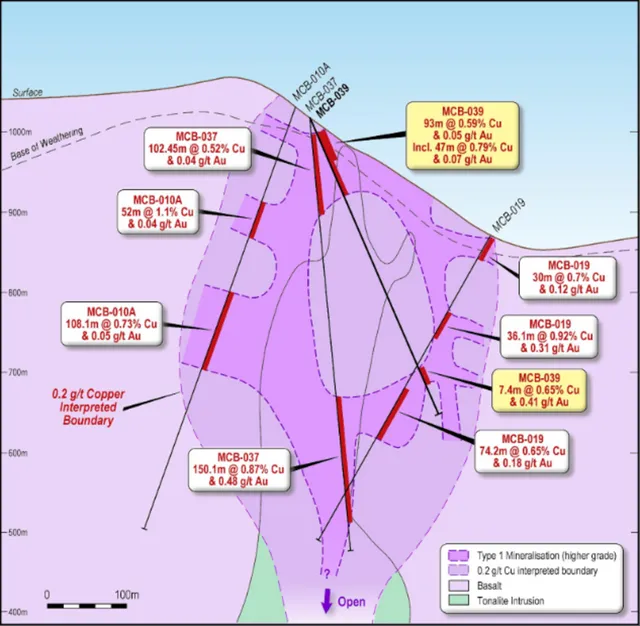
Figure 3. Cross section of drill hole MCB-039 relative to the interpreted geology and significant assay results.

We (Celsius Resources) are pleased to announce we have received further shallow and high-grade copper assay results from the ongoing drilling program at our flagship MCB copper-gold project, held under our Philippine subsidiary Makilala Mining Company, Inc. (“MMCI”). 

The results continue to identify new positions of shallow mineralisation which are in line with other recent drilling results from holes MCB-036, MCB-037 and MCB-038 (see CLA announcements dated 13 December 2021, 23 May 2022 and 4 July 2022 respectively) confirming the presence of an extensive shallow higher-grade position. 

The results from MCB-039 were designed to further expand the size of the shallow higher-grade copper zones which are considered to have an important positive impact on early mining options at MCB. The current drill hole in progress (MCB-040) is similarly designed to further expand the higher-grade copper mineralisation leading to potential improvements to the economics of the already positive Scoping Study at MCB as reported by Celsius on 1 December 2021.

“The results from MCB are continuing to grow the size of the shallow higher-grade copper zones,” said Country Operations Director, Peter Hume.

“We are getting much better definition now on the various high-grade zones, which are important for the optimisation of the MCB mine plan. We can see many good high-grade intersections coming together to expand on the earlier understanding of these high-grade zones. Where we get multiple high-grade zones staked on top of each other, we can achieve outstanding results, as recently announced from hole MCB-038 which intersected 611.4m @ 1.39% copper and 0.75g/t gold from 32.5m.”

RESULTS FROM MCB-039

Drill hole MCB-039 was drilled to further confirm the interpretation that further shallow high-grade positions exist as a relatively flat body extending into the surrounding host rocks (see Figures 2 and 3).

This drill hole was more specifically targeted to fill a gap in the drilling information where there was previously defined lower grade copper mineralisation.

The results from MCB-039 have confirmed the further extensions to the higher-grade copper mineralisation as part of a series of relatively flat lying, high-grade zones which are extending away from vertically orientated feeder structures which are all closely related to an intrusive Tonalite rock (Figure 3).

Figure 2. Location of MCB-039 drill hole relative to recent and historical diamond drilling at MCB.​​​​​

A large broader envelope of copper mineralisation at a lower cut-off grade at approximately 0.2% copper also continues to be better defined, highlighting the very large scale of the copper-gold mineralisation at the MCB deposit.

Table 1: Significant intersections from drill holes MCB-039.


Article courtesy of Celsius Resources. Full press release can be found HERE

August 04, 2022

Photo credit: PNA - Finance Secretary Benjamin Diokno

Finance Secretary Benjamin Diokno said the mining industry is a potential source of sustained economic growth as he underscored the benefit of mobilizing investments for mine development.

“The mining industry holds the greatest potential to be a key driver in our economic recovery and long-term growth, especially now that world metal prices are high. The Philippines, after all, is one of the world’s most richly endowed countries in terms of mineral resources,” he said Wednesday at the listing of Philex Mining Corporation’s (Philex) common shares in the Philippine Stock Exchange (PSE).

Philex is mobilizing investments for the development of its Silangan underground copper-gold mine in Surigao del Norte.

In a disclosure to the PSE, the company said it is offering a maximum of 842 million common shares at the rate of one offer share for every 5.8674 shares owned for PHP3.15 each to raise a total of PHP2.652 billion new equity.

The stocks rights offering (SRO) period started on July 12, 2022 and ended July 25, 2022.

The Silangan project, considered one of the biggest copper-gold mines in the country, is planned to be mined in two phases. The first phase has a mineable ore reserve of 81 million metric tonnes which will be mined for 22 years at a rate of 4 million tonnes per year.

The mine is targeted to commence commercial operations in the first quarter of 2025.

Diokno said Philex’ SRO listing demonstrates the mining industry’s confidence in the country’s promising economic growth prospects.  

He said the offering means more jobs will be created, local economies will be reinvigorated, and additional revenues will be contributed to the government. 

The Department of Finance (DOF) estimates that the project will generate around PHP8.5 billion in excise taxes alone for its entire mine life.

Diokno said the listing sends a strong signal to the mining industry that the country's capital markets are viable instruments for fast tracking the development of large mining projects.  

He said the Marcos administration is committed to continue creating an enabling environment for mining activities to flourish in the country as he looks forward to similar listings in the future.

“We recognize that apart from boosting local development, mining is a strong magnet for investments that can propel our economy into a higher growth trajectory,” he added.

Diokno said the government expects the mining industry to strictly adhere to responsible and sustainable mining practices. 

He said the mining industry should strike a balance between protecting the environment, uplifting local communities, and supporting the government’s socioeconomic agenda.

“This is a non-negotiable condition so we can guarantee the sustainability of the industry and the strong economic growth of its host communities,” he said. 


Article courtesy of the Philippine News Agency

August 03, 2022

Photo credit: PH Stocks

Integrated energy company Semirara Mining and Power Corporation (SMPC) posted P10.8 billion in second-quarter net income, 171 percent better than the P4 billion reported last year.

All-time high coal selling prices coupled with higher spot electricity sales volume at elevated prices accounted for the upsurge.

From January to June, SMPC’s bottom line more than quadrupled (311%) from P6.3 billion to P25.8 billion, its highest for any given semester.

“As expected, we had a weaker performance quarter over quarter because of the China lockdowns but compared to last year, we did very well,” said SMPC president and COO Maria Cristina C. Gotianun.

“We maintain our view that the second semester will be anemic because of market volatility and unfavorable weather conditions,” she added.

For the second quarter alone, contributions from the coal segment grew by 195 percent from P3 billion to P9 billion while SEM-Calaca Power Corporation (SCPC) accounted for P1 billion, up 81 percent from P581 million. Southwest Luzon Power Generation Corporation (SLPGC) contributed P742 million, a 107-percent increase from P359 million.

Coal Operating Results

Total shipments from April to June dropped by 24 percent from 4.9 million metric tons (MMT) to 3.7 MMT as China imposed COVID-19 lockdowns and shifted to Russian coal.

Export sales plunged by 44 percent from 3.2 MMT to 1.8 MMT while domestic sales grew by 12 percent from 1.7 MMT to 1.9 MMT.

Buffering the impact of lower shipments was the 126-percent increase in average selling prices from P2,393 to P5,399, the highest for any given quarter.

Heavy rainfall and higher stripping activities curbed coal production, dropping 21 percent from 4.3 MMT to 3.4 MMT. This, together with lower sales volume, raised high-grade coal inventory by 50 percent from 1.0 MMT to 1.5 MMT.

Power Operating Results

Overall gross generation in the second quarter was mostly flat at 984 GWh as SCPC Unit 2 remained on forced outage because of a defective generator stator.

Total electricity sales declined by 9 percent from 987 GWh to 900 GWh, most (56%) of which was sold to the spot market. The rest (393 GWh) was sold through bilateral contracts.

High uncontracted capacity allowed SMPC to boost spot electricity sales by 188 percent from 176 gigawatt-hour (GWh) to 507 GWh. Average spot selling prices remained elevated at P6.91 versus P6.87 last year.

Total spot purchases declined by 60% from P617 million to P245 million on higher plant availability, which improved by 8 percent from 60% to 65%.


Article courtesy of the Philippine Stock Exchange

August 02, 2022

Photo: Group photo of the participants after the MGB Management approved the Capstone Project (CP) for implementation during CP Orientation on July 12, 2022

With the start of online transactions, the Mines and Geosciences Bureau (MGB) is currently developing a system that will serve as a digital platform for the submission of the compliances by the mining companies and stakeholders with the terms and conditions of the Contracts/Permits/other similar Mining Tenements, and other pertinent laws, rules, and regulations.

The project is the approved Capstone Project (CP) of Mr. Jeffrey S. Ledesma, a scholar of the Development Academy of the Philippines under the Public Management Development Program. His CP entitled, “Strengthening Mining Monitoring Method by Enhancing Mining Compliance Procedures Through Process Automation: Development of an Electronic Mining Compliance and Monitoring System (eMCMS)” was conceptualized through the guidance of his Institutional Partners, Engr. Nonita S. Caguioa, Department of Environment and Natural Resources Assistant Secretary for Finance, Information Systems, and Mining Concerns and Engr. Teodorico A. Sandoval, Chief of the MGB Planning, Policy, and International Affairs Division (PPIAD). The project was approved for implementation by the MGB Management on July 12, 2022, during the CP Orientation.

The project targeted the internal and external stakeholders as the beneficiaries. It is designed in three phases based on its scope and coverage in terms of mining scale, mineral type, and policy requirements. The Phase I will serve as the pilot phase which aims to use the system by the selected mining companies who will initially be engaged in the design, development, and implementation. Phases II and III will commence after the successful pilot testing and integration of provisions in the mining-related policies which will serve as the legal basis for its implementation. Phase I is expected to be completed at the end of September 2022.

The eMCMS development is an in-house system development through the collaborative effort of the eMCMS Technical Working Group created on July 28, 2022.

The success of this project will improve the organizational productivity of the MGB and mining companies’ technical personnel conducting the monitoring activities and mining compliance respectively. Likewise, it will provide an efficient and effective way of delivering services to its stakeholders because of the conversion of manual to electronic and digital transactions. It is also expected that related information will easily be generated and shared to the public.

This initiative will ensure the integration of other government policies such as the ease of doing business, e-commerce law, and the Data Privacy Act among others.


Article courtesy of the MGB

July 28, 2022

Atlas Consolidated Mining and Development Corporation (“Atlas Mining”) completed the first half of the year 2022 with a reported net income of Php2 billion compared to the net income of Php1.935 billion for the same period in 2021. The improvement in the bottom line is attributed to the considerable increase in grades and metal prices during the first half of the year.

Atlas Mining’s wholly-owned subsidiary, Carmen Copper Corporation, reported copper metal production from 38.73 million pounds in 2021 to 36.58 million pounds in 2022 which attributed to lower tonnage milled. In the first half of 2022, milling tonnage decreased by 6% from 9.26 million tonnes to 8.66 million tonnes. On the other hand, copper grade increased by 1% from 0.231% to 0.234% and gold grade improved by 6% from 5.09 grams/dmt to 5.41 grams/dmt. Copper metal content of concentrate shipped decreased by 2% to 38.80 million pounds but gold content increased by 6% to 11,212 ounces due to higher gold grade.

The increase in metal prices continued in the first half of this year where copper price increased by 6% from $4.21/lb to $4.45/lb and gold price increased by 4% from USD1,812/ounce to USD1,879/ounce compared to the same period last year.

Number of shipments were comparatively the same as first half of last year but the higher prices in the first half of this year pushed revenues to grow by 8% to Php9.74 billion from Ph9.01 billion.

Earnings before interest, tax, depreciation and amortization (EBITDA) settled at Php3.89 billion in the second quarter of 2022 compared to Php4.93 billion in the same period of 2021. The reduction was caused by the increase in energy cost particularly power and fuel. This likewise pulled down core income for the period to Php930 million in the first half of 2022 from Php2.16 billion in same period of 2021.

Accordingly, cash generated from operations improved which enabled the additional loan payment of $60 million of Atlas Mining’s loans on the first half of 2022. With the partial repayment of loan, an accounting gain of Php938 million was recognized in the second quarter.


Article courtesy of the Philippine Stock Exchange

July 28, 2022

Photo credit: Provincial Government of Ilocos Norte logo

Ilocos Norte is set to recognize the public and the private sector’s initiatives and exemplary achievements in promoting responsible mining.

Provincial administrator Yvette Convento-Leynes confirmed this on Monday as she reported that the awarding of outstanding partners is set on July 27 in time for a provincial mining summit at the JLP Resort in Barangay Suba, Paoay, Ilocos Norte.

“One of the highlights of the summit is to recognize and give special wards to our outstanding quarry permittees who adhere to our rules and regulations as well as those who help us in apprehending violators,” she said, stressing the importance of the quarry industry as a major source of local revenue in the province.

“This is the only way to thank them for the contributions they are giving to the province,” she said.

The provincial government, however, has yet to announce the awardees.

To date, the Provincial Quarry Office reported that there are about 60 permit holders of commercial sand and gravel and 22 permittees of industrial sand and gravel.

Hosted by the Department of Environment and Natural Resources-Environment and Management Bureau and in cooperation with the Ilocos Norte government, the mining summit aims to discuss pressing issues and concerns for the minerals industry in the region.

Existing quarry permittees, including new permit applicants, are expected to attend to help them become updated of the best practices and new mining policies.

Earlier, the Commission on Audit commended the Provincial Quarry Office under the provincial government for increasing its quarry collections to PHP43.8 million in 2021 as compared to the PHP26.8 million in the previous year. By Leilanie Adriano


Article courtesy of the Philippine News Agency

July 11, 2022

Photo credit: Celsius Resources

Celsius Resources is pleased to announce that the Philippine Mines and Geosciences Bureau (MGB) has granted a six month extension to the exploration permit for the Sagay Copper-Gold Project, extending the permit term up to February 2024.

The Sagay Project is held under Celsius’ Philippine subsidiary Tambuli Mining Company, Inc. (“TMCI”).

In a letter to TMCI, the MGB stated that the request for extension was approved as it falls under the definition of force majeure or justifiable causes under the Philippine Mining Act.(1)

“The MGB was extremely supportive of granting the permit extension to provide enough time for the company to carry out our approved work programs as part of developing the Sagay mineral resource into an economically viable project in support to the national government’s economic recovery efforts,” said Celsius Resources Executive Chairman Martin Buckingham.

The grant of extension is consistent with the Medium-Term Fiscal Framework under the new Marcos Administration, affirming his predecessor’s (Duterte Administration) recognition of mining as among the country’s major economic growth sectors.

In a press briefing in Malacañang on 6 July 2022, Philippines Finance Secretary Benjamin E. Diokno acknowledged the mining industry’s contribution to the country’s gross domestic product (GDP) and most recently conveyed President Ferdinand Marcos Jr.’s expressed desire to revive the mining industry.

Industry leaders, including the Chamber of Mines of the Philippines, welcomed the government’s economic strategy as it will provide a much-needed boost to an industry that has been saddled with policy roadblocks in previous years.

“This pronouncement from the Finance Secretary is a clear manifestation of the Philippine government’s continued strong support and renewed commitment to revitalise the local mining industry. It will further boost the potential of developing MCB and Sagay Mineral Resources into economically viable and socially transformative mining projects that will strictly adhere to ESG principles and significantly contribute to the Philippine National Economic Recovery Program,” said Atty. Julito R. Sarmiento, President of Makilala Mining Co. Inc. (MMCI) and Tambuli Mining Co Inc. (TMCI) both Philippine subsidiaries of Celsius Resources.

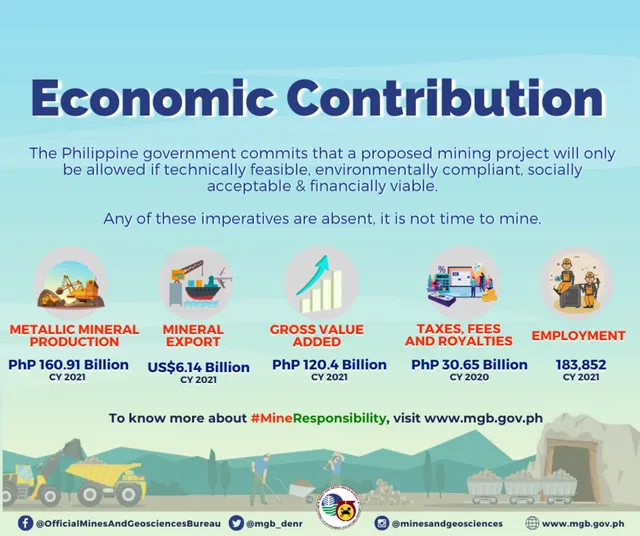
The Philippine Mining Industry played a significant role in the country’s economic growth amid the pandemic, contributing about PhP102.3 Billion to the GDP in 2020, according to a report by the Philippine Mines and Geoscience Bureau (MGB).

The Philippine Department of Trade and Industry (DTI) is ramping up its efforts in attracting investors for the mining industry under its “Make it Happen in the Philippines Investment” campaign. DTI is banking on the copper industry as one of the five key sectors to attract foreign investments for the extraction and manufacturing of high-value copper products industry.

This is a timely development as Celsius continues to seek for a joint venture partner that shares the same principles and vision to develop the Sagay property in a sustainable manner. The same can be said for the MCB project as it progresses with its applications for a Declaration of Mine Project Feasibility and Mineral Production Sharing Agreement (MPSA).


Article courtesy of Celsius Resources

July 07, 2022

Photo credit: Celsius Resources

We are pleased to announce we have received outstanding large scale and high-grade assay results from the ongoing drilling program at our flagship MCB copper-gold project, held under our Philippine subsidiary Makilala Mining Company, Inc. (“MMCI”). 

Highlights

  • Intersection of 611.4m @ 1.39% copper and 0.75g/t gold from 32.5m (1.67% CuEq*).
  • Multiple internal higher-grade results confirmed:
    • 150.85m @ 1.90% copper and 1.57g/t gold from 207.15m (2.55% CuEq*),
    •  234.45m @ 1.90% copper and 0.87g/t gold from 391.55m (2.22%CuEq*) and,
    • 77.55m @ 2.47% copper and 2.12 g/t gold from 232.10m (3.34%CuEq*)

The results are in line with other recent drilling results from holes MCB-036 and MCB-037 (see CLA announcements dated 13 December 2021 and 23 May 2022, respectively) confirming the presence of an extensive shallow higher-grade position.

MCB-038 continued on further to confirm and expand the position of two additional higher-grade zones which have a horizontal orientation within a larger and broader lower grade envelop. 

The results from MCB-038 were designed to improve the confidence level of the existing Mineral Resource in addition to focusing on defining further higher-grade positions for the purpose of enhancing the feasibility study.

Celsius Executive Chairman, Mr. Martin Buckingham said: “The results from MCB-038 are exceptional, and we believe reflect the quality of the MCB deposit.

We still have a few more diamond drill holes to come which are planned to further define the shallow and easy to access higher-grade copper at MCB. The drilling results over the past 6 months have identified important additions to copper mineralisation and we are looking forward to understanding the impact of these results as we move into our JORC Update resource estimate and feasibility studies in the second half of this year.

These large intersections have substantial gold credits to result in very high CuEq values after allowing for the estimated recoveries of both the copper and gold.”


Article courtesy of Celsius Resources 

June 24, 2022

Photo credit: Celsius Resources

Celsius Resources is pleased to announce it has received results from 3 drill holes confirming shallow extensions to the large-scale copper mineralisation previously discovered at its Sagay Project held under its Philippine subsidiary Tambuli Mining Company, Inc.

“The copper mineralisation covers a huge area at Sagay at depth, and we are now proving this up at shallower levels. This round of drilling has confirmed that the mineralisation now extends up close to the surface, extending up from the earlier discoveries which has intersected copper mineralisation from around 100 meters to over 1,000 metres depth.” Celsius Executive Chairman, Martin Buckingham.

The results identified extensive geological alteration and other features which are interpreted to be linked to the porphyry copper mineralisation at Sagay. 

Broad zones of low grade copper mineralisation were also intersected in all three drill holes, including 44.3m @ 0.27% copper from 139.2m in SGY-036, 112.2m @ 0.16% copper from 197m in hole SGY-038A and 247m @ 0.14% copper from 113m (to the end of the drill hole). 

“The discovery of key geological features and copper mineralisation near the surface is an important stepping stone, with further follow-up now required to define the higher grade core to this system also at shallow levels.  This is extremely encouraging as it also allows us to consider lower cost bulk mining methods as part of our next phase of studies at the Nabagia-a Hill Project area.”


Article courtesy of Celsius Resources. Full press release can be found HERE
June 23, 2022

The Philippines has withdrawn from the Extractive Industries Transparency Initiative (EITI) on the back of questionable metrics and procedures for assessing the compliance of implementing-countries with the international organization’s transparency requirements.

In a June 20, 2022 letter addressed to EITI chairman and former New Zealand prime minister Helen Clark, Finance Secretary Carlos Dominguez III called EITI’s Validation –a quality assurance assessment process– “subjective, biased and unfair.”

“We find that the manner by which the EITI Board undertakes its validation is unduly subjective, biased and unfair. The Philippines has no confidence in the ability of the EITI to undertake an impartial, transparent, and evidence-based validation process,” Dominguez said.   

The Department of Finance (DOF) chairs the Philippine Extractive Industries Transparency Initiative (PH-EITI), a multi-stakeholder body that governs the implementation of the EITI in the Philippines. 

EITI prescribes a standard for transparency and accountability in the mining, oil and gas industries. 

Extractive companies in implementing-countries are engaged to publicly disclose data on taxes, royalties and other payments they make to the government and their host-communities.

In his letter, Dominguez said the country has been treated unfairly by the EITI Board by using irrelevant metrics and relying on unvalidated reports in assessing the status of civic space in the extractives sector.

The DOF repeatedly sought the details of alleged issues on civic space to enable the government to address the same.

The EITI, however, has not supplied the requested details. 

Dominguez called out EITI for its lack of due process and for imposing actions on the Philippines that violate the country’s sovereignty. 

“We refuse to be taken hostage by unverified allegations from foreigners and people who have no mandate from the electorate,” he said.

The Philippines has been implementing the EITI since 2013. 

In 2016, the EITI recognized the country for its impactful implementation. 

EITI implementing-countries undergo validation every three years. 

In 2017, the Philippines was declared the first among more than 50 countries in the world to have achieved satisfactory progress in meeting the EITI requirements. 

Over the years, the country has demonstrated innovation and best practices in the areas of contract and beneficial ownership transparency, and social, environmental, employment, and gender data disclosures. 

The Philippines has also sustained and broadened stakeholder engagement amid extreme situations, such as the coronavirus disease 2019 pandemic. 

Despite the withdrawal from the EITI, Dominguez said the Philippines has the process, systems and manpower to ensure transparency in the extractives sector. 

“The government will continue to champion better resource and revenue management, and ensure that resource utilization remains open, accountable, and responsive to the needs and aspirations of Filipinos,” he added.

June 22, 2022

Photo by Roel N. Catoto

Instead of increasing taxes on mining, President-elect Ferdinand “Bongbong” Marcos Jr. on Monday said he is eyeing the collection of value-added taxes (VAT) from the export of partially-processed ore.

“What we would like to do is encourage that the value added [taxes] to the raw ore stay in the Philippines as much as possible. Whether there should be fiscal measures in that regard is something we have not decided on and what the levels that will be. But I think what we are trying to achieve, the desired result for all of this, is instead of exporting raw ore, we export at least partially-processed ore so that may value added that’s left in the Philippines,” he said in a press briefing in Mandaluyong City.

Marcos also emphasized the need to push for “clean mining” in the country, citing its negative environmental impact.

“I cannot believe that here in the Philippines we cannot monitor and regulate the mining industry sufficiently so that we can have clean mining in the country,” he said.

He lamented that practices in the mining industry in the country remain problematic.

“We have to view the natural resources as a national treasure which can help the Philippines a great deal. It is only up to us to ensure that the practices that we see in the mining operations in the country are such that they are environmentally neutral,” he added.

Earlier, the economic team of outgoing President Rodrigo Duterte pushed for the revival of the mining industry to generate more jobs.

Duterte has repeatedly urged the mining industry to observe stricter environmental rules or risk getting shut down.

In April 2021, Duterte issued an executive order lifting the nine-year moratorium on mineral agreements to spur economic growth and support projects and programs of the government.

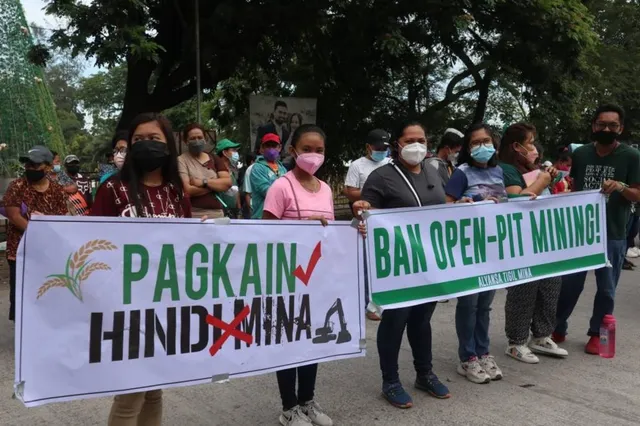
The Department of Environment and Natural Resources, in December 2021, issued an administrative order lifting the four-year ban on the open-pit method of mining. By Azer Parrocha


Article courtesy of the Philippine News Agency