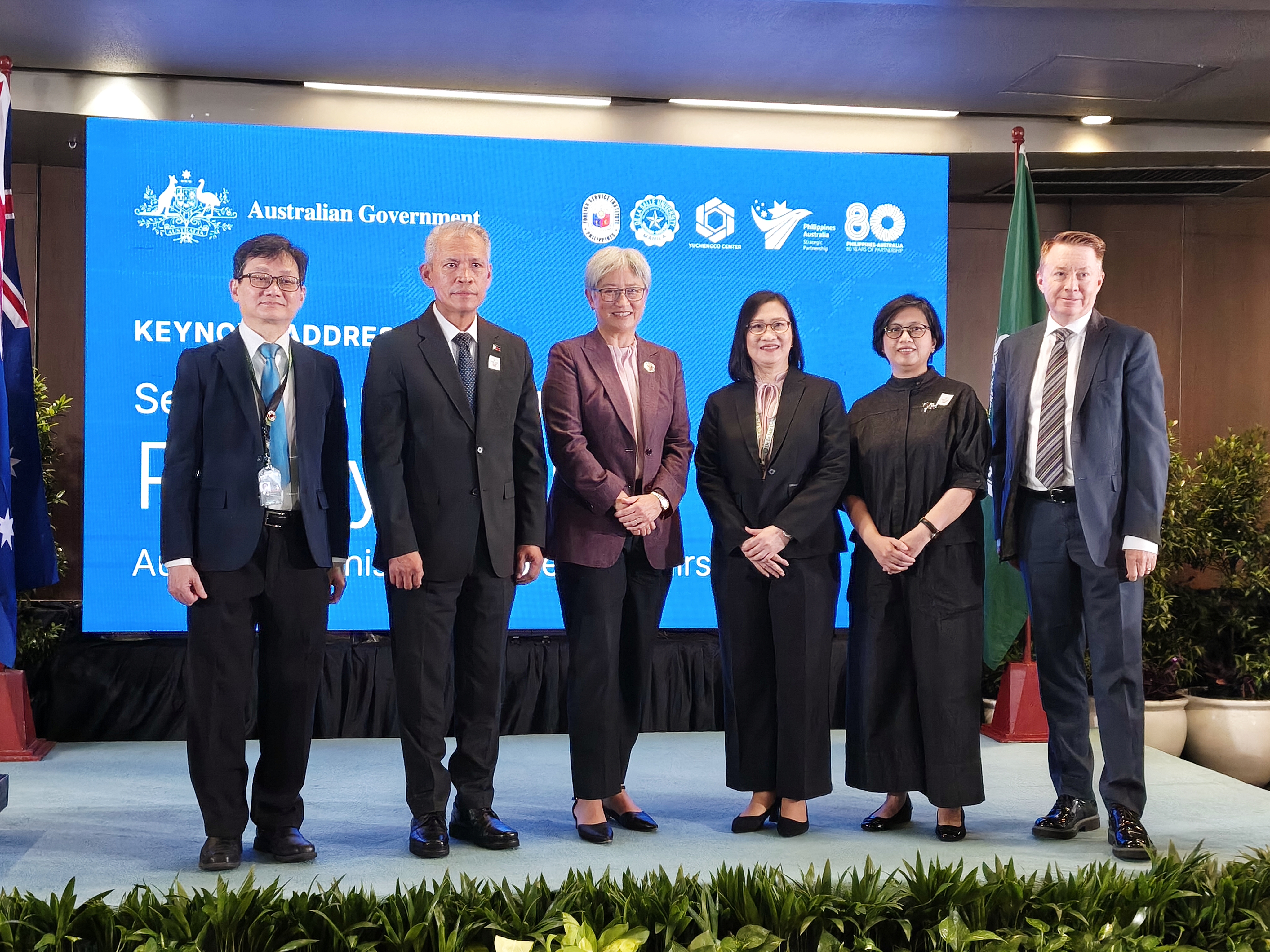
Honorable Penny Wong, Australia’s Minister of Foreign Affairs and the Leader of the Government in the Senate, visited Manila in July 2026 to attend the 59th ASEAN Foreign Ministers’ Meeting, the East Asia Summit Foreign Ministers’ Meeting, and the ASEAN Regional Forum, while commemorating 80 years of diplomatic ties between Australia and the Philippines.
From a media release of the Australian Embassy, Wong stated, “Australia strongly supports the Philippines as the 2026 ASEAN Chair and its theme of ‘Navigating our Future, Together’, which reflects the spirit of our partnership and friendship.”
Additionally, she was the keynote speaker at a foreign policy address at De La Salle University in Manila on July 23, 2026. The event was organized by the Australian Embassy in the Philippines, De La Salle University, Yuchengco Center, and Foreign Service Institute Philippines.
In her speech, Wong called for stronger cooperation between Australia, the Philippines and other Southeast Asian nations to safeguard regional stability, uphold international law and strengthen economic resilience amid intensifying strategic competition and global uncertainty.
She emphasized the importance of collective action among middle powers, saying that countries such as Australia and the Philippines must work together to shape the region's future rather than allow a single power to dictate its direction.
She mentioned the importance of ASEAN and its central role in maintaining a balance of power in the Indo-Pacific.
“It is really a great pleasure to be back in Manila during the Philippines ASEAN chair year. And it is a privilege to be here in the year we celebrate eight decades of diplomatic relations.”
“But of course, our ties of trade and culture, our ties of friendship and family are centuries older.”
The Australian Foreign Minister highlighted the deep-rooted ties between Australia and the Philippines as the two countries mark the 80th anniversary of diplomatic relations this year.
“They reach back to the Manilamen who set out across the seas to the shores of northern Australia in the late 1800s, casting their fortunes in the pearling trade… And they endured through the sacrifices of both our peoples, side by side, in the darkest days of the Second World War,” Wong said.
She said their partnership has reached a historic high, strengthened by the Strategic Partnership between Philippine President Ferdinand Marcos Jr. and Australian Prime Minister Anthony Albanese. Cooperation spans defense, development, maritime security, counterterrorism, cybersecurity, trade and investment.
She also stressed the importance of the Treaty of Amity and Cooperation in Southeast Asia, which marks its 50th anniversary this year, citing its principles of mutual respect, sovereignty, territorial integrity, peaceful dispute settlement and cooperation among countries with different interests and political systems.
Minister Wong mentioned these principles demonstrate that restraint, dialogue and respect are strategic assets rather than signs of weakness.
“We worked with the Indonesian Government and industry to facilitate more than 250,000 tonnes of additional agricultural-grade urea for Australian farmers. And this means Australia can continue being a reliable supplier of food and energy to the region. Because what goes to Australia as fuel and fertilizer comes back to this region as food.”
“We supply a third of the Philippines LNG needs, half of your wheat imports, and almost a fifth of your beef. So when you have a plate of bistek tagalog or kaldereta there's a good chance it has its origins in an Australian cattle station.”
“This is an example of what we mean when we say Australia's future depends on the countries of ASEAN. And the countries of ASEAN can depend on Australia.”
“We share a region, and we share a future. And the flow of trade that sustains our shared future depends not only on ships and sea lanes, but also on the rules that govern them.”
“As a middle power, we will continue to support the rules and norms that underpin shared prosperity and shared security. And that is why our country will continue to be a champion of the UN Convention on the Law of the Sea.”
On maritime security, Wong reaffirmed Australia's support for the United Nations Convention on the Law of the Sea (UNCLOS) and the 2016 arbitral award in the South China Sea case between the Philippines and China.
She said Australia has consistently called on both countries to abide by the ruling and expressed concern over what she described as destabilizing and dangerous conduct by Chinese vessels toward Philippine and other Southeast Asian vessels.
She also criticized China's recent test of a nuclear-capable submarine-launched missile, citing insufficient information and notification to countries in the region.
“Ten years ago, an Arbitral Tribunal constituted under UNCLOS handed down a unanimous, clear, and binding ruling in the South China Sea arbitration between the Philippines and China.”
“That 2016 Award was a landmark decision – and we have consistently called for China and the Philippines to abide by it.”
To strengthen maritime cooperation, she announced that Australia would provide A$160 million over 10 years to expand maritime cooperation with Southeast Asian partners, including the Philippines.
Australia will also double its bilateral maritime assistance to the Philippines through a new A$18-million, four-year investment and provide an additional A$10 million for advanced drone technology and operator training for the Philippine Coast Guard.
“Australia, with others, will continue to register our concerns about Chinese vessels engaging in destabilizing and dangerous conduct in the South China Sea, including towards Philippine, Vietnamese, Malaysian, and Indonesian vessels,” Wong said.
Australia will continue to invest in stability – providing $160 million AUD (6.8 billion pesos) over 10 years to expand maritime cooperation with Southeast Asian partners – including the Philippines, she said.
“Cooperation that is helping partners boost maritime domain awareness, implement maritime governance reform, protect the marine environment, and strengthen resilience.”
“And we are doubling our bilateral maritime assistance to the Philippines through a new $18 million AUD (770 million pesos), four-year investment. And we are investing additional funds of $10 million AUD (427 million pesos) of cutting-edge drone technology and operator training for the Philippine Coast Guard.”
“The same principles we uphold at sea must also hold in the digital domain – our vision is of an Indo-Pacific where every country has the capability to build its own digital future.”
On economic cooperation, Wong stated that Australia and Southeast Asia have recorded nearly A$200 billion in two-way trade, while two-way investment is approaching A$300 billion.
She highlighted Australia's Southeast Asia Economic Strategy to 2040, which aims to deepen investment and expand cooperation in clean energy, digital trade and other growth sectors.
Additionally, she cited investments in battery and solar storage projects in the Philippines and support for the ASEAN Power Grid as part of efforts to strengthen energy security and economic resilience.
Minister Wong announced a new A$11-million, five-year ASEAN-Australia Political Security Partnership to support practical cooperation and policy dialogue on shared regional security challenges.
She said Australia would also continue working with ASEAN on conflict prevention, including discussions on an early warning system to help prevent crises from escalating into conflict.
As part of Australia’s commitment to regional resilience and development assistance, Minister Wong said Australia had increased support for Southeast Asia, including the Philippines.
Australia has provided assistance to more than 150,000 people affected by tropical typhoons in the Philippines, as well as support following the earthquake near Mindanao. She maintained that development cooperation helps foster prosperity and stability across the region.
Wong concluded by invoking the Filipino concept of bayanihan and its Australian counterpart, mateship, as guiding principles for the bilateral relationship.
She said the challenges facing the region require countries to share responsibility and work together, emphasizing that no single country can achieve regional security and prosperity alone.
As the Philippines assumes the ASEAN chairmanship in 2026, Wong said Australia stands ready to strengthen its partnership with the country and contribute to a peaceful, stable and prosperous Indo-Pacific.
Minister Wong also welcomed questions from the audience during the Open Forum.
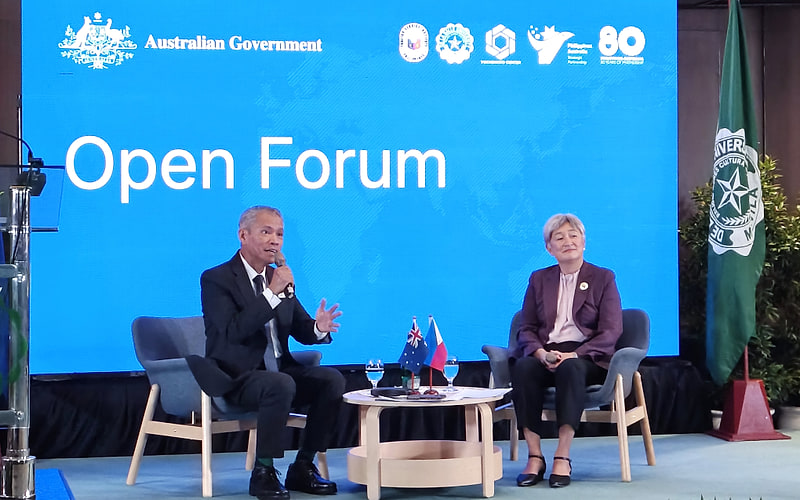
[Photo by Marcelle Villegas]
About Hon. Penny Wong
Senator the Honourable Penny Wong was elected to the Senate for the Australian Labor Party in 2001, and has been re-elected four times in 2007, 2013, 2016 and 2022.
Senator Wong was appointed Minister of Foreign Affairs in 2022 with the election of the Albanese Government.
As Minister of Foreign Affairs, Senator Wong seeks to rebuild Australia’s reputation as partner of choice to build a stable and prosperous region, where sovereignty is respected and the rules of the road are upheld.
---
Acknowledgement: Thank you to Australian Embassy in the Philippines for the opportunity to attend this event.