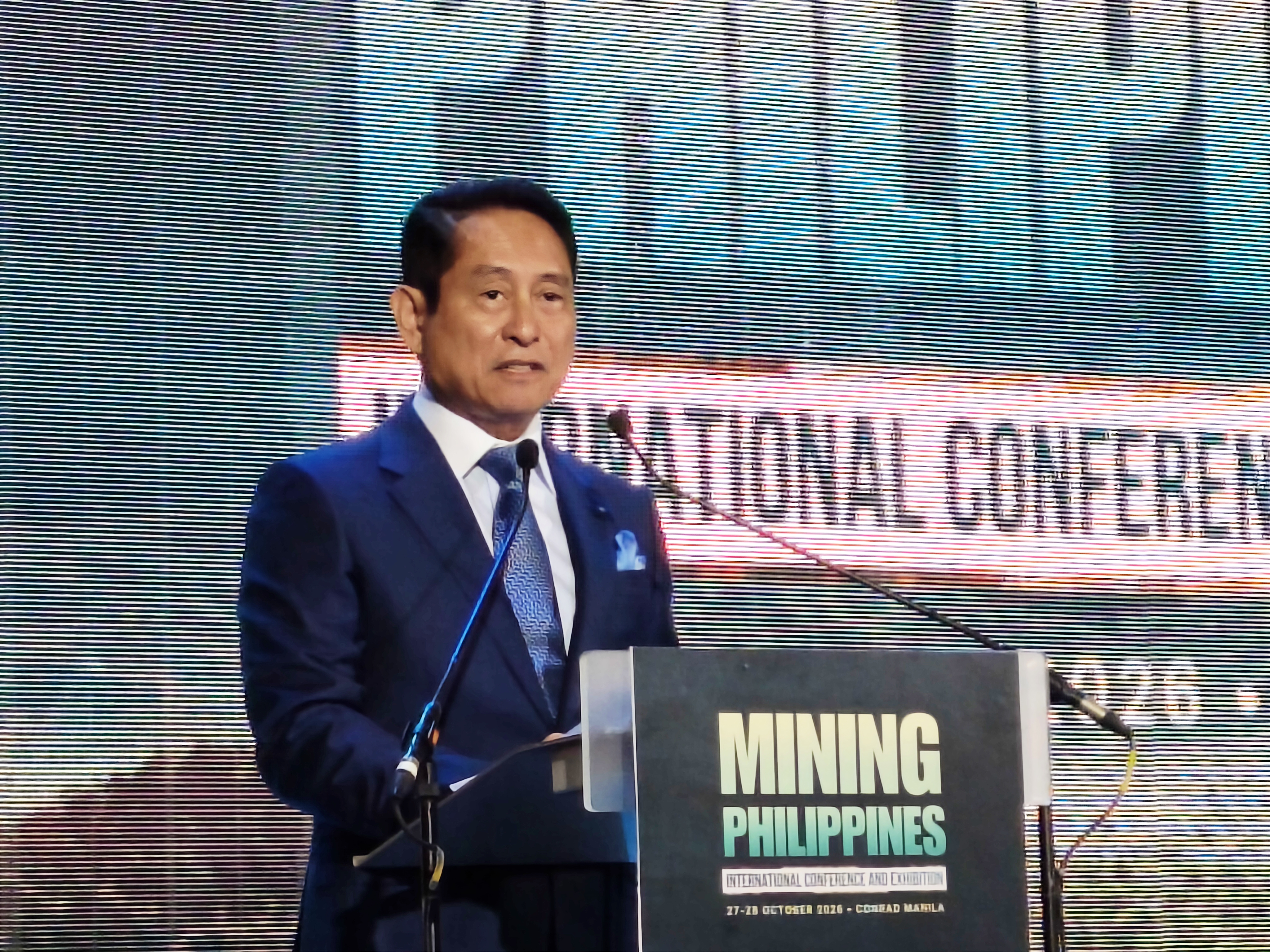
On the opening day of Mining Philippines – International Mining Conference and Exhibition 2026, Chamber of Mines of the Philippines (COMP) chairman Michael T. Toledo emphasized the need for responsible mineral production and clear rules to safeguard investments.
The event was a two-day conference on October 27 - 28, 2026, and was held at Conrad Manila Hotel, Pasay City.
In his opening remarks, he pointed out the vital role of mining in nation-building. Toledo called for reliable and responsible mineral production mindful of the environment and community.
“The demand for minerals is unquestionable. Minerals are needed for electrification, technology, infrastructure, and the transition to cleaner energy. But extracting them has consequences. Water systems, biodiversity, local communities, and Indigenous Peoples must all be part of the equation.”
“We cannot responsibly mine without limits. But neither is it realistic to imagine a world that can meet its development needs without mining,” he said, adding that to mine the minerals that drive progress, miners must do so without losing sight of the environment and the communities that bear the impact of mining. The success of the mining industry is dependent on sound government policy, responsible operators, and accountability.
He further noted, “We appreciate President Ferdinand Marcos, Jr. and his administration for recognizing both the economic importance of mining and the obligations that come with it.”
“Mining can contribute to national development and global mineral supply chains, but it must operate within clear rules, with effective safeguards, and genuine regard for the communities that host our projects.”
The COMP Chairman mentioned that several policies that support such goal are Republic Act No. 12253, which establishes an enhanced fiscal regime for large-scale metallic mining; Executive Order No. 122 on critical minerals; the ongoing work on a Critical Minerals Development Roadmap; and efforts to streamline and digitalize permitting while strengthening environmental and social safeguards.
“At the Chamber of Mines, we recognized that declarations of sustainability mean little unless they are backed by evidence. It is not enough to say that we operate responsibly. We must be prepared to demonstrate it,” he said.
Toledo stressed the initiative of COMP which started in 2017 to adopt Towards Sustainable Mining, or TSM, which is now mandatory for operating members.
“TSM provides a framework for measuring performance, reporting publicly, and undergoing independent external verification. It also fosters continuous improvement. The point is not to claim that we have everything right. The point is to identify where we fall short, make that visible, and work to do better,” he said.
He also highlighted the active participation of COMP member-companies in the Extractive Industries Transparency Initiative, or EITI, which promotes transparency and accountability in the management of revenues from the extractive sector.
“We recognize that responsible mining goes beyond compliance at the mine site. It also means supporting the public’s right to understand how the country’s mineral resources contribute to national development, and ensuring that transparency remains central to the governance of our industry,” he said.
According to Toledo, the test of a mining company is not simply how much it produces, but the standards it meets, the way it operates, and the responsibilities it accepts.
“For the Philippines, this has particular significance. We have substantial mineral resources, including nickel, copper and gold. We have an opportunity not only to supply a good portion of the world’s demand, but also to serve our countrymen, to create good jobs, to generate public revenues, to strengthen host communities, and to develop industries further along the value chain,” he mentioned.
Toledo said that the ambition for the Philippines should be to become more than a source of raw materials, but rather to become a responsible mineral producer that attracts investment. Being a source and producer equates to commercial advantage with credible environmental and social standards.
“We are competing for investment, certainly. But we are also competing for credibility. Investors need predictable rules. Communities need protection, meaningful participation and tangible benefits. Government needs compliance. And the Filipino public needs confidence that our mineral wealth is being developed in the national interest,” he said.
Additionally, Toledo said that confidence “cannot be secured in a conference hall. It has to be earned at mine sites, in host communities, and through the daily decisions companies make. It depends on performance, transparency, and a willingness to be held accountable.”
He mentioned that finding the right balance requires serious engagement among government, industry, civil society, local leaders and the communities concerned.
In conclusion, Toledo said, “We will not always agree. What we owe one another is an honest assessment of the choices before us, the consequences they carry and the standards by which our decisions should be judged. That is the conversation we must continue, not because it is easy. It is not. It is because the stakes are too high for any of us to get it wrong,”