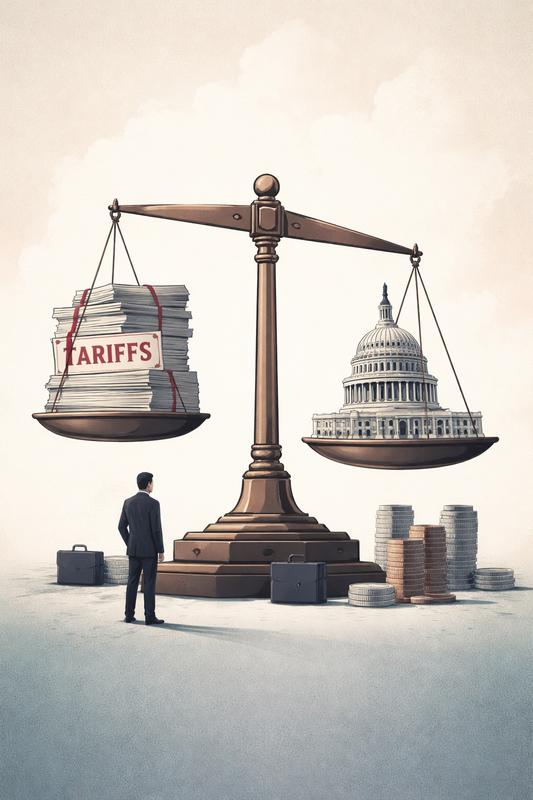
Recently, the U.S. Supreme Court did something deceptively old-fashioned: it reminded a president that tariffs are not a vibe, not a threat, not a negotiating posture — but a tax, and taxes belong to Congress.
In Learning Resources, Inc. v. Trump (decided Feb. 20, 2026), the Court held 6–3 that the International Emergency Economic Powers Act (IEEPA) does not authorize the President to impose tariffs. The Chief Justice’s opinion opens with the Constitution’s blunt allocation of power: “The Congress shall have Power To lay and collect Taxes, Duties, Imposts and Excises.” The government, the Court noted, conceded the President has no inherent peacetime authority to impose tariffs, so everything depended on whether IEEPA’s phrase authorizing the President to “regulate … importation” could bear the weight of a worldwide import tax.
It could not. The Chief Justice described the administration’s theory as resting on “two words separated by 16 others” — “regulate” and “importation” — to claim “independent power to impose tariffs” of essentially unlimited reach. That is not interpretation so much as alchemy. And because tariffs are an instrument with “major” economic and political consequences, the Court insisted on what it called “clear congressional authorization” before the Executive may claim such a power.
That doctrinal move matters for the world beyond the courthouse. A tariff is not merely a cost; it is a signal that reorders investment and logistics. When the United States can impose a near-universal duty by emergency proclamation, every export-dependent country is forced to price in presidential volatility. When the Court narrows that pathway, it does not end uncertainty — but it changes its shape.
The first proof came immediately. After the decision, President Trump moved to a new legal hook: Section 122 of the Trade Act of 1974, which permits a temporary import surcharge (up to 15%) for a limited period without prior congressional approval. Reuters reports the administration is also pointing toward other trade tools (like Section 301 investigations) that can still generate significant duties, though with more procedure and predicates. In short: the ruling weakens the President’s ability to impose instant, global tariffs under IEEPA — but it does not abolish the tariff state. It forces the White House to use narrower statutes, take more steps, and accept more legal vulnerability.
What about tariffs “imposed on other countries”? If those duties were justified solely under IEEPA, the Court’s holding means they lack statutory authority and cannot be sustained on that basis. But a critical caveat is that many U.S. tariffs can be re-anchored to other laws — and the dissent itself practically supplied the roadmap.
Justice Brett Kavanaugh dissented, joined by Justices Clarence Thomas and Samuel Alito. His argument is a study in executive pragmatism: if IEEPA allows the President to impose quotas or embargoes — even to block imports altogether — why would it forbid the “lesser” tool of tariffs, which merely condition importation on payment? Kavanaugh also criticized the majority’s reliance (in part) on the “major questions” canon and warned that, in foreign-affairs cases, courts should not apply that doctrine as “a thumb on the scale against the President.” Yet even he acknowledged the practical reality that “numerous other federal statutes authorize the President to impose tariffs,” including Section 232 and Sections 122, 201, and 301 of the Trade Act of 1974. The dissent’s bottom line is revealing: today’s decision is wrong, but the tariff machine can keep running — it will just run on different tracks.
Now place Manila in that picture.
The Philippines is not a spectator to American tariff drama; it is one of the countries that absorbs its tremors. The U.S. is a major trading partner, and Philippine exporters — especially in electronics and related supply chains — are exquisitely sensitive to across-the-board U.S. duties that act like a tax on access. For an economy where trade in goods and services is roughly two-thirds of GDP by World Bank measures, tariff uncertainty is macroeconomic uncertainty. A “temporary” U.S. surcharge can become permanent in business planning, because factories and contracts do not turn on judicial syllabi.
Here is the comparative twist: the Philippine Constitution anticipated this problem more cleanly than the American statute fight did. Article VI, Section 28(2) expressly allows Congress to authorize the President, “within specified limits” and “subject to … limitations and restrictions,” to fix tariff rates and related imposts. Delegation is not smuggled in through an emergency law; it is written in the constitutional design.
And the Customs Modernization and Tariff Act (R.A. 10863) operationalizes that design with guardrails. Its “Flexible Clause” (Section 1608) empowers the President — upon recommendation and subject to stated limits — to increase, reduce, or remove existing import duty rates, and even impose an additional duty (not exceeding 10% ad valorem) when necessary, among other measures. It also makes the delegation politically reversible: the power may be withdrawn or terminated by Congress through a joint resolution. That is what “agility with accountability” looks like in statutory form.
So the Supreme Court’s lesson is not simply “Trump lost.” It is that tariff power, when exercised at scale, is governance at its most invasive: it reaches straight into prices, jobs, and the cost of living — “access to the pockets of the people,” as the Court quotes Madison. In the United States, the Court has now insisted that Congress must clearly hand over that key before the President may use it. In the Philippines, Congress already can hand it over — but only with limits, procedures, and the ever-present possibility of taking it back.
The deeper point is democratic ownership. When tariffs become a president’s improvisational instrument — raised, lowered, announced, threatened, relabeled — trade partners learn to treat policy like weather. The Court’s decision tries, in its own lawyerly way, to make trade policy political again: debated, enacted, and answerable.
In an era when a “national emergency” can be declared as easily as a press conference, that is not judicial fussiness. It is constitutional hygiene.
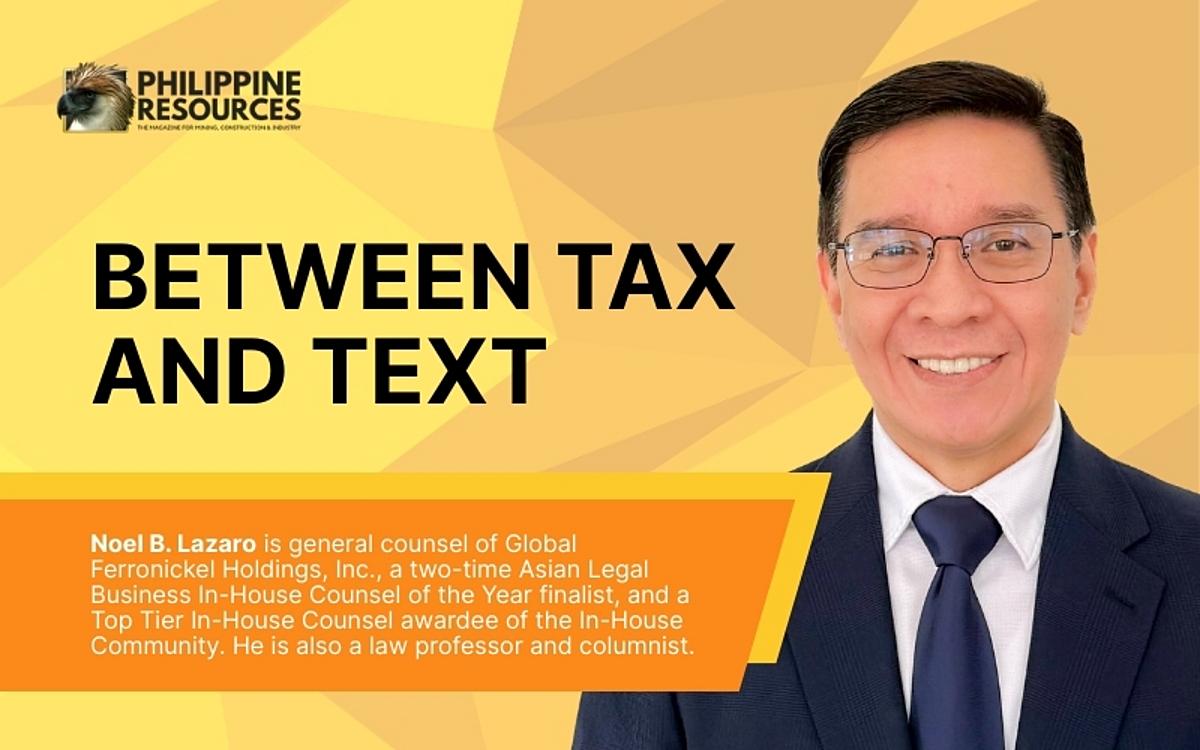
Noel B. Lazaro is general counsel of Global Ferronickel Holdings, Inc., a two-time Asian Legal Business In-House Counsel of the Year finalist, and a Top Tier In-House Counsel awardee of the In-House Community. He is also a law professor and columnist.