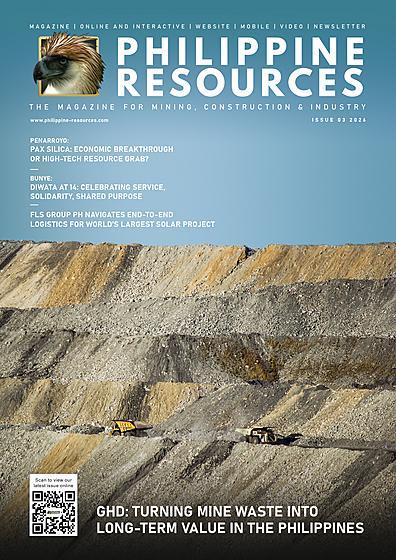

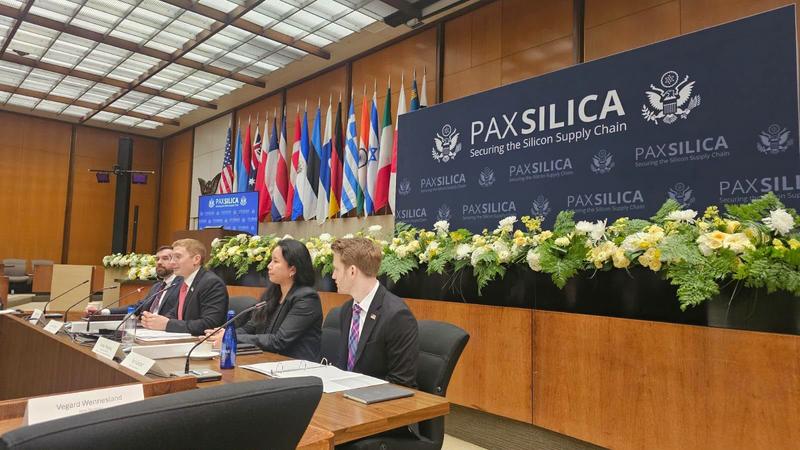
Pax Silica is a U.S.-led initiative launched in late 2025 to establish a trusted network of partner countries across the artificial intelligence (AI) and semiconductor value chain, from critical mineral extraction and energy infrastructure to semiconductor manufacturing, data centers, and AI technologies. Named from the Latin word pax ("peace" or "stable order") and silica (silicon dioxide, the primary source of silicon used in semiconductor chips), the initiative envisions a stable international economic order built on secure and resilient technology supply chains. Designed to strengthen resilient technology supply chains and reduce dependence on geographically concentrated production—particularly in China—it seeks to secure critical minerals, ensure reliable energy, expand trusted semiconductor manufacturing, strengthen AI infrastructure, diversify supply chains, and coordinate strategic investments among partner economies.
Pax Silica has also emerged as one of the more controversial policy initiatives following President Ferdinand R. Marcos Jr.'s endorsement of the project in his 2026 State of the Nation Address. While the administration has presented the initiative as a transformative opportunity to position the Philippines as a regional hub for artificial intelligence, semiconductors, and advanced manufacturing, it has also sparked public debate over its long-term implications. Supporters view Pax Silica as a strategic pathway to attract high-value investments, accelerate industrialization, and strengthen the country's role in global technology supply chains. Critics, however, question whether the initiative could deepen foreign influence over the Philippines' strategic minerals, energy resources, and critical infrastructure, while raising concerns about environmental impacts, indigenous communities, national security, and whether Filipinos will capture a fair share of the economic value created. These competing perspectives underscore that the success of Pax Silica will depend not only on the scale of investment it attracts but also on the legal, regulatory, and governance frameworks that ensure the country's natural resources and strategic industries advance long-term national interests.
The Philippines has emerged as a key prospective participant in the initiative. The Philippine and U.S. governments are working toward a framework agreement, with Foxconn expected to become the first locator at the AI and semiconductor hub in New Clark City. The initiative has also attracted support from the U.S. International Development Finance Corporation, Amazon Web Services, and the U.S. Millennium Challenge Corporation through proposed investments in digital infrastructure, energy security, and the Luzon Economic Corridor. These developments reinforce the country's ambition to become a regional hub for AI, semiconductor manufacturing, and advanced digital infrastructure.
For the Philippines, Pax Silica has profound implications for the mining and energy sectors, which supply the critical minerals and reliable power required by the digital economy. The country's abundant nickel, copper, gold, chromite, and renewable energy resources—particularly geothermal energy—position it to become an important participant in global technology supply chains. However, realizing these opportunities will require policies that promote domestic value addition, responsible resource management, environmental sustainability, and long-term national development rather than simply facilitating foreign investment.
The Strategic Importance of Philippine Mining
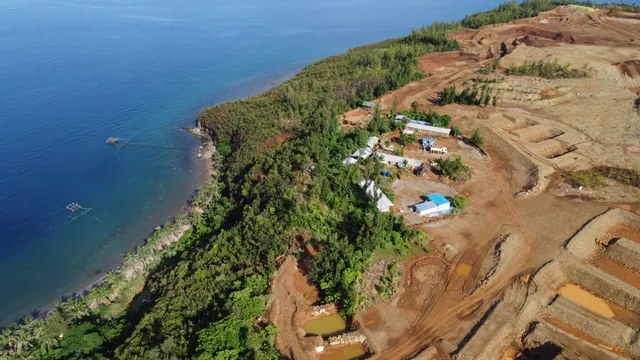
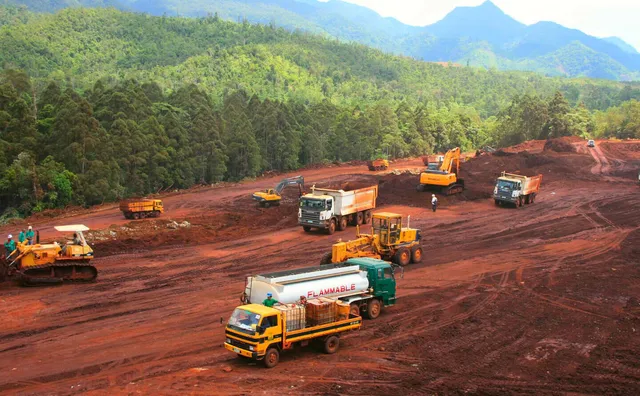
Mining has traditionally been viewed as an extractive industry supplying raw materials to foreign manufacturers. Under Pax Silica, however, mining assumes a strategic dimension because critical minerals have become essential inputs to the global digital economy.
Nickel, for example, is no longer merely an industrial metal. It is now fundamental to battery technology, data center energy storage systems, semiconductor manufacturing equipment, and electric vehicles. Likewise, copper is indispensable for electrical transmission, semiconductor fabrication equipment, renewable energy systems, and AI infrastructure. As demand for these technologies expands, so too does the strategic importance of countries capable of supplying these resources.
For decades, the Philippines has largely exported raw nickel ore, much of which is processed overseas before being incorporated into higher-value products. Consequently, the country captures only a small fraction of the total value generated throughout the technology supply chain. Pax Silica presents an opportunity to reverse this historical pattern by encouraging domestic mineral processing, refining, precursor chemical production, and integration into semiconductor manufacturing.
Instead of remaining merely an exporter of mineral resources, the Philippines could participate in multiple stages of the technology value chain. Such industrial upgrading would generate higher incomes, increase technological capabilities, and reduce dependence on commodity exports whose prices fluctuate significantly in global markets.
Industrial Transformation Rather Than Resource Extraction
Perhaps the greatest opportunity presented by Pax Silica lies in shifting Philippine mining policy from extraction toward industrialization. Historically, many developing economies have experienced what economists describe as the "resource curse," wherein abundant natural resources generate export revenues without fostering sustainable industrial development. The Philippines risks repeating this pattern if mining expansion merely increases exports of unprocessed ore.
Participation in Pax Silica should therefore be conditioned upon policies that require greater domestic value addition. Mineral processing facilities, battery precursor plants, high-value semiconductor material manufacturing, and advanced metallurgical industries should accompany expanded mining activities. These downstream industries create significantly more employment, generate higher tax revenues, stimulate research and development, and encourage technology transfer.
Without such industrial policies, Pax Silica could merely reinforce existing patterns in which foreign firms extract Philippine resources while capturing most of the economic value through overseas manufacturing and intellectual property ownership.
The Energy Sector as the Foundation of Pax Silica
While mining supplies the raw materials, energy provides the foundation upon which the entire Pax Silica ecosystem depends. Modern semiconductor fabrication plants require uninterrupted electricity twenty-four hours a day with exceptionally high-power quality. Voltage fluctuations lasting only milliseconds may destroy millions of dollars' worth of semiconductor wafers. Likewise, AI data centers consume extraordinary quantities of electricity for computing and cooling systems.
This presents both opportunities and challenges for the Philippine energy sector. The country's substantial geothermal resources offer a significant competitive advantage. Unlike solar and wind generation, geothermal energy provides stable baseload electricity independent of weather conditions. Such reliability is particularly attractive for semiconductor manufacturing and AI facilities that cannot tolerate interruptions in power supply.
Consequently, Pax Silica could substantially increase demand for geothermal development, creating opportunities for additional steam fields, power plants, and associated transmission infrastructure. Long-term electricity requirements may also increase demand for sophisticated steam supply agreements and project implementation arrangements that provide investors with contractual certainty over several decades.
While geothermal energy offers a natural competitive advantage, nuclear energy may also become an important component of the long-term energy mix required to support Pax Silica. Semiconductor fabrication plants and hyperscale AI data centers require continuous, high-capacity baseload electricity that intermittent renewable sources alone may not consistently provide. The Philippine government's renewed interest in nuclear energy—including the possible deployment of small modular reactors (SMRs)—could therefore complement geothermal generation by providing reliable, carbon-free electricity capable of supporting energy-intensive industries. If implemented under robust safety, environmental, and regulatory frameworks, nuclear power could strengthen the country's energy security while reducing dependence on imported fossil fuels and helping achieve its decarbonization objectives.
Hydrogen, particularly white (natural) hydrogen, also represents a potentially transformative energy resource for the future Pax Silica ecosystem. Unlike green hydrogen, which is produced through electrolysis using renewable electricity, white hydrogen occurs naturally in geological formations and can potentially be extracted directly from the subsurface with significantly lower production costs and carbon emissions. Although commercial development remains at an early stage globally and the existence of economically recoverable deposits in the Philippines has yet to be established, ongoing exploration suggests that naturally occurring hydrogen could emerge as a strategic energy resource. If viable deposits are identified, white hydrogen could provide low-carbon fuel for industrial processes, backup power generation, hydrogen fuel cells, and future clean manufacturing applications associated with semiconductor production and AI infrastructure. Given the Philippines' active tectonic setting and extensive geothermal systems, the country may warrant further geological assessment to evaluate the potential occurrence of natural hydrogen resources.
Risks of Rising Energy Costs
Despite these opportunities, significant risks remain. The Philippines already has some of the highest electricity prices in Southeast Asia. Energy-intensive industries such as semiconductor manufacturing require globally competitive electricity prices to remain economically viable. If generation capacity does not expand sufficiently, increasing industrial demand could place additional pressure on electricity prices for households and other industries.
Moreover, the substantial public investment required for transmission networks, substations, industrial parks, and power generation may impose significant fiscal burdens if not carefully planned. Policymakers must therefore ensure that investments serving strategic industries also strengthen the broader national electricity system rather than creating isolated infrastructure benefiting only a limited number of multinational corporations.
Environmental Sustainability and Responsible Mining
Any expansion of mining inevitably raises environmental concerns. Critical mineral extraction can generate deforestation, biodiversity loss, watershed degradation, sedimentation, acid mine drainage, and increased greenhouse gas emissions if environmental safeguards are inadequately enforced. Many mineral deposits are located within environmentally sensitive regions and indigenous ancestral domains, further complicating project development.
Consequently, environmental governance must become an integral component of any Philippine participation in Pax Silica. Mining companies should be required to implement internationally recognized environmental management systems, progressive rehabilitation programs, transparent monitoring mechanisms, and comprehensive mine closure plans. Likewise, the principles of Free and Prior Informed Consent (FPIC) should be rigorously observed whenever projects affect indigenous communities.
Semiconductor fabrication plants and hyperscale data centers are also among the most water-intensive industrial facilities in the world. Semiconductor manufacturing requires ultra-pure water (UPW) for wafer cleaning, chemical processing, and contamination control, with a single fabrication plant consuming millions of liters of water daily. Likewise, large data centers require substantial volumes of water for cooling systems, particularly in facilities that rely on evaporative cooling technologies. As Pax Silica encourages the development of semiconductor manufacturing and AI infrastructure in the Philippines, policymakers must recognize that water security will become as strategically important as energy security. Industrial expansion should therefore be accompanied by integrated water resource management, including sustainable groundwater regulation, watershed protection, wastewater recycling, rainwater harvesting, and investments in advanced water treatment and reuse technologies. Without careful planning, increased industrial demand could intensify competition for water among households, agriculture, and industry, particularly during periods of drought or in water-stressed regions. Ensuring reliable and sustainable water supplies will thus be essential not only for maintaining industrial competitiveness but also for protecting environmental sustainability and safeguarding the country's long-term water security.
Failure to maintain high environmental standards risks undermining the social legitimacy of Pax Silica while imposing long-term ecological costs that exceed short-term economic gains.
Legal and Regulatory Challenges
Successful participation in Pax Silica will require significant reforms across multiple legal sectors. Mining legislation may need revision to encourage downstream processing while maintaining environmental safeguards. Investment regulations must balance foreign participation with protection of strategic national assets. Energy regulation must facilitate long-term infrastructure investments while preserving affordability and reliability.
Equally important are legal frameworks governing data protection, cybersecurity, competition policy, indigenous peoples' rights, and environmental compliance. Since AI infrastructure and semiconductor facilities constitute critical national infrastructure, regulatory agencies must coordinate economic development objectives with national security considerations.
Contractual arrangements will likewise become increasingly important. Long-term mineral supply agreements, power purchase agreements, steam supply contracts, infrastructure concessions, and investment agreements must allocate commercial risks fairly while protecting the public interest. Excessively generous incentives or inflexible stabilization clauses may constrain future governments and reduce policy flexibility.
Economic Governance and Technology Transfer
One of the greatest concerns surrounding Pax Silica is the possibility that the Philippines may remain confined to lower-value activities while advanced manufacturing, intellectual property, and AI innovation remain concentrated abroad. To avoid this outcome, government policy should prioritize technology transfer, workforce development, domestic research, and local supplier participation.
Investment agreements should include measurable commitments to develop Filipino human capital and domestic industrial capabilities through the training of local engineers and geoscientists, collaboration with Philippine universities, research partnerships, procurement from domestic suppliers, support for small and medium enterprises, and, where appropriate, technology licensing and transfer. These commitments help ensure that foreign investment strengthens national capabilities and long-term industrial competitiveness rather than merely utilizing Philippine labor and natural resources.

Conclusion
Pax Silica offers a rare opportunity to reshape the Philippine economy—advancing industrialization, strengthening energy security, reinforcing semiconductor supply chains, creating high-value employment, and positioning the country at the forefront of the global digital economy. Yet these benefits are far from inevitable and will require deliberate policy choices and strong institutional governance to be realized. Without sound policy and effective governance, the country risks remaining primarily a supplier of critical minerals and low-cost labor while foreign firms capture the greatest value through advanced manufacturing, technology ownership, and intellectual property. Expanding industrial activity also brings challenges, including greater geopolitical exposure, environmental pressures, rising energy and water demand, and substantial infrastructure and fiscal requirements.
The issue, therefore, is not whether the Philippines should participate in Pax Silica, but how it can do so on terms that promote long-term national development. Achieving this objective will require strong institutions, clear legal and regulatory frameworks, responsible environmental stewardship, competitive and reliable energy systems, meaningful technology transfer, and a coherent industrial policy that fosters domestic value addition. If these conditions are met, Pax Silica could transform the Philippine mining and energy sectors from traditional resource industries into strategic foundations of the country's digital and industrial future.
Fernando “Ronnie” S. Penarroyo specializes in Energy and Resources Law, Project Finance and Business Development. He is also currently the Chair of the Professional Regulatory Board of Geology, the government agency mandated under law to regulate and develop the geology profession. For any matters or inquiries in relation to the Philippine resources industry and suggested topics for commentaries, he may be contacted at fspenarroyo@penpalaw.com. Atty. Penarroyo’s commentaries are also archived at his professional blogsite at www.penarroyo.com