Category:

ADB Approves Project Financing for South Commuter Railway Project in the Philippines
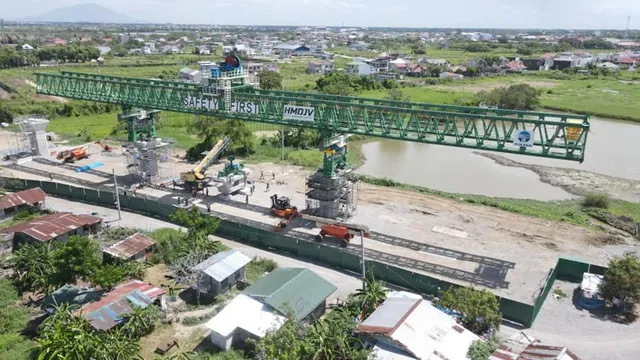
The Asian Development Bank (ADB) has approved up to $4.3 billion to help finance the construction of nearly 55 kilometers (km) of modern suburban railway line connecting Metro Manila with the city of Calamba in the Philippines. The investment in the South Commuter Railway Project, which is part of the North–South Commuter Railway (NSCR) network, is ADB’s largest infrastructure financing in the Asia and Pacific region to date.
Once completed, the South Commuter Railway will offer commuters fast public transport, help to ease road traffic congestion, and contribute to a reduction in greenhouse gas emissions in line with the Philippines’ climate change agenda. The project follows ADB’s financing of the Malolos–Clark Railway line north of the capital, for which construction is ongoing.
“The South Commuter Railway Project will provide affordable, safe, reliable, and fast public transport for commuters,” said ADB Vice-President for East Asia, Southeast Asia, and the Pacific Ahmed M. Saeed. “This project represents ADB’s biggest infrastructure investment and reflects our commitment to helping the Philippines attain its goals of reducing poverty, improving the lives of Filipinos, and achieving green, resilient, and high economic growth.”
The project includes the construction of 18 stations designed to provide safe access for all, including the elderly, women, children, and people with disabilities; and a connecting tunnel to allow the operation of direct trains from Calamba to stations on the future Metro Manila Subway system. All infrastructure will be designed to be disaster-resilient and able to withstand typhoons and earthquakes. The project will reduce travel time between Manila and Calamba by over half, from 2.5 hours currently by road.
The NSCR will further strengthen the Philippines’ economic recovery from the devastating impact of the COVID-19 pandemic as it is expected to create more than 35,500 jobs during construction and over 3,200 permanent jobs during operation. It will create a substantial growth multiplier effect in the economy through supplier contracts and new opportunities opened with better connectivity in the region. It will improve access to an average of more than 300,000 jobs within any 1-hour commute for residents along the project, according to an ADB study.
ADB’s Infrastructure Preparation and Innovation Facility supported the Department of Transportation (DOTr) in preparing the project. The loan will further support the capacity development and institutional strengthening of DOTr, the implementing agency. The railway will be elevated to avoid flooding and reduce the impact and disruption to communities along the railway route. A technical assistance grant will support affected communities.
The South Commuter Railway Project will be financed under a multitranche financing facility, with the first tranche of $1.75 billion to be made available starting this year. The release of the second and third tranches is expected in 2024 and 2026, respectively. ADB will finance civil works for the railway viaduct, stations, bridges, tunnels, and depot buildings. The Japan International Cooperation Agency is funding the rolling stock and railway systems.
The project is one of the Philippines’ infrastructure flagship projects (IFP) and is part of the government’s “Build, Build, Build” infrastructure development program. Other IFPs financed by ADB include the Metro Manila Bridges Project in 2021, the EDSA Greenways Project in 2020, the Angat Water Transmission Improvement Project in 2016 and additional financing in 2020, the Malolos Clark Railway Project in 2019, and the Improving Growth Corridors in Mindanao Road Sector Project in 2017.
ADB is committed to achieving a prosperous, inclusive, resilient, and sustainable Asia and the Pacific, while sustaining its efforts to eradicate extreme poverty. Established in 1966, it is owned by 68 members—49 from the region.
Article courtesy of the ADB

PH GETS LOAN FROM CHINA FOR SAMAL ISLAND - DAVAO CITY CONNECTOR BRIDGE
Photo credit: Department of Public Works and Highways
A new era of ties between Philippines-China relations ushered with the Chinese government providing Official Development Assistance (ODA) for the Samal Island - Davao City Connector (SIDC) Bridge Project in Davao Region.
The Government of the Republic of the Philippines (GPH), through Department of Finance (DOF) Secretary Carlos G. Dominguez III, and Government of the People's Republic of China (GPRC) through Embassy of the People's Republic of China in the Philippines Ambassador Huan Xilian exchanged on Monday, June 13, 2022 the Framework Agreement on the provision of concessional loans to the Philippines for the design and build of SIDC Project under China Government Financing Facility.
A long-awaited dream project over decades, Samal Island - Davao City Connector Project is one of the key G-to-G cooperation projects between China and the Philippines and a flagship project under the "Build, Build, Build" program.
DOF Secretary Dominguez also exchanged with Ambassador Xilian, witnessed virtually by the officials of Export-Import Bank of China (China Eximbank) the loan document that provides financing for the construction of SIDC Project, a toll-free two-way four-lane extradosed bridge to be implemented by the Department of Public Works and Highways - Unified Project Management Office (DPWH-UPMO) Operations headed by Undersecretary and Build Build Build Chief Implementer Emil K. Sadain.
The ceremonial event held at DOF Building was also attended by Chinese Embassy Minister Counselor Yang Guoliang; DPWH Undersecretary Sadain representing Acting Secretary Roger G. Mercado; DOF Undersecretaries Maria Edita Z. Tan and Mark Dennis Y.C. Joven; DOF Assistant Secretary Neil Adrian S. Cabiles; UPMO Project Director Sharif Madsmo H. Hasim; and Project Managers Soledad R. Florencio and Lilibeth B. Rico.
The loan will cover 90 percent of the project’s ₱23.039-billion price tag.
The bridge is envisioned as a modern bridge that will connect the Samal Circumferential Road in Barangay Limao, Island Garden City of Samal to Davao City in between R. Castillo-Daang Maharlika junction.
With a total length of 3.98 kilometers including Davao ramps and at grade road and roundabout in Samal, the bridge has a width of 24 meters and a vertical navigational clearance up to 47 meters. The bridge crossing over Pakiputan Strait will also be supported by two (2) pylons with a height of 73 meters.
In line with the Chinese loan procedures and arrangements, the DPWH commenced the procurement process and undertook limited competitive bidding among Chinese contractors provided by GPRC.
China Road and Bridge Corporation has been selected as the contractor for the project.
On January 14, 2021, DPWH and China Road and Bridge Corporation entered into a contract amounting ₱19.32-billion for the design and build of Samal Island-Davao City Connector Project to head start the negotiation process and support the loan application.
According to Undersecretary Sadain, the project is expected to break ground in July 2022 and the construction duration is estimated to last 60 months.
Once completed, the bridge will provide a resilient and reliable transportation link between Metro Davao and Samal Island, reducing travel time from 26 to 30 minutes via roll on roll off or ferry operations to only 5 minutes, and enhancing internal mobility and external linkage to support the economic and tourist growth potential of the local region, said Undersecretary Sadain.
It will also increase the economic activities and improve the livelihoods of the local people who have long dreamed of having such a bridge, added Undersecretary Sadain.
Article courtesy of Department of Public Works and Highways
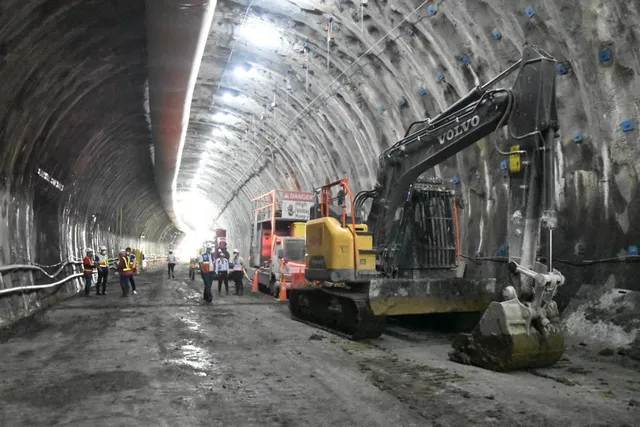
DPWH FAST TRACKING FLAGSHIP BYPASS ROAD PROJECT IN DAVAO CITY, WORKING SIMULTANEOUSLY ON BOTH ENDS OF 2.3-KM ROAD MOUNTAIN TUNNEL
Photo credit: Department of Public Works and Highways
A new milestone was reached by the Department of Public Works and Highways (DPWH) in the Davao City Bypass Construction Project with excavation works for the 2.3-kilometer twin tube road mountain tunnel now conducted at four (4) areas north and south portals.
DPWH Undersecretary and Build Build Build Chief Implementer Emil K. Sadain together with Embassy of Japan in the Philippines Economic Affairs Minister Masahiro Nakata and Japan International Cooperation Agency (JICA) Chief Representative Takema Sakamoto led on June 9, 2022 the ceremonial kick-off of excavation activities for south portal tunnel southbound direction.
Undersecretary Sadain, in-charge of Unified Project Management Office (UPMO) Operations, explained that the road tunnel construction works using cutting-edge equipment and technologies were earlier started at north portal on November 19, 2021 for southbound direction and December 10, 2021 for northbound direction while excavation activities from opposite end at south portal northbound direction commenced last May 12, 2022.
Simultaneous tunnel portal construction activities on both ends will fast-track the completion of the soon to be first-ever long distance road mountain tunnel in the Philippines, Undersecretary Sadain said.
Based on the report of Undersecretary Sadain to DPWH Acting Secretary Roger G. Mercado, construction of road tunnel at north portal has reached 202 meters at southbound and 91 meters at northbound.
The construction of road tunnel involves excavation of tunnel portal areas using the conventional "New Austrian Tunneling Method”, mucking or removal of soil from tunnel interior, initial shotcrete to protect from risk of fall materials and to prevent loosening during shotcrete application, steel ribs installation to provide effective structural protection, second shotcrete with wire mesh to secure stability, and rock bolt installation to provide bearing force and become a part of tunnel support system.
The kick-off ceremony, following Filipino and Japanese traditions, at Barangay Matina Biao, Davao City was also attended by Councilor Edgar P. Ibuyan Jr. representing Davao City Mayor-elect Sebastian Z. Duterte; DPWH UPMO Roads Management Cluster 1 (Bilateral) Project Director Benjamin A. Bautista; Embassy of Japan 1st Secretary Jumpei Tachikawa; JICA Representative Ochi Kaoru; Davao City District Engineer Richard Ragasa; Project Managers Joselito Reyes and Joweto V. Tulaylay; Engrs. Juan M. Diña Jr. and Earl Nicholas F. Rada; and officers of the consultants Nippon Koei Ltd., Katahira & Engineers International, Nippon Engineering Consultants Co., and PhilKoei International Inc.
The 45.5-kilometer Davao City Bypass Construction Project is divided into six (6) contract packages (CP) with the on-going CP 1-1 covering a 10.7 kilometers of 4-lane highway and 18.9 kilometers CP 1-2 and CP 1-3 under procurement stage financed by Official Development Assistance (ODA) from JICA thru the Special Terms for Economic Partnership (STEP) Loan Agreement Nos. PH-P261 and PH-P273. While for funding by the Government of the Philippines are CP 2-1, CP 2-2 and CP 2-3 with a total length of 15.9 kilometers.
The opening of new road networks through the Davao City Bypass Construction Project is expected to usher more development opportunities as it will greatly improve Davao City's accessibility and traffic condition.
“On behalf of DPWH, I would like to thank the Government of Japan thru JICA together with other development partners Asian Development Bank, World Bank, Export Import Bank of Korea, and Export-Import Bank of China for taking a great part in bolstering the Philippines’ stride to reach the peak of infrastructure development through the “Build, Build, Build” Program that will elevate living condition and benefit every Filipino”, added Undersecretary Sadain.
Other than the tunnel, CP 1-1 awarded to Shimizu – Ulticon - Takenaka joint venture involves construction of four (4)-lane road with a length of 7.9 kilometers; three (3) pairs of bridges with total length of 500 meters including the Davao River Bridge; two (2) underpasses and two (2) overpasses; 12 waterways culverts; and four (4) at-grade intersection.
Starting from Davao-Digos section of the Pan-Philippine Highway in Brgy Sirawan, Davao City going to Davao-Panabo section of the Pan-Philippine Highway in Brgy J.P. Laurel, Panabo City, the project is expected to ease traffic situations along the areas.
The completion of the entire bypass road project will slash travel time to under 49 minutes from the usual 1 hour and 44 minutes.
Article courtesy of Department of Public Works and Highways

DPWH STARTS CONSTRUCTION OF 2 BRIDGES CONNECTING TAWI-TAWI ISLANDS
Photo credit: Department of Public Works and Highways
After years of planning and preparation, the Department of Public Works and Highways (DPWH) has officially launched the construction of two (2) bridges aim to provide a direct route between the existing major growth center of Bongao, Tawi-Tawi Province with Sanga-Sanga Island and future growth center in Panglima Sugala.
DPWH Acting Secretary Roger G. Mercado together with Tawi-Tawi Governor Yshmael L. Sali, Undersecretary and Build Build Build Chief Implementer Emil K. Sadain, and Asian Development Bank (ADB) Country Director Representative Alain X. Morel led on Friday, June 3, 2022 the ceremonial groundbreaking at Provincial Capitol for the two (2) years construction of Nalil-Sikkiat Bridge over Bongao Channel and Malassa-Lupa Pula Bridge over Manalik Channel to mainland Tawi-Tawi island.
The two (2) bridges costing ₱2.14 Billion which aims to decongest Bongao, the capital of Tawi Tawi, by bringing the development in the mainland thru an improved connectivity between islands/municipalities of the province are part of the ADB-funded Improving Growth Corridors in Mindanao Road Sector Project.
“The team of Undersecretary Sadain and Project Director Sharif Madsmo H. Hasim have been working really hard for these projects for years now from the conduct of feasibility studies, loan agreement, detailed engineering design, and procurement for civil works contractor and consultant”, Acting Secretary Mercado said.
Others present at the project groundbreaking are Undersecretary for Mindanao Operations Eugenio R. Pipo Jr.; Assistant Secretaries Ador G. Canlas, Antonio V. Molano Jr., Wilfredo S. Mallari, Mel John I. Verzosa and Rolito D. Manalo; DPWH Unified Project Management Office (UPMO) Roads Management Cluster 2 (Multilateral) Project Director Hasim; Region 9 Director Cayamombao D. Dia; Bureau of Construction OIC-Director Aristarco M. Doroy; Bureau of Design OIC-Director Edwin C. Matanguihan; OIC Project Director Najib D. Dilangalen; Project Managers Soledad Florecio and Emmanuel Supe; and other public works and local government officials.
With less than a month left before the term of President Rodrigo Duterte ends, the DPWH is committed to push forward the implementation of high-impact infrastructure flagship projects under the Build Build Build Program that will bring long-term benefits to the Filipino people in the countryside, said Undersecretary Sadain.
According to Undersecretary Sadain, the construction of Nalil-Sikkiat and Malassa-Lupa Pula Bridges including the proposed Tongsinah Paniongan Bridge over Sanga-Sanga Channel connecting to Papahag Island under DPWH procurement stage and also part of the Improving Growth Corridors in Mindanao Road Sector Project will open up potential in the tourism and fishing industry for Tawi-Tawi.
There is also a proposed port development which is the Malassa International Port because of the economic potential for the island province as it is in the path of international shipping containers, added Undersecretary Sadain, in-charge of DPWH UPMO Operations.
DPWH Project Director Hasim said that the 541-meter Nalil-Sikkiat Bridge, 681-meter Malassa-Lupa Pula Bridge, and 569-meter Tongsinah-Paniongan Bridge were a product of years of research and consultation undertaken.
Undersecretary Sadain disclosed that the bridges were among the infrastructure projects long before recommended to DPWH and the Office of the President by Tawi-Tawi Congressman Rashidin H. Matba to spur the economic activities that would boost the economy of Tawi-Tawi and further enhance the quality of life of its people.
Located in the Bangsamoro Autonomous Region in Muslim Mindanao occupying the southwestern part of Sulu archipelago and considered the largest seaweed producing province in the Philippines, Tawi-Tawi is a hidden treasure waiting to be discovered. It remains an uncharted territory for many because of its geographical location sitting at the southernmost part of the country.
With the construction of new bridges, local and foreign tourist will soon get to see the wonders of the island province – the pristine beaches, historical and religious sites, sanctuaries and marine biodiversity.
Article courtesy of the Department of Public Works and Highways
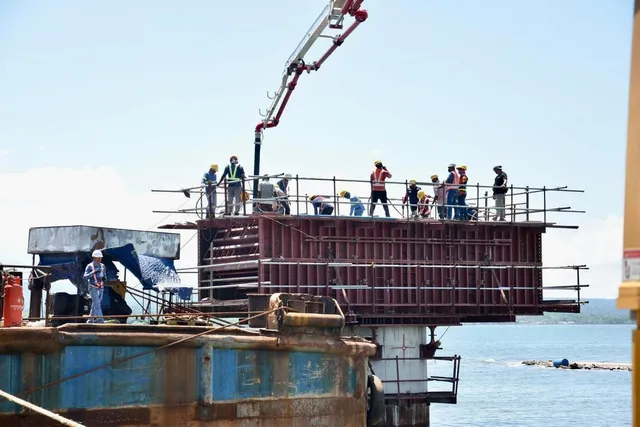
CONSTRUCTION OF MINDANAO’S LONGEST BRIDGE NOW HALFWAY DONE
Photo credit: Department of Public Works and Highways
Department of Public Works and Highways (DPWH) Acting Secretary Roger G. Mercado is keen to make the most of his remaining few days as member of the Cabinet of President Rodrigo Roa Duterte administration.
Secretary Mercado declared that although time is running out for the term of President Duterte will end this June 30, his duty to the public is far from over and will not take a pause in fulfilling the enormous job at DPWH of providing the Filipino people with quality infrastructure.
The DPWH Chief together with Undersecretary and Build Build Build Chief Implementer Emil K. Sadain inspected on Wednesday, June 1, 2022 the on-going Panguil Bay Bridge Project, listed among the 119 infrastructure flagship projects under the “Build, Build, Build” Program.
The two (2) officials were joined in the project visit by Undersecretary for Mindanao Operations Eugenio R. Pipo Jr.; Lanao Del Norte Governor Imelda Quibranza-Dimaporo and Congresman Abdullah D. Dimaporo; Assistant Secretaries Ador G. Canlas, Antonio V. Molano Jr., Wilfredo S. Mallari, Mel John I. Verzosa and Rolito D. Manalo; and Project Director Sharif Madsmo H. Hasim and Project Manager Teresita V. Bauzon of DPWH Unified Project Management Office (UPMO) Roads Management Cluster 2 (Multilateral).
When finished, the 3.17 kilometer two-way two-lane Panguil Bay Bridge, which will link Tangub City in Misamis Occidental with the Municipality of Tubod in Lanao del Norte, will be Mindanao’s longest bridge.
With funding assistance from South Korea, the ₱7.37 Billion project is being implemented by the DPWH UPMO Operations.
Undersecretary Sadain, in-charge of DPWH UPMO Operations, reported in his briefing that the project has achieved 51.4 percent completion to date, recovering from the delays in the delivery of equipment and materials in 2020 brought about by the unprecedented impacts of the global coronavirus pandemic.
“I am delighted that the work is now progressing at a faster pace using state-of-the-art engineering equipment and adopting modern technology in bridge construction”, added Secretary Mercado.
The bridge project that has gained the full support of the Provincial Government of Lanao Del Norte and Misamis Occidental has an established Multi-Partite Monitoring Team to properly monitor and successfully implement the Panguil Bay Bridge Project.
Targetted for completion by December 2023, the Panguil Bay Bridge Project will make commuting easier as it will only take 7 minutes from Tangub to Tubod compared to 1 hour and 30 minutes via Roll-On Roll-Off vessels operating from Ozamis to Mucas or land travel through Panguil Bay road of 2 to 2 and a half hours over a total length of 100 kilometers.
Article courtesy of the Department of Public Works and Highways

DPWH TO OPEN BOHOL’S NEW ICONIC BRIDGE TO 2-WAY TRAFFIC THIS JUNE
Photo credit: Department of Public Works and Highways
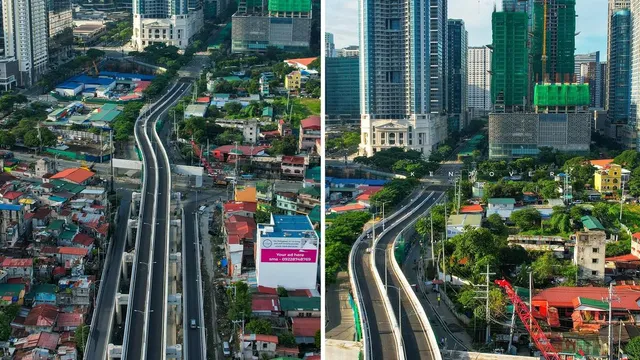
The Department of Public Works and Highways (DPWH) is looking to finish the paving of access ramps for a new bridge in Loay, Bohol by June 7, 2022.
In his report to Secretary Roger G. Mercado, Undersecretary and Build Build Build Chief Implementer Emil K. Sadain said that the construction of approach road for the new Clarin Bridge has reached the final stage with on-going laying of bituminous asphalt concrete finish after undergoing full compaction of base materials.
Undersecretary Sadain, in-charge of Unified Project Management Office (UPMO) Operations was on the construction site of new Clarin Bridge along Tagbilaran East Road on Wednesday, May 25, 2022 and reported that everything was going well with the asphalt paving of approaches and installation of concrete guardrail posts and lighting works comprising the remaining unfinished work before opening to two (2) way traffic.
Also present during the conduct of project assessment are UPMO Roads Management Cluster 1 Project Director Benjamin A. Bautista, Project Manager Franscisco M. Sawali, Region 7 Maintenance Chief Faustino A. Dela Cruz, Bohol 3rd District Engineer Magiting A. Cruz, Asst. District Engineer Generoso Y. Sison, and Project Engineer Bernardo A. Austria.
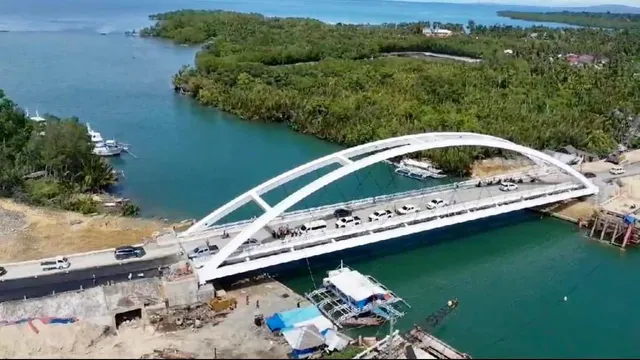
The new bridge in Barangay Poblacion Ubos, Loay crossing Loboc River is designed as a Nielsen Arch bridge spanning 104 meters with an approach roads at abutment “A” of 208 meters and at abutment “B” of 217 meters.
In response to the unfortunate collapse of the parallel old Clarin Bridge on April 27, 2022, DPWH UPMO with the assistance of DPWH Regional Office 7 and the District Engineering Offices in Bohol has worked vigorously to immediately open the new Clarin Bridge into a one (1)-lane traffic scheme to light vehicles with assigned flagmen and traffic aides in coordination with the local police and barangay.
The old bridge was built in the 1970s and was among the infrastructure affected by the 7.2-magnitude quake that jolted Bohol in 2013.
The Clarin Bridge Replacement Project costing ₱462 Million is part of the Bohol Circumferential Road Contract Package 3 under the DPWH Road Upgrading and Preservation Projects (RUPP) funded through Japan International Cooperation Agency (JICA) Loan Agreement No. PH-P247.
As of first week of May 2022, the new Clarin Bridge was made passable in a one (1)-lane traffic for light vehicles including motorcycles, cars, vans, and utility vehicles.
While remaining civil works are being undertaken, passing motorists are advised to drive slowly and to follow all construction safety signs and barriers.
The embankment materials for the new Clarin Bridge have to be well-compacted to ensure quality and for the safety of the motorists.
“All equipment and personnel are in full-force working double time to open the bridge into two (2) way traffic the soonest possible time," added Undersecretary Sadain.
With a relatively favorable weather condition, all minor corrections and compaction of base course before the final asphalt overlay of approach road is targetted for completion by DPWH within 12 days or by June 7.
Aside from providing safe, economical and reliable mobility of people, goods and services, the new Clarin Bridge will further boost the tourism industry of the island province of Bohol in Central Visayas.
Bohol’s Loboc River is a major tourism destination and also offers alternate route to the province Billar manmade forest as well as conservation areas for tarsiers and butterflies.
Prior to COVID-19 pandemic, the pristine beaches of the province is among the most visited destinations by domestic and international tourists.
Article courtesy of the Department of Public Works and Highways

DPWH - JICA INK AGREEMENT ON ROAD DISASTER PREVENTION AND OTHER COUNTERMEASURES ON MOUNTAINOUS ROADS IN PH
Photo credit: The Department of Public Works and Highways
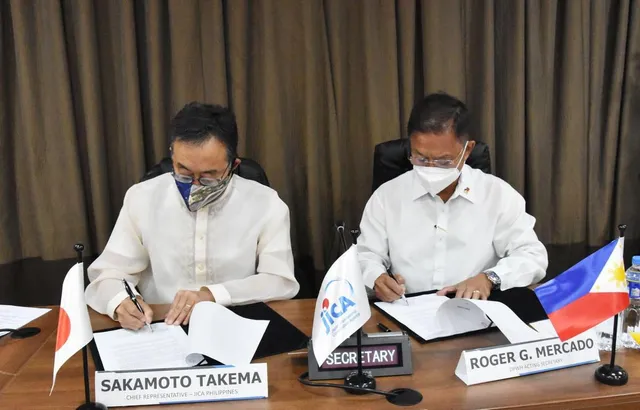
The Department of Public Works and Highways (DPWH) will be assisted by Japanese experts in enhancing capabilities of DPWH engineers with the end in view of applying latest technologies in the Philippines to address road disasters on hazard-prone mountain areas.
DPWH Secretary Roger G. Mercado and Japan International Cooperation Agency (JICA) Philippines Office Chief Representative Takema Sakamoto signed on Wednesday, May 18, 2022 the Record of Discussions to formally commence a technical cooperation program on road disaster preventions and other countermeasures on mountainous roads.
The signed record of discussions establishes a mutual agreement for implementation of detailed plan for the project to enhance capability on implementation of permanent countermeasure works for slope disaster, emergency response, hazard maps development, and road disaster information management based on road disaster information system.
Earlier, President Rodrigo Roa Duterte issued on April 12, 2022 Special Authority to DPWH Undersecretary and Build Build Build Chief Implementer Emil K. Sadain and Department of Finance (DOF) Undersecretary Mark Dennis Y.C. Joven to negotiate and or facilitate for and on behalf of Government of the Republic of the Philippines and JICA the record of discussions for the ₱178 million JICA grant project.
DPWH has been implementing different strategic infrastructure policies and programs which aims to: a.) to ensure safe and reliable national road system through the rehabilitation/reconstruction of national roads with slips, slope collapse and landslides, b.) to provide safe access to highly vulnerable areas; and c.) to rehabilitate, retrofit and strengthen existing bridges.
The signing event held at DPWH Central Office was also participated by Undersecretary Sadain of DPWH Unified Project Management Office (UPMO) Operations; Undersecretary Maximo L. Carvajal of Technical Services; Acting Undersecretary Constante A. Llanes Jr. of Planning Service; JICA Senior Representative Kenji Kuronuma; and Bureau Directors Ernesto S. Gregorio Jr., Aristarco M. Doroy, Edwin C. Matanguihan, and Reynaldo P. Faustino.
Secretary Mercado said that this latest collaboration program is a new seal in the partnership of DPWH and JICA in building safe, reliable, sustainable and resilient infrastructures resulting in the improvement of the quality of life of millions of Filipinos.
Appropriate road disaster countermeasures against landslides, debris flow, and rock collapse are necessary due to yearly occurrence of strong typhoons and earthquakes in the country which renders many roads unpassable.
With the willingness of Japanese experts to share their effective technologies on landslides and other road disaster mitigation, the DPWH engineers will be able to apply the best methodology in mitigating and preventing road catastrophes, added Secretary Mercado.
Prior to signing of the record of discussions, DPWH Planning Service headed by Acting Undersecretary Llanes held a series of discussions with JICA and other relevant organizations to develop a plan for the project.
The technical cooperation project has a three (3) years and a half reckoned period with the Cordillera Administrative Region and Regions 7 and 11 as pilot sites.
Article courtesy of the Department of Public Works and Highways