August 15, 2022

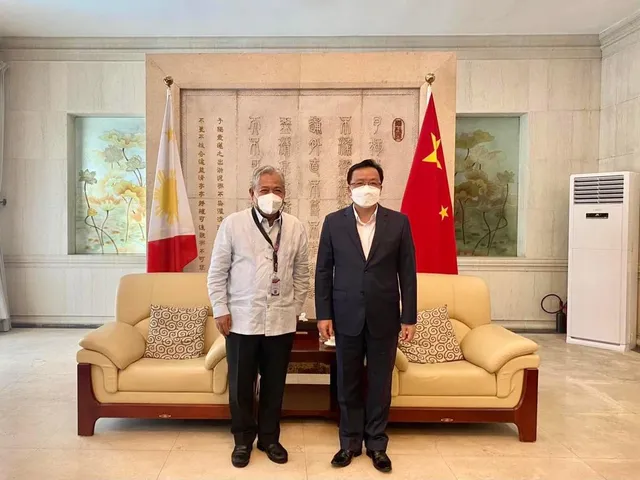
Transport Secretary Jaime Bautista and Chinese Ambassador Huang Xilian restart “negotiations for major transport projects” in a formal meeting at the Chinese Embassy in Makati City on Aug. 11, 2022. They also tackled three China-funded railway projects -- the PNR South Long Haul Project (North-South Commuter Railway), Subic-Clark Railway and Mindanao Railway (Tagum-Davao-Digos) that were terminated after China reportedly failed to act on the funding requests by the previous administration. (DOTr photo).

The Philippines has resumed talks with China to renegotiate China-funded transport projects in the country, the Department of Transportation (DOTr) announced Sunday.

In a press statement, the DOTr said Transportation Secretary Jaime Bautista and Chinese Ambassador Huang Xilian met in a formal meeting at the Chinese Embassy in Makati City on Thursday to “restart negotiations for major transport projects”.

“The two officials discussed the resumption of talks for the major China-funded railway projects such as the PNR South Long Haul Project (North-South Commuter Railway), Subic-Clark Railway and Mindanao Railway (Tagum-Davao-Digos),” the DOTr said.

To recall, these transport projects were earlier deemed “withdrawn” due to China’s inaction on funding requests by the previous administration.

The DOTr said the Chinese government’s funding support for these projects will “strengthen bilateral relations and enhance the partnership between the Philippines and China.”

In a separate statement, Huang described his meeting with Bautista as “constructive” and expressed hope that the two countries would accomplish more infrastructure projects in the railway sector.

“[I] hope that China-Philippines cooperation in infrastructure and railway would achieve more tangible fruits and bring about more benefits to the Filipino at an early date,” he said.

He also said China is committed to helping Southeast Asian countries in railway development.

“China is also devoted to promoting the connectivity of the Southeast Asian countries by sharing its experience and introducing the cut-edging technology of railway construction and rolling stock manufacturing,” he added.

China earlier said it has helped the Philippines complete 17 projects while more than 20 projects are under implementation or in progress.

Meanwhile, Bautista and Huang also discussed several China-Philippines Maritime Cooperation Projects, particularly the hotline communication and legal affairs cooperation arrangements between the Philippine Coast Guard (PCG) and the China Coast Guard.

Also discussed was a possible collaboration on Maritime Traffic Safety, Ferry Safety; a Memorandum of Understanding on Maritime Search and Rescue; as well as the capacity building for maritime governance, safety supervision, and vessels safety inspection.


Article courtesy of the Philippine News Agency

August 15, 2022

Photo credit: Department of Public Works and Highways

The Korea Eximbank (KEXIM) Manila Representative Office, implementing agency of the Korean Government’s Economic Development Cooperation Fund (EDCF) Official Development Assistance (ODA) program in the Philippines, is keen on levelling up funding support to infrastructure development priorities of the Department of Public Works and Highways (DPWH).

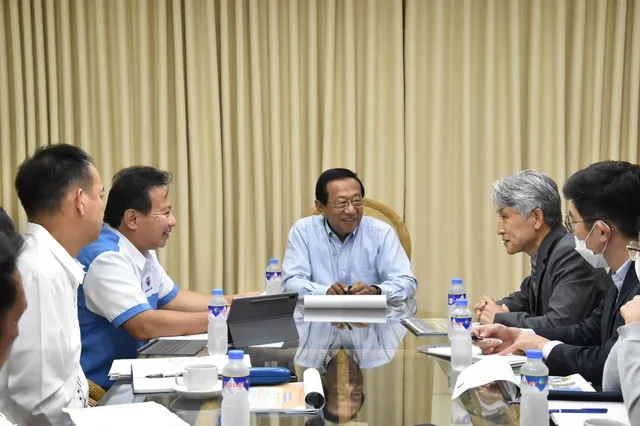
In his meeting with DPWH Secretary Manuel M. Bonoan and Senior Undersecretary Emil K. Sadain, KEXIM-EDCF Country Director and Chief Representative Jaejeong Moon expressed interest to support DPWH pipeline new projects to ‘Build Better More’, with the leaders of the two (2) agencies discussing ways of further strengthening the cooperation between Philippines and South Korea.

The Korean Government intends to further increase the EDCF concessional loan assistance to the Philippines to fund development projects under the President Ferdinand Romualdez Marcos Jr. administration.

The EDCF provides assistance to DPWH-implemented flood control, roads and bridges and flood control projects managed by the Unified Project Management Office (UPMO).

According to Senior Undersecretary Sadain, in-charge of ODA-funded projects, three (3) EDCF projects are on-going namely Samar Pacific Coastal Road Project in Northern Samar, Panguil Bay Bridge Project in Northern Mindanao, and Integrated Disaster Risk Reduction and Climate Change Adaptation Measures in the Low-Lying Areas of Pampanga in Central Luzon.

Early this year, the Philippine government has also secured loan from South Korea to cover funds for the engineering services of the Panay-Guimaras-Negros Island Bridges Project, an interisland bridges project that will entails the construction of two sea-crossing, four (4)-lane bridges totaling 32.47 kilometers — including connecting roads and interchanges — to connect the islands of Panay, Guimaras and Negros in Western Visayas, added Senior Undersecretary Sadain.

The EDCF also provided a grant for the recently completed feasibility study of the Samar Pacific Coastal Road Project Phase II, which aims to construct two (2) bridges namely Laoang 2 Bridge (360-meter) and Calomotan Bridge (630-meter) including the upgrading of about 12.5-kilometer existing road from Laoang-Palapag Road Junction to Catarman-Laoang Road Junction that will connect the island of Laoang to mainland Northern Samar.

DPWH is looking forward to the approval of submitted final feasibility study report to National Economic and Development Authority (NEDA) Board and the subsequent endorsement of the project to KEXIM for funding of the detailed engineering design and civil works for its construction.

Other Korea-funded ODA feasibility studies discussed during the meeting includes Philippines-Korea Project Preparation Facility for Lubao-Guagua-Sasmuan-Minalin-Santo Tomas Bypass Road (30 km), Mount Kitanglad Range Belt Road (108 km), Capas-Botolan Road (38.4km), and Lubao-Guagua-Sasmuan-Minalin-Santo Tomas Bypass Rd., Section 4: Minalin (Bulac)-Sasmuan Viaduct (7 km); Maasin City Coastal Bypass Road; Iconic Bohol-Leyte Bridge Project; and Integrated Flood Management Master Plan of Lower Pampanga River Basin covering Pampanga Delta Development Project Phase II and Central Luzon-Pampanga River Floodway Flood Control Project.

The meeting held August 12, 2022 at the DPWH Central Office was also participated by UPMO Project Directors Ramon A. Arriola III, Sharif Madsmo H. Hasim, and Benjamin A. Bautista; UPMO Project Manager Teresita V. Bauzon; and KEXIM Deputy Director Yunhak Lee and Program Officer Ana Labella.


Article courtesy of The Department of Public Works and Highways
July 28, 2022

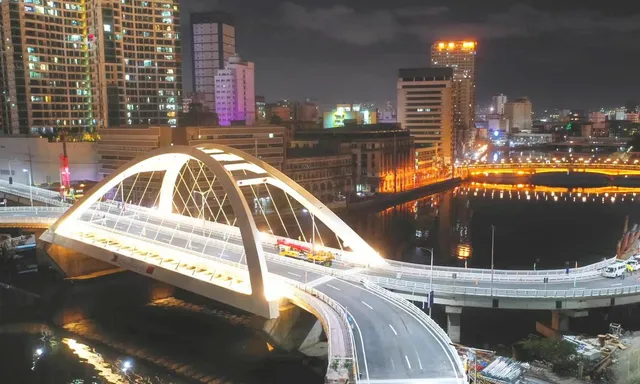
Photo credit: Rappler - Binondo-Intramuros Bridge, Manila

The government will build several bridges in Metro Manila to further improve mobility, the Department of Public Works and Highways (DPWH) said Tuesday.
Secretary Manuel Bonoan said construction and development in the National Capital Region (NCR) will include “I think, five or six bridges, across the Pasig River.”

“As far as the infrastructure program is concerned, we will continue with the construction of more bridges across Pasig River and Marikina River so that the mobility will be enhanced from north to south sectors because there are just but a few bridges connecting north and south sector,” he said at the post-SONA (State of the Nation Address) Economic Briefing held at the Philippine International Convention Center in Pasay City.

Apart from bridges, the government is also looking at constructing more expressways “that would be leading toward the other areas of Metro Manila.”

“Right now, I think there are several expressway projects that are in line. There’s an expressway that is going to be developed in the eastern corridor of Metro Manila that will go through, Pasig, Cainta, and all the way to Bulacan,” Bonoan said.

He said the extension of the South Luzon Expressway going to Lucena City and the Cavite-Laguna Expressway to Tagaytay City are underway.

Bonoan said President Ferdinand Marcos Jr. announced in his inaugural State of the Nation Address (SONA) on Monday that the “Build, Build, Build” (BBB) programs initiated by the Duterte administration will continue.

“I reiterate today (Tuesday) the marching order of the President during his SONA that under his administration, the infrastructure development program will be pursued relentlessly. We will continue what has been started under the BBB program of the past administration and must not only continued but whenever possible, be expanded,” he said.

“As the President said, the infrastructure program will be very vital to support national government efforts to push for the revival of the economy which has slumped due to the Covid-19 pandemic. This is the foundation that we will build upon as the President pronounced we must keep the momentum and aspire to build better more and faster,” he added.


Article courtesy of the Philippine News Agency

July 28, 2022

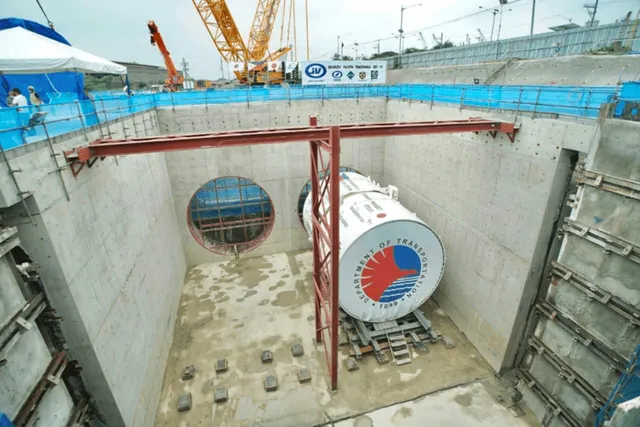
An official of the Department of Transportation (DOTr) on Tuesday said the Metro Manila Subway Project has reached 60 percent completion rate on procurement.

“Metro Manila Subway is 33 kilometers (km) from Valenzuela all the way to the Ninoy Aquino International Airport (NAIA), around 17 stations. We expect to provide daily ridership from 400,000 to as high as 800,000,” DOTr Undersecretary for Railways Cesar Chavez said during the post-State of the Nation Address (SONA) economic briefing at the Philippine International Convention Center (PICC) in Pasay City.

He also gave an update on the railway projects based on four indicators—procurement, design, right-of-way (ROW) acquisition, and construction.

Another big-ticket project is the North-South Commuter Railway (NSCR) project, with both its Tutuban to Malolos and Malolos to Clark segments at 93 percent complete on procurement, while the Manila to Tutuban to Calamba segment is at 61 percent complete on procurement.

“As to the detail and design, we're more than 70 percent complete, and as to ROW, it's 55 to 60 percent,” he said.

The NSCR is expected to be operational by 2026 to 2027 and will run for 147 kilometers from Clark to Calamba.

It will have 35 stations and is expected to have a daily passenger capacity of 400,000 to 700,000 daily.

Chavez said the Light Rail Transit Line 1 (LRT-1) Extension Project—which will extend the LRT-1 southward from Baclaran to Bacoor, Cavite—is at 69 percent completion rate on construction.

“The 122 trains are there already, around 24 rolling stocks. The station developments are in place already, except Las Piñas to Bacoor,” he said.

Meanwhile, the Metro Rail Transit Line 7 (MRT-7), a public-private partnership (PPP) project with San Miguel Corp., is at a 61 percent completion rate on construction.

Once complete, Chavez said the MRT-7 is seen to have a daily passenger capacity from 400,000 to 800,000.

It will run for 22.8 km from northeast to northwest, have 14 stations, and will connect San Jose del Monte, Bulacan to the Common Station in Quezon City.

To date, Chavez said the common station, or the Unified Grand Central Station, is expected to be completed by “the second quarter of 2023.”

Designed to connect the LRT-1, MRT-3, MRT-7, and the Metro Manila Subway with access to road transport, he said the station is expected to serve “at least 150, passengers daily.”

In addition to these projects in Luzon, he reiterated President Ferdinand “Bongbong” Marcos Jr.’s desire to complete the Cebu Railway System, the Panay Railway Project, and the Mindanao Railway Project (MRP).

The MRP, he said, is to be “resubmitted” to the National Economic Development Authority (NEDA) “in the coming weeks” for funding reapproval.

“The intention is to continue whether we're going to PPP or ODA (official development assistance), we will leave it to the Department of Finance, NEDA, and the economic team of the President,” he said.

He said while the Panay Railway Project is not “in the master plan,” he said at least five railway projects have been identified for development in the Visayas.

“Good news for Cebu, because in the master plan of rail transport from 2018 to 2019 there are five railway projects identified for development in the Visayas, in particular in Cebu province,” he said.

On Monday, Marcos in his first SONA announced his administration’s desire to continue the “Build, Build, Build” program of the previous administration and other projects such as the Panay Railway Project and the Cebu Railway System.

The 12 railway projects have a combined cost of PHP1.9 trillion and are at various stages of implementation.

Marcos noted that the infrastructure development spending of the country will be sustained at 5 percent of the gross domestic product in addition to making use of PPPs.


Article courtesy of the Philippine News Agency

July 28, 2022

Photo: The government will review other funding options for several major railway projects that were proposed to be financed by China. Finance Secretary Benjamin Diokno said the Japanese government, the World Bank, and the Asian Infrastructure Investment Bank are among the options to finance the projects. (PNA file photo)

The government will review funding proposals and options for several infrastructure projects previously eyed to be financed by China.

“We will revisit. At saka (and we will) we will resubmit it to NEDA (National Economic and Development Authority) just in case,” Finance Secretary Benjamin Diokno told journalists after the post-State of the Nation Address (SONA) Philippine economic briefing in Pasay City on Tuesday.

Transportation Undersecretary Cesar Chavez earlier said the official development assistance loan deals for three major infrastructure projects have been considered “withdrawn” after the Chinese government failed to act on the previous administration’s funding request.

The financial deals are for the engineering, procurement, construction, and commissioning for the Subic-Clark Railway project, the design-build pact for the Philippine National Railways (PNR) South Long-Haul Project, and the management consultancy for the Mindanao Railway Project (MRP). 

The Department of Finance (DOF) earlier informed the China Eximbank that the loan applications would be valid only until May 31, 2022, or a month before the end of the Duterte administration’s official term. 

Diokno said the government has other funding options for the said infrastructure projects, such as those from the Japanese government, World Bank (WB) and the Asian Infrastructure Investment Bank (AIIB). 

“These are nice projects. These have been evaluated by NEDA and (these are) socially-worthwhile projects so we will just look for funding,” he said.

Meanwhile, Diokno said the government will push for the implementation of other railway projects to boost the domestic economy’s recovery and growth potential.


Article courtesy of the Philippine News Agency

July 24, 2022

The Department of Public Works and Highways (DPWH) is inching closer to delivering the entire 30-kilometer Central Luzon Link Expressway (CLLEX) Project which is 96 percent overall complete to date.

In his report to Secretary Manuel M. Bonoan, DPWH Undersecretary for Unified Project Management Office (UPMO) Operations Emil K. Sadain said that the first 18 kilometers of CLLEX from Tarlac Interchange at the connection of Subic-Clark-Tarlac Expressway (SCTEX) and Tarlac-Pangasinan-La Union Expressway (TPLEX) in Balingcanaway, Tarlac City to Guimba-Aliaga Road in Aliaga, Nueva Ecija will be extended with additional 11 kilometers by March 2023 to include seven (7) kilometers up to San Juan Interchange and four (4) kilometers to Umangan-Julo Road at the boundary of Aliaga and Cabanatuan City before Felipe Vergara Road and Daang Maharlika Highway.

Undersecretary Sadain with DPWH UPMO-Roads Management Cluster 1 Project Director Benjamin A. Bautista inspected on Friday, July 22, 2022 the continuing works for the construction of four (4) lane expressway including interchanges, overpasses and underpasses from Aliaga Section to Cabanatuan Section whose progress were stalled in the past due to unworkable portions with problem in the acquisition of road right of way.

CLLEX is part of the Luzon Spine Expressway Network which is aimed at reducing travel time from the northernmost part of Luzon, Ilocos, to the southernmost part, Bicol.

Other than cutting travel time between Tarlac and Nueva Ecija, the partial opening in 2021 of CLLEX provided options to motorists and spread out traffic better resulting to reduce transportion costs, benefitting farmers of Central Luzon and Cagayan Valley Regions.

“The CLLEX Project will support the country’s new vision for improving agricultural productivity under the administration of President Ferdinand Bongbong Marcos Jr. Using this toll-free high standard highway, palay crops and other products from Nueva Ecija - the Philippines’ rice granary, including those coming from Region 2 can reach the market centers in Metro Manila much faster and cheaper”, added Undersecretary Sadain.

Essentially an extension of the SCTEX and TPLEX, CLLEX will form an important east-west link for the expressway network of Luzon to ensure a continuous seamless traffic flow for the motoring public from Metro Manila and vice versa passing thru North Luzon Expressway (NLEX), SCTEX, and TPLEX.

Once fully operational, the ₱11.811-Billion expressway is expected to shorten the usual travel time of 70 minutes between Tarlac City and Cabanatuan City to just 20 minutes.

With funding assistance from the Japan International Cooperation Agency (JICA), the expressway will also facilitate better access to economic hub and areas of employment in Region 3 such as Clark and Subic.


Article courtesy of The Department of Public Works and Highways
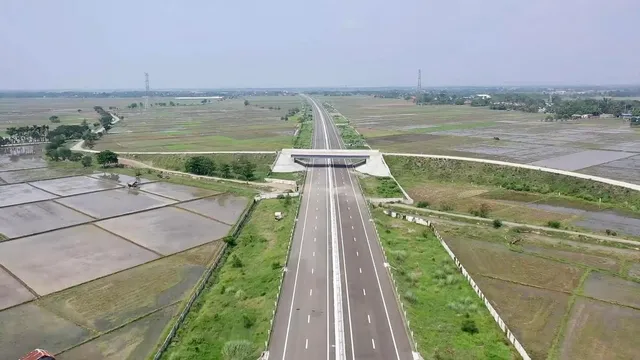
July 18, 2022

Photo credit: build.gov.ph

China on Sunday said it is “negotiating” with the Philippines over the funding of some infrastructure projects after a Philippine transport official bared that these were deemed “withdrawn” due to Beijing’s inaction on funding requests by the previous administration.

The Chinese Embassy issued the clarification after Transport Undersecretary for Railways Cesar Chavez revealed that the Philippines scrapped its loan applications for three big-ticket railways— the Philippine National Railways Bicol project, Subic-Clark Railway Project, and the first phase of the Mindanao Railway Project— due to Beijing’s unresponsiveness to its loan application since 2019.

Chavez earlier said President Ferdinand "Bongbong" Marcos Jr. is looking at renegotiating the loans with Beijing or negotiating with other countries.

In a statement, the Chinese Embassy did not directly mention the funding withdrawal, but vowed to “tap its own advantage and support the Philippines to improve its infrastructure.”

“Our two sides have been negotiating technical issues and made positive progress to move the projects forward,” the embassy said.

The embassy said “China is open for technical discussions over our G-to-G [government-to-government] projects, and is ready to carry our cooperation forward, in close communication with the Philippine new administration.”

According to the embassy, China has helped the Philippines complete 17 projects while more than 20 projects are under implementation or in progress.

“Over the past two years, Covid-19 has impacted implementation of some projects, hindering the site availability, causing delays of procurement, affecting goods mobility, and so on. Despite those difficulties and challenges, our two sides have worked tirelessly to push the projects forward and yielded rich outcomes, spanning from anti-pandemic response, disaster relief to infrastructure, agriculture, and other fields,” the embassy said.

New era of friendship

The Chinese Embassy described the phone conversation between Chinese President Xi Jinping and Marcos on May 18 and recent high-level visits as having ushered in “a new era of China-Philippine friendship.”

“Governments of the two countries are dedicated to further enhancing friendship and mutual trust, adhering to good-neighborliness and deepening mutually beneficial cooperation. China’s policy towards the Philippines has always been and will continue to be consistent and stable as ever,” the embassy said.

The Chinese Embassy expressed confidence that “continuity” would be secured in relations between two countries as well as the bilateral practical cooperation.

“Looking forward, China will build on the past fruition and further our cooperation in agriculture, infrastructure, energy, people-to-people exchange, and other fields,” it added.

Chavez said China's funding commitment for the railway projects was "deemed canceled" as China has been unresponsive to the Philippine government's loan application since 2019.

He said the Chinese bank was asking for 3-percent interest on the loans, much higher than the 0.01-percent rate charged by Japan. By Azer Parrocha


Article courtesy of the Philippine News Agency

July 18, 2022

President Ferdinand Marcos Jr. wants more investments in the rail transport sector as he directed the Department of Transportation (DOTr) to go back to the negotiating table to secure the loan agreements for three big-ticket railway projects, the agency said on Saturday.

“The President was referring to the Subic-Clark Railway Project; the Philippine National Railways (PNR) South Long-Haul Project and the Davao-Digos segment of the Mindanao Railway Project (MRP),” DOTr Undersecretary for Railways Cesar Chavez said.

Chavez  said the three railway projects was to be funded under China’s official development assistance (ODA) through loan agreements between the governments of the Republic of the Philippines and the Peoples Republic of China.

“There was a policy discussion on three China ODA Rail Projects in last Tuesday’s Cabinet Meeting during which the President commented that as a matter of policy, we should encourage more investments in rail and that we should focus more on rail transport,” Chavez said.

Chavez explained the status for each of the three big-ticket railway projects:

Last January, the contract for the PHP142-billion PNR South Long-Haul Project -- also called the PNR Bicol Express -- was awarded to the joint venture of China Railway Group Ltd., China Railway No. 3 Engineering Group Co. Ltd., and China Railway Engineering Consulting Group Co. Ltd.

The PHP83-billion Tagum-Davao-Digos segment of the MRP, on the other hand, failed to proceed after China was unable to submit a shortlist of contractors for its design-build contract.

Meanwhile, the contract for the construction of the PHP51-billion Subic-Clark Railway Project was awarded to China Harbour Engineering Co. in December 2020.

Chavez had said the loan agreements for three railway projects are now considered “withdrawn” after the Chinese government failed to act on the funding requests by the former Duterte administration.

He said negotiations for the three projects began in 2018 and have been approved by the National Economic and Development Authority (NEDA) to receive ODA loan from China.

From 2021 to 2022, Chavez said the Department of Finance (DOF) informed China Eximbank that the submitted loan applications would only be valid until May 31, 2022, and would be automatically withdrawn if not then approved.

Former Finance Secretary Carlos Dominguez III later decided to cancel the loan applications with China in the light of the upcoming transition of government and in deference to the incoming administration.

Chavez said other funding options are also being considered for the three railway projects such as the possibility of opening it for the private sector since the government thrust is towards public-private-partnerships (PPP).

At the beginning of his term, then-President Duterte brought home USD24 billion or about PHP1.2 trillion worth of pledges in loans and grants from China as part of his “Build, Build, Build” program after chief executive’s state visit to Beijing in October 2016.

On record, the Philippines has so far received from China about PHP12.18 billion loan for Kaliwa Dam project, PHP5.9 billion grant for the Binondo-Intramuros and Estrella-Pantaleon bridges, PHP4.37 billion loan for the Chico River Pump Irrigation project, and PHP998 million grant for the Marawi City rehabilitation.

July 18, 2022

The loan agreements for three railway projects are now considered “withdrawn” after the Chinese government failed to act on the funding requests by the Duterte administration, an official of the Department of Transportation (DOTr) said Friday.

DOTr Undersecretary for Railways Cesar Chavez said negotiations for the three projects began in 2018 and have been approved by the National Economic and Development Authority (NEDA) to receive official development assistance (ODA) loan from China.

Based on “applicable executive agreements” between the Philippines and China, he said the DOTr had earlier procured and awarded contracts for the engineering, procurement, construction, and commissioning of the Subic-Clark Railway Project; the design-build of the Philippine National Railways (PNR) South Long-Haul Project; and for the project management consultant of the Mindanao Railway Project (MRP).

From 2021 to 2022, he said the Department of Finance (DOF) informed China Eximbank that the submitted loan applications would only be valid until May 31, 2022, and would be automatically withdrawn if not then approved.

"In his text message to me this mornning, former Finance Secretary Sonny Dominguez said that he 'cancelled the application instead of keeping it in suspended animation," Chavez said. “DOTr understands that this is in light of the upcoming transition of government, and in deference to the incoming administration."

With the withdrawal of the loan applications, he said the current DOTr leadership has “immediately” written and coordinated with the DOF to initiate “policy discussions” on the future of the three China-backed rail projects.

“Policy discussion on the way forward for the above three China ODA Rail Projects has also been initiated at the July 12 Cabinet Meeting, during which [President Ferdinand ‘Bongbong’ Marcos Jr.] commented that as a matter of policy, we should encourage more investment in rail and that we should focus more on rail transport,” he said.

In January, the contract for the PHP142-billion PNR South Long-Haul Project -- also called the PNR Bicol Express -- was awarded to the joint venture of China Railway Group Ltd., China Railway No. 3 Engineering Group Co. Ltd., and China Railway Engineering Consulting Group Co. Ltd.

On the other hand, the PHP83 billion Tagum-Davao-Digos segment of the MRP failed to proceed after China was unable to submit a shortlist of contractors for its design-build contract.

The contract for the construction of the PHP51 billion Subic-Clark Railway Project was awarded to China Harbour Engineering Co. in December 2020.

July 11, 2022

Photo credit: The Department of Public Works and Highways

The Department of Public Works and Highways (DPWH) is exploring the opportunity to tap financing and technical support from World Bank for its proposed Infrastructure Development Plan for Greater Metropolitan Sulu.
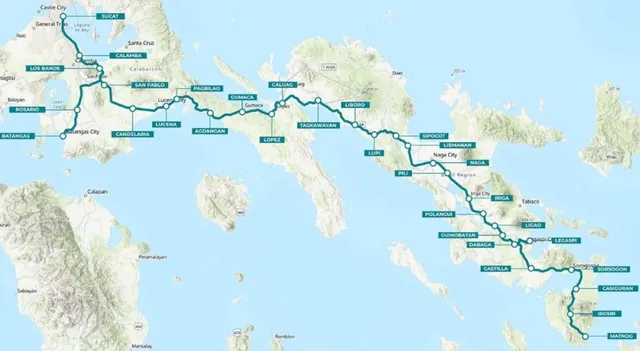
In his report to Secretary Manuel M. Bonoan, Undersecretary for Unified Project Management Office (UPMO) Operations Emil K. Sadain said that World Bank has expressed interest to provide funding support to DPWH-proposed infrastructure projects in Sulu aimed at reviving the status of the province of Bangsamoro Autonomous Region in Muslim Mindanao (BARMM) as a main economic and trade hub not only for Mindanao but for the Philippines.

Undersecretary Sadain and Dr. Ndiamé Diop, World Bank Country Director for the Philippines, Malaysia, Thailand and Brunei, met on July 7, 2022 and discussed ways to further strengthen cooperation on planned developmental projects specifically roads and bridges; water supply system; sanitation development; and urban renewal at coastal communities.

The World Bank executive reaffirmed the Bank’s support to DPWH initiatives that will address Sulu’s need for clean water and proper sanitation, opportunity to improve transportation facilities that will also benefit delivery of agricultural products, development and promotion of various heritage and tourism potentials, building of sustainable communities and eventual decline of armed conflict due to available and improved economic opportunities.

“I am grateful to the World Bank for showing the desire to partner anew with DPWH on projects that will help in the food security program, raise living standards of people, and in advancing economic transformation of Sulu”, Secretary Bonoan said.

Other than Undersecretary Sadain and Dr. Diop, the meeting at the DPWH Central Office was attended by DPWH UPMO Project Directors Ramon Arriola III and Sharif Madsmo H. Hasim; Project Manager Shirley Castro; and World Bank Sector Leader for Sustainable Development for the Brunei, Malaysia, Philippines and Thailand (BMPT) Program Ms. Madhu Raghunath together with Ma. Fiorella Fabella, Mavi Ladia, and Hope Gerochi.

Pursuant to Section 37 Article 13 of the Bangsamoro Organic Law, DPWH is committed to bringing development in the Bangsamoro Autonomous Region specifically in the construction and maintenance of national roads and bridges, water supply services, and flood control and irrigation system.

“By coming up with several infra projects, community-driven development and social services, the aspirations of the people of Sulu who have suffered from decades of conflict and underdevelopment will be addressed with positive change in terms of employment and opportunities to escape poverty”, said Undersecretary Sadain, DPWH Alternate Representative and Focal Person for BARMM.

Proposed DPWH - World Bank partnership for Sulu has the following scope of activities: preparation of a detailed engineering design, conduct of civil works and construction supervision for Sulu Mainland Water Supply Project; preparation of a feasibility study, detailed engineering design, conduct of civil works and construction of Jolo Sanitation Development Program; preparation of detailed engineering design, conduct of civil works, and construction supervision for the 161-kilometer Sulu Circumferential and 77-kilometer Transcentral Roads, and additional 42-kilometer loop roads; preparation of master plan and feasibility studies, detailed engineering design, and conduct of civil works and construction supervision for Urban Renewal Program at Coastal Communities.

Under DPWH Department Order 87, Sulu Circumferential Road in the first and second legislative districts was recently converted into national road under the jurisdiction of DPWH thru the Regional Project Management Office – BARMM and Regional Office 9.

July 07, 2022

Photo credit: Department of Public Works and Highways
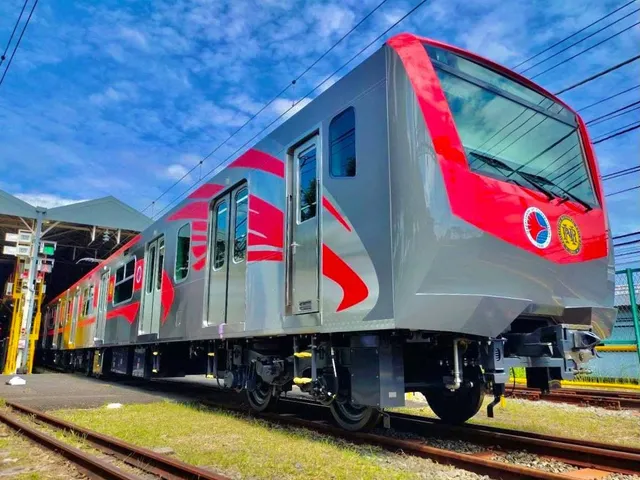
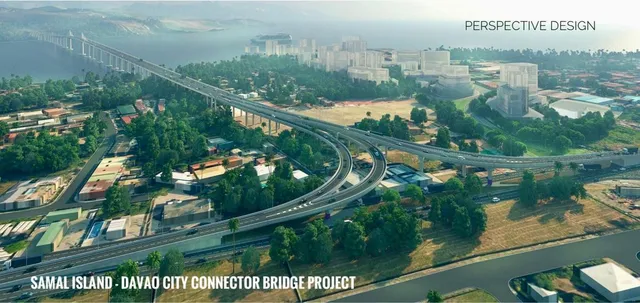
It is all systems go for the design and build of Samal Island-Davao City Connector Project of the Department of Public Works and Highways (DPWH).

A launching ceremony of the bridge project to be funded by Official Development Assistance (ODA) from People's Republic of China (PRC) was held Wednesday, July 6, 2022 at the Department of Foreign Affairs (DFA) Main Office in Roxas Boulevard, Pasay City.

The scale model of the 3.98 kilometers Samal Island-Davao City Connector Project was formally unveiled by visiting Chinese State Councilor and Foreign Minister Wang Yi; Ambassador Huang Xilian of the People’s Republic of China in the Republic of the Philippines; DFA Secretary Enrique A. Manalo; and DPWH Secretary Manuel M. Bonoan and Undersecretary Emil K. Sadain.

The event was also highlighted by the unveiling of commemorative plaque for Samal Island-Davao City Connector Project.

Secretary Bonoan said that the construction of toll-free, four-lane Samal Island-Davao City Connector is good news to commuters and motorists in Davao Region as it will connect in five (5) minutes the beautiful Island Garden City of Samal and the highly urbanized Davao City.

This means faster travel time, less traffic gridlock and improved productivity affecting around 25,000 vehicles traversing these areas on a daily basis, added Secretary Bonoan.

The Samal Island-Davao City Connector Project seeks to enhance internal mobility and external linkages to support the economic and tourist growth potential of the local region.

The project is the first loan agreement of the Government of the Philippines and the People’s Republic of China for an infrastructure project under implementation of DPWH Unified Project Management Office (UPMO) Operations.

A flagship project under the Build Build Build program, the Samal Island-Davao City Connector Project is a key Government-to-Government cooperation project between the Philippines and China. Implementation will be started this year 2022 and targetted for completion by 2027.

Underscretary Sadain, in-charge of DPWH UPMO Operations, said that the bilateral relations between the Philippines and China have significantly grown especially with the completion of the two (2) China-grant bridges namely Estrella-Pantaleon and Binondo-Intramuros Bridges which has become a landmark tourist attraction because of their aesthetic and iconic design.

With an indicative cost of ₱23.039-billion, Samal Island-Davao City Connector Project is envisioned as a modern bridge that will connect the Samal Circumferential Road in Barangay Limao, Island Garden City of Samal to Davao City in between R. Castillo-Daang Maharlika junction.

Crossing over Pakiputan Strait, Samal Island-Davao City Connector has a width of 24 meters and a vertical navigational clearance up to 47 meters and will also be supported by two (2) pylons with a height of 73 meters.


Article courtesy of the Department of Public Works and Highways
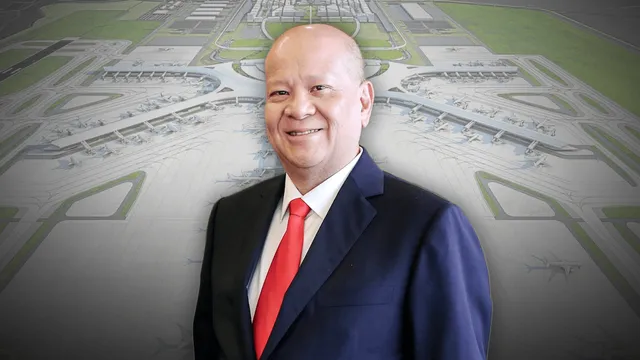
July 07, 2022

Photo credit: Global Daily Mirror

Government stands to reap upwards of US$200B in export revenues annually from potential foreign investors from the aviation, manufacturing, technology, education, healthcare, and tourism industries, if the vision for the Bulacan Airport Economic Zone is realized, SMC President and Chief Executive Officer Ramon S. Ang said. 

Following the recent veto by Malacanang of House Bill 7575, “An Act Establishing the Bulacan Airport City Special Economic Zone and Freeport”, Ang expressed optimism that the vision for the ecozone could still be realized, given the many benefits it will bring to the country. 

“We respect and abide by the government's decision. We thank him for recognizing where the proposed Freeport bill can be further improved, and we look forward to working with his administration towards perfecting this. We are eager to continue working with government, and play an active role in helping our country reach its goals — as we have faithfully and consistently done,” said Ang. 

Ang, whose SMC is fully financing and building the P740 -billion New Manila International Airport (NMIA) project in Bulacan, maintained a positive outlook about the decision, saying that if all the issues raised in the President’s veto could be addressed, and recognizing that the primary intent of the ecozone is for the benefit the country and Filipinos, its full potential could still be realized. 

Ang added that the Bulacan economic zone, if approved, would be managed by the Philippine government, and any tax incentives to be given to investors will still pass the Department of Finance’s Fiscal Incentives Review Board (FIRB) review and approval process, to ensure these are aligned with the CREATE Law. 

The CREATE Law was enacted to provide relief to foreign and local corporations already doing business in the Philippines, in light of the pandemic. 

“Among our plans for the ecozone is to help create science and technology export hubs with the cheapest logistics cost, because these will be close to the airport and seaport. We are looking to attract world-class semiconductor manufacturers, battery power storage system manufacturers, electric vehicle makers, and even modular nuclear power assemblies and other new and emerging tech industries. We estimate these industries alone will add some US$200 billion in annual exports—a big boost to our GDP,” Ang said. 

He expressed firm belief that the long-term benefits to the country of the ecozone would far outweigh and outnumber any supposed “losses” due to the grant of incentives to potential investors. 

He said these benefits include hundreds of thousands of new jobs to be generated, which will benefit the next and future generations of young Filipino graduates, professionals, and skilled workers. 

The transfer of knowledge and technology from foreign investors and locators, as well as access to world-class education and healthcare opportunities and services — industries the ecozone also looks to attract — would also be invaluable. 

These are on top of the trillions in tax revenues that will accrue to the government for the entire lifetime of the ecozone and airport, coming from the various industries and institutions that will set up facilities and operations there, to take advantage of the low cost of logistics, incentives, and our country’s primary asset: a high-quality workforce. 

“Incentives are a way for government to attract much-needed investments into our country, especially now that we are all pulling together to help our economy not just recover, but continuously grow in the post-pandemic era. This way, our future generations will have enough and better opportunities than we have.” 

Ang also addressed the issue of NMIA being close to the Clark Airport, which was mentioned in the veto and was initially raised by the DoF under the previous administration, which said NMIA would “compete” with Clark International Airport. 

Ang said that apart from the considerable distance between the two airports—Clark is approximately some 100 kilometers from Metro Manila—large and progressive cities all over the world employ a multiple airport strategy, such as Tokyo and New York, among others. 

Anticipating the long-term population and economic growth of Metro Manila and Luzon provinces in the next 20-30 years, and taking into consideration the limited expansion opportunities for the current gateway, Ninoy Aquino International Airport (NAIA)—which only has space for one runway operating at any given time, compared to NMIA’s four parallel runways—-the country would need several airports to efficiently serve Filipinos, tourists, and industries, Ang added. 

“What we don’t want is to repeat the mistakes of the past where we were not quick enough to develop new infrastructure, giving rise to overcapacity and congestion on our aging roads, ports, and other facilities, and even in our skies. Temporary fixes will not do anymore. We are building for the future, with a clear vision of a fully-developed and progressive, prosperous Philippines,” Ang said. 

Ang said that regardless of the outcome of any further government review or action on the ecozone, SMC remains fully committed to continuing on its path of growth through nation-building, and building the NMIA—seen as the solution to decades of air traffic and land congestion that have severely limited the country’s growth. 

“We believe in, and fully subscribe to President Marcos’ message of unity. It’s something we have always tried to demonstrate in many ways, particularly in times of great difficulty for our nation. We will do everything we can to help President Bongbong Marcos and his administration succeed, because their success is our country’s success. We look forward to working with them and contributing to their efforts to build our country back even better,” Ang said. 


Article courtesy of San Miguel

July 04, 2022

Photo: "ADB has approved up to $4.3 billion to help finance the construction of the South Commuter Railway in the Philippines. The 54.6 km line will connect the capital Manila with the southern city of Calamba and help the country meet its climate change agenda.” [Asian Development Bank Facebook page]

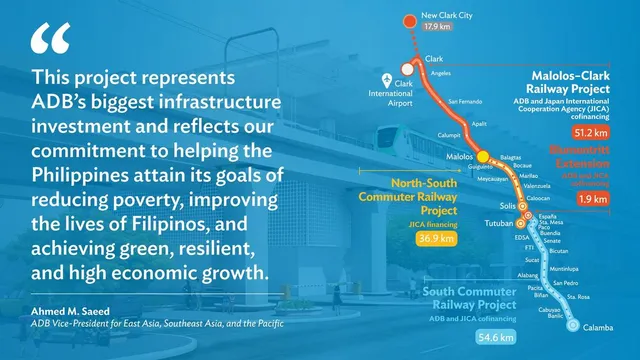
A financial assistance of up to $4.3 billion loan was recently approved by the Asian Development Bank in order to support the construction of a 55-km suburban railway that will connect Metro Manila with the City of Calamba in Laguna province.

This is currently ADB’s largest infrastructure financing in the Asia and the Pacific region. The South Commuter Railway Project is part of the North-South Commuter Railway (NSCR) network. The project aims to provide commuters a fast public transport and reduction of traffic congestion. On a bigger picture, this project addresses the climate change problem since this transportation alternative will help in the reduction of greenhouse gases. Therefore, the project is in conformance with the Philippine climate change agenda.

From a report published by Philippine News Agency, “The project follows ADB’s financing of the Malolos-Clark Railway line north of the capital, for which construction is ongoing.” [1]

ADB Vice-President for East Asia and Southeast Asia and the Pacific, Ahmed Saeed stated, “The South Commuter Railway Project will provide affordable, safe, reliable, and fast public transport for commuters.”

“This project represents ADB’s biggest infrastructure investment and reflects our commitment to helping the Philippines attain its goals of reducing poverty, improving the lives of Filipinos, and achieving green, resilient, and high economic growth.”

Photo credit: Department of Transportation

The design of this railway project will be “disaster-resilient” and can hold out against natural disasters like earthquakes and strong typhoons. The railway’s elevated design will make it possible to avoid disruptions of floodings in the route in case of heavy rains.

Eighteen (18) stations will be constructed in order to deliver convenience and safe accessibility for elderly, people with disabilities, children and others. There will also be connecting tunnels that will facilitate direct trains from Calamba to Metro Manila for future projects.

Will this railway project help commuters travel faster? From the reports, the project is expected to reduce over a half of the usual travel time of 2.5 hours between Manila and Calamba. 

The City of Calamba is a first-class city in the province of Laguna. According to a 2020 census, it has a population of 539,671 people, making it the most densely populated local government unit in Laguna. Calamba is located 50 km (31 mi) south of Manila.

Other than providing convenience and shorter travel time for commuters, the NSCR aims to further boost the country’s economic recovery from the pandemic. The project’s construction will bring job opportunities, both permanent and temporary work.

ADB supports the Department of Transportation (DOTr) through the Infrastructure Preparation and Innovation Facility. ADB’s load will assist the development and projects of DOTr.

Beginning this year, the South Commuter Railway Project will be financed with $1.75 billion, the first tranche of the multitranche financing facility (MFF). The second the third trances is expected to be released in 2024 and 2026. The coverage of ADB’s financing support includes civil works for the railway viaduct, stations, bridges, tunnels and depot buildings. Supporting this project, the The Japan International Cooperation Agency (JICA) will fund the rolling stock and railway systems.

The railway project is part of the Philippine government’s “Build, Build, Build” infrastructure development program. It is also one of the country’s infrastructure flagship projects.

ADB also financed other infrastructure flagship projects like the Metro Manila Bridges Project in 2021, the Angat Water Transmission Improvement Project in 2016, the Malolos Clark Railway Project in 2019, and more.

Since 1966, the Asian Development Bank has been providing financial assistance for the development of countries in Asia and in the Pacific region. ADB aims to reduce extreme poverty which is rampant in these regions. There are around 1.7 billion people in Asia and in the Pacific who are poor and have no access to basic needs and opportunities for a dignified living that every human being deserves to have. ADB supports its members and partners through the granting of loans, technical assistance, grants and equity investments with a goal to promote social and economic development. 

“The Asian Development Bank (ADB) envisions a prosperous, inclusive, resilient, and sustainable Asia and the Pacific, while sustaining its efforts to eradicate extreme poverty in the region. Despite the region's many successes, it remains home to a large share of the world's poor: 263 million living on less than $1.90 a day and 1.1 billion on less than $3.20 a day.” [2]


Reference:

[1] Philippine News Agency (9 June 2022). "ADB approves financing for South Commuter Railway Project" Retrieved from - https://www.pna.gov.ph/articles/1176331

[2] Asian Development Bank website - https://www.adb.org/who-we-are/about

[3] Census of Population (2020). "Region IV-A (Calabarzon)". Total Population by Province, City, Municipality and Barangay. PSA. Retrieved July 8, 2021.

July 04, 2022

Photo credit: Palafox

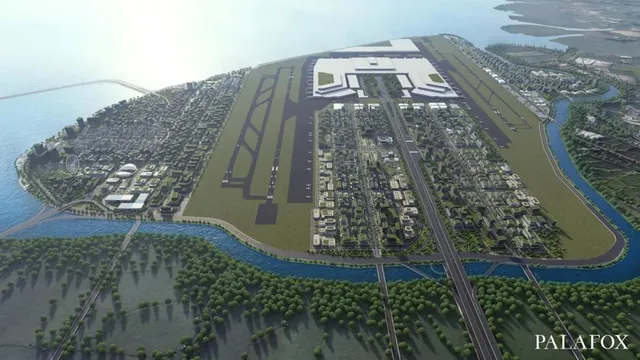
The construction of a 2,500-hectare international airport in Bulakan, Bulacan will proceed even after President Ferdinand “Bongbong” Marcos Jr. vetoed a measure establishing an adjacent special economic zone and freeport.

Press Secretary Trixie Cruz-Angeles explained in a statement on Sunday that the construction of the New Manila International Airport (NMIA), also known as Bulacan International Airport, will push through because Congress has granted San Miguel Corporation (SMC) a franchise for the construction.

“The construction of the Bulacan international airport and aero city is not affected by the veto. The presidential veto was meant to include the necessary corrections and include the missing processes that might render HB (House Bill) 7575 entirely unconstitutional,” Cruz-Angeles said in a press release.

Cruz-Angeles maintained that Marcos fully supports the creation of the Bulacan Airport City Special Economic Zone and Freeport Authority (BACSEZFA) but his decision to veto HB 7575 was meant to “cure the defects found in the measure”.

In his two-page veto message dated July 1 and released the following day, Marcos said the bill "lacks coherence with existing laws, rules, and regulations", noting that it has no provisions for an audit by the Commission on Audit (COA), procedures for expropriation of lands awarded to agrarian reform beneficiaries, and a master plan for the specific boundaries of the economic zone.

“Presidential veto is the fastest way to cure the defects of HB 7575, especially the provision which exempts the Commission on Audit to look into the financial transactions on the special economic zone and freeport. Had the President not vetoed the HB 7575, it would have lapsed into law on July 4 or 30 days after the bill was sent by the legislature to Malacañang,” Cruz-Angeles said.

She noted that all financial transactions in government are audited by COA and the proposed BACSEZFA should be of no exception.

“Without those necessary amendments indicated in the veto explanation, the law may be vulnerable to constitutional challenge. The delegation of rule-making power on environmental laws which is unique to the special economic zone is of particular concern,” she added.

Citing Marcos’ veto message, she explained that the bill did not provide procedures for expropriation of lands awarded to agrarian reform beneficiaries and granted “blanket powers” to the economic zone authority to handle technical airport operations, which would violate aeronautical laws.

The proposed economic zone is also located "in close proximity" to the Clark Special Economic Zone in Pampanga which runs against government policy on creating special economic zones in strategic locations.

BACSEZFA was described by SMC as a “major boost to both national and local economies” as it will complement the PHP740-billion airport project. 

Under its conceptual master plan, the NMIA will feature four parallel runways, world-class terminal, and a modern and interlinked infrastructure network that includes expressways and railways.

SMC president and chief executive officer Ramon S. Ang earlier said the airport's construction and operations will bring inclusive growth to the province post-pandemic.

The project was proposed by SMC as a build-operate-transfer scheme under a 50-year concession.


Article courtesy of the Philippine News Agency

June 23, 2022

Photo credit: Department of Public Works and Highways
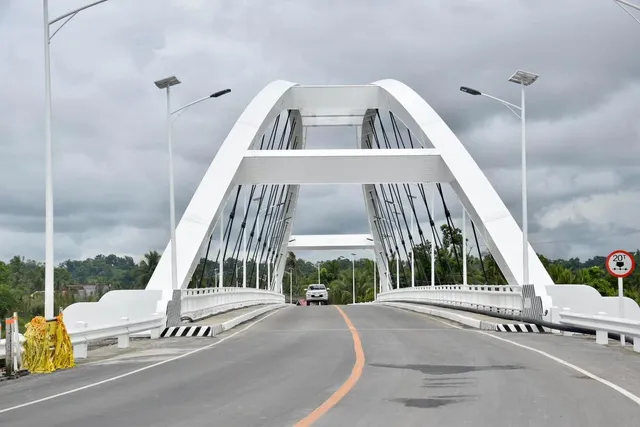
The countdown to the long-awaited day for the full opening to vehicular traffic of the newly built iconic bridge in Loay, Bohol has come to an end.

In his report to Department of Public Works and Highways (DPWH) Acting Secretary Roger G. Mercado, Undersecretary and Build Build Build Program Chief Implementer Emil K. Sadain said that the new Clarin Bridge across Loboc River designed as a nielsen arch superstructure spanning 104 meters has been fully opened for both traffic direction to the motoring public effective Tuesday, June 21, 2022.

Undersecretary Sadain, in-charge of DPWH Unified Project Management Office (UPMO) Operations together with Consulate General of Japan in Cebu Hideki Yamaji; Japan International Cooperation Agency (JICA) Senior Representative Kenji Kuronuma; Bohol Governor Arthur C. Yap; Bohol 3rd District Representative Congresswoman Kristine Alexie Besas-Tutor; and Loay Mayor Hilario L. Ayuban led the ceremonial unveiling of marker of the new resilient bridge under the JICA-assisted Road Upgrading/Improvement Component of the Road Upgrading and Preservation Project (RUPP).

Other key personalities that participated at the inauguration ceremony are DPWH Undersecretary Maximo L. Carvajal; Assistant Secretary Wilfredo S. Mallari; Project Director Benjamin A. Bautista and Project Manager Franscisco Sawali of UPMO - Roads Management Cluster I (UPMO-RMC 1); Bureau of Design Director Edwin Matanguihan; Bureau of Construction Director Aristarco Doroy; Region 7 Director Edgar Tabacon and Assistant Director Mario Montejo; Project Manager Luis Paredes; Project Engineer Bernardo Austria; Bohol District Engineers Magiting A. Cruz, Vicente R. Valle Jr., and Godofredo R. Laga Jr.; and other local government officials of Bohol.

Costing ₱501.87-million, Clarin Bridge is part of the Bohol Circumferential Road and will serve an important role in the mobility of goods and people and provide greater access to the tourism sites of Bohol Province.

Economic development in the area will surely surge from improved transport of goods and services and more local and foreign tourists visiting the wonders of Bohol.

The bridge has an approach road at Abutment “A” of 209 meters and at Abutment “B” of 217 meters with enhancement of landscape and protection work to be done near the bank of Loboc River, one of Bohol’s major tourism destination.

Undersecretary Sadain said the new bridge is another thread of friendship linking Philippines and Japan steady and long-term development of meaningful bilateral cooperation.

For over decades, the time-tested cooperation of the Philippines and Japan has brought so much development in the country.

On behalf of Secretary Mercado, allow me to extend my heartfelt gratitude to the representatives of the Government of Japan led by the Consul – General Yamaji and JICA Philippines Senior Representative Kenji Kuronuma for letting your presence grace this ceremonial groundbreaking, added Undersecretary Sadain.

Although challenged by a global pandemic that hampered project progress in general, the completion of new Clarin Bridge is a timely response to address the urgent need for a safer and sturdier replacement for decades-old structure especially those affected by recent calamities.

Construction of Clarin Bridge consist of 12 pieces bored piles 1,200-millimeter diameter each abutment in a new alignment; reinforced concrete deck slab with asphalt concrete pavement overlay and reinforced concrete sidewalk with metal railings at bridge; and miscellaneous structures and lighting works.

The approach road was laid with bituminous asphalt concrete pavement with installed metal beam guardrail on reinforced concrete posts; and provision of service roads no. 1 and 2 with 230-millimeter-thick portland concrete cement pavement.

Implemented by DPWH UPMO-RMC1, the project was undertaken by joint venture contractor Vicente T. Lao Construction and PT Wijaya Karya TBK.


Article courtesy of Department of Public Works and Highways