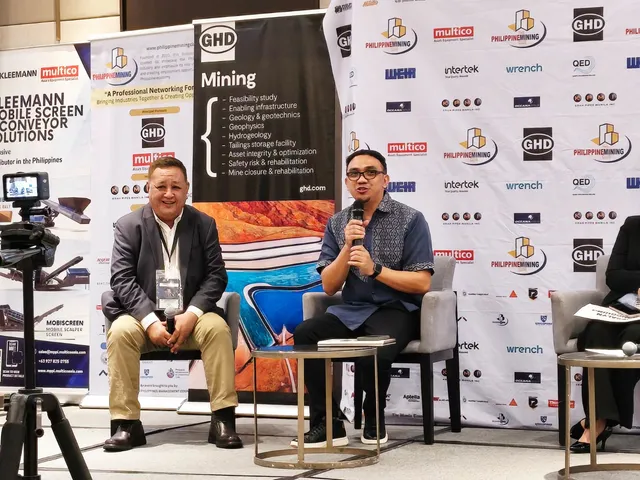
A team of student researchers from Adamson University presented promising preliminary results in the search for safer, more sustainable methods of gold processing in the Philippines, successfully extracting gold from local ores using a simple amino acid and oxygen at room temperature.
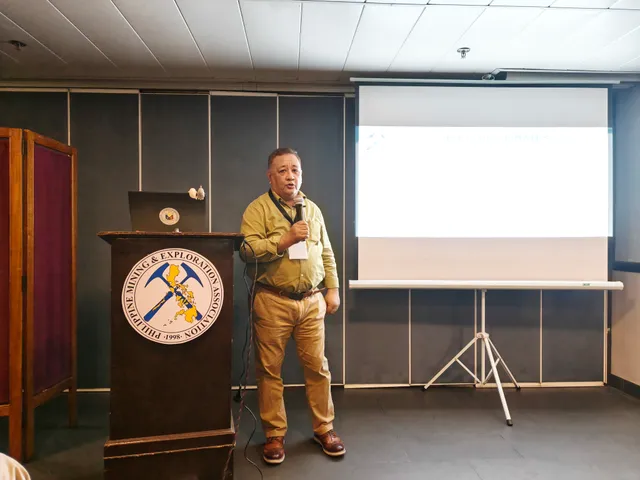
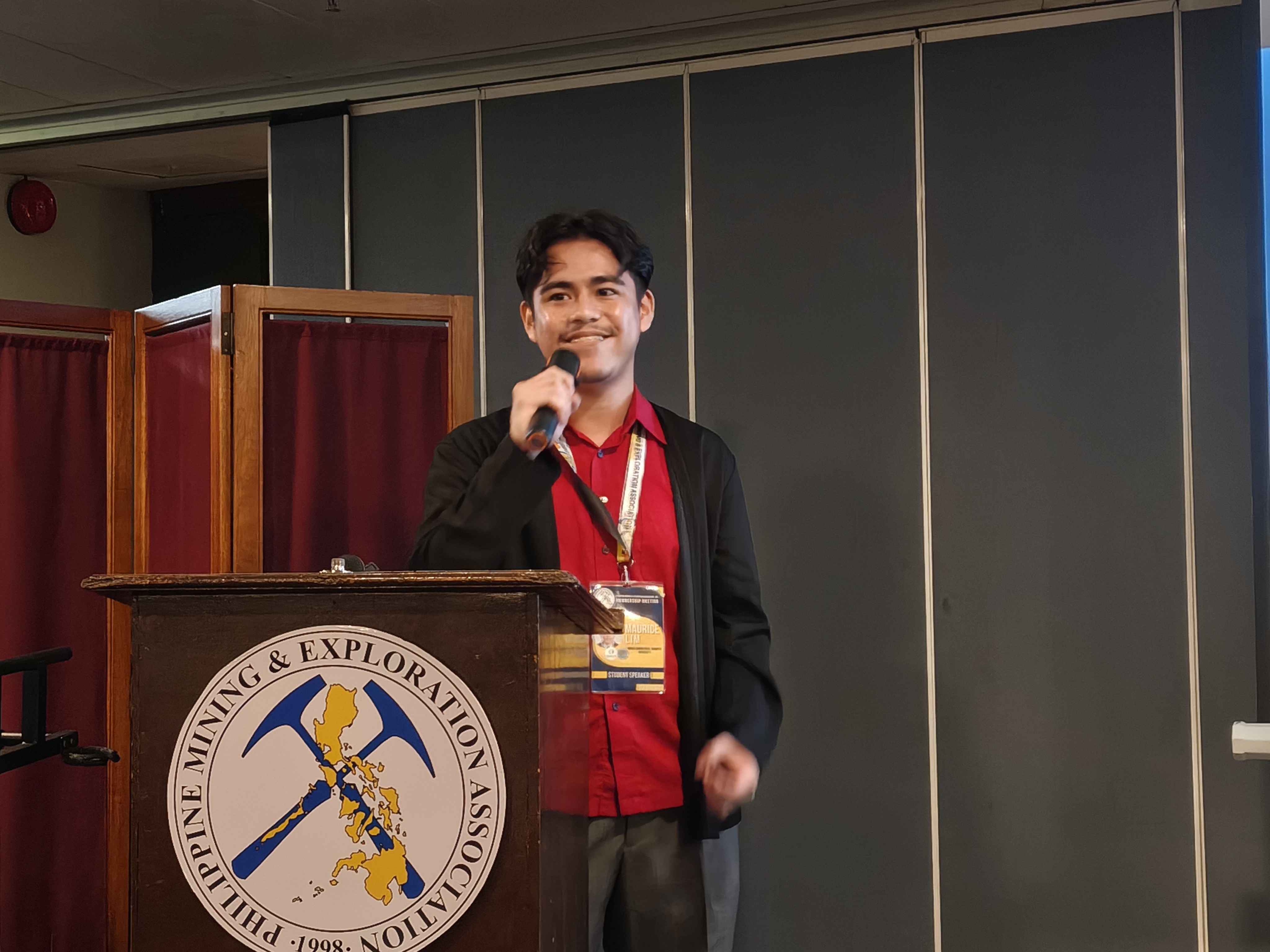
Maurice Gail Lim, a Mining Engineering student who graduated recently, shared the findings on behalf of co-researchers Franzine Mae Angeles, Augi Diane Ganda, and Tristan Bernard Mendoza, under the mentorship of adviser Engr. Angelo Siervo. Their thesis is titled, “Cyanide-Free Gold Extraction Using Aerated Glycine - A preliminary laboratory investigation on Philippine gold ores (Runruno, Nueva Vizcaya & Paracale, Camarines Norte)”.
The study was supported by FCF Minerals Corporation, Apex Mining, and the Mines and Geosciences Bureau (MGB) Metallurgical Technology Division.
For over a century, cyanide has served as the backbone of modern gold processing. However, its use involves strict regulatory and environmental responsibilities.
In the Philippines, cyanide is strictly managed under the Chemical Control Order pursuant to Republic Act No. 6969, requiring stringent permitting, handling, containment, and safety protocols.
Furthermore, processing complex local mineral systems, such as copper-bearing and sulfide-rich ores, presents additional metallurgical challenges.
In the pursuit of finding an alternative solution that is optimal to actual Philippine conditions, the research team conducted a scientific study that aims to identify the potential use of glycine, a common amino acid.
The experiment’s methodology begins with mixing finely ground gold ore to an alkaline glycine solution. Oxygen is introduced via aeration to act as an oxidant, allowing glycine to form a complex with the dissolved gold so it remains in solution for subsequent recovery.
Glycine was chosen for this experiment due to its lower toxicity level compared with cyanide. Glycine is also biodegradable, recyclable, and selective under alkaline conditions.
The Alternative: Glycine + Aeration
- Glycine is an amino acid - the same type found in everyday food and our bodies.
- It is non-toxic, biodegradable, and fully recyclable after leaching.
- Air (oxygen) replaces cyanide as the chemical 'activator' that enables gold to dissolve.
- Instead of: Crush ore -> add cyanide -> toxic effluent,
- We use: Crush ore -> add glycine + air -> safe solution
To explain that in technical terms:
- Glycination anion (NH2CH2COO-) stable at pH >9.78 (alkaline condition)
- Forms bis-glycinato gold(I) complex [Au(Gly)2]- (log β2 = 18.0) -- thermodynamically stable
- O2 from aeration is the electron acceptor: Au0 -> Au+ + e- (anodic), O2 + H2O + e- -> OH- (cathodic)
- Glycine shows negligible dissolution of Fe, Mn, Al, Si in alkaline conditions--excellent selectivity
Experimental Design and Methodology
To test the method against real-world complexities rather than idealized laboratory samples, the researchers utilized ores from two distinct geological regions: the complex, sulfide-bearing mineral system of Runruno in Nueva Vizcaya, sourced with the aid of FCF Minerals Corporation, and the historic epithermal gold district of Paracale in Camarines Norte.
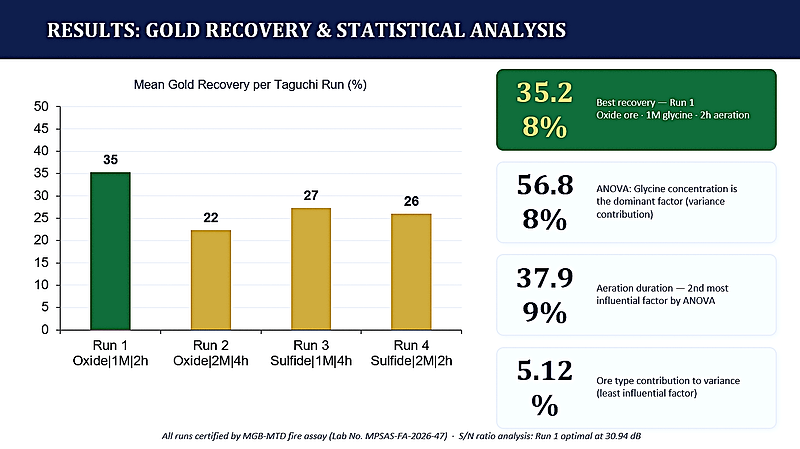
Using a Taguchi orthogonal design at room temperature over a 24-hour leaching period, and verifying results through fire assays conducted with the MGB laboratory, the team’s best-performing condition yielded a mean gold recovery of approximately 35%.
While modest compared to fully optimized industrial cyanidation circuits, the researchers noted that the experiments were conducted using ambient temperatures and unoptimized oxygen-supply setups. In relation to this, statistical analysis revealed that simply increasing glycine concentration and aeration duration did not automatically improve recovery. On the contrary, higher concentrations and longer closed aeration periods occasionally resulted in lower yields.
Lim compared the phenomenon to a candle in a sealed room: as the system's dissolved oxygen was consumed by reactions within the slurry during the closed 24-hour period, the oxidizing capacity progressively declined.
Gold Recovery
Their findings suggest that oxygen availability is a critical limiting factor in glycine leaching, indicating that the chemical limits of the process have not yet been fully reached. The team hopes these insights will pave the way for more efficient, environmentally responsible gold extraction technologies suited for the diverse mineral wealth of the Philippines.
The experimental findings indicate that gold recovery using an aerated glycine system is viable on Philippine gold-bearing materials, though researchers emphasize that the technology is not yet ready to replace conventional cyanide processing.
“A limitation caused by oxygen transfer is fundamentally an engineering problem—and engineering problems can be addressed through reactor design, continuous air sparging, agitation, oxygen management, and improved mass transfer.”
“Our results therefore should not be interpreted as claiming that glycine is already ready to replace cyanide tomorrow.”
“Rather, they provide preliminary evidence that gold recovery using an aerated glycine system is possible on Philippine gold-bearing materials and identify the process limitations that must be addressed next. That brings us to the future of the research.”
To outline the next steps and industry implications:
1) The first priority is continuous aeration.
Replace sealed-bottle setup with open-vessel or continuously sparged reactors. Expected: break well past 50% recovery barrier at ambient conditions.
“Instead of supplying oxygen only during the initial portion of the experiment, future tests should maintain oxygen availability throughout the leaching period. This will allow us to determine how much of the observed recovery limitation was truly caused by oxidant starvation.”
2) The second priority is temperature.
Elevated Temperature (40°C to 60°C) - Literature shows 75% to 95% recovery achievable. Modest heating + aeration unlock the full potential of the system for Philippine complex ores.
“Our current investigation was deliberately performed at room temperature. Future work can examine moderate operating temperatures to determine whether improved reaction kinetics can significantly increase gold extraction.”
3) The third priority is mineralogical characterization.
Advanced Ore Characterization - XRD + SEM-EDS on Runruno and Paracale composites to quantify gold encapsulation, sulfide reactivity, and preg-robbing potential.
“Techniques such as X-ray diffraction and scanning electron microscopy with energy-dispersive spectroscopy can help determine exactly where the gold is hosted, how much is associated with sulfide minerals, and whether encapsulation or preg-robbing materials are limiting extraction.”
4) Finally, the process must eventually move beyond gram-scale laboratory experiments.
Pilot-Scale Demonstration - Scale from 90g bottle roll to 50 kg to 100 kg pilot reactor. Interested mining companies and research institutions are invited to collaborate.
“Rather than signaling an immediate industry-wide transition, the results provide a foundational proof of concept for glycine leaching locally, while clearly mapping out the operational challenges that must be overcome next.”
To address these limitations, researchers have outlined a targeted roadmap for the future of the research:
Lim noted that, “Ultimately, the initiative aims to scale up from gram-scale laboratory tests to pilot-scale operations. Realizing this transition will require a collaborative multi-sector effort, engaging universities, government laboratories, mining companies, metallurgical experts, and industry bodies such as the Philippine Mine Safety and Environment Association (PMEA).”
He explained that if continuous aeration and further optimization substantially improve recovery, the logical next step would be larger laboratory and pilot-scale testing. “That transition will require collaboration among universities, government laboratories, mining companies, metallurgists, and organizations such as PMEA.”
On a final note, Lim stated, “Our study does not claim to have solved cyanide-free gold extraction.
What we believe we have done is establish a Philippine starting point.”
“For more than a century, cyanide has defined how the world thinks about gold extraction. But the next generation of mining engineers should also be willing to ask whether the processes we inherited are the only processes available to us.”
“This research is still preliminary. There is much more work ahead of us,” he said.
This study is the first systematic evaluation of aerated glycine on Philippine gold ores. The team has proven the chemistry. The industry can solve the engineering. Let us work together!
---
Acknowledgement: Thank you for the support of FCF Minerals Corporation, Apex Mining, and the Mines and Geosciences Bureau Metallurgical Technology Division, for making this research possible.
Note: All technical information and chart presented in this article are property of the research team who conducted the experiment and study.
Reference:
Lim, Maurice Gail, Angeles, Franzine Mae, Ganda, Augi Diane, Mendoza, Tristan Bernard [July 6, 2026]. “Cyanide-Free Gold Extraction Using Aerated Glycine - A preliminary laboratory investigation on Philippine gold ores (Runruno, Nueva Vizcaya & Paracale, Camarines Norte)”. PMEA Monthly Membership Meeting presentation.