The Philippines is not poor in minerals; it is poor in converting them into national value. Government and industry estimates place the country’s untapped mineral wealth at more than $1 trillion, a figure supported by a 2025 analysis by John P. Causey IV for Vantage FDI. This analysis ranks the archipelago among the world’s mineral heavyweights, placing it fourth globally in copper ore with roughly 4.41 billion tons and fifth in nickel with about 5.29 million tons. Beyond these primary reserves, the Philippines holds substantial potential in cobalt, gold, silver, and early-stage rare-earth minerals. Yet, the more revealing statistic is not what lies underground; it is how little of it has been seriously studied. Only about five percent of the country’s mineral potential has been actively explored, while mining contracts cover just around three percent of the land.
That is not a failure of geology; it is a failure of governance.
The mining sector’s modest economic footprint highlights this contradiction, with mineral exports reaching approximately $7.37 billion in 2024. At year-end, the country had 58 operating mines, including 36 nickel, 11 gold, and three copper operations. Despite this endowment, mining contributes only about one percent of the gross domestic product. For a nation sitting on minerals critical for batteries, power grids, and the global energy transition, this is a surprisingly small return on a massive endowment.
This staggering gap stems from tenurial stasis, a state of paralysis where development is choked by technical incapacity and an accumulation of cancelled, withdrawn, or expired permits. The Department of Environment and Natural Resources has signaled an end to this inactivity. In October 2025, DENR Undersecretary Carlos Primo David announced new policies aimed at raising the sector’s GDP contribution to approximately two percent. Central to this pivot is the implementation of a performance-based mandate to dispose of roughly 50 idle assets through a competitive selection process.

While the instinct to mobilize national wealth is correct, as a mining tenement is a privilege granted over a public resource rather than a trophy, the phrase "Use It or Lose It" is easier to chant than to administer. Used carefully, it can pry open idle assets; used crudely, it can turn an investment reform into a litigation machine. To ensure this reform attracts serious capital, the new guidelines must be built upon a framework of five essential tasks.
The first task is classification. The government must distinguish between dormancy and strategy. Large-scale mining operates on a decadal horizon distinct from standard commercial cycles, involving a complex progression of exploration and permitting that unfolds over years. In large tenements, phased development is a strategic necessity rather than an act of neglect. A project may develop one area while studying another to ensure operational cash flow and grade control. The guidelines must separate those who cannot perform from those developing responsibly in phases to avoid punishing patient capital.
The second task is legal fidelity. Administrative guidelines cannot quietly narrow statutory rights through technicalities or retroactive disqualifications. Republic Act No. 7942 provides that mineral agreements are renewable under the same terms and conditions. The framework must ensure that filing timelines do not act as extra-statutory disqualifications that trigger forfeiture. Because regulatory stasis often results from permitting backlogs or weather disruptions, penalizing an operator for external delays could undermine the stability the policy seeks to cultivate.
The third task is ensuring title stability. Substantial capital investment is rarely allocated to assets with unresolved legal status. A tenement entangled in litigation does not constitute a bankable opportunity; rather, it represents an inherent legal risk that complicates project financing and valuation. Before any area is offered to bidders, the state should require a clean title certification to ensure the prior right was validly terminated and remains free from pending contest. Without this safeguard, competitive selection merely transfers regulatory uncertainty to the investor’s balance sheet.
The fourth task is mandating clean succession. The state should not ask new investors to become insurers of old misconduct. Environmental liabilities, unpaid royalties, and tax delinquencies should remain the legal obligation of the defaulting entity. If rehabilitation risks are assumed by a new grantee, they must be part of a transparent, valued bid package. Hidden liabilities are not governance; they are poison pills.
The fifth task is institutional transparency. Credibility depends on design; criteria for selection should be published, and financial qualifications, such as the $8.7 million minimum paid-up capital benchmark must be measurable. Furthermore, the management of bid proceeds and revolving funds must strictly adhere to Commission on Audit and Department of Budget and Management rules. This ensures the process is driven by public resource stewardship rather than bureaucratic monetization.
The country has long debated mining as a choice between unrestrained extraction and paralysis. That is a false choice. The better path is disciplined development: strict enough to weed out speculators, predictable enough to attract capital, and lawful enough to survive judicial review. A trillion-dollar endowment is merely a headline; it becomes wealth only when law, science, and environmental responsibility align. The country does not need a mining rush; it needs a mining reckoning. The treasure chest has been there all along. The question is whether the State can open it without breaking the lock.
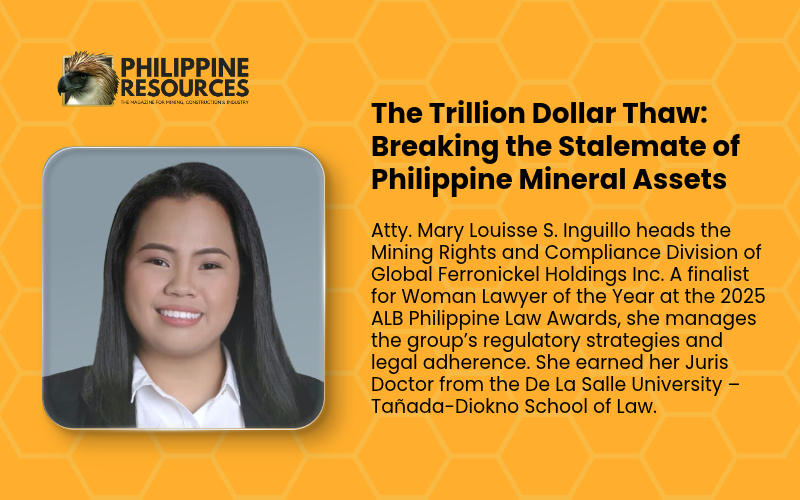
Atty. Mary Louisse S. Inguillo heads the Mining Rights and Compliance Division of Global Ferronickel Holdings Inc. A finalist for Woman Lawyer of the Year at the 2025 ALB Philippine Law Awards, she manages the group’s regulatory strategies and legal adherence. She earned her Juris Doctor from the De La Salle University – Tañada-Diokno School of Law.