Its All About the People
For RDCL its all about the people. It’s Malasakit, family and caring; these concepts capture RDCL’s ethos. That is how we engage with clients. When you join with us and work together we all realise our common goals, and we want everybody who engages with us, to come out better as a result.
Searching to do things better. That is what we strive for at RDCL. Just like the famous All Blacks - the most successful team in the world - who consistently inspire their people, drive to improve and successfully disrupt the way the game is played. For us, we have assembled a world-class team of geologists, geophysicists and geotechnical engineers, with a view to being the best in the business when it comes to in-situ ground testing.
With a focus on people, safety and quality assurance, RDCL has an enviable safety record, ISO9001 certification and highly successful track record of delivery in the Philippines since 1994.
Don’t Gamble with the Ground
Talk to us first. Unforeseen ground conditions are one of the single greatest risks to any mining or infrastructure project.
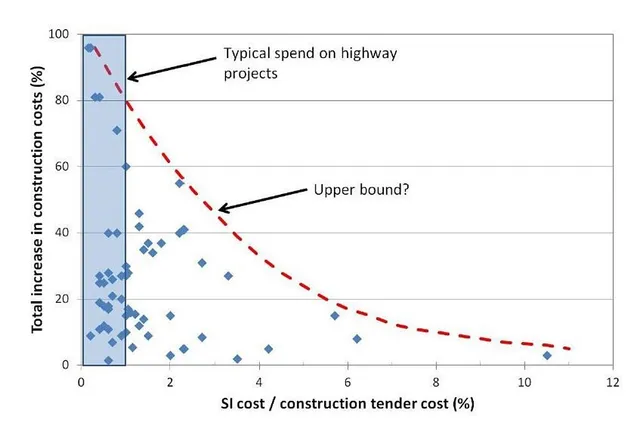
There is strong correlation between a ‘lowest cost’ approach to ground investigations resulting in project delays, inflated contract price and expensive project cost overruns.
Together let’s appropriately-scope geotechnical investigations, execute them to an excellent standard because it’s a right thing to do. The cost of up-front investment compared to the potential cost of unsatisfactory ground performance or unforeseen ground conditions, is a simple equation.
Under-investment in site investigations, leading to unreliable data and inadequate coverage most often lead to cost overruns and delays at the design, tender and construction stages by failing to adequately identify ground issues (Clayton, 2011).
In short, the smart money knows, and international evidence proves that a comprehensive site investigation can pay for itself many times over in construction and the project life cycle, with timely, early intervention (is the) most effective (Lazarus & Clifton, 2001).
Projects Penalised by Poor Practice
With over 25 years, working continuously in the Philippines, Cam Wylie Principal Engineer and Managing Director at RDCL has seen many projects and a lot of ground investigation. Without pulling punches, he believes many projects have stalled due perceived ground risk leading to inflated contract price. In his view, that is often due to poor ground investigation centered on “drillholes”, with poor recovery and quality assurance.
The Rights Tools for the Job
RDCL brings modern ground investigation techniques and makes them available in the Philippines to greatly improve project outcomes. Combined with smart surface geophysics and other downhole measurements such as pressuremeters and shear wave velocities, it is easier to understand the previously unknown. RDCL provides a better dataset so contractors and improve certainty in project estimation.
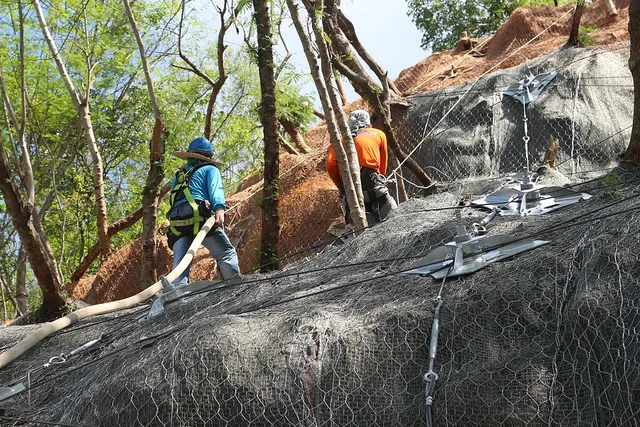
Even with poor drilling, downhole geophysics using televiewers provide a more accurate picture of ground conditions in the borehole walls. This is game changing technology providing a factual, repeatable log of ground not directly affected by the drilling or logging process. The high resolution optical and acoustic logs are digital and produce details that are easily stored for the future for reference during the project life.
As an engineer if you are trying to define fracture zones, accurately map orientation and dip from core and need reliable Rock Quality Designation (RQD) then use televiewers, it makes your job easier.
Cone Penetrometer Testing (CPT) for soft sediments and tailings is leading technology widely deployed in the rest of the world, and available through RDCL in the Philippines. CPT is very fast, accurate and repeatable. CPT is the most versatile in-situ soil test available. The data aids in many geotechnical assessments including liquefaction, bearing capacity (foundations) and settlement.
Make RDCL Your First Phone Call
RDCL has the people and equipment on the ground in the Philippines to execute high quality ground investigations. Our teams and tools are suited to your projects and together we combine our expertise with your design teams to execute any project.
We welcome all inquiries and work best when we engage closely with you to understand your job. That’s what Malasakit means. We invite you to join with us as we take our professional journey towards bigger goals.
It is important for gold mining industries to choose high quality activated carbon in order to improve yield and decrease losses in gold operations. At Philips Carbon, Inc., the company understands that every gram counts.
What is Activated Carbon?
Activated carbon is a processed form of carbon which is extremely porous and with high surface area making it very effective to capture and hold materials. It can be produced from coal, wood, coconut or other carbon-rich organic materials.
The Making of Activated Carbon
Activated carbon is produced through carbonization and activation. The raw material is first carbonized by converting the organic matter into a solid porous carbon through pyrolysis or destructive distillation. The carbonized material or char will then be activated either through chemical or physical activation.
In chemical activation, the char is exposed to acids then subjected to high temperatures. On the other hand, physical activation is done by exposing the raw material to high temperature and steam. Both methods produce different performance for activated carbon. Combination of different raw materials, activation technology and process parameters produce a wide variety of products for a wide variety of application and economic considerations.
Activated carbon Thru Time
It was the Egyptians that first used carbon in the form of charcoal or coal for smelting ores to create bronze in 3750 B.C. In 1500 B.C., they also used it for intestinal ailments, odor adsorption, and for writing. In 400 B.C., the Hindus and Phoenicians used it for water purification. It was in 50 A.D. that Hippocrates and Pliny began using carbon to treat different ailments such as vertigo, epilepsy, and chlorosis.
With technological advancements in the modern times, activated carbon is used to purify liquids and gases in a variety of applications, including municipal drinking water, food and beverage processing, odor removal, and industrial pollution control.
Choosing the Right Activated Carbon for Gold Recovery
There are different types of activated carbon for every type of application. Choosing the right type of activated carbon is oftentimes overlooked because it can be a costly process and the physical appearance is almost the same. However, selecting the ideal activated carbon can give you a competitive advantage.
In the mining industry, the use of activated carbon to separate gold from cyanide leaching solutions has become a standard practice in efficient gold recovery in Carbon-in-Leach (CIL) and Carbon-in-Pulp (CIP) and Carbon-in-Column (CIC).
To ensure maximum gold recovery in your operations, the following considerations should be considered:
1. Adsorptive Capacity (K-value) or Loading Capacity refers to how much the activated carbon can adsorb.
2. Adsorption Rate (R-value) refers to the rate of adsorption
3. Mechanical Strength and Hardness refers to the resistance of the material to be crushed or abraded into smaller particles which results in carbon loss and gold.
4. Particle Size Distribution is the size of the carbon granules. It is closely linked to adsorption rate, pressure drops in system and screening efficiency.
With the above in mind, coconut based activated carbon is most suitable for gold recovery as it exhibits most characteristics above.
Choosing Philips Carbon, Inc. Activated Carbon
In the same way that it is beneficial for mining companies to select the ideal activated carbon, it is also an advantage to select Philips Carbon, Inc. as the source of excellent activated carbon. The company follows a strict raw material selection and production processes. The company’s commitment to quality is exhibited by its ISO, Halal, and NSF Certifications and its repeat customer transactions in mining companies in South America, South Africa, Australia, and Russia for several years, proves the reliability and consistent quality of its products.
About 270-kilometers north of Metro Manila lies the mineral rich barangay of Didipio in Kasibu, Nueva Vizcaya. It is home to some 4,000 people and the Didipio gold-copper mine.
OceanaGold is working with the Philippine government through the country’s first Financial or Technical Assistance Agreement (FTAA)--an agreement that allows the large-scale exploration, development and utilization of gold, copper, nickel, and other metallic minerals in the Philippines.
The mine started its commercial production in 2013 and has since paved the way for a massive economic transformation, which connected the barangay to information, education, jobs, and markets.
“We felt the hardship before OceanaGold came to Didipio. There were no roads, our agricultural products were not able to reach the market. OceanaGold has given us our three basic needs: school, roads, and electricity. The business opportunities boomed and work opportunities increased when the Company started operating,” says Pastor Efren H. Bulawan, resident and one of the local leaders of Didipio.
Single dirt track and fire roads that were once only passable to pedestrians and motorcycles were turned to paved boulevards that facilitated movement of cars, goods, and people; suddenly, there was electricity and better cellular signal; suddenly, people from neighboring communities turned to Didipio for economic opportunities.
Growing opportunities from the land
The barangay’s pivot to mining did not stop OceanaGold from pouring support to community agriculture--after all, the barangay has been producing mountain vegetables and some palay. It is also home to some citrus farms, which have been reporting lower yields because of the citrus tristeza virus.
In 2015, Dr. Pio Javier, an entomologist from the University of the Philippines conducted an onsite investigation and validated the findings. His research included a forum to share methods for preventing further spread of the pest and disease infestation and production and post-harvest techniques.
The company's collaboration with the Department of Agriculture and the local government units paved the way for the empowerment of close to a hundred local Kasibu farmers on coffee production and some 30 farmers for organic vegetable production.
“In Didipio, there are vegetable farms situated very close to our operating mine. We know that they have excellent produce because we buy some of it through the community’s three local agricultural cooperatives. We have interventions in the production and marketing aspects to ensure that our local partners would have a solid capital and operational foundation,” said David Way, General Manager of OceanaGold Philippines Inc.
OceanaGold, recognizing that agriculture is a main economic activity, also supports ten other local agriculture cooperatives in ten communities adjacent to the mine.
Jobs, jobs, jobs
About 97% of OceanaGold’s employees are Filipinos, with more than half of the workforce coming from Nueva Vizcaya and Quirino. In the mine’s first six years of operation, the company disbursed some PhP 2.5-billion in salaries.
To date, OceanaGold directly employs more than 1,500 people and provides additional employment opportunities for thousands more through cooperatives, suppliers and subsidized workers.
The mine requires a steady stream of mining specialists and technical experts. To safeguard this talent pipeline, OceanaGold runs training and scholarship programs which include the Development of Mining Technology and Geosciences program.
Every year, they allot scholarship slots and provide Php 170,000 in tuition fees and allowances to individual students who want to take up Mine Engineering, Geology, Metallurgical Engineering, Materials Engineering, Civil Engineering, as well as Bachelor of Science in Forestry, and Bachelor of Science in Agriculture.
Engineering, geology, and metallurgy are professions that were not in the horizon of most Didipio residents before the mine came in. The continuous investment on capacity building of both employees and community members elevated their dreams, and tremendously increased their employability and likeliness to start their own businesses.
“We are seven in the family. When I was about to enter college, I knew my parents were worried as I had two other siblings who were in college. So, I worked in DiCorp for a time to earn money for my college education. It was there I saw that OceanaGold offered scholarships, so I applied, got in, and now I’m a mining engineer and working for the Company,” says Wilbur Habiling, resident and scholarship program graduate.
The need to provide for the basic needs of many workers--feeding them three times a day, seven days a week--necessitated auxiliary units, one of which is the Didipio Community Development Corporation (DiCorp).
DiCorp is owned and managed by the town’s residents, with 361 local shareholders and 279 local workers. It offers a multitude of services such as housekeeping, catering, camp administration, transport services and construction services. OceanaGold has awarded several contracts to DiCorp from 2011-2018 with total gross revenue amounting to PHP 1.5B (USD 28M). The growing enterprise is now worth PHP 85.5 million and has extended their services beyond the mine.
“DiCorp. is a perfect example of what local community enterprises can achieve if plugged in to value chains,” says David Way, General Manager of OceanaGold Philippines Inc. He adds, “DiCorp has come a long way and I am proud that it remains to be one of the largest taxpayers in Nueva Vizcaya.”
Technology and Infrastructure
No other private firm has contributed to the infrastructure growth of Didipio as OceanaGold – from roads to health centers, to school buildings and community centers.
In 2017 it made the dreams of local students and educators a reality through the construction of a PhP 43-million senior high school building at Eastern Nueva Vizcaya National High School.
The company has provided essential healthcare for students, improvement of school buildings, and construction of day care centers in the past. The high school building, however, is one of the biggest single investments made locally for education, and this was in view of the K-12 implementation, which some high schools in Metro Manila found hard to comply with.
OceanaGold directly supports infrastructure, training and education, health and enterprise development programs not only of Didipio but of ten other communities adjacent to the mine with combined population of about 15,000 residents.
A final anecdote from a resident
“I wasn’t able to take up high-school in Didipio because there was no high school then. Instead, I went to the municipality of Bayombong, which is about five hours away--very far from my family. I’m proud to say that I’m one of the graduates of the OceanaGold scholarship program. There are about 246 of us and I belong to those who took up courses like mining and geology.
For the past years, I worked as a mining engineer in the Didipio mine. I learned about the environment and how responsible OceanaGold is and I’m proud that we are where we are right now. OceanaGold offered a lot of opportunities to my community and to adjacent barangays. “The Company’s operation has been a blessing to us,” concludes Echievery Baguilat, Didipio’s first local mining engineer.
OceanaGold’s mine life is expected to last until 2032, by which time Didipio could reach or even surpass its full economic and social potential as a barangay in the midst of a lush greenery that characterizes most of Nueva Vizcaya and Quirino, with all the necessities for a comfortable life.
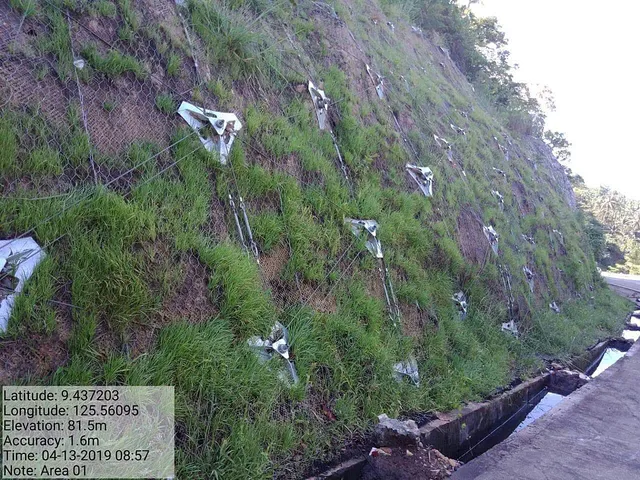
The first half of 2019 proved to be busy, yet a fulfilling period for Green Acres Hydroseeding Inc. the young and emerging company has been targeting multiple sectors within the fast-developing market of hydroseeding.
With another “Roadside Vegetation Establishment / Slope Stabilisation” project working with Ground Specialists Inc. again proving successful, now totalling to three successful projects for this partnership. The Green Acres system is really starting to prove itself in this sector, with multiple success stories leaving no doubt this is an economical and effective solution.
Green Acres have also been working hard with the environmental team at NAC (Nickel Asia Corporation) and are excited to be putting together a Demo project at their site on the north-eastern side of Dinagat Island. Having worked within the mining sector only once before, Green Acres is keen to show off their products capabilities with NAC’s fantastic environmental team. They plan is to utilise their ‘HydroStraw All In One (BFM)’ and ‘GAH Vegetator Seed Mix’ alongside with one of their new products ‘SiltSoxx’, a three-dimensional tubular device made of filter media encased in Filtrexx mesh. The devices are designed to support storm-water management, sediment & erosion control, and pollutant removal Best Management Practices (BMPs). One of the goals given to the company by NAC was the desire to reduce the requirement for berms and allow for longer gentler sloping, without risk of wash out for the hydroseeding. This is something Green Acres is confident they can achieve with the use of SiltSoxx. Which when used as a ‘Slope Interruption Device (SID) – it will create the same effect as the use of berms, without the costly use of heavy earth moving equipment.
Green Acres is also venturing into the construction and landscaping sectors, developing a good working relationship with MDC (Makati Development Corporation) over the course of consulting on several projects. Utilising Green Acres flexibility and access to the U.S. seed market and the expertise of Summit Seed. With imminent plans to move forward with a recreational park project and with multiple other projects on the horizon, it’s clear to see Green Acres and MDC are going to have a long-lasting successful partnership.
Green Acres is shortly going to be an accredited supplier of multiple noteworthy companies. MDC, JICA (Japan International Cooperation Agency), Republic Cement have all decided to sign up Green Acres to be their official supplier for hydroseeding materials and services. The company looks forward to seeing what opportunities will arise to prove their products and services from these new partnerships.
Having worked on several DPWH projects previously, Green Acres felt privileged to be invited by the government agency to contribute their expertise in the updating of the agencies ‘Item 520 – Hydroseeding’ Specifications. The company felt excited to see the government agency embracing the modern hydroseeding technologies and practices. They also found this a great opportunity to discuss the benefits and potential growth of the hydroseeding industry throughout the Philippines and how Green Acres intends to make this happen. With their ‘Self-Installation’ system, that supports companies in purchasing the right equipment and trains them how to hydroseed themselves. This will provide opportunities around the country and create a supply for the DPWH’s increasing levels of hydroseeding projects.
Gracing the opening of GHD’s third office in the Philippines are Darren Shrives, General Manager – Philippines, Steven Robinson, AO, Australian Ambassador to the Philippines, and Ian Fraser, General Manager – Asia Pacific.
“As we head towards 75 years of formal diplomatic ties, we continue to strengthen the deep and broad connections between Australia and the Philippines,” Steven said.
The new office is located in Quezon City, a rapidly growing business hub located north of the Philippine capital, Metro Manila.
Darren shares, “Quezon City is home to many of our key clients in the Philippines, so our proximity to them helps us collaborate better. Aside from this, our new office forges our commitment to provide a better and more accessible workplace to our staff.”
GHD’s local teams worked on the biophilic design of the new office. It is has approximately 120 working stations, four meeting rooms, and several collaboration areas. Aside from encouraging staff to interact freely within the area, the overall design of the new office has an "outdoor" feel, as evident in the textures/elements of its interiors.
When President Rodrigo Duterte was elected in 2016, he made a complete turn-around in the Philippines’ relation with China. He cultivated friendship with Beijing in contrast to former President Benigno Aquino's hard-line approach particularly on the South China Sea maritime dispute. In exchange for Duterte’s offer of the olive branch, he was able to secure China’s commitments in the form of official development assistance (“ODA”) and private investments to his infrastructure projects under his Build Build Build (“BBB”) initiative.
Duterte was also able to create a Chinese market for the country’s fruit exports and lift China’s travel ban paving the way for the influx of Chinese tourists. Chinese foreign direct investments (“FDI”) were also sought for real estate projects and Philippine offshore gaming operations (“POGO”). Developments in the Philippines bode well for China’s belt and road initiative (“BRI”), an ambitious global development strategy involving infrastructure development and investments spanning 152 countries to improve connectivity and cooperation on a transcontinental scale.
The rosy relations with China did not sit well with some sectors however. Manila's arbitration victory against China over the maritime dispute was set aside. Critics lambast Chinese development assistance as nothing more than massive foreign borrowings, which the country pays back at usurious contract rates at the expense of giving away sovereignty but creating jobs for Chinese workers. At the same time, China’s aggressive stance in the South China Sea, now considered as Asia’s most complex territorial dispute involving land reclamation and militarization, have increased tensions and undermined peace, security and stability in the region.
Investments
Duterte's BBB initiative plans to inject USD160 billion to USD180 billion in new infrastructure improvements during his administration, which saw an infrastructure spending increase from 2.7 percent of gross domestic product (“GDP”) between 2011 and 2015 to 6.3 percent of GDP at the start of 2018. Duterte’s BBB program has a combined price tag of USD171 billion required to complete the 75 projects, half of which is expected to be funded by money from China. Data from the Bangko Sentral ng Pilipinas reveal that FDIs from China more than doubled to USD28.79 million in 2017 from USD10.77 million in 2016. In 2018, Chinese investments have ballooned to USD198.68 million, a whopping 590% increase from 2017.
This means that in under three years, Chinese FDIs already amounted to USD232.24 million, greatly exceeding the inflows in the Arroyo and Aquino administrations combined.
Five Key Areas of Cooperation
1) Policy Coordination:
Beijing and Manila signed a Six-Year Development Program for Trade and Economic Cooperation in March 2017, which aims to gradually harmonize mutual development goals and interests within the BRI framework. Complementing the program is the agreement of the Board of Investments and the Bank of China on the 2017-2019 Investment Priorities Plan for Chinese Companies, which is meant to facilitate business-matching activities and industrial linkages.
2) Infrastructure development and connectivity:
China has pledged $7.34 billion in soft loans or official development assistance and grants for large-scale Philippine infrastructure projects and flagship programs. This amount forms part of $24 billion worth of agreements Beijing committed to President Rodrigo Duterte on his first visit to China in 2016. The basket of loans through official development assistance programs in two tranches ($7.19 billion) includes dam and irrigation, railways, expressways and bridge projects, among others.
3) Trade and investment:
China became the Philippines’ largest trading partner in early 2017, marking an increase of $15.04 billion (16 percent) from 2016. Furthermore, investments approved by the Philippine Economic Zone Authority and the Board of Investments more than tripled for the first three quarters of 2017 to around $40 million (from $10.9 million in 2016). Private Chinese firms are also making headways in penetrating the Philippine consumer market through mobile firms such as Huawei, Xiaomi, Oppo, and Vivo. Even Alibaba Group is making its presence felt in promoting financial inclusion and digital payment services through strategic partnerships with local firms, such as Globe Fintech Innovations Inc. or Mint. Moreover, Alibaba’s Alipay and Tencent’s WeChat Pay have also signed licensing agreements with Asia United Bank, which favorably enables Chinese tourists to drive the growth of cashless payment systems in the Philippines.
4) Financial integration and connectivity:
The Bangko Central ng Pilipinas officially added the renminbi as part of its international reserves. It also approved the Peso-Yuan spot market, which will lower the transaction costs for Philippine and Chinese banks and businesses by reducing reliance on the dollar as the intermediate peg. The issuance of “panda bonds” or renminbi-denominated bonds worth $200 million began, which could pave the way for more access to Chinese assistance in Philippine financial requirements.
5) People–to–people exchanges and connectivity:
China has become the Philippines’ second-largest tourism market. As of November 2017, 14 new flights connect China and the Philippines, and the Philippine Bureau of Immigration initiated a Visa Upon Arrival scheme for Chinese tourists. In the area of media and communications, China Central Television and the Presidential Communications Operations Office have signed an MOU for the rebroadcasting of China Global Television Network programs.
Source: Aaron Rabena, The Complex Interdependence of China’s BRI in the Philippines
According to Trade Secretary Ramon Lopez, of the $24-billion investment and credit line pledges that the Philippine government secured from China, $15 billion worth of investment projects were signed and allocated as follows:
Itemized list of PH projects covered by China’s $15-B investment pledges to Duterte
Source: Amy R. Remo, Philippine Daily Inquirer
Tourism
With the lifting of the travel ban to the Philippines by the Chinese government, 1.26 million Chinese visitors were recorded last year, nearly triple the number in 2015. There is aggressive development of two and three-star hotels in the Manila Bay area and the fringes of the Makati central business district mostly catering to Chinese tourists. Property developer Double Dragon is planning to build more Jinjiang hotels, a chain popular among Chinese tourists and business executives given its brand recall and convenient booking platform.
Double Dragon intends to more than double its room count to about 2,000 by 2020 in the country’s capital and other urban areas. It also helped that the Philippine government implemented the visa-upon-arrival scheme for Chinese nationals. Justice Secretary Menardo I. Guevarra however said that his department and the Bureau of Immigration will tighten up the rules since the scheme was reportedly being abused by overstaying Chinese who ended up working in the Philippines.
Development of Industrial Parks
Memoranda of Understanding between the Philippine and Chinese governments on industrial park development were also signed as Chinese industrial park developers are aware of the rising demand for industrial space in the Philippines given the country’s expanding manufacturing and export base. Among the investment pledges signed worth USD9.5 billion that is seen benefitting the property sector are the following:
USD3.46 billion project with Shanghai GeoHarbour Group that involves land reclamation and development projects;
Development of large tourism projects and electronic industry parks with Zhongfa Group;
Construction of China-Philippines International Techno-Industrial Zone with China National Heavy Machinery Corp; and
Development of infrastructure and construction projects with Haocheng Group.
Philippine Offshore Gaming Operations
Fifty-four (54) POGO licenses offered by the Philippine government that allow companies to set up internet-based casinos for overseas gamblers were bagged by China-linked companies, bringing with them dozens of companies providing information technology support and call center services manned by Mandarin-speaking mainlanders. POGOs have overtaken the Information Technology and Business Process Management (“IT-BPM”) industry in terms of office demand. Demand from Chinese-run firms in the first half of the year already exceeded 2018’s full-year take-up by 37%. In 2018, POGOs took up 229,000 square meters (sq. m.) of office space, while take-up as at June 30 this year was at 315,000 sq. m.
Much of the growth in demand could be attributed to the growing acceptance of POGOs among Philippine landlords. From only three (3) local government units giving Letters of No Objection (“LONO”) to POGOs in 2016, there are now seven (7) cities in Metro Manila issuing this document required by the Philippine Amusement and Gaming Corporation for POGOs to operate in their areas. These cities include Makati, Pasay, Parañaque, Mandaluyong, Las Piñas, Muntinlupa, and recently Quezon City by way of Special Use Permits. To date, Taguig City has yet to issue LONOs to POGOs, but hosts the largest IT-BPM locators in the country and remains to be the preferred district.
Higher demand from offshore gambling firms filled up the slack brought about by the decline in the IT-BPM sector, whose continued development are further dampened with the government-issued moratorium on economic zone proclamations in Metro Manila, as well as looming fears regarding the second package of the Duterte administration’s Comprehensive Tax Reform Program.
POGOs are also driving residential condominium sales especially in the Manila Bay area where office buildings are developed alongside residential towers. The online gaming industry's revenue ballooned to PHP7.35 billion in 2018 from PHP657 million in 2016.
Will the Philippines Fall into a Debt Trap?
Chinese-funded infrastructure development associated with BRI in developing countries particularly in Asia and Africa has been hounded by fears of “debt traps”. Reports have highlighted that these Chinese investment and financing deals have in some cases involved predatory policies of high interest rates and unsustainable payment schemes for projects mostly identified as white elephants. These resulted in the debtor government unable to pay the loan and the project being acquired by the Chinese funder by virtue of debt-for-equity swaps.
The same debt trap scenario has been hounding Chinese ODA in the Philippines with critics comparing China’s interest rates to that of Japan, which supplies a majority of the country’s overseas development aid. Even some officials in government are alarmed at Chinese investments considering their security implications that threatens our sovereignty not only because future debt burdens will result in an “economic invasion” but also at the proliferation of Chinese workers and their access to sensitive strategic geographic areas in our territory.
There has been counter arguments that the Philippines will not fall into a Chinese debt trap. A debt trap usually occurs when debt obligations reach an unsustainable threshold of a country’s GDP creating a high debt-to-GDP ratio. Debt service will eventually lead to low growth because most economic output will be used to cover debt payments.
However, the country’s economic managers maintain that the country possesses economic fundamentals that mitigate against the danger of excessive indebtedness. They noted that while Philippine debt increased, external debt-to-GDP ratio (in percentage) has actually decreased, indicating that less of the country’s GDP has been used for servicing debt. To avoid being debt trapped, Budget Secretary Benjamin Diokno highlighted that the current administration has pushed for a 75:25 debt mix, with the larger bulk falling on local financing.
The government also banks on the successful implementation of the Tax Reform for Acceleration and Inclusion Act to pay off necessary finances related to the BBB plan.
Critics warned that Chinese-funded infrastructure projects might end up like the Hambantota International Port in Sri Lanka that was doomed to fail because the port has seen very low levels of shipping traffic but at a high financing cost. The project was referred to by the New York Times as “one of the most vivid examples of China’s ambitious use of loans and aid to gain influence around the world — and of its willingness to play hardball to collect.”
The government however believes that unlike the Sri Lankan port project, the local transportation projects lined up for Chinese financing generate internal demand and can successfully contribute to economic growth. The Philippine economy relies on domestic consumption, and there is a huge internal demand for transportation services. In addition, government economic managers argue that the BBB initiative taps a diverse range of development lenders making a debt trap and domination by a single lender highly unlikely, citing that more than half of developmental infrastructure projects in the country are funded by the Japanese International Corporation Agency and the Asian Development Bank. The National Economic Development Authority further clarified that the government will make use of an optimal mix of government domestic financing, aid, and private capital in funding infrastructure projects.
Fear of Chinese Workers
Another major cause of concern is the influx of Chinese workers brought about by offshore gaming operations and infrastructure construction activities. The number of Chinese nationals arriving in the country has nearly tripled since 2016. POGO workers filled hotel rooms and office towers previously intended for IT-BPM operations, snapped up residential condominiums and boosted retail sales. Despite the economic benefits, there has been a mounting opposition from locals who fear Chinese workers are taking away jobs from Filipinos and evading taxes aside from their unruly behavior.
From 2016 to 2018, around 335,800 working visas and special work permits were issued to Chinese, representing over half the total number of permits issued to foreigners. More than half of them were for online gaming-related jobs, and the rest for sectors including construction, information, and communications. However many Chinese tourists who entered the Philippines reportedly ended up overstaying to find jobs while others bribed immigration officials to get working visas.
To address the situation, the labor, finance and trade secretaries have joined the heads of the tax, immigration and gaming bureaus to form an "interagency committee on the influx of foreign nationals.” The committee seeks to stop tax avoidance by Chinese workers.
Finance Secretary Carlos Dominguez estimated that the Bureau of Internal Revenue could collect at least PHP2 billion per month from an estimated 100,000 offshore gaming workers.
The government is also planning to transfer Chinese POGO workers to “self-contained” communities or hubs that will limit their interaction with Filipinos. While clamping down on Chinese workers could appease local critics, the government was cautioned that the move would mar relations with China as harsh treatment of foreign workers could backfire on the roughly 30,000 Filipinos working in China excluding the more than 200,000 workers in Macao and Hong Kong.
As the Philippine government embarks to tighten the regulation on POGOs, the Chinese embassy in Manila is asking the Philippines to stop hiring Chinese citizens in casinos and other gaming facilities in its efforts to stop the proliferation of cross-border gambling. China will also crack down on “underground banks” and online payment platforms that provide financial settlements for cross-border gambling, and wipe out domestic network operators and companies that provide technical support for such operations. China blames offshore gaming operations for increased crimes and other social problems in China.
The Controversy Behind the Kaliwa River Dam Project
The Philippine government is seeking funding for a dam project which seeks to address the water crisis brought about by the unexpected demand from the construction industry, shortages in the primary water source, and delays to infrastructure projects designed to bring additional supply onstream. The New Centennial Water Source-Kaliwa Dam Project (“Kaliwa Dam”) comprises a series of three (3) dams in the nearby Sierra Madre mountains, which have been originally planned as a solution to Metro Manila’s water requirements since the Marcos administration.
The Kaliwa Dam will add 2,400 million liters per day (“MLD”) to the existing 4,000 MLD supply that serves the 20 million people in Metro Manila and its surrounding regions.
According to the Metropolitan Waterwork and Sewerage System (“MWSS”), the initial phase is slated to begin with a 60-meter concrete dam at Kaliwa, which straddles the boundary of Rizal and Quezon provinces, a 25-kilometer conveyance tunnel, and two water treatment plants. If built, the Kaliwa Dam will secure Manila’s water supply for the next 10 to 15 years.
The conveyance tunnel, meant to serve the Kaliwa and Laiban dams will have a capacity of 2,400 MLD. The third dam in the series, at Kanan, will dwarf the first two with a potential capacity on its own of 3,720 MLD.
Government officials have come out in support of the Kaliwa project, as the MWSS is working on the Environmental Impact Assessment. The road right of way has been secured while the Department of Public Works and Highways is reviewing the design of the dam. The target date for completion of the project is 2023. China Energy Engineering Corp, the company responsible for building the Three Gorges dam in China, has been contracted for construction utilizing Chinese workers. The Kaliwa Dam will be funded through a loan finance agreement signed on 20 November 2018 by the Export-Import Bank of China and the MWSS. The bank will make available a loan facility of up to USD 211.2 million, equivalent to 85 percent of the contracted cost of the dams, at an interest rate of 2 percent.
Kaliwa Dam has been opposed on grounds it will lead to environmental destruction and the displacement of indigenous peoples in Sierra Madre. Previously, a Japanese contractor, Global Utility Development Corp. (“GUDC”) made an unsolicited bid to finance and build a far less environmentally impactful seven-meter dam at Kaliwa, only to have their proposal rejected by the Philippine government. The project was also criticized for the use of highly concessional ODA financing instead of the Public-Private Partnership (“PPP”) unsolicited proposal of GUDC.
To answer the criticisms, the Department of Finance (“DOF”) explained that the use of ODA financing will benefit Filipino consumers more with cheaper project and financing costs rather than if the project were to go through the PPP route, which would entail additional charges to be passed on to water users by the private proponent to recoup its investments.
The project cost went down from PHP 18.7 billion under a PPP scheme to PHP 12.2 billion under ODA. The DOF further explained that even if fees and interest payments were taken into account in completing the project through ODA, the cost would still be significantly lower at PHP 14.5 billion compared to the estimated price tag of PHP 18.7 billion under a PPP scheme.
The DOF also clarified that the unsolicited proposal of GUDC only involved the construction of the 7-meter high weir, which is just a portion of the whole project. GUDC has been pushing its unsolicited proposal for a mere intake weir as early as 2008, but the government has, since 2013, opted for the construction of a complete dam. Unlike dams, weirs are dependent on the water flowing from the river source, and susceptible to the effects of both droughts and flooding. In contrast, the 60 meter-high Kaliwa Dam can provide adequate water even during low-flow seasons because it can store water. Unlike a weir where water has the possibility to overflow, a dam’s overflow is channeled into a spillway to prevent flooding.
Moreover, the proposed Kaliwa Dam conforms to international safety standards, with its design able to withstand an earthquake of “probable maximum magnitude.”
The loan finance agreement for the Kaliwa Dam, among other loan agreements with China, has also been heavily criticized for containing certain contractual provisions onerous to the Philippine government. The DOF addressed the issues as follows:
There are no collaterals in any of the loan agreements signed by the Philippine government
A waiver of immunity is standard across loan agreements the Philippines has signed, whether explicitly stated or implied via an agreement to arbitral proceedings. A waiver of immunity only allows the Philippines' counterparty in an agreement to take the country to arbitration, in the unlikely event that the Philippines defaults on its loans;
Arbitral rulings are still subject to the Philippine Constitution, court system and public policy; and
The Philippine government is managing its debt responsibly.
US-China Trade War and Geopolitical Risks in the South China Sea
Diplomatic relations between the United States and China are on pins and needles as both countries are currently engaged in a trade war, which may lead to an economic slowdown in China and tilt the world towards a global recession. At the same time, the United States is concerned by reports of China's actions in the disputed waters of the South China Sea involving its interference with Vietnamese oil and gas drilling activities and a reported Chinese vessel colliding with a Philippine fishing trawler in the Reed Bank area. US State Department spokesperson Morgan Ortagus said in a statement that China's "repeated provocative actions aimed at the offshore oil and gas development of other claimant states threaten regional energy security and undermine the free and open Indo-Pacific energy market.” Chinese territorial claims over the South China Sea based on its nine-dash line boundary is its justification for its large-scale land reclamation activities on seven reefs (Fiery Cross Reef, Johnson South Reef, Cuarteron Reef, Gaven Reef, Hughes Reef, Mischief Reef and Subi Reef) in the disputed waters that are fully-equipped with military runways and outposts.
In June, the People’s Liberation Army (“PLA”) Rocket Force conducted anti-ship ballistic missile tests in a disputed part of the South China Sea. Chinese state media also reported that pilots of the PLA Air Force tested the sea warfare capabilities of their advanced fighter jets over the South China Sea. Tensions in the area further increased as the US Navy carried out what Washington calls “freedom of navigation exercises” close to islands and reefs Beijing claims as its own.
While analysts believe that President Donald Trump appeared uninterested in Southeast Asia compared with his predecessor Barack Obama whose “pivot to Asia”, meant to be a centerpiece of his foreign-policy legacy, was nonetheless never fully realized. The Trump administration however has increased the number of military operations in the South China Sea in its efforts to push back on China’s combativeness in the contested waters.
The weapon of choice for the US is trade. The Trump administration criticizing the World Trade Organization regime and China’s trade practices, vowed to take action to ensure fair and equal market access for US products. Trump then investigated and issued tariffs targeting China’s industrial policies as a response to the alleged unfair trade practices of China over the years including theft of U.S. intellectual property. China responded by imposing tariffs on certain products it imports from America. Following China’s devaluation of the yuan after the Trump administration threatened to impose additional tariffs on just about every Chinese export, the US labeled China a "currency manipulator.” China has also stopped buying American crops and was reportedly considering more aggressive retaliatory options, including cutting off key parts of the global supply chain in rare earth minerals and flooding the financial system with US Treasury Bills.
At home, while some of Philippine business group’s members are feeling pain from the prolonged trade battle, their greater worry is that the conflict will spill over into the volatile South China Sea where tensions are already high because of the maritime dispute between China and the Philippines. Existing companies are more concerned about keeping the sea lanes open and how it plays out in the context of Philippine politics. Though the Philippine government filed and won a case against China’s “nine-dash line” claims in an international tribunal in 2016, it still is reluctant to invoke the arbitral ruling as Duterte temporarily set it aside in pursuit of warmer economic relations with China. Nevertheless, he is expected to make the Hague ruling a central component of his administration’s foreign policy. Duterte said that he would not accept China’s claim on the whole of the South China Sea and would push for the completion of a Code of Conduct in the area. How this will fan out with existing Philippine-China trade relations remains to be seen.
Joint development of the petroleum resources within the disputed of the West Philippine Sea is also on top of President Duterte’s agenda as he reportedly amenable to the 60-40 joint exploration deal with China in the West Philippine Sea. The ongoing dispute has certainly dampen the interest in petroleum exploration even as the Department of Energy is embarking on another contracting round for petroleum service contracts. In the meantime, in the absence of exploration activities in offshore Northwest Palawan and Reed Bank, there seems to be no viable upstream petroleum resource alternative to replace the near depleting Malampaya Gas field, a vital energy supply for the highly-industrialized Luzon island power grid.
Meanwhile, Philippine military officials and the political opposition expressed grave concerns on the possible strategic maritime and security implications over reported plans of Chinese investors to develop three strategic islands into economic hubs. The islands — Fuga in Cagayan Province and adjacent Grande and Chiquita Islands in Subic Bay, Gambles province — play strategic roles in the country’s national security. Fuga Island is near where the country’s telecommunications cables pass, making it theoretically possible for someone based on this island to tap into these cables. Grande and Chiquita Islands, on the other hand, provide a strategic location to monitor activities in Subic, which is being eyed as a base for the Philippine Navy. There were also reports of Chinese warships passing through Philippine waters and oceanographic survey ships conducting research within the Philippine EEZ without permission from the government.
Clearly, the Duterte administration is balancing the country’s economic interest by de-securitizing its approach to the South China Sea conflict in its cordial relations with China but at the same time recognizing the US as the only superpower in the world and sole defense treaty ally of the Philippines, as manifested in the Philippine National Security Policy 2017-2022. The Philippines will maintain the Visiting Forces Agreement and the Enhanced Defense Cooperation Agreement with the US. At the same time, Defense Secretary Delfin Lorenzana calls for the need to review the reassurance of mutual defense under the 1951 Mutual Defense Treaty with the US.
Conclusion
The BRI has stoked fears that participating countries engaging China in large infrastructure projects and investments exposes these countries to debt risks giving China the legal cover to gain access to resources, forfeit assets, and impinge on sovereignty in pursuit of its geopolitical interests and world dominance. Chinese investments offer much potential to Philippine infrastructure projects ,which is playing catch up to our Asian peers, and failure to tap these would again cause the Philippines to miss the boat. The main concerns are both political and financial. By opening up to Chinese investments, is the Philippines opening itself not only to risks on commercial and operational viability, but most importantly to geopolitical risks and sovereignty issues? To address financial issues for Chinese-funded projects, government regulators must conduct thorough risk planning and feasibility studies, and for greater transparency involve the private sector, local government units, and other stakeholders. On the side of China, it must ensure that proposed projects are transparent, commercially viable, and participating Chinese contractors are of good standing and Chinese workers follow Philippine labor and immigration laws. So much is at stake because should these Chinese-funded projects fail, there are risks of legal action and nationalist backlash against the Duterte administration. These will damage China’s BRI program and standing in the international community. It will also not help in mending the reputation of Chinese firms operating abroad which are perceived as exploiters of natural resources and destroyers of the environment particularly in developing countries. More importantly, China must assure that its infrastructure loans will not violate the sovereignty of debtor countries lest it will only give credence to the “Yellow Peril” conspiracy theory that China intends to take over the world.
Fernando “Ronnie” S. Penarroyo specializes in Energy and Resources Law, Project Finance and Business Development. He may be contacted at fspenarroyo@gmail.com for any matters or inquiries in relation to the Philippine resources industry. Feel free to follow Atty. Penarroyo on LinkedIn (https://www.linkedin.com/in/fernando-s-penarroyo-2b8a7312/)
References:
Beltran, Bjorn Biel M., “Offshore Gaming Firms’ Growth Drives Demand for Office Space”, BusinessWorld, 30 July 2019, https://www.bworldonline.com/offshore-gaming-firms-growth-drives-demand-for-office-space/
Camba, Alvin,“Inside Belt and Road 'Debt Trap' Projects in the Philippines”, The Jamestown Foundation’s China Brief, 01 February 2019, https://international.thenewslens.com/article/112937
“China’s ‘One Belt One Road’ to Benefit Philippine Property”, Colliers Radar, 11 April 2018, https://www.colliers.com/en-gb/philippines/about/media/chinas_one_belt_one_road_to_benefit_philippine_property
“China’s One Belt One Road: The Dragon Spreads Its Wings over Asia”, Colliers Radar, 06 March 2018, https://www.colliers.com/-/media/files/apac/asia/colliers-dragon-asia-obor.pdf
Estrada, Darlene V., “China’s Belt and Road Initiative: Implications for the Philippines”, Foreign Service Institute, Vol. V, No. 3, March 2018, http://www.fsi.gov.ph/chinas-belt-and-road-initiative-implications-for-the-philippines/
Green, David, “The Philippines’ China Dam Controversy”, The Diplomat, 27 March 2019, https://thediplomat.com/2019/03/the-philippines-china-dam-controversy/
Katigbak, Jovito Jose P., “Bridging the Infrastructure Investment Gap Through Foreign Aid: A Briefer on Chinese ODA”, Center for International Relations and Strategic Studies of the Foreign Service Institute, Vol. V., No. 11, June 2018, http://www.fsi.gov.ph/bridging-the-infrastructure-investment-gap-through-foreign-aid-a-briefer-on-chinese-oda/
“National Security Policy for Change and Well Being of the Filipino People 2017-2022”, National Security Council, April 2017, http://www.nsc.gov.ph/attachments/article/NSP/NSP-2017-2022.pdf
“ODA Financing on Kaliwa Dam Project to Benefit Consumers with Cheaper Project, Financing Costs”, Department of Finance, 26 March 2019, https://www.dof.gov.ph/index.php/oda-financing-on-kaliwa-dam-project-to-benefit-consumers-with-cheaper-project-financing-costs/
Rabena, Aaron, “The Complex Interdependence of China’s BRI in the Philippines”, Brinknews, 30 October 2018, https://www.brinknews.com/the-complex-interdependence-of-chinas-bri-in-the-philippines/
Remo, Amy R., “Itemized List of PH Projects Covered by China’s $15-B Investment Pledges to Duterte", Philippine Daily Inquirer, October 23, 2016 https://business.inquirer.net/217269/itemized-list-ph-projects-covered-chinas-15-b-investment-pledges-duterte
Salvador, Alma Maria O., “The New Cold War in the US-China Trade Wars: Application to the Philippine Foreign Policy”, Blueboard, http://ateneo.edu/ls/soss/political-science/news/research/‘new-cold-war’-us-china-trade-wars-application-philippine
Uy, Weslene, Rise of Chinese investments in Duterte’s Philippines: Some Consequences, 19 March 2019, https://www.philstar.com/other-sections/news-feature/2019/03/19/1902800/rise-chinese-investments-dutertes-philippines-some-consequences
Venzon, Cliff, “Duterte Under the Gun Over Chinese Influx into Philippines”, Nikkei Asia, 05 March 2019, https://asia.nikkei.com/Spotlight/Asia-Insight/Duterte-under-the-gun-over-Chinese-influx-into-Philippines
Zheng, Sarah, “Risk of US-China Clash in South China Sea Worries Philippine Firms More Than Trade War”, South China Morning Post, 23 Dec. 2018, https://www.scmp.com/news/china/diplomacy/article/2176793/us-china-clash-south-china-sea-not-trade-war-worries
Patricia A. O. Bunye
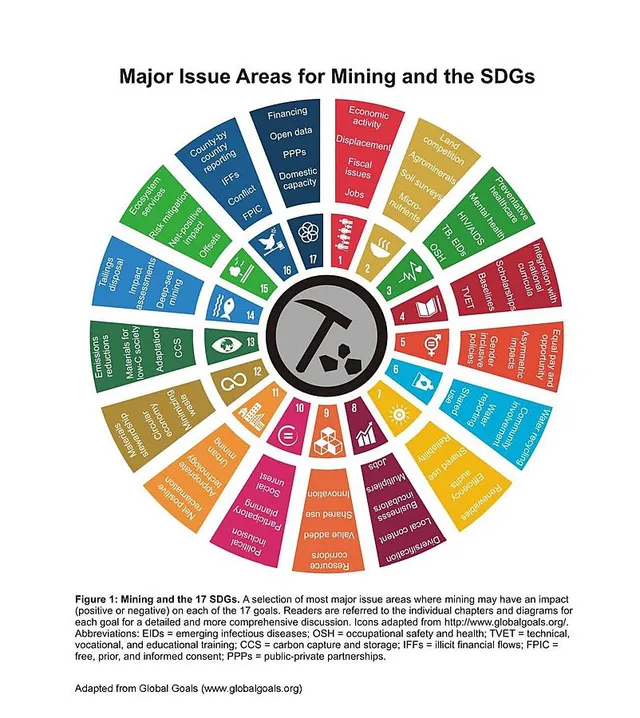
In September 2015, the United Nations member states adopted the 2030 Agenda for Sustainable Development, which includes a set of Sustainable Development Goals (SDGs) for 2015-2030 and represents a comprehensive plan of action for social inclusion, environmental sustainability and economic development.
Mining, as an industry employing millions of people, often in the remotest and least developed countries, is viewed as having the opportunity and potential to positively contribute to all 17 SDGs. Conversely, it is also seen as the culprit for many of the challenges that the SDGs are precisely trying to address – environmental degradation, displacement of populations, worsening economic and social inequality, armed conflicts, gender-based violence, tax evasion and corruption, increased risk for many health problems, and the violation of human rights.
What are the 17 SDGs and how are they relevant to mining and metals?
SDG 1: No Poverty
Mining can help reduce poverty through direct employment, sourcing goods and services locally and the payment of taxes and royalties which enable the development of essential social and economic infrastructure. Where companies operate in remote areas, poverty levels can be significant. Mining’s presence can either alleviate poverty through job creation and skills development, or exacerbate poverty if traditional livelihoods and ways of life are adversely affected.
SDG 2: Zero Hunger
Where mining companies operate in traditionally agricultural areas, the impact of mining on water, land and biodiversity resources can be a concern to farmers and local communities and can become a potential source of social conflict. Mining companies may also operate in areas with chronic malnutrition, especially among children. Companies can manage their impacts on natural resources, through limiting the amount of land they use and enabling access by communities to lands they manage which may provide important sources of food. They can also collaborate with development agencies to help eliminate hunger.
SDG 3: Good Health and Well-being
Mine workers may be exposed to increased occupational health risks such as cardiovascular and respiratory diseases, as well as communicable diseases like tuberculosis and HIV/AIDS. Certain working arrangements such as fly-in/fly-out have been linked to mental illness, substance abuse and domestic violence. Community health can also be of concern where mining takes place in poorer areas with limited healthcare facilities, making communities more vulnerable to disease.
SDG 4: Quality Education
Investments of mining companies in education improve local capacity, build the future workforce and strengthen relationships with host communities.
SDG 5: Gender Equality
Mining companies have a responsibility to build inclusive access to jobs and economic opportunities.
SDG 6: Clean Water and Sanitation
Water is essential at every stage in a mine’s life cycle. Mining and metals operations are significant users of water and can also negatively impact water access and quality if sound water management practices are not applied.
SDG 7: Affordable and Clean Energy
Mining is energy intensive and accounts for almost 2% of global energy use. As a major energy user, the industry can cut carbon emissions through accelerating energy efficiency measures and deploying renewable technologies.
SDG 8: Decent Work and Economic Growth
Where mining is significant in the economic life of a country, it can boost GDP by a number of percentage points. For growth to be fully inclusive, it requires government to effectively manage revenues from mining and encourage linkages to the broader economy.
SDG 9: Industry, Innovation, and Infrastructure
Mining requires significant infrastructure investments in order to develop, operate and export mined products.
SDG 10 Reducing Inequality
While governments are primarily responsible for reducing inequality through policies and redistributive mechanisms, mining companies can actively promote inclusion through local employment and procurement and through supporting livelihood diversification. They can also embrace an inclusive approach to community consultation and participation in decision-making.
SDG 11 Sustainable Cities and Communities
The products of mining such as steel, copper and aluminum play a vital role in the construction of cities. They also help connect cities physically and virtually by supporting road, rail and air transport networks as well as ICT infrastructure.
SDG 12 Responsible Consumption and Production
While mining produces the materials essential for modern society, it also generates large quantities of waste. Concerted collaborative action is required to increase recycling rates.
SDG 13 Climate Action
Mining companies can contribute to addressing climate change by reducing their carbon footprint and by engaging in dialogue with stakeholders to enhance adaptive capacities and integrate climate change measures into policies and strategies.
SDG 14 Life Below Water
Mining companies can contribute to ocean sustainability by identifying marine-related impacts and mitigation strategies, understanding the dependence of local communities on marine resources that may be adversely impacted by mining and contributing to the protection and conservation of the oceans and seas.
SDG 15 Life On Land
Mining companies have a potentially important role to play in biodiversity and conservation management.
SDG 16 Peace, Justice, and Strong Institutions
Mining companies can contribute to peaceful societies by respecting human rights, providing access to information, supporting representative decision-making, working to avoid company-community conflict and carefully managing their security approaches to ensure they decrease rather than increase the likelihood of conflict. Companies can also commit to transparency across the scope of their activities that impact society, from transparency of mineral revenues and payments to transparency in commitments made to local communities.
SDG 17 Partnerships for the Goals.
The 2030 Agenda, particularly SDG17 (Partnerships for the Goals) emphasizes that building a sustainable world is a multi-stakeholder endeavor.
First, governments are responsible for the laws, rules and policies on mineral extraction and all areas covered by the SDGs, including social services, public health, education, public infrastructure, economic policies and setting environmental performance standards.
Second, companies are responsible for undertaking their core business operations in a responsible manner that respects human rights, complies with government regulations, maximizes positive contributions to society, and avoids or minimizes negative economic, social, cultural and environmental impacts. Companies also pay taxes and royalties, engage in responsible policy dialogue and can collaborate to leverage resources and make social investments, ensuring that these are aligned with local development priorities.
Third, non-government organizations are responsible for working alongside governments and companies to address gaps and ensure governments and companies are fulfilling their responsibilities to society.
Fourth, development partners including multilateral institutions and bilateral donors can support in many ways: from providing project finance conditioned on adherence to sustainability standards to providing technical expertise and capacity-building support to governments, communities and local enterprises. They can also contribute to sharing cross-country best practices and promoting greater alignment between mining sector policies, practices and sustainable development.
In ensuring the attainment of the SDGs in the Philippines, the National Economic and Development Authority (“NEDA”) performs oversight and monitoring to ensure coordination among the various stakeholders. Specifically, it is NEDA which chairs the Multi-Sectoral Committee on International Human Development Commitments (“MC-IHDC”), which is composed of national government agencies and non-government organizations, and ensures the mainstreaming of the SDGs into policies of the government. On the other hand, the Department of Interior and Local Government is in charge of the localization of SDGs within local government units.
Other government agencies involved in mapping mining into the attainment of SDGs in the Philippines include the Department of Environment and Natural Resources, specifically the Mines and Geosciences Bureau (“MGB”) and the Environmental Management Bureau, the Department of Energy, the Climate Change Commission, the Department of Labor and Employment, the Department of Health and the National Commission on Indigenous Peoples.
The SDGs have been integrated into the Philippine Development Plan (“PDP”) 2017-2022 and in our various sectoral development plans, and are measured and reported annually through the Socioeconomic Report.
To support the monitoring of the SDGs and the PDP, NEDA introduced the SDG Annex in the formulation of the 2018 Socioeconomic Report. Since the PDP is the de facto implementation mechanism of the SDGs and the PDP is assessed through the SER, each chapter of the PDP and SER is used to assess the contributions and consistency of the Philippines’ actions with the global commitments of the SDGs. The SDG Annex of the SER identifies the Philippine policies, programs, activities, and projects (“PPAPs”) that are implemented to meet our SDG targets. The MGB’s role in implementing SDG 13 on Climate Action, for example, is covered by the PPAPs for “Geological Assessment for Risk Reduction and Resiliency”.
While each of the SDGs sounds lofty and difficult to achieve, there are concrete ways for these to be integrated by mining companies into their core business. Further, it is imperative for these companies, along with the mining industry as a whole, to collaborate with other stakeholders – particularly the government, civil society, and communities - to leverage their resources to achieve the SDGs.
Patricia A. O. Bunye is a Senior Partner at Cruz Marcelo & Tenefrancia where she heads its Mining & Natural Resources Department and Energy practice group. She is also an intellectual property lawyer and has served as President of the Licensing Executives Society International (www.lesi.org), the first Filipino and Southeast Asian to hold this position.
By Marcelle P. Villegas
If you need to accomplish tasks such as ordering food, checking the movie schedules, or doing bank transactions, there are apps that one can download on a smartphone or tablet to do these and more. In mining, wouldn't it be great to have an app that can monitor real-time drilling activities and other stages and details of an operation? This is a fascinating option that is offered by a company called IMDEX.
Before the year ended last year, Mr Ryan Cairns of REFLEX (a branch of a company called IMDEX), was the Industry Hi-Lite Speaker at the Philippine Mining and Exploration Association (PMEA) Monthly Membership Meeting. The topic was "The Importance of Accurate Core Orientation and Logging - The Imdex Solution". [1] Mr Cairns is the Area Manager in Southeast Asia for REFLEX.
Ryans Cairns is a graduate of the University of Birmingham, United Kingdom, with a bachelor's degree in Geological and Earth Sciences/Geosciences with honours. He has work experience on exploration in the Philippines, Laos, Myanmar, India and Papua New Guinea.
Mr Cairns is an elected fellow of the Geological Society of London and an elected member of the Society of Petrophysicists and Well Log Analysts.
Real-Time Subsurface Solutions
In planning a mining operation, it is important to have accurate core orientation and structural logging. Thus REFLEX offers "Real-Time Subsurface Solutions." Mr Cairns explains, "The IMDEX group is made up of two components. The group where I work for is REFLEX and we specialise in geotechnical, geochemical and geophysical analysis."
"The other side of the business is AMC or Australian Mud Company Pty. Ltd. and they focus on the fluids used during the drilling process to keep borehole stable while still drilling."
AMC's headquarters is in Perth, Australia with offices in North and South America, Africa, and Europe.
"Together, AMC and REFLEX aim to redefine the way drilling fluids, equipment and technology are used to ensure execution of drilling programs are to specification -- on time, within budget and safety."
IMDEX group has five main solution sets, namely: Downhole Navigation, Structural Geology, In-Filed Geoanalysis, Driller Operable Geophysics, and Drilling Optimisation.
During his presentation, Mr Cairns focused on structural geology and the world of apps for mining activities. "We just released the world's first non-radioactive driller operated downhole gamma survey for geophysical analysis. We have Downhole Navigation which has devices that goes down drillholes in order to tell you the azimuth, dip and direction of that drillhole. And we have Drilling Optimisation, which is the drilling fluid, which is the AMC side of the business."
IMDEXHUB-IQTM
"If I want to order a pizza, I use an app. If I want to order a taxi, I use an app. However, in the mining and the exploration game, almost nothing is seen pushed to this level. We still have people writing information on pieces of paper, sending it downhill with a guy in a motorbike, to send it to a core shed to upload it to a database. This is the wrong way of doing things.
What we have really tried to push is to bring all of our instruments into real-time analysis," said Mr Cairns.
IMDEXHUB-IQTM (formerly called REFLEXHUB-IQTM) is an application that provides secure access to validated data which is transmitted from a range of sub-surface instrumentation, analytical instruments and mobile form data inputs. This provides a convenient and immediate access to the information you need, wherever you are. In effect, this will improve drilling contractor productivity and transparency across multiple streams of data. [2]
"So if I had a drilling project down in Zamboanga and I used one of the REFLEX instruments, whether it is geochemical or geophysical, that instrument would then send that data up to our cloud." He explains that in using this app, one can monitor the operation and check activity details while stuck in traffic on EDSA, for example. Moreover, using the IMDEXHUB-IQTM, he states, "I get a notification on my phone via this app and I would be able to see in real-time and start making real-time decisions on my exploration project."
Regarding structural maintenance, he said, “One of the most important questions that we get is 'Why do we need to have reliable and accurate structural measurements?’" It is important because it will help us predict the location where ore can be found or where more ore is located. "I need to be able to determine how my blocks of ore are going to behave during mining. Not only that, but I need to be able to predict the ground conditions, so when I am mining, I am mining safely and effectively."
Having the ability to predict the ground conditions will ensure safe mining and tunnelling.
Traditionally, anyone who has been a geologist in a core shed knows that collecting data is time consuming. It is a repetitive work where there is a tendency to end up with partial or inaccurate data which in turn may lead to fatal errors. [1]
Mr Cairns further explains the importance of accuracy of the drillhole surveys and the core orientation mark or line. "Quality Structural Measurements are always very important. They are only as good as the drillers and the geologist's care factor, and information they are trying to get from the drill hole. We need to have an accurate drillhole survey so these are the devices that go down the borehole path to tell us exactly where that core is coming from. If am a geologist or mining engineer and I am trying to make an analysis on a piece of core and I don't know exactly where that core is coming from in 3D space, then I am wasting my time."
"And the same thing comes from the orientation mark or line. If I don't know how that core looked prior to being drilled, I am going to make errors and make assumptions and going to be incorrect when I start my resource models or when I start to make my mine plans."
"So it is more than just taking a stand in measurement on a piece of core. We need to ensure that the survey, orientation and logging tools are fit for purpose." The next step is to have QA/QC systems in place. Then, he said that it is essential to provide proper training and supervision of the drillers and geologists. Lastly, he said, “I need to make sure that everyone takes ownership of this quality solution to highlight the importance of the
information that we are getting from this core."
"So why do we need structure and logging... and what does that play in terms of our 3D geology? Now, if I am drilling a piece of drill core and I don't have the exact angle, azimuth and depth of my geological context, I am going to open myself up to error margins when I start to make my resource models.”
As part of accurate measurement on the drill core, Mr Cairns also stressed on the need for a QA/QC. "Why is it important that we have QA/QC? These are some of the errors that unfortunately we don't want anyone to have, but they do have in the mining industry. For example, my orebody has moved 10m because I didn't accurately do surveys on my drill holes so I don't know where my core was coming from. I hit my drive, not my orebody. My pit ore has collapsed because my fault was meant to be 10 degrees deeper because I didn't accurately have core orientation marks to tell me what that degree was, or the ore wasn't meant to intercept and offset my orebody.”
The illustration above is a very basic design for some surface mining. The blue lines that are running down the edge are benches. “I have sunk the shaft and drilled some tunnels across. The red lines are drill holes running straight through. As you can see, it is planned straight. And the blue box is my orebody.
As you can see, my orebody is going down the center of my mine plan. I intersected underneath and we're all very happy,” he said.
"However, in the real world, not all drill holes are going to go straight. In fact, almost every drill hole is going to deviate to some extent. And if I don't have a proper understanding or control on that drill hole deviation, all the information that I am taking from my core, whether it is geological or structural, is opening myself up to errors. As you can see, the mine plan and the underground workings are completely off because we did not take the time during the drilling phase to accurately get that information.”
Pre-Requisites
- To accurately measure structures in drill core you need to know:
- where the hole has been drilled in 3D space and
- the orientation of the core in the hold
- Errors in the hole location and core orientation will significantly impact on the accuracy of your structural measurements.
DRILL HOLE SURVEYS
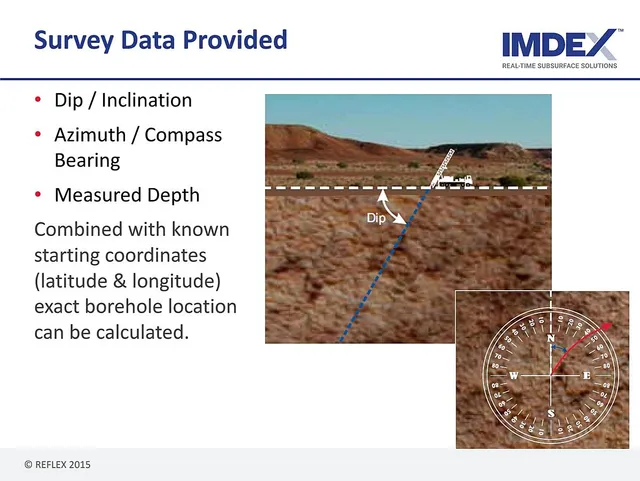
“A drillhole survey is a device that goes down the drillhole that is going to give me my azimuth or my direction and my inclination or my depth of the drill hole. so I am using this information to see exactly where that drill hole is going.”
Surveying the Hole
It is important to remember that all drillholes will deviate from their planned path. This deviation can be significant because it will affect the outcome of the next stages. Structural measurements might result in errors if the hole path is not accurately known. For that, survey tools are used. There are two kinds of survey tools, namely: magnetic and non-magnetic. The survey tool for non-magnetic environment is the Digital REFLEX EZ-TRAC. On the other hand, for the magnetic environment, the Gyroscope Survey Tools, and REFLEX Sprint-IQ Gyro are used.
Magnetic Survey Tools -- Digital REFLEX EZ-TRAC has features like having a built-in QA/QC functionality, auditable, digital data capture and transfer, data is easy to interpret, and it has robust, solid-state electronics. Using this tool, multiple survey shots can be taken at any time; however, it cannot provide an azimuth inside the drill rods or magnetic ground.
The Gyroscope Survey Tools is not affected by magnetic ground and drill rods, north-seeking gyro systems can automatically find true north, simplifying operation. It also has less downtime -- can be sued inside an overshot system, during the normal drilling cycle. It has easy to use software with built in QA/QC report generation.
REFLEX Sprint-IQ Gyro can be used at all hole inclinations from vertical to horizontal, and on multiple operation modes. It also functions on high-speed operation with more than 150m/minute continuous mode. This tool is twice as accurate compared to other Gyro tools.
CORE ORIENTATION
Core orientation is the process of determining the in situ orientation of the drill core in the ground. The drill core is marked to reference the gravimetric bottom or top of the core so we know what it looked like prior to being drilled. “If you don't know the orientation of your core then you can't determine the orientation of your structure. Errors in the position of the orientation mark will impact on the accuracy of your structural readings.” For correct Core Orientation, Reflex offers two main tool systems, namely: Contact or Front End tools and Non-Contact or Back End tools
Contact or Front End tools marks the core face at the top of the run. These include the Spears, Clay Shoes, REFLEX EZ-MARK, and REFLEX VERTI ORI.
On the other hand, Non-Contact or Back End tools orientates the core tube and marks the core face at the bottom of the run. This includes Electronic REFLEX ACT 3 & ACT-IQ, and Mechanical REFLEX EZ-ORI & Ball Mark.
More on the Non Contact Systems/Back End, they have REFLEX ACT 3/ACT-IQ as the electronic tool, and the REFLEX EZ-ORI and Ball Mark as the mechanical tools. The tools attach to the end of the core barrel and orientate the core tube. When the tube is retrieved it is rotated to its correct position and the orientation is marked on the core, which is locked in the lifter case. [1]
For more information:
IMDEX - https://www.imdexlimited.com/
REFLEX - https://reflexnow.com/
AMC - https://www.amcmud.com/
Reference:
[1] Cairns, Ryan (1 Oct. 2018). "The Importance of Accurate Core Orientation and Logging -- the IMDEX Solution". PMEA Monthly Membership Meeting Presentation, Oct. 2018.
[2] Retrieved from - https://reflexnow.com/imdexhub-iq/
5 July 2019, Villamor Air Base Golf Course, Pasay City: The 4th Rocks and Forests Invitational Golf Tournament was held, organised by the UP Geology Alumni Association (UPGAA) and the Society of Filipino Foresters Inc. (SFFI). This annual golf tournament is one UPGAA’s major projects which aims to generate funds for the different projects of the group. Part of the proceeds of the tournament this year will be used to purchase equipment for National Institute for Geological Sciences (NIGS).
UPGAA is a non-stock, non-profit organisation. Its main objective is to provide a forum for the members of the UP Geology Alumni Association. Here, there can interact through mutually beneficial contacts and “to provide avenues for drawing upon the knowledge and expertise of the alumni for furthering the cause of UP NIGS as a School of Excellence”. UPGAA is headed by its Chairman, Joey Nelson Ayson while SFFI is headed by its President, Tom Valdez.
Both UPGAA and NIGS work together to further develop the geological profession.
SFFI is an independent, democratic, non-profit, non-political and non-partisan professional organisation of the foresters in the Philippines. They actively promote and support sustainable management of forest resources. Their vision is to be “committed professionals for the advancement of forest technologies, practice and biodiversity in the country essentially contributing to the sound environmental management, social justice and economic development”.
With UPGAA working for the advancement of the geological profession and SFFI is doing the same for the advancement of the forestry profession, their partnership further led in addressing the climate change problem. In 2016, UPGAA and SFFI started a collaboration and worked together on the Carbon Neutral Program (CNP). This program “joins the global call for climate change mitigation in view of the dreadful impacts that can change the world’s landscape as we know it today”.
UP Geology Alumni Association (UPGAA) - https://upgaa.com/
Society of Filipino Foresters Inc. (SFFI) - https://sffi.org.ph/
_ _ _ _ _
Acknowledgement:
UP Geology Alumni Association (UPGAA) for the photos and golf tournament updates
Is the Philippines coping with the global trend for green solutions in transportation? A lot of electric vehicles are out now in the international market. With this wave in green technology, the Electric Vehicle Association of the Philippines (eVAP) organised and hosted the 7th Philippine Electric Vehicle Summit 2019. This was held last 17 - 18 July 2019 at the SMX Convention Center, Pasay City.
The eVAP is the Philippines’ main voice of the electric vehicle industry and for the past 7 years, they had been hosting the Philippine Electric Vehicle Summit. This year’s theme is “Modernizing the Transport Landscape: Driving Sustainable Growth”. [1]
“Infrastructure and government support to sustain the growth of the EV industry are now being set up. The 3,000 Bemac eTrikes of the Department of Energy (DOE) [which are] now being deployed nationwide are becoming more visible in various LGUs,” according to Mr Edmund Araga, EVAP President. He stated that the e-vehicle industry has become mainstream in the Philippines. He also said that more e-Jeepneys are being deployed in Metro Manila, Visayas and Mindanao regions as part of the PUV Modernization Program.
Mr Agara also noted that the program is planning to upgrade some 200,000 public utility jeepneys for the next six years with modern public utility vehicles powered by either a Euro 4-diesel engine or an electric motor. He also stated that retail financing is available for PUVMP via Landbank of the Philippines and the Development Bank of the Philippines (DBP) [1]
The summit featured car manufacturers like Nissan, Mitsubishi and Hyundai to showcase their electric vehicles. The summit also had technical sessions where transport officials, local government representatives, members of the academe and electric vehicle and automotive industry players were present.
During the summit, Atty. Dante Bravo, President of the Philippine Nickel Industry Association (PNIA) emphasised the role of nickel in the growing e-vehicle industry. He said that the nickel industry is poised to supply the growing demand for nickel in lithium ion batteries that are used to provide power to electric vehicles. [2]
Mr Bravo said, “We want the nickel industry to be able to rise to the challenge of globalization, and in the process we would need a long-term strategic approach. This can be embodied through collaboration with our partner industries as well as the private, public and academic sectors. Thus, I would like to enjoin our friends in the EV sector to join us in the pursuit of an industrialised and sustainable economy.” [3]
[1] Manahan IV, Ruben. (5 June 2019). “‘Green Light’ for PH EV Summit 2019”. Retrived from - Carmudi Philippines - www.carmudi.com.ph/journal/green-light-for-ph-ev-summit-2019/amp/
[2] {18 July 2019). “Briefs: Nickel, EVS moving forward together”. Daily Tribune.
[3] (19 July 2019) “Nickel Industry’s Role in Growing The EV Industry”. Philippine Nickel Industry Association website. Retrieved from - https://www.philippinenickel.org/news-and-updates/press-release/
nickel-industrys-role-in-growing-the-ev-industry/
18 - 20 June 2019 - Oil and Gas Philippines is co-located with PhilMarine 2019 at the SMX Convention Center, Pasay City. This is an annual three-day event that features products in the oil and gas sector, fire protection systems and materials, flare systems and equipment, electromechanical equipment, ships, boats, vessel equipment and services, and more! Maritime Industry Authority (MARINA) hosted the PhilMarine 2019 and their theme is “Continuous Quality and Productivity Improvement in the Shipbuilding and Ship Repair Sector.”
On day 1 at the 6th PhilMarine 2019 International Maritime Exhibition, the Maritime Industry Authority Technical Conference was held. Also on this day, the MARINA signed an agreement with a Japanese association to adopt Japanese technology in the manufacturing of resources for the Philippine shipbuilding and ship repair industry (SBSR). The cooperation agreement was signed by Vice Admiral Narciso Vingson, Jr (MARINA Officer in Charge) and Chairman Shinzo Yamada of Japan Ship Machinery and Equipment Association (JSMEA). [1]
“With Japan’s latest technologies and expert strategies, it has sufficient machinery and technical skills to discover and provide solutions to challenges. We hope that this cooperation agreement between the MARINA and JSMEA will aid us in building a solid ancillary industry for SBSR sector, which will generate jobs for millions of Filipinos... Together, let us achieve a mutual progress of having a flourishing Philippine maritime industry.” he stated. [1]
Vice Admiral Vingson said that this agreement will open new opportunities for partnership in investments between the Japanese and Filipino businesses. This will give local shipbuilders an easy access to good quality shipbuilding and ship repair materials.
He also stated that the objective of the Maritime Industry Development Plan (MIDP) will be more feasible now since locally manufactured resources are already within reach. “So, in 10 year, hopefully, the programs under the MIDP are no longer plans, but tangible results.”
Mr Yamada said, “We believe that with the MoU (memorandum of understanding), it would bring a solid relationship between MARINA and JSMEA and a good relationship between the Philippines and Japan.” He noted that the Southeast Asian maritime market is important to JSMEA. Thus, he hopes that his company will be able to provide progress in the maritime industry in the Philippines. [1]
PhilMarine 2019 is the only specialised event in the Philippines that brings together an international array of maritime, shipbuilding, offshore, oil and gas naval defense, and other supporting industries to showcase the latest developments in the maritime industry. The objective is to improve the current shipbuilding, technology and equipment and to maintain the Philippines’ ranking as the world’s 5th largest shipbuilding nation.
On day 2, “The Philippine’s Domestic Shipping Modernization Forum and SONAME General Assembly and Election” was held. This was hosted by the Society of Naval Architects and Marine Engineers, Inc. (SONAME). Welcome Remarks were given by Engr. Sammuel T. Lim, Chairman of SONAME. Some of the topics presented were:
- “Philippine Domestic Shipping & Shipbuilding Situation: by Engr. Ramon C. Hernandez (Director, Shipyard Regulations Service, Maritime Industry Authority)
- “High-Speed Craft Technologies for Philippine Shipping” by Ms Julie Zhu, General Manager, Pio-Ship Design & System Integrate and Harbin Engineering University Ship Equipment & Technology Co. Ltd.
- “Probabilistic Damage Stability - Case Studies for Philippine Ferries” by Engr. Jerome M. Manuel (Pres., PRS Tech)
- “The Shipbuilding Cooperation between Philippines and China” by Mr Wang Xiaohal (Vice General Manager, China Shipbuilding Trading, Co. Ltd. - Shanghai)
On day 3, the 146th Maritime Forum and Exhibitors Night were held.
The PhilMarine 2019 had attendees from 20 countries. There were 152 companies/exhibitors who participated at the 6,500 square meter exhibition space. Of note, 60% of the companies in the exhibit have already renewed their participation for 2020.
The event was organised by Fireworks Trade Exhibitions and Conferences Philippines, Inc. This company is a part of Fireworks Trade Media Group, one of Asia’s largest independently owned trade media companies.
[1] Factao, Genevi. (19 June 2019). “Pro-ship sector agreement signed”. The Manila Times.
On 14 June 2019, The Philippine Mining Club celebrated their 50th Luncheon Anniversary. Their special guest speaker for this luncheon was Mr Eulalio B. Austin, Jr. who is the President and CEO of Philex Mining Corporation. His presentation’s title is "The Future: Padcal and Silangan". With the many hurdles and challenges that the industry is facing today, what can we learn from a 60-year-old mining project like Padcal?
Mr Austin started his discussion with the World Happiness Report 2019 by the United Nations Sustainable Development Solutions Network. It states that the Philippines ranked 69th out of the 156 nations in the World Happiness Index. The Philippines also ranked as the 12th among the countries that showed the highest increase in level of happiness between the periods of 2005-2008 and 2016-2018.
Then, he showed a clipping from a newspaper article dated February 2008 with the statement -- "a Golden Age in Philippine Mining was coming" due to upcoming investments from the world's biggest mining and metals leaders. Generally, things look bright and promising for the Philippines. In the mining sector, we have the Philippine Mining Act of 1995 (RA 7942) which was declared valid and constitutional by the Supreme Court in 2005.
This Republic Act is "An Act Instituting A New System of Mineral Resources Exploration, Development, Utilization and Conservation".
However, he stated that by 2012, Executive Order 79 presented challenges for the industry all the way to 2016. He mentioned that the industry "has been highly injured because it was misunderstood". Mr Austin further noted that perhaps the boom years of mining were in the 1950s when gold and copper became the pillars of large-scale mining. That decade also ushered the introduction of new technologies in mining.
From his report, he expressed that Philex Mining Corporation has been reaching milestones for decades. Their Padcal Mine just turned 60 years old in 2018. "Turning 60 is the age of senior citizenship and the age of retirement or retiring. The once-hectic pace of life is replaced with a 'delicious sense of calm, confidence and clarity of purpose'. Our Padcal Mine is settling into that delicious sense of calm."
For the record, a total of 10 million trees were planted at Philex Padcal and other mining properties in more than 4,000 hectares of disturbed and undisturbed areas. Additionally, even before DENR mandated ISO 14001 certification in 2015, Philex Padcal Mine already secured IMS Certification (ISO 14001:2004, OHSAS 18001:2007) by TUV Rheinland. Philex has also taken the initiatives and introduced to the Chamber of Mines of the Philippines the "Towards Sustainable Mining" (TSM) commitment to promote responsible mining in cooperation with the Mining Association of Canada.
"Initial Padcal mine life was originally up to 2014... All in all, while interim prospects remain subdued, we are determined to maximize the remaining mine life of Padcal." Now, the projected end-of-mine life of Padcal is 2022. "The closure of Padcal will be an opportunity for us to showcase that closing mines can be done properly with dignity."
How did Philex Mining Corporation handle the TSF3 incident in 2012? It was on 1 August 2012 when Philex Mining suspended operations voluntarily as nontoxic tails and water discharge from the TSF3 spilled onto the Balog Creek. This was an effect of the destructive heavy rains brought about by Tropical Depression Ferdie (a.k.a. Typhoon Vicente) and Typhoon Gener which hit Benguet successively. The company resumed production only on 8 March 2013 due to the four-month temporary lifting order issued by the government which was extended indefinitely afterwards. Thus, the operations formally resumed on 27 August 2013. [1]
Philex Mining Corporation was allowed to resume operations after they implemented urgent remediation measures such as providing immediate assistance to the affected residents, cleaning up the Balog Creek, and ensuring the integrity of its TSF3 by building an open spillway. [1]
Regarding the hard lessons learned from the 2012 TSF3 incident, Mr Austin stated that they faced the challenge and "never ran away from our obligations". The first public consultation of its kind was conducted to address the problem. The company paid the government PHP1.34 billion for the tailings leak. This is the highest payment ever done by a single company. The spillway that the company constructed at the TSF3 is the first of its kind in tailings management in the Philippines.
Mr Austin recalled, "It was a humbling experience for us but we have to prove that we are advocates of right and principled mining."
His presentation also include the Silangan Project which is expected to generate 8,000 direct and indirect employment, raise PHP60 billion in investments, contribute PHP31 billion in taxes and will spend PHP6 billion for community development. "The project will proceed with underground sub-level cave mining method. Regulatory developments between 2016 - 2017 necessitated shift to underground mining from open-pit method. Sub-level caving presents itself to be a better method rather than block caving. Well-engineered solutions are now incorporated in our recent studies. Silangan Mindanao Mining is currently working on securing all necessary permits and approvals."
To conclude his presentation, he left the audience with an optimistic message. "We have the opportunity to make Silangan and all other pending mining projects to make it big for the Philippines in the global market. We have the opportunity to make this the Golden Age of Mining now. Believe that best to come for the mining industry."
Update on Silangan Project
Last 1 August 2019, Philex Mining Corporation reported that the definitive feasibility study for the first phase of the Silangan Project is finally complete.
The mine site is a development for high-grade copper and gold and is located at Surigao del Norte in Mindanao. Silangan is coined as one of the three major mining projects expected to push the Philippines as a regional copper producer.
The mine site is composed of three tenements, namely: Boyongan, Bayugo and Kalayaan.
On the first stage of the development of the Silangan Project, the Boyongan deposit is estimated to have a mine life of 22 years. Silangan is expected to produce high grade ores with 0.63% copper and 1.20 grams per tonne of gold. [2] Bayugo deposit is part of the second phase of the development and this is still under initial feasibility study for underground sub-level cave mining within the year.
Philex Mining Corporation will be adopting underground sub-level cave mining for ore extraction. They shall be using state-of-the-art milling facility that uses modern convention technologies for ore processing.
Mr Austin stated, "We are thrilled with the outcome of the study which reaffirms the immense potential and magnitude of the project. Over the next few months, we will be focusing our efforts on raising equity and financing for mine development."
Philex Mining Corporation will allocate USD750 million for the Boyongan ore body development. For fund-raising, Philex has appointed J.P. Morgan for equity investment and Mizuho for project financing. The international law firm White & Case and local law firm Sycip Salazar Hernandez & Gatmaitan will be the legal consultants for this development project. [2]
[1] Philex Mining Corporation website. Retrieved from - http://www.philexmining.com.ph/2017/07/29/mine-firm-assures-integrity-of-storage-facility/
[2] Ison, Lilybeth. (1 Aug. 2019). "Philex completes feasibility study on Silangan project". Philippine News Agency. Retrieved from - https://www.pna.gov.ph/articles/1076750
Since April 2011, the Philippine Mining Club has been a professional networking forum that brings industries together and creating opportunities. The club was established to form better relationships across all areas of the Philippine mining industry. Moreover, the Philippine Mining Club is affiliated with the globally-recognised Melbourne Mining Club.
Their goal is "to uphold a professional networking environment in order to promote the mineral industry for those with an interest in the sector."
In celebration of the club's milestone 50th luncheon event, Philippine Resources Journal has this exclusive interview with Mr Kevin Lewis and Mr Alexander Gilles, two important people behind the Philipine Mining Club.
Creating a mining club in the Philippines that was patterned after the Melbourne Mining Club had its share of challenges and rewards. As a platform for communication among the industry's experts, executives, investors, government officials, media and students, the Philippine Mining Club has an interesting story behind its origin.
Mr Kevin Lewis, General Manager of Philippine Mining Club, hails from Australia and has been living in the Philippines for almost 20 years now. In 2009, Mr Lewis and a partner decided to start a new venture called "World Resources Events and Consultancy Inc." which catered as a consultancy to the resources services industry with business development planning. [1]
Due to many requests from people in the industry, the event side started with the concept of "Philippine Mining Club" which has brought to the lunchtime networking circuit many of the Philippine and international industry leaders as guest speakers, all under the banner of responsible mining. [1]
PRJ: When you first established the Philippine Mining Club, what was your goal or motivation for the events? Could you share with us how it all started?
Mr Lewis: "The motivation was, at that time... I personally was at a loose end with my career at that time. It was also because my previous job included being part of a service area to mining and oil and gas. I identified the mining industry and oil and gas sectors as the ideal customers because they really didn't mince their words. They knew what they wanted. They knew when they wanted it, and they would tell you that. And most of all, the best thing was when it came to being paid, they always paid you. So I identified them as a group of people that we could always rely on as being good, A-class customers."
"Because I've been dealing with the miners and mining groups and the oil and gas for so long, the relationship developed from being client to friends. And when they found out that I was leaving my previous job, they asked me what I was going to do next. At that time, I said I'm not too sure. Then, some of them asked me to see if I wanted to start a club for them -- a mining club."
"And one of those gentlemen was Gavan Collery from Indophil at that time and he was a founding director of the Melbourne Mining Club. When he heard the others saying that they want a 'mining club', he said, 'Well the Melbourne Mining Club could use the Philippines as an affiliate.' So then we developed our relationship with the Melbourne Mining Club. We were lucky because, of course, Melbourne Mining Club is globally recognised and is the largest mining club globally, so we're quite privileged to be part of that."
"So my motivation was the people that developed from clients to friends and with the support of the Melbourne Mining Club."
PRJ: During the early days of the Philippine Mining Club, what were some of the challenges or difficulties that you and your team have encountered?
Mr Lewis: "Some of the difficulties was doing it in the Philippines. At first, the Filipino people really did not understand what it was. They thought a club involved membership fees and all of those things that you would normally associate with a club. However, like the Melbourne Mining Club, the word 'club' is used loosely. It means that becoming a member simply meant that you want to be listed our mailing list. There are no fees to be a member. It is totally free. That was one challenge."
PRJ: Tell us about your first ever mining luncheon event.
Mr Lewis: "For our first mining luncheon ever on 8th of April 2011, we had Fernando Moya who was the Country Manager of Vale Exploration Philippines at that time. He was our first speaker and we had a full house! I think we had 180 to 200 people at the venue. We did have quite a few months lead after that particular event."
"Once that event was finished, we had several companies come up to us who said that they wanted to be our marketing partners and sponsors. Therefore, we started there. We had a little bit more money in the bank to keep developing it and to develop our website. The Mining Club has never made a profit, so it is the support from the industry and the sponsors that make it happen. Without them, we have a short fall because we have students and CSR programs to support. We couldn't support the idea of the club without the help of the sponsors."
PRJ: Could you mention some memorable moments or notable guest from the past luncheon events?
Mr Lewis: "Yes, I can say we've had some speakers who really gripped the audience. One in particular was a gentleman called Mitch Hooke who was at the time the Chairman of the Minerals Council of Australia. He came all the way from Melbourne to speak and he had a clear cut view on the mining industry as it is in Australia. As you might know, Australia is one of the leading mining countries in the world. The mining industry in Australia is pretty much black and white. It is pretty clear."
"When he was introduced to the challenges that we face in the Philippines, he could not believe some of the hurdles facing the industry. So he actually opened up and said his mind about some of these hurdles and how he would have dealt with them. While he was talking, you could have heard a pin drop! The audience was mesmerized by his words."
"I consider all of our speakers notable. Some of the others were Gerry Brimo from Nickel Asia Corporation. He gave his initial rebuttal to Gina Lopez that was prior to Lopez being the DENR Secretary, so that was quite a few years before that. That was an interesting talk."
"Mick Wilkes has always been a good talker from OceanaGold, with the Didipio Project being their blue ribbon mine in there. He is always very happy to be here in the Philippines and he talked about how much he loves the Philippines. But he also talked about how much he thinks the Philippines misses out due to some of the regulations and some of the attitudes toward mining."
"Another one is Mr Walter Brown who has spoken twice here. He is a good man and an intelligent man. Walter doesn't mince his words either. He is very clear cut on how he thinks things should be."
Finally, Mr Lewis shares his special message about Philippine Mining Club and its media partner, Philippine Resources Journal.
"I believe that literally the Philippines is sitting on a gold mine. I also believe that eventually they are going to discover that again. I said 'again' because it has in the past, but there will be a rebirth of the industry. For those people who continually support the Philippine Mining Club, they all know something is going to happen. The ones that will win are the people that believe that things will change in the Philippines and stick with it. Now, with respect to the Philipine Mining Club, I think the more people, the merrier. The more friendships they make, the more business I will be doing in the future."
"We have always supported Philippine Resources Journal since the beginning. I think the journal has been on as long as Philippine Mining Club has been going... The magazine, Philippine Resources Journal, has been able to sustain itself during this period -- very tough time. And it is still the magazine of choice and it is still here."
On our next edition, part 2 of the Philippine Mining Club 50th Luncheon Anniversary series, we shall feature stock market expert, Mr Alexander Gilles.
[1] Retrieved from Philippine Mining Club website - http://www.philippineminingclub.com/
3 June 2019, Manila Elks Club, Makati City -- For the Philippine Mining and Exploration Association Monthly Membership Meeting, two speakers from Brisbane, Australia presented for the evening. They are Ms Rhonda Bulmer (Sales and Account Manager) and Mr Luke Cecchi (Mining Application Engineer) from a company called Hexagon Mining. Their topic is “Hexagon Mining Solutions”.
With the complexity and unique needs of a mining operation, specialised technology makes a big difference in ensuring success, efficiency and safety within the site. Hexagon Mining can help mining companies by providing the right tools, services and technology on every step of the operation..
Hexagon Mining is an information technology company that integrates planning, operations and safety solutions. “As champions of smart change, we recognize your competitive edge depends on a life-of-mine solution.” [1]
Hexagon is a global leader in sensor, software and autonomous solutions. They help manage data to assure efficiency, productivity and quality output in industrial, manufacturing, infrastructure, safety and mobility applications. “Our technologies are shaping urban and production ecosystems to become increasingly connected and autonomous -- ensuring a scalable and sustainable future.” [1]
Hexagon has a Mining Division that links together all parts of a mine with technologies that handle data in real time. “Hexagon’s Mining division brings surveying, design, fleet management, production optimization, and collision avoidance together in a life-of-mine solution that connects people and processes. Our customers are safer, more productive and can make sense of their data.” [1]
Hexagon offers services that connects all parts of a mine while integrating, automating and optimizing critical workflows. “As energy costs fluctuate, high-grade ores become scarcer, and profit margins tighten, productive mines recognize that technology is essential to their success. Companies must be smarter, safer, and quicker to respond to change. Their future depends on it.” [1]
On initial geological planning stage for example, they assist in drillhole database management, statistical analysis, and explicit and implicit modelling. Other functions include geological interpretation, QA/QC, and block modelling modules. [2]
Further on in the operation, Hexagon offers Planning Evaluator which helps evaluate various scenarios, investigate ultimate pit limits, and generate the best value pushbacks. Planning - Schedule Optimizer offers the best value extraction sequence, detailed equipment modelling, spatial constraints and precedence. It is scalable for optimal plans across mine life. [2]
Then, there is the Planning - Activity Scheduler which offers the following benefits: customizable rules and workflow for rapid sequencing, resource achievable schedule, auditable and improvable configuration.
Moreover, Hexagon’s services include Fleet Management UG and OP (FMS), Collision Avoidance System (CAS), and Fatigue Management System (FMS). Fleet management include Foundation and Pro systems for UG and OP to handle all kinds of environment and site requirements. To further ensure safety, since most operations run 24/7 in some sites, Hexagon solution suite has features like mature collision avoidance and fatigue tracking systems along with other safety solutions. Work scenario in a mine site is now safer and efficiency levels are improved with the help of these technological solutions.
[1] Retrieved from - https://hexagonmining.com/company
[2] Bulmer, Rhona. Cecchi, Luke. (3 June 2019) “Hexagon Mining Solutions”. Presentation during the PMEA Monthly Membership Meeting, Makati City, Philippines.
There are many stories about scholarship programs sponsored by responsible mining companies. You may find these stories in company websites and brochures of mining companies. The stories may sound cliché or may have a mild impact on people who were never deprived of education. However, for someone who is financially struggling in life, finishing high school and college education through sponsorship of a mining company is a blessing and a gift of hope for a brighter future.
Despite the significant number of beneficiaries from mining companies, there are still some who are unaware on how large-scale mining companies are effectively helping the Philippines in nation-building initiatives. Several mining companies provide scholarship programs and livelihood projects to host communities.
Last May, Philippine Resources Journal was invited by Filminera Resources Corporation to come and visit the Masbate Gold Project (MGP) site in Aroroy, Masbate for a first-hand experience on how they take care of their host communities. One of the important events that MGP hosted and organised recently is the “Testimonial and Recognition Ceremony - A Tribute to MGP Scholars who graduated in School Year 2018 - 2019”. This was held last 22 May 2019 at the MPJ Function Hall, Poblacion, Aroroy, Masbate.
Masbate Gold Project is operated by Filminera Resources Corporation (FRC) and Phil. Gold Processing & Refining Corp. (PGPRC). FRC is the holder of the mining tenements, surface rights and the Environmental Compliance Certificate. PGPRC is the owner and operator of the processing plant and is a subsidiary of B2Gold Corporation, a mining company that is based in Vancouver, Canada.
MGP is a USD250-million project which represents the single largest investment in the Province of Masbate. Aroroy has always been an old mining town even before MGP started.
There are archaeological discoveries in the area that show early gold mining and trading. For instance, there were Chinese jars from the 10th century that were found in Kalanay Village, Aroroy in 1930s. Kalanay Cave is one of the most important archaeological sites in Masbate province. Furthermore, in 1569, the Spaniards settlers here were trading gold and other commodities with China.
Atlas Consolidated Mining and Development Corp. operated the mine area in 1980 until 1994. Then, MGP started in September 2007. After its first year of operation, MGP became the largest operating gold project in the Philippines. This ranking still remains today. [1] In 2018, Masbate Gold Project produced an annual record of 216,498 oz of gold. [2]
The money invested by MGP helped the province recover from extreme poverty. In 2009, the Province of Masbate ranked as the 8th poorest province in the Philippines. By 2015, it later ranked as the 30th. [3] It was on that year when MGP produced its first one-millionth ounce of gold. Moreover, before MGP started their operation, the town was a 4th-class municipality, but today it is a 1st-class municipality.
Education comprises a fourth of MGP’s Social Development Management Program (SDMP).
MGP believes that giving opportunities for the less fortunate in their impact area to go to school is a legacy that will benefit generations. MGP has been providing scholarship grants to many high school and college students from its host communities. This started in 2009 during the first phase of their SDMP. Since its launch, there are now a total of 486 college scholars and 433 high school scholars who have graduated. This year alone, there are about 127 college graduates and 147 high school graduates as a product of MGP’s scholarship program.
During the “Testimonial and Recognition Ceremony” event, Philippine Resources Journal interviewed one successful scholar. She is Ms Gladys Hinate Bangalisan who graduated last 27 March 2019 with a bachelor’s degree in Secondary Education, Major in English. She finished her studies in Dr. Emilio B. Espinosa Sr. Memorial State College of Agriculture and Technology.
Gladys is a young mother and MGP helped her achieve her goal of finishing college. In 2011, Gladys was appointed as a barangay health worker. Through MGP's scholarship program, she was able to finish high school and by 2015, Gladys received a college scholarship grant from MGP and graduated last March.
"For me, being a scholar of MGP is such a big help. I came from a poor family and my parents cannot afford my education due to severe poverty. Because of our situation, I ended up getting married at an early age. I now have two children.”
"Despite the fact that I got married at a young age, I held on to my dream of becoming a professional teacher someday. Filminera offered me the opportunity to become a scholar. Because of this, I was able to continue my studies, and with God's grace, I was able to finish."
"For people who are against the mining industry, please think of us scholars as living proofs on how mining can bring a positive change in this country. MGP's scholarship program, for example, helps many poor people start a better life, and this is because of mining.
Education is the key to success. Just like what our new mayor said, 'Gold will fade in time, but education cannot be taken away from a person.'"
For more information about Masbate Gold Project, please visit: https://www.b2gold.com/projects/producing/masbate/
_ _ _
Ms Rosalie Taguba, Ms Noelle Nazareno, Ms Marie Lanie Lanuzo, Mr Rey Carlo Belgica and everyone from the Community Relations Department of Filminera Resources Corp, Masbate Gold Project
[1] The WorldFolio website. Retrieved from - http://www.theworldfolio.com/company/masbate-gold-project-mgp/33/
[2] B2Gold Website. Retrieved from - https://www.b2gold.com/media-gallery/producing/masbate-mine-phillippines/
[3] (14 Nov 2016). "Maayos na! Masbate strips 'poor province' image". Politiko Bicol. Retrieved from - http://bicol.politics.com.ph/2016/11/14/maayos-na-masbate-strips-poor-province-image/
Bangsamoro Interim Chief Minister Murad Ebrahim encouraged mining companies to consider investing in mining operations in the Bangsamoro Autonomous Region in Muslim Mindanao (BARMM).
Speaking at a luncheon in Makati organized by the Philippine Mining Club on Friday, August 9, Murad also emphasized that the Bangsamoro government will only approve mining operations that respect the people and the ecological integrity of the new southern region.
"I invite you to explore opportunities on mining to bolster the economic development of the Bangsamoro," he told mining executives and leaders of mining groups.
"I hope that we do this with the lens of the 4 bottomlines that I have outlined. Profit, yes, but please include also the people, the planet, and the purpose for all this which is change for the good," Murad continued.
Also in the audience were European Union Ambassador Franz Jessen, New Zealand Ambassador David Strachan, and Australian Ambassador Steve Robinson – envoys of countries with mining interests in the Philippines.
The Bangsamoro Transition Authority (BTA), the interim government of the Bangsamoro, is honoring mining contracts entered into by the now-defunct Autonomous Region in Muslim Mindanao (ARMM), said Murad.
Mining audit, mining code
The Bangsamoro Organic Law gives the BTA the power to grant mining permits for operations in the region.
But before it exercises this power, the Bangsamoro government would first conduct an audit of mining operations in the region to ensure compliance to environmental regulations and other laws.
The audit is to be led by BARMM Minister of Environment Abdulraof Macacua.
"In order for the administration to measure the impact of mining industry in the lives of our people, the BARMM Minister of Environment and Natural Resources constituted the mining performance audit team that will look into the compliance of these mining companies to their commitments, both in environmental and social contributions," said Murad.
He told the mining executives that the mining audit shouldn't be seen as an effort to "find holes" in the mining industry but to "provide an avenue for a better, pro-environment, pro-people and responsible mining in the BARMM."
Murad called the mining code the "responsible mining law."
"This mining code shall address robust development, not at the expense of the environment," said the Chief Minister.
Murad expects the audit results to be in by August and to be set for discussion by the Bangsamoro Parliament in September.
The audit results would be among the considerations in crafting a Bangsamoro mining code, also to be led by Macacua.
Macacua had been Murad's military chief, leading the Moro Islamic Liberation Front's Bangsamoro Islamic Armed Forces (BIAF). He is also known by the name Sammy Gambar.
Source: https://www.rappler.com/nation/237422-murad-encourages-pro-people-environment-mining-bangsamoro
Be part of this year’s game-changing conference. Join the country’s biggest and boldest collaboration of industry experts, analysts, business owners, contractors, investors and professionals.
Since 1997, the Chamber of Mines has been at the helm of the latest updates and trends on mining and extractives. As one of the leading professional associations of the country’s largest mining, quarrying, and mineral processing companies, the Chamber organizes an annual event, dubbed as the Mining Philippines International Conference and Exhibit, held in September every year.
Over 100 leading companies will showcase their latest technologies, innovations and services to the mining industry. On top of that, get the opportunity to witness the best practices of the top 10 leading mining companies in the Philippines today.
Now on its 22ndyear, the Mining Philippines will see more companies come together to showcase their current and pipeline projects that will move forward the mining industry in the country.
The exhibition floor will put on a display of leading mining companies, service providers and startups giving our 500+ attendees the chance to interact with a diverse array of technologies and innovations from local businesses and around the world.
Don’t be left behind! Seize the opportunity to be part of this groundbreaking event!
Pick out the best package to bring you and your company into the forefront of mining in the Philippines.
Delegate
Register online as Delegate Download Delegate Form
Fee includes luncheons and receptions.. It does not include the cost of accommodation and travel. Attendance will be permitted upon receipt of full payment. Participants wishing to register on-site will be charged published rates.
Exhibit
You may book you exhibit booth and choose 2m x 2m or 2m x 3m booth or customize your exhibit booth size.
Download Exhibitor Form
Inclusions: carpeted floor area, partition walls and company name in fascia board, information table, 2 chairs, 2 fluorescent lamp sets, power outlet (300w), cleaning services, security, directory listing. For RAW SPACE only, carpet, power outlets, cleaning services, security and directory listing will be included.
Please note that all booth allocations and ad spaces / Locations are on a “first come, first served” basis. A 50% down payment must be made within 2 weeks of the contract date and the remaining balance must be settled 2 weeks before commencement of the exhibit.
This year, Asia International Auctioneers, Inc. (AIA) marks its 20th year in the auction industry.
To commemorate its anniversary, AIA organized a remarkable lineup of events, which include the groundbreaking of its new remanufacturing facility, recognition events for VIPs, Top Buyers, Consignors and Employees, and planting of 20,000 mangroves in Bataan.
As the country's biggest and fastest growing trucks and equipment auctioneer, AIA has sold over 130,000 units and served about 58,000 satisfied customers in its 86 successful auctions since 1999. Today, it continues to deliver exceptional value by providing the highest quality trucks and equipment to various industries nationwide.
AIA 20 Years Back
AIA's story began in 1996 when its founders, who had prior auction experience in Japan, recognized the unique potential of establishing the very first proudly Filipino-Japanese owned auction company in the Philippines. At the time, the economy was unstable due to the Asian Financial Crisis. While others cast doubt on the viability of conducting auctions amid the bleak business climate, AIA’s founders took a great leap of faith and worked vigorously for the materialization of AIA, the premier and pioneer trucks and equipment auctioneer in the Philippines.
Since then, auctions have increased popularity with AIA at the forefront. The company’s first auction in Subic Bay was held in 1999 with only around a thousand units available. 20 years later, AIA has grown exponentially and is now auctioning off over 12,000 items per year.
AIA Breaks Ground on its New Remanufacturing Facility
To kick-start AIA's 20th-anniversary celebrations, the company held the official groundbreaking of its remanufacturing facility in Subic Bay on March 15, 2019.
The project marks another milestone for AIA as it will vastly transform the company's remanufacturing operations and quality control procedures. It will include a modernized and advanced assembly line incorporating AIA's No Cut, No Weld, No Bend Conversion Technology System using brand new and original left-hand drive parts. It will also be equipped with highly developed facilities for comprehensive and systematic quality control.
With this major development, AIA will continue to fulfill its customers' evolving needs by offering only the best quality and widest selection of units at competitive and affordable prices.
AIA Hosts VIP Appreciation Night for its Top Buyers
As a way of showing gratitude for their continued patronage, AIA brought together its VIP and top buyers on April 25 at Segara Villas in Subic Bay for an evening of celebration, special gifts, grand prizes, dinner and entertainment.
The highlight of the night was the recognition and presentation of awards to AIA's top buyers.
One of the awardees, Philipp Po of Leyte United Trading, said he has seen how AIA grew since he first joined its auctions in 2000.
"There are a lot of small and medium enterprises that have been established because of AIA. For my family, our trucking business started with AIA and has grown in consonance with our requirements, which we have also sourced from AIA. I believe that AIA will be here for the next generation and beyond, and I can attest their leadership in the auction industry," Po said.
AIA COO Paulo Armamento shared that on top of these special events, AIA honors their customers and values their trust by providing them with high standard trucks and equipment.
"We are proud to say that AIA has not only become the largest and leading auctioneer in the country, we also became the benchmark that stimulated a safer trucking and transportation system by raising the standards for used trucks in the market," Armamento said.
He concluded the event by reaffirming the company's commitment to work harder in delivering its promise of quality and reliability.
AIA Consignors Tee Up for Golf and Awards Day
To honor its consignors who have been with the company throughout the years, AIA hosted a Golf and Awards Day on April 28 at Anvaya Cove Golf and Sports Club. Plaques of appreciation and tokens were given away during the awarding ceremony.
AIA's consignors always go above and beyond in exporting the highest quality trucks and equipment directly from Japan. The company's premium range of products is meticulously screened so that only the best-of-class units are included in the auction lineup. Because of its consignors, AIA could showcase the most comprehensive array of light, medium, and heavy-duty units from the top brands such as Isuzu, Fuso, Hino, Caterpillar, Komatsu, Hitachi, Kobelco, and Tadano among many others.
AIA holds 20th Anniversary Employee Recognition and Thanksgiving Night
AIA's 20 years of leadership in the auction industry can be attributed to the men and women who constantly provide excellent service to AIA's customers. Thus, the company recognized its personnel at its Employee Recognition and Thanksgiving Night on May 15.
A total of 78 employees who have worked with the company for ten, fifteen, and twenty years were given Meritorious Service and Loyalty awards.
AIA plants 20,000 mangroves for its 20 fruitful years
As a way of giving back for AIA's 20 fruitful years in the auction industry, the company planted 20,000 mangrove propagules in a 10-hectare coast at Abucay, Bataan on May 17 in cooperation with DENR and the SBMA Ecology Center. 165 volunteers took part in the program.
AIA initially started its biodiversity conservation and mangrove reforestation programs in 2015.
AIA took on the responsibility of caring for a total of 15 hectares of protected sites and had since planted around 25,000 mangroves in various areas.
“We specially picked Mangrove Planting as the core activity of our CSR programs because of its environmental significance. Mangroves are powerhouses when it comes to carbon storage.
Studies indicate that mangroves can sequester four times more carbon than rainforests. This is so relevant to our industry for ways we all know. Unlike other one-day tree planting activities, ours is a continuing activity as we will see to it that the mangroves will survive and serve its purpose,” said AIA General Manager Atty. Ma. Leonora Tabladillo.
Join AIA's 4-Day Trucks and Equipment Auction on June 19, 20, 21 and 22
AIA will continue to celebrate its anniversary with more events and activities in store for its customers. Watch out for AIA's upcoming four-day auction on June 19, 20, 21 and 22! Inspect and select from a wide variety of over 2,300 trucks and equipment as it opens its gates on June 16, 17 and 18 and join AIA’s Auction Fair for more surprises.
For more information about AIA’s auctions, contact them at (047)-252-3333 or visit www.aia-auction.com.
With a longstanding reputation for engineering expertise, Weir Minerals continually develops solutions and technology to better serve the mining industry. Recognising that throatbush wear rate has a major impact in the overall efficiency of slurry pumps, Weir Minerals has developed superior rotating and axial adjustment technology.
In many applications, the pump’s throatbush is the component that has the shortest life compared to the impeller and liners, with considerable variability.
Adjusting the gap between the throatbush and the impeller front shroud reduces hydraulic recirculation in the pump. This prevents localised wear on the throatbush, improves hydraulic efficiency and lowers the total ownership cost for the operator. To avoid impacting the plant’s production, these adjustments are often performed while the pump is operating. However, this can have safety implications for individuals working at the front of the pump unit.
“Manually adjusting an alloy throatbush on a large pump requires several people and is labour intensive. It requires mechanical tools to adjust the four pusher bolts, one at a time, in order to reduce the gap between the throatbush and impeller. We wanted to find a safer and quicker way to extend the wear life of the pump with regular adjustments, which led us to development of this technology,” states Marcus Lane, Global Product Manager for Centrifugal Pumps for Weir Minerals.
“Our automated throatbush adjustment solutions are available for pumps fitted with either rubber or alloy throatbushes on Warman slurry pumps used in the most arduous applications, and have been designed with our customers’ safety and pump operation in mind. By mechanising the adjustment procedure, personnel are removed from the line of fire, and the accuracy of axial movement is increased,” states Ron Bourgeois, Director of Slurry Pumping Technology Group for Weir Minerals.
Weir Minerals’ automated adjustment systems speed up the process, allowing for more frequent adjustments with minimal effort. When maintaining an alloy throatbush, all four bolts are adjusted at the same time to ensure even adjustment and accurate positioning, improving the wear life of the throatbush.
Rubber throatbush adjustment is considerably different because it poses the risk of hysteresis and premature failure of the throatbush. The goal is not to adjust to a minimum clearance but to maintain a standard gap to ensure that there is no contact between the impeller and throatbush, whilst periodically rotating the throatbush face to avoid acceleration of localised wear.
“We developed an automated rotating solution which maintains an optimum gap between the throatbush and impeller front shroud for the particles to flow through without catching and tearing the rubber. The localised surface wear is usually near the discharge position, but by slowly rotating the throatbush, we even out the material loss over the entire face. Field results have been very positive, showing an average of 40% increase in wear life,” states Claudio Needham, Application Engineer for Weir Minerals.
For the smaller Warman® slurry pumps used in medium to heavy duty applications, Weir Minerals offers a single point adjustment mechanism, providing both axial and rotational repositioning. This allows one individual to safely stand to the side of the pump while making the adjustment.
Mining operators who have trialled Weir’s adjustment technology have reported improved wear life and safer, simpler maintenance through the process of regular adjustment.
Weir Minerals has already taken its adjustment technology one step further by integrating it with their IIoT Synertrex® platform to offer predictive maintenance feedback.
“This is made possible through machine learning. Over time Synertrex learns from past adjustments, recording how many times the throatbush was adjusted and the magnitude of adjustment each time. This trending data is collected and analysed by Synertrex to communicate future adjustment requirements. Through automating all adjustments, we can successfully communicate remaining useful life, and inform customers of optimum times to adjust the pump to increase efficiency and maximise wear life,” Marcus Lane concludes.
With the introduction of the 220 SM/220 SMi surface miner, Wirtgen is unveiling a new machine designed especially for use in small and medium-sized mining operations as well as for routing work and infrastructure projects.
Selective Extraction of Raw Materials
With a cutting width of 2.2 m and a cutting depth of up to 300 mm, the 220 SM/ 220 SMi can extract raw materials up to a uniaxial compressive strength of 50 MPa. The extracted material is deposited behind the machine in a windrow and then loaded onto trucks with wheel loaders. Selective extraction makes it possible to mine raw materials with a high level of purity. The use of surface miners also reduces the amount of equipment, maintenance, and time required compared to drilling and blasting or rip-and-stack mining. In addition, refraining from drilling and blasting makes it possible to efficiently mine materials close to industrial sites and other infrastructure like pipelines or high-voltage power lines, which ultimately results in the optimized exploitation of the deposit.
Thanks to its compact dimensions and smooth, hydraulic, all-track steering, the smallest Wirtgen surface miner has a tight turning radius, which is particularly beneficial in small mining fields.
Routing Operations and Infrastructure Projects
The 220 SM/220 SMi can also be used for routing work and infrastructure projects. Where excavators or other machinery reach their performance limits, the 708 kW powerhouse can cut even the hardest rock, reduce it to the desired maximum grain size, and create stable and even surfaces with extreme precision. The excellent maneuverability of the 220 SM/220 SMi also makes it ideal for routing narrow sections such as ramps.
Highly Productive Cutting Drum Unit
The heart of the 220 SM/220 SMi is the optimized cutting drum unit. Specially designed for challenging windrow applications, the cutting drum turns the power delivered by the engine into maximum cutting power, and as a result, increased productivity. In this process, the high, narrow sides of the holder base ensure that material flows smoothly and energy consumption is kept to a minimum. This results in reduced wear and tear on the housing, holders, point-attack cutting tools, and scraper blade – even when mining hard, abrasive material.
All of the 220 SM/220 SMi’s components are designed for extremely demanding open-cast mining applications. This also applies to the massive track units with strong dual-bar base plates for excellent advance, even in difficult conditions.
LEVEL PRO PLUS Leveling System
The LEVEL PRO PLUS leveling system has a proven track record in road construction and mining and is intuitive and easy to operate. A flat or inclined formation level can be created with absolute precision thanks to side plate scanning and the cross-slope sensor. The machine is also ready to be equipped with GPS or laser control.
Effective Safety Concept
The safety of operating and maintenance personnel is the highest priority in open-cast mining In the ROPS/FOPS operator’s cabin, the operator is protected from external hazards. The cutting drum is easily and safely accessible from the rear through the scraper blade, which opens hydraulically. Pick changes are only carried out when the engine is off. Plenty of space to move, a hydraulic pick ejector, and a milling drum rotation device further simplify this process. Unintentionally switching on the miner can be prevented mechanically by locking the battery and starter isolator, which allows maintenance work to be carried out safely when the machine is shut down. The rear view camera offers excellent visibility for fast, safe maneuvering. When reversing, Reverse Assist offers the operator added support.
“We need our people to lead and embrace change. It’s going to be about increased productivity, efficiency and being more sustainable and responsive in a social and environmental sense. It’s about embracing disruption, not fearing it.” - Angelita Lee; President, Eastern Rizal Miners Association (ERMA)
To create a strong safety culture in medium to high risk professions such as quarrying and mining, behaviour- based transformation is necessary. On April 4 2019, the Eastern Rizal Miners Association (ERMA), together with 245 participants from different companies and 25 barangays within the province of Rizal attended an emergency awareness and preparedness seminar at the Ynares Event Center in Antipolo City, Rizal.
In line with celebrating its 23rd Anniversary, Lee invited as one of its speakers, Disaster Risk Reduction and Management (DRRM) doctor, Teofredo ‘Ted’ T. Esguerra, or popularly known as ‘Everest Doc’.
Esguerra is the medical member of the elite medical rescue team: The Specialized Medical Assistance Response Team (SMART) of the Philippine Coast Guard, who specializes on High Altitude Medicine, Wilderness EMS, and Air Medical Evacuation. Aside from being an accomplished flight surgeon, Esguerra was also the Expedition & Wilderness Emergency Medical Services Physician of the Philippine Mt. Everest Expedition Team, hence the name “Everest Doc”.
Quite the speaker for an audience composed of quarry operators and miners!
Close to an advocacy, Esguerra drills down to his rapt audience the need to be prepared even before a calamity strikes. Esguerra says “disaster preparedness is a skill that shouldn’t just be taught in our workplaces. It should start from the home. For a country that is scourged with yearly calamities, it is crucial that we are equipped with life skills in the most literal sense of the word!”
More than just an association
Aside from its annual safety awareness and fire prevention seminars, Eastern Rizal Miners Association (ERMA) has spearheaded and continue to maintain the ‘Agro-Forestry Project’ (Reforestation) under former President Aquino’s National Greening Program, and established a school in partnership with TESDA, called the Rizal Quarry Academy, Inc., that offers technical skill courses suited for those engaged in the mining and quarrying industry wherein the Development of Mining Technology and Geosciences (DMTG) of Rizal Quarry operators are being used as its fund.
Founded with the mission of promoting the optimum utilization of the country’s natural resources through sustainable development, the Eastern Rizal Miners Association (ERMA) is a group of quarry operators and miners who have coordinated efforts among mining associations, groups, individuals, and other mining entities.
Duterte’s ‘Build Build Build program’ and a responsible quarrying industry
Quarry products provide the basis for our transport network - roads, railways and airports - and for our water and sewerage systems. Without quarries, we would not have the stone, gravel and sand that go into any form of construction. Stone is an essential component, therefore quarries underpin a country's ongoing development and play a vital role in a nation's economy.
It goes without saying that the Philippines needs an effective quarrying industry to supply us with vital materials necessary for our economy. Furthermore, there is a need for responsible and professional practitioners to operate quarries in a way that is safe, productive and good for our environment. The demand for aggregates will get colossal in the months to come, especially under the Duterte administration.
Infrastructure, being one of the top priorities of President Rodrigo Duterte’s Administration with public spending on infrastructure projects targeted to reach 8-9 trillion pesos from 2017-2022, is an ambitious program that can be achieved if the players involved in the supply chain are: physically and mentally fit, equipped to perform their tasks in a safe environment, and are professionally trained. Groups such as the Eastern Rizal Miners Association is one of the organizations that try to do their part in helping make this vision a reality.
This event was also attended by Mines and Geosciences Bureau (MGB) Calabarzon representative Socorro Hernandez, Provincial Disaster Risk Reduction and Management Office (PDRRMO) Officer Mr. Loel Malonzo and Bureau of Fire Protection (BFP) Officer Nathaniel Ladia, with media partner Ka Felix Tambongco of DZRJ.
ERMA’s member companies include Republic Cement & Building Materials, Inc.,Solid Cement Corporation, LaFarge Holcim Aggregates, Inc., Rapid City Realty and Development Corporation, Teresa Marble Corporation, Hardrock Aggregates Corporation, Gozon Development Corporation, Monte Rock Corporation, A.C. Equities, Inc., Millex Construction & Development Corp., LDD Drilling and Blasting Management Consultancy, Inc., Orica Philippines, Nitro Asia Company, Inc., Delta Earthmoving Drilling and Blasting Management Group, B.M. Explosives, Inc. and Equirent, Inc.
Current ERMA Officers are President - Angelita Lee, VP for Internal Affairs - Annie Dee, VP for External Affairs - Rafael Baldueza, Secretary - Vicente Pulvinar, Asst. Secretary - Christian Neis, Treasurer - Luisa Noche, Asst. Treasurer - Lolita Robles, Auditor - Ariel Yson, PRO - Gil Castro, Cherry White Tan, Mann Mercado, Raymond Gatlabayan, and Advisers - Veronica Lee, Louie Sarmiento, Ed Dacanay.
Amidst a period of rapid technological change in the mining and exploration sector, Mining Equipment, Technology and services (METS) company IMDEX has established itself as a global technology leader within this space with its two leading brands AMC and REFLEX.
As the amount of data being produced increases exponentially, mining companies must determine what information is relevant and how it can be best interpreted. To assist rather than overwhelm clients, IMDEX’s tools and software packages are fully integrated, to allow for rapid interpretation and analysis.
“We want people to acquire as much information as they can while the drilling is happening, or immediately afterwards, whilst remembering the most important thing is that our tools can’t impact drilling productivity,” IMDEX General Manager Product Development, Michelle Carey, says.
No product better reflects IMDEX’s pursuit of seamless integration than its cloud-based IMDEXHUB-IQ™ software.
IMDEXHUB-IQ™ provides a complete software-as-a-service solution for the collection, storage and reporting of critical data from the field. The analytics within IMDEXHUB-IQ™ converts the significant amount of data collected by IMDEX’s instruments into relevant information, which can be accessed by geologists or exploration managers anywhere and at any time.
“It is about accurate information, not just data collection,” she says. “There has always been a love/hate relationship between the geologist and the driller but IMDEXHUB-IQ™ is a tool that can help them communicate clearly with each other,” added Carey.
“This paperless system eliminates human error and associated inefficiencies from the workflow. With access to survey and in-field rock property data in real-time, decisions can be made while the rig remains operational on site.”
The ability to make decisions based on live data is becoming imperative to miners and explorers, a trend IMDEX has been keen to incorporate into IMDEXHUB-IQ™.
The power of IMDEXHUB-IQ™ is growing as users extract ever more data from IMDEX’s wide-ranging suite of down-hole instruments and tools. The Company has released a series of new products in recent years with tools such as the REFLEX IQ-LOGGER™, REFLEX GYRO SPRINT-IQ™ and the REFLEX TN14 GYROCOMPASS™ already being widely adopted in the industry.
The REFLEX IQ-LOGGER™ is a hand-held structural logging device, which simply runs along the orientation line on diamond core. Depth is recorded at all times and structural measurements taken at a press of a button.
“The idea of taking days or even weeks to collect and interpret structural geology data just isn’t feasible anymore,” Carey says. “We wanted to provide a tool which could speed up the structural logging process and give structural geologists accurate data. We think it will encourage people to want to acquire more oriented drill core to get structural information as soon as possible.”
Filminera Resources have been one of the early adopters of IMDEX’s technologies, utilising the REFLEX IQ-LOGGER™ at the Masbate Mine.
Danny Tondoc, Exploration Manager at Filminera Resources commented, “The REFLEX IQ-LOGGER™ has been fantastic in improving our geotechnical logging. We have minimized the risk of human error as the REFLEX IQ-LOGGER™ has simplified and digitised our geotechnical logging workflow. It is simple to use, highly accurate and has allowed us to save many hours of logging core. The REFLEX IQ-LOGGER™ has greatly speeded up our geotech logging operation and increased our logging accuracy.”
It is a similar situation with IMDEX’s fleet of down-hole navigation solutions. The Company has been at the forefront of downhole navigation tools for four decades and continues to develop instruments which provide accurate, reliable information in all ground conditions, including both magnetic and non-magnetic ground. Its latest product releases are driller-operable, eliminating the need for additional costs of third-party gyro services providers and technicians.
“Down-hole surveying has been a very core part of the business historically,” Carey says.
“We have developed new north seeking gyro technology [such as the REFLEX GYRO SPRINT-IQ™] as the industry is moving away from magnetic based technology and we want to say to clients whatever survey tool you need, we have the solution. And whatever tool you choose we wrap it in our solution.
“Our downhole navigation solution has delivered demonstrable productivity benefits and increased accuracy, giving the geologist continual trace of holes and more accurate data which can then be moved through IMDEXHUB-IQ™,” Carey says.
For rig alignment, the REFLEX TN14 GYROCOMPASS™ is a highly accurate driller-operable tool which minimises downtime and saves costs in surface and underground operations. The REFLEX TN14 GYROCOMPASS™ takes approximately 10 minutes to complete self-calibration and within minutes a drill rig can then be aligned to the correct azimuth and dip. Direct data communication with the secure, cloud-based IMDEXHUB-IQ™ allows efficient drill program management in near real time, from anywhere.
A Senior Geologist at a major Philippines gold mining operation commented, “Setting up and orienting a drill rig underground has always been a challenge for us, with the need to set up survey stations on each drill platform and align the rig by eye. We need to turnover drill results as fast as possible, so reducing rig down time is key.
“Ever since we started using the REFLEX TN14 GYROCOMPASS™, rig setup time has reduced considerably, and we have much more confidence in our rig orientation. Knowing the drill hole is going where we intend it to, right from the start gives us the assurance that we will be hitting our targets.”
With the culmination of REFLEX’s easy-to-use, reliable and accurate tools communicating with IMDEXHUB-IQ™, the IMDEX solution is becoming an invaluable way to manage data between the office and the rig. Further integration with third-party software providers such as Seequent’s Central platform means the possibilities are limitless.
“We think we know what geologists need and the uptake has been really good, but we recognise how long it takes technology to be fully embraced, not just taken up by the early adopters,” Michelle Carey says.
“We are taking these solutions to companies as best practice and I think you’ll see much wider adoption in coming years.
“For the last 4-5 years we have been building the plumbing, now we can put the platform on top.”
With the principal goal to deliver easy-to-use, reliable and accurate solutions for drillers and mining companies, IMDEX offers the full spectrum of subsurface solutions covering the areas of down-hole navigation, drilling optimisation, driller operable geophysics, in-field geoanalysis and structural geology.
Nickel Asia Corporation - Hinatuan Mining Corporation (NAC-HMC) turns over the Fish Processing Center to Campandan Fisherfolks Association (CAMFISA) as part of its commitment to uplift the lives of the residents of its host communities.
A total of 121 members of the CAMFISA members will benefit from the project turnover. All members of CAMFISA are residents of Sitio Campandan, Barangay Talavera, Tagana-an, Surigao del Norte.
The Fish Processing Center has two main activities in its building - the bottled fish production and dried fish production. Both of which are also provided by the livelihood aspect of the Social Development and Management Program (SDMP) of NAC-HMC.
CAMFISA members have also undergone various trainings from government agencies such as Bureau of Fisheries and Aquatic Resources (BFAR) and Department of Science and Technology (DOST) through the support provided by NAC-HMC to develop and enhance their skills in dried and bottled fish productions.
Apart from trainings with government agencies, basic management and bookkeeping trainings were also sponsored by NAC-HMC for CAMFISA members to help ensure the proper management and sustainability of the bottled and dried fish productions project.
CAMFISA President Christopher Madraga is thankful for the project provided by NAC-HMC and also reminded fellow CAMFISA members that they should work together for the good of the project and their organization, saying that “Daku akong pasalamat sa SDMP NAC-HMC. Sa akoang mga kauban sa CAMFISA, kinahanglan kita magtambayayong, mga opisyales man o mga miyembro kinahanglan kita magkahiusa kita aron maglambo sad kita, dili kay mag iyaiya. Apil kita tanan.”
He also added that, “Nindot kaau ang ilaha gihatag na pinaskohan sa ato, daku kaau na proyekto. Akoa lng hangyo sa tanang myembro na mgtinabangay gajud. Sa mga dili pa myembro, pwede na mo mgpa myembro kay mag operation na kita.Manghinaut ko na kini atong dried fish ug bottled fish musustener gajud hangtud sa hangtud para makatagamtam ang atong mga anak, atong mga apo kay alang man pud ini sa nagsunod ug dili lang kay alang kanato karon” (They have given us a wonderful Christmas present, which is a very big project. I ask all members that we should help one another. To those that are still not members, we are inviting you to join us as we will now start our operation. I hope that our dried and bottled fish projects will be sustainable and still be operational in the time not only of our sons and daughters but also in the time of our grandchildren as well. I hope this will happen as this project is also for our future and not only for us).
Barangay Talavera Councilor Eulita C. Borja, who was also present during the turn-over ceremony, also shared the same sentiment of CAMFISA President Madraga, adding that, “You should take care of this project and do everything to help one another as it will be good for your future, and you should also be thankful of the projects provided by NAC-HMC and take care of all of it to sustain the projects.”
Green Acres has already completed two projects this year from January to March. Both have been DPWH projects; Green Acres has been working closely with this government department to update their hydroseeding specifications to include modern vegetation establishment mulches, namely their core product ‘HydroStraw All In One (BFM)’.
The first project of the year was located in Agusan, Del Norte, Butuan. The project involved the application of Green Acres hydroseeding products in conjunction with geo textile matting. The second project located in Iloilo involved combining multiple products for the challenging site. It was decided to use Green Acres; HydroStraw and Summit Seed hydroseeding products in combination with Takino filter erosion control matting which has geo textile component. Through the course of both projects Green Acres was able to showcase the usability and benefits of the hydroseeding process for these DPWH projects. Highlighting the fast establishment nature of the process as a whole. Many representatives of DPWH and other private companies were present and able to watch the process and see the fast and effective results first hand.
The core products Green Acres focus’ on are:
- HydroStraw All In One (BFM) – A vegetation establishment mulch which already incorporates the required: Tackifiers, Balanced NPK Fertilizers and Soil Amendments.
- GAH Vegetator Mix – A seed mix consisting of three species of grass: Rye Grass, Bermuda and Paspalum. Providing both fast and long-term ground cover.
Green Acres has also recently added silt socks to their product list. The silt sock product is a three (3) dimensional tubular run-off & erosion control device used for slope interruption. The product is applied prior to hydroseeding and is advised when hydroseeding sloped areas to mitigate potential wash out issues in areas with heavy rainfall. The slope interruption minimizes the risk of erosion and washouts by dissipating the energy of overland run off water, reducing its erosive potential.
Green Acres also supplies high quality equipment for their customers, a range designed by HydroStraw LLC for markets like the Philippines with a focus on usability on projects with access issues. This being the case the range is focused on smaller units. Currently offering the following sizes:
- 550 Gallon (2,000 L)
- 900 Gallon (3,500 L)
- 1,200 Gallon (4,500 L)
All of the above products are supplied in conjunction with HydroStraw LLC USA and Summit Seed USA, who are in fact the U.S. partners of Green Acres Hydroseeding Inc. Both companies have been in their respective industries for 25+ years providing top quality products and supporting their partners where ever possible.
Green Acres works on an honest, transparent system. Focused on finding the best solution for their customers individual needs. Doing so with various combinations of their products, services and highly skilled team members. Upon assessment of the project via site visit, their team will discuss and offer various solutions to individual clients. These solutions can loosely be categorised as one of the below systems:
- Complete Solutions: This involves Green Acres supplying products and installing them on the behalf of their customers entirely.
- Self-Installation: This involves Green Acres supplying products, equipment and setting up their customers with training. Supplying supervision for as long as necessary and then remotely supporting as needed.
The company also offers other cost saving alternatives. Allowing their customers to use their own equipment and labour where possible or even providing their own mobilization. The goal being to support their customers in a way that best suits their needs.
Green Acres hopes to modernize rehabilitation and vegetation establishment throughout the Philippines and South East Asia. Doing this through the modern hydroseeding technologies they’re now providing their customers throughout South East Asia. Through their flexible, cost effective services and top-quality products, Green Acres hopes to help their customers grow their own solutions.
Follow on LinkedIn:
Philippine Resources Journal
Be the "First" to get our exclusive Digital Magazine & Weekly Newsletter.