Category:





Ground-Breaking Global Study Unveils the Mental Health Minefield of the Remote Rotational Workforce
Whether on or offshore, the work and lifestyle of a remote rotational worker is unique. While lucrative for some, it has long been associated with a high impact on mental health and wellbeing. A groundbreaking global report from the International SOS Foundation and Affinity Health at Work, ‘Mental Health and the Remote Rotational Workforce’, provides in depth insight into the psychological impacts of this unique mode of working. The new study highlights evidence of the high level of suicidal thoughts, clinical depression, impacts on physical health (such as diet) and the impact of the COVID-19 pandemic on this workforce.
Dr Rodrigo Rodriguez-Fernandez, Medical Director Wellness and Non Communicable Diseases (NCDs) International SOS, commented, “There is an urgent need for increased focus, understanding and strategies to mitigate mental ill health and promote better mental health of the remote rotational workforce. This is highlighted in our survey, which uncovers significantly high levels of critical mental ill health issues, including suicidal thoughts and depression. The COVID-19 environment has also added increased stress on this already pressured working arrangement.”
Key study findings:
- 40% of all respondents experienced suicidal thoughts on rotation some or all the time (compared to average of 4-9%). 1 in 5 are feeling suicidal all or most of the time.
- 29% met the benchmark for clinical depression whilst on-rotation.
- 52% reported a decline in mood, and their mental health suffered whilst on rotation.
- 62% had worse mental health than would be the norm in a population. While off rotation, this remains at a high of 31% experiencing lower mental health than the general population.
Burn Out
The study also exposed that almost a quarter (23%) of the remote rotational workers surveyed experienced emotional exhaustion on a weekly basis. 46% experienced higher stress levels while on rotation and over half (57%) were not engaged in their work. 23% reported that they received no psychological support from their employers.
Dr Rachel Lewis commented, “We would expect burn out to be between 2-13% in the general population, so the almost quarter that we see from the survey is particularly high. Burn out can have a serious impact both personally and professionally, on the ability of an individual to carry out their role. Remote rotational work may come with the perks of higher pay, but with its propensity to be isolating at the best of times. On and offshore, working pressures and varying shift patterns also add their weight. And this is not to mention the impact of the current pandemic, which has seen may remote workers unexpectedly away from family and friend networks for longer than anticipated.”
Impacts of the COVID-19 pandemic
- 65% experienced increased job demands.
- 56% increased working hours stress, anxiety
- 49% concerned for personal safety (before pandemic?)
- 1/3 became increasingly lonely
- 23% had more negative physical symptoms (such as headaches and stomach issues)
The Tip of the Iceberg
Dr Rodriguez-Fernandez continues, “Mental and physical health are intrinsically linked. Organizations and individuals with a Duty of Care to their remote rotational workers should have visibility and a plan of support for their workforce encompassing both.”
- Over a third exercised less (35%)
- 38% experienced worse-quality sleep (38%)
- Over a quarter (28%) were less able to eat a nutritious diet whilst working
On the flipside, the majority of respondents felt that their health and safety was prioritized. They report a strong sense of community and support among co-workers and from managers. Many also felt that they could share their mental health concerns with colleagues.
Closer to Home
In the Philippines, the Department of Health (DOH) has reported an increase of calls on mental health and suicide through the National Center of Mental Health (NCMH) hotline, with over 3,000 individuals supported during the first quarter of 2021. The Department of Labor and Employment (DOLE)’s supplemental guidelines on workplace prevention and control of COVID-19 issued last year has mandated establishments to implement all necessary safety and health programs at no cost to employees.
Dr. Carrianne Ewe, Medical Director at International SOS Philippines shares, “Mental health has been an area of concern for organizations as we continue to navigate through this crisis. We have been supporting our clients with rotational workers by incorporating mental health support into their health and wellness programmes.
This has become essential to support employees who are experiencing mental stress and pandemic fatigue. It is important to message that they are not alone in their journey and support is within reach through the Employee Assistance Programmes (EAP) which can help them with sessions on mindfulness and tips on improving one’s mental wellbeing. This approach helps organizations build the resilience of their employees, ensuring that they are healthy and productive during these challenging times.”
The full report, including practical recommendations on mitigation measures for companies is now available here.

Be Confident to Make Good, Timely Decisions During your Nickel and Base Metal Mining Process
With new smart, easy and affordable XRF elemental analysis
With extensive mining across the world, many mining companies are challenged with decreasing ore grades. “Geologists need not only reliable but frequent monitoring of the elemental composition of ores; so that they can make snap decisions to accurately predict and optimize recovery rates. This in turn making the extraction and separation of base metals - whether nickel, copper, zinc, a profitable process,” shares Dr Uwe Konig, global mining manager and geologist at Malvern Panalytical.
Increase your process efficiency and recovery rate
That is exactly why Malvern Panalytical offers comprehensive suite of material characterization tools, a safe, quick, and non-destructive method of elemental analysis known as X-ray fluorescence spectroscopy (XRF). XRF and in particular Malvern Panalytical’s Epsilon range of benchtop spectrometers are widely used by global to small and medium-sized mining companies across the world.
Delivering reliable high throughput analysis, so you can be confident to make good decisions
Malvern Panalytical’s R&D team has designed a revolutionary model, the Epsilon 4. We are proud that Epsilon 4 combines high analytical performance with low running costs. One of our customers, Ms. Monica Velasco of Berong Nickel Corporation shared, “The Epsilon4 is easy to use. It consistently delivers results according to set standards and is reproducible across different analysis methods. Initial cost is justifiable for the quality of the product. “
“The Epsilon 4 is easy to use. It consistently delivers results according to set standards and is reproducible across different analysis methods. Initial cost is justifiable for the quality of the product,“ says Ms Monica Velasco of Berong Nickel Corporation
Fast and sensitive
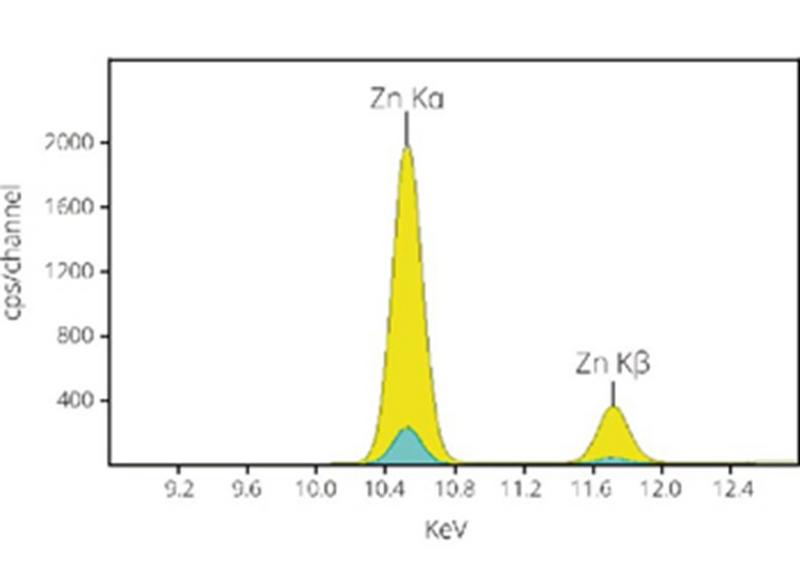
Fast measurements are achieved by using latest silicon drift detector technology that produces significantly higher intensities. Unique detector electronics enable a linear count rate capacity to over 1,500,000 cps (at 50% dead time) and a count rate independent resolution typically better than 135 eV for better separation of analytical lines in the spectrum. This allows the Epsilon 4 spectrometer to run at full power, resulting in higher intensities and therefore, giving better data quality, better limits of detection, lesser interference from overlapping elements and a much higher sample throughput compared to traditional EDXRF benchtop instruments. (See comparison with earlier model in Figure 1).
Case study: accurate & repeatable measurements of nickel in as fast as 5minutes
25 secondary nickel ore standards containing Ni, Co, Mg, Mn, Zn, Al, Cr, Ca and Si were used to set up the calibration. All elements were measured in air medium.
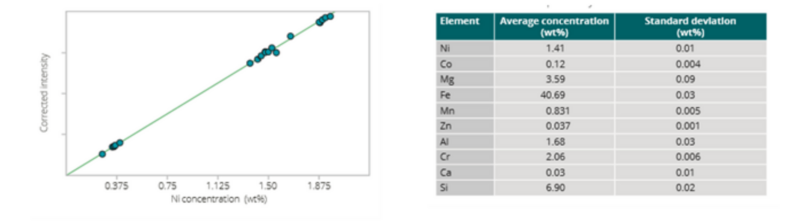
On the left, note that the calibration plots demonstrate good correlation between the given concentrations and the measured intensities. On the right, notice the low standard deviations and high repeatability (Repeatability data missing) achieved. Combining the latest excitation & detection technologies and smart design, this data demonstrates how the analytical performance of Epsilon 4 approaches that of more powerful and floor-standing spectrometers.
High throughput analysis with unattended operations of Epsilon 4
The combination of a 10-position removable sample changer with spinner enables the automatic processing of sample batches without the need for operator attention. Continuous rotation of the sample during measurement minimizes any errors caused by non-homogeneity or surface irregularities within individual samples and provides more accurate results.
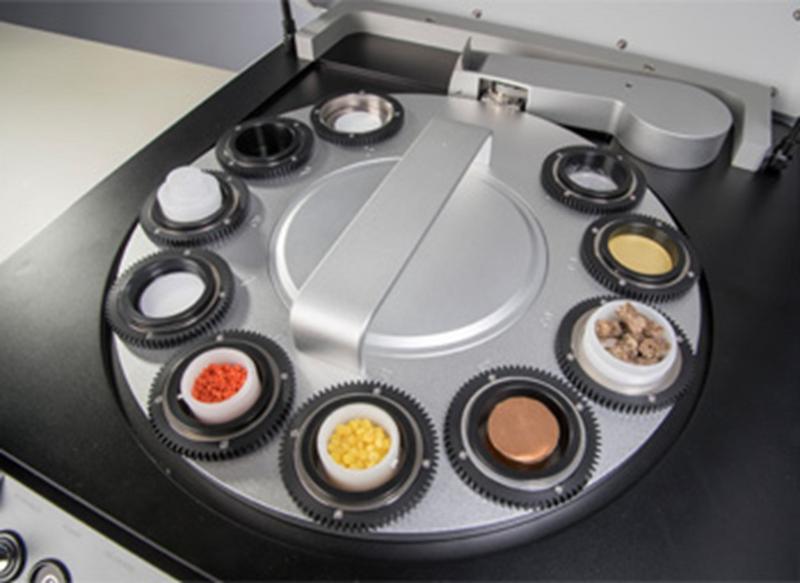
Automatic transfer of data to a central location gives you access to the latest results. Did you know that you can even link the Epsilon 4 to an automation arm for continuous sample loading?
Reduce expensive running costs with smart Epsilon 4 technology
Little or no expensive sample preparation unlike other traditional elemental methods like ICP or AAS which require long durations of samples digested in acid.
Reduce overheads without comprising on performance. The high performance of Epsilon 4 enables many applications to be operated in air atmosphere, without longer overhead time and costs involved for helium or maintenance of vacuum system. Even when measuring in air, Epsilon 4’s smart built-in sensors compensate for temperature or pressure variations. Hence ensuring excellent results whatever the weather.
Save on calibration maintenance thanks to our new low-drift X-ray tube and automatic drift correction. Especially for high throughput environments, this ensures no downtime for calibration maintenance. You can be confident of your results always.
We take care of your needs from instrumentation to CRMs to tailored standards For the mining and minerals industry, Malvern Panalytical has specially developed a unique set of 15 synthetic, multi-element wide-range oxide known as the WROXI standards. Together with Epsilon 4, WROXI can be used for the analysis of major and minor elements in fused beads.
Added benefits!
Did you know? WROXI-CRM is manufactured under ISO 17034 accreditation which means the traceability is guaranteed. Being synthetic, WROXI standards will be available forever, and that means there is no risk of the requested CRM being sold out or otherwise unavailable.
All of this is possible because of our accredited Nottingham laboratory, in the UK. Through our Nottingham lab, you have easy access to expert knowledge, accredited reference standards and tailored custom applications and standards.
Why you consider the Epsilon 4 from Malvern Panalytical for your mine site:
- Easy, non-destructive analysis with X-ray fluorescence
- Widely embraced among global mining companies
- Accurate and repeatable analysis in as fast as 5 minutes
- Malvern Panalytical, a trusted supplier
- We provide end to end solutions from calibration reference materials to reliable and smart service support
Global outreach with strong local support
Malvern Panalytical is proud of its strong network of service support. All instruments undergo rigorous checks and comply with the latest radiation safety norms like the Machinery Directive, CSA, IEC standards.
Global, regional and local training hubs have been established for all service engineers and application specialists to be ready to support your demanding requirements. In addition, we also established cutting edge technology and software for remote support. This is much appreciated by clients who are in remote mine-sites. Malvern Panalytical is the only X-ray analytical instrumentation company that has its own X-ray tubes factory. That means no unnecessary downtime waiting for the delivery of your tube. Also no unnecessary middle-man expenses.
Great performance, versatile usage
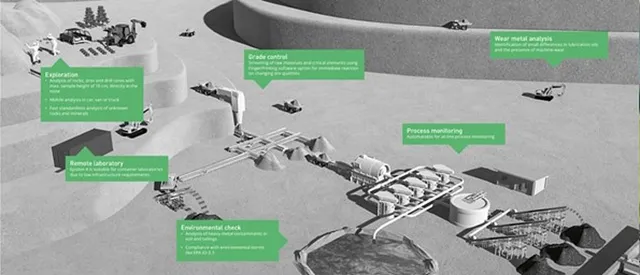
The Epsilon 4 has been proven in offering accurate, reliable and fast results. While having the benefits of smart technology to eliminate any unnecessary operational costs and downtime. Global mining companies are using the Epsilon 4 either in their laboratory or next to their site. We hope that the below illustration gives more ideas in terms of its versatile applications.
For more information, visit www.malvernpanalytical.com/Epsilon4
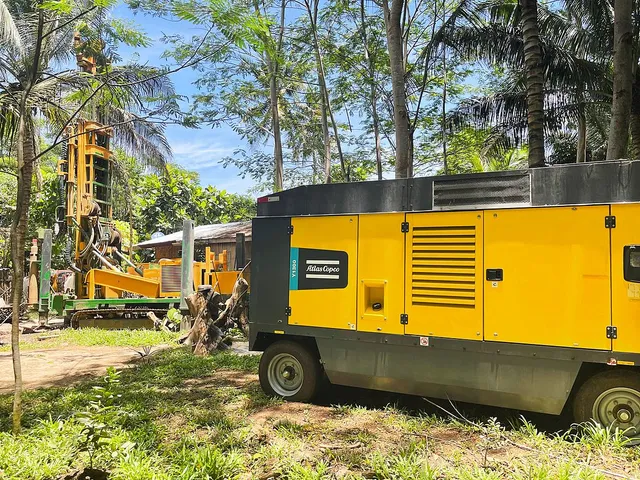
The first Atlas Copco High-pressure Portable Engine-driven Compressor Y1300 in the Philippine market
Photo Credit: Atlas Copco Philippines - The first Atlas Copco High-pressure Portable Engine-driven Compressor Y1300 in the Philippine market
Atlas Copco is an industrial company based in Stockholm, Sweden, with approximately 40,000 employees and customers in more than 180 countries. Atlas Copco is a pioneer in technology and engineering, with expertise relied upon by all industries, all over the world. With market-leading products, solutions, and services help ensure the customers’ reliable operations, optimize their productivity, reduce their costs, lower their CO2-emissions, and help them achieve their own sustainability ambitions.
Atlas Copco (Philippines), Inc. (ACPI) is a world-leading provider of industrial productivity solutions. It was established on March 30, 1967 in Metro Manila with more than 50 years presence nationwide. The head office is located at Laguna Technopark, Biñan, Laguna, and have branch offices in Cebu, Cagayan de Oro, and Davao, ready to respond around the clock to the customers’ needs.
ACPI serves various industries including electronics, semiconductors, construction, cement, agriculture, mining, automotive, food & beverage, and general manufacturing segments. Some of the products include construction equipment, portable compressors, light towers, dewatering pumps, compressed air systems, vacuum pumps, gas equipment sales and rental, industrial tools, and assembly systems.
DrillAir range - reliable and efficient power
The Atlas Copco DrillAir range of portable engine driven compressor is built scientifically around the principles of pressure and flow. The focus of the range is the relationship between these two variables and for the compressor to find the combination which is right for the application.
DrillAir is all about putting the operator in control. Thanks to innovative design and unique performance management solutions, such as Atlas Copco PACE and DrillAirXpert, the new DrillAir Model will deliver better performance in smaller and lighter package applicable to vast industries such as construction, mining, and oil and gas.
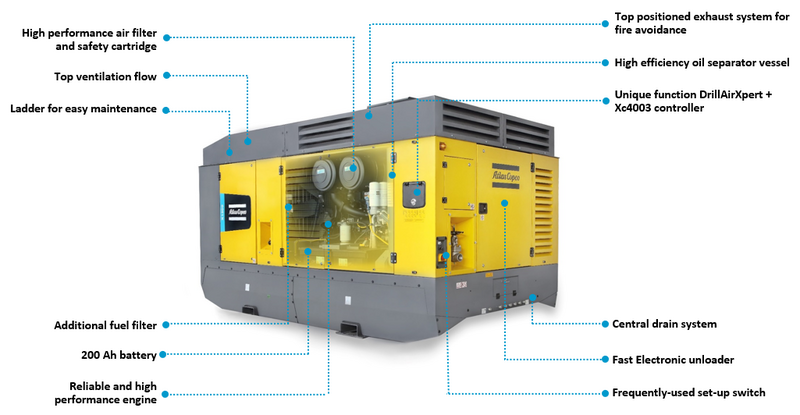
Atlas Copco’s screw element has low energy consumption over a wide range of pressure and flow settings which helps in covering fluctuations without the need to boost fuel injection. Combination of efficient screw compressor, DrillAirXpert and high pressure help to reduce fuel consumption by up to 15%.
All Atlas Copco machines are engineered, not assembled. The innovative design that makes the machine results to better performance and smaller package while the top located exhaust system will reduce the potential risk of fire. On top of it, the standardized design makes the management of big fleet easier.
The first Atlas Copco High-pressure Portable Engine-driven Compressor Y1300 in the Philippine market
The first ever Atlas Copco portable engine driven compressor acquired in the Philippine market was by ABI Interior Hardware, a company based in Ozamis City, Misamis Occidental.
ABI Interior Hardware was established in 2001 at Ozamiz City, Misamis Occidental with its main office at Pagadian City, Zamboanga Del Sur, initially established in 1997 under the name Alvin Bazaar Incorporated with business focused in hardware and paint industry. In 2002, it diversified its business and opened the Executive Hotel in Ozamiz City, with a clear vision to provide comfort and service to guests at an affordable price. It expanded in 2006 and 2011 when the company acquired a property in Cagayan de Oro City and Cebu City, respectively, and opened the Executive Pension and Food House. It was in 2007 when ABI Interior Hardware ventured into water-well drilling services with nine units of drilling rigs at present.
In 2019, with the mission to provide quality industrial, commercial, and residential water-well drilling services as well as pump and well-system repairs to ensure customer satisfaction, ABI Interior Hardware expanded their drilling services with percussion method. It is during this time that the owner, Mr. Mervin Ang, searched for a specific machine that can satisfy their requirements for the pneumatic and hammer drilling applications – a 1300-CFM, 35-bar portable engine-driven compressor. Atlas Copco’s high-pressure portable engine-driven compressor model Y1300 is the perfect candidate for such requirements.
In the height of the pandemic situation in the country in 2020, the first ever Y1300 in the Philippine market was delivered to Misamis Occidental with direct support from Mr. Junior Mangatong, Atlas Copco Philippines’ Product Engineer in Mindanao. When asked about why they chose Atlas Copco for their biggest project, Mr. Mervin Ang said, “The Atlas Copco Y1300 really boosted our productivity as we can finish a project within two months, unlike with our previous percussion method that normally takes us six months to finish. The advantages are not only directly correlated to financial savings, but also to customer satisfaction as we can fulfill our commitment and deliver above expectations.” More than the features and benefits the equipment can provide, Mr. Ang also elaborated that the technical expertise and 24-hour service hotline are keys in the decision of choosing Atlas Copco. “Machine has a good performance, easy to operate, has a good protection, and most of all why I chose Atlas Copco is the aftermarket support”, he added.
To know more about Atlas Copco’s range of products and services, visit https://www.atlascopco.com/en-ph/construction-equipment or email powertechnique.SEA@atlascopco.com.
New Report Identifies Major Carbon Reduction Opportunities in Global Mining
- New analysis lays out the scale of the mining industry’s energy use and identifies ways it can be reduced using currently available technologies
- Materials such as copper, lithium and nickel play an essential role in the technologies like electric vehicles and renewables that will help the world meet its decarbonisation targets
- As demand for these metals increases, the mining industry must itself become more efficient and environmentally sustainable
The global mining industry must move away from legacy systems and processes if it is to meet the challenge of decarbonisation, according to a new report released today which calculates mining’s share of global energy consumption and identifies ways the industry can aid the transition to net zero emissions needed to limit temperatures in line with the Paris Agreement.
The report, commissioned by the Weir Group plc, analyses mine energy data from over 40 published studies to give a comprehensive understanding of where energy is consumed in mining and minerals processing. It shows that the total amount of power used by the mining industry – which plays an essential role providing the metals used at the heart of the modern economy – is equal to c.3.5% of global energy use.
The metals produced by mining are critical for enabling the global transition to low-carbon infrastructure. But without action, energy use in mining itself is set to trend higher in the coming years as demand increases for metals like copper, nickel and zinc. The report suggests there are technologies available today that could make a significant difference to this trend. For example, it highlights that comminution – i.e. crushing and grinding processes – is the single biggest user of energy at mine sites, typically accounting for 25% of mining’s final energy consumption. This is equivalent to the power used by 221 million typical UK homes, or c.1% of total consumption globally. Comminution is therefore a natural target for the most impactful energy savings opportunities.
Small improvements in comminution technologies can lead to relatively large savings in both energy consumption and greenhouse gas emissions. For example, a 5% incremental improvement in energy efficiency across comminution could result in greenhouse gas emissions reductions of more than 30m tonnes of CO2-e. The replacement of traditional comminution equipment with new grinding technology also reduces indirect emissions in the mining value chain, for example by removing the need for the manufacture of emission-intensive steel grinding balls.
Of the remaining energy consumption by the mining industry, diesel in varied forms of mobile equipment accounts for 46%, electricity in mining (ventilation) 15% and “other electricity” 14%.
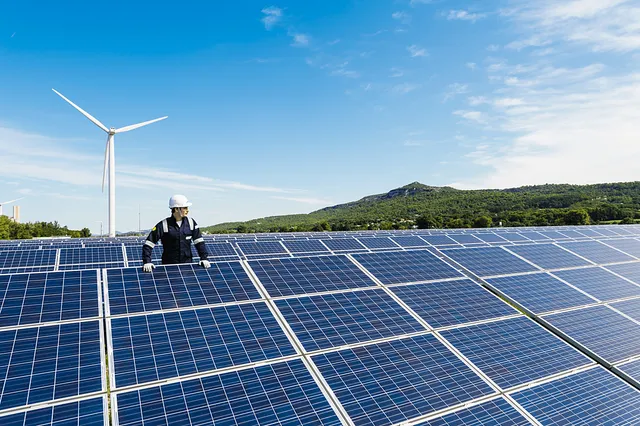
Other significant opportunities identified by the report for reducing mining’s energy consumption include optimisation, big data and artificial intelligence. In addition, if zero emissions energy sources are deployed for mining equipment – e.g., renewable energy, energy storage and alternative fuels – then the industry may well be able to achieve zero emissions, leaving a relatively small role for offsets and carbon credits to play.
The report comes as the mining industry is under ever-greater pressure to produce essential minerals that
support some of the biggest global structural trends, from population growth to urbanisation and decarbonisation. Copper, nickel, steel and lithium are core components of electricity transmission and storage, electric vehicles and renewable energy infrastructure. The move to a decarbonised economy will result in increased primary consumption of these mined commodities, even after factoring for recycling, so it is important that mining itself becomes more sustainable.
Download the independent Mining Energy Consumption 2021 report here: www.energysavingsinmining.com
Commenting, Weir Group Chief Executive Jon Stanton said:
“The mining industry is central to economic development globally, with critical minerals enabling the low-carbon transition required in the rest of the economy. But the environment in which it will operate in future will be very different from the past, requiring comprehensive change and investment. In short: mining needs to become more sustainable and efficient if it is to provide essential resources the world needs for decarbonisation while reducing its own environmental impact.This report is an important contribution to that debate which we hope will spark thoughtful conversations around the world on the way forward.”
Alison Keogh, Chief Executive of the Coalition for Energy Efficient Comminution, said:
“This report highlights both a challenge and an opportunity to revitalize cross-industry discussion and actions on decarbonisation and ESG solutions. We invite industry leaders to actively contribute and collaborate through mining-vendor-research partnerships and share knowledge. Together, we can accelerate improved energy, emissions and water footprint across industry faster.”
Ricardo Garib, Weir Minerals Divisional President commented:
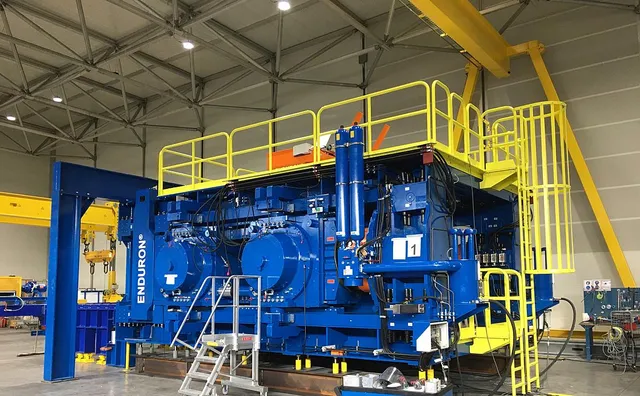
“Weir Minerals is focused on making mining more efficient and sustainable by leading technology change in the industry. Our Enduron HPGRs are increasingly replacing conventional milling systems in comminution (crushing, screening and grinding) circuits because of their substantially lower energy consumption, finer rock reduction requiring less water downstream and potential for significant total cost of ownership reductions.”
Stuart Hayton, Managing Director of Weir Minerals Netherlands, where the Enduron® HPGRs are designed and manufactured, added: “Not only do Enduron HPGRs require as much as 40% less energy than traditional alternatives, their wearable components last much longer and the maintenance time required to replace worn out parts is significantly lower. The estimated carbon saving of each Enduron HPGR in operation is equivalent to taking more than 3,600 petrol fuelled cars off the roads each year.”
Notes:
- The report quantifies energy use in five commodities: copper, gold, iron ore, nickel and lithium. Bringing together mine energy use data from more than 40 published studies (each of which references dozens more studies) from 2007 to 2020 into a single narrative, the report aims to build a more comprehensive understanding of energy use in the mining industry.
- Using the current production rates of the commodities in question, and the energy intensities for each of the commodities, a total of 1,68 EJ/a (1,680,000,000,000,000,000 joules per year) has been calculated. This is approximately 0.5% of total final energy consumption globally. Published information indicates that the entire mining industry consumes approximately 12 EJ per year – or 3.5% of total final energy consumption globally.
- Assuming that present trends continue, there will be 250m electric vehicles on the road by 2030. To meet this demand, production of cobalt, lithium, graphite and nickel will need to be scaled up significantly.
- Current projections show that the current rate of decarbonisation globally is far below what is required to meet the goals of the Paris Agreement. A sustained decarbonisation rate of up to 7% per year, year on year should be sufficient to achieve the goal of a temperature increase of well below 2°C by 2100. For the mining industry, there are multiple ways to achieve decarbonisation including energy efficiency and fuel/energy switching. Many of these opportunities are starting to be explored by both the mining companies and the mining services providers, who see decarbonisation and energy reduction as a key way to reduce exposure to the risks of climate change.