May 24, 2022

Article by: Roniel R. Arguillas - CTPCMC ICE Officer

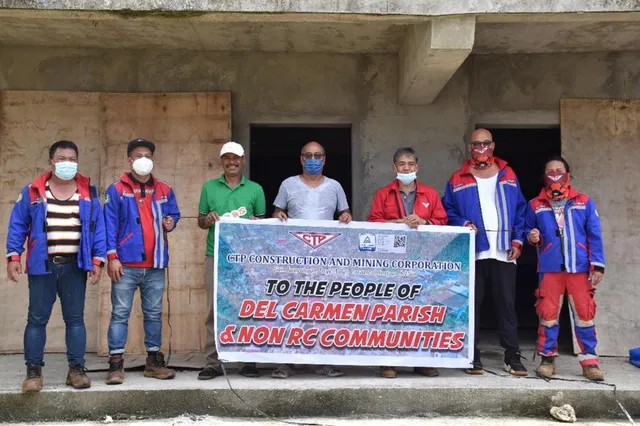
Siargao Islands was ravaged by Typhoon Odette on December 16, 2021 leaving massive damage on its vegetation and infrastructures. Due to the typhoon’s impact, Siargaonons’ access to health services, electricity, food and water was curtailed. In response to their need, CTPCMC conducted “Operation Odette: To the People of Del Carmen Parish Siargao and Non-Roman Catholic Communities” on January 20,2022. CTPCMC Personnel and Staff and CTPCMC Emergency Response Team(ERT) spearheaded by Engr. Charlo R. Basadre with LCT Charles Jason went to Siargao bringing 3,500 relief goods, 3,300 nipa shingles, galvanized-iron roofs, mineral water, 10,000 seedlings of trees namely Maria Buhok, Mango-Tambis and Magkono species. Likewise, former CEO/President Clarence J. Pimentel Jr. also donated 45 units of generator sets, 20 sets of solar lamps and PARAMINA also sent 25 sacks of rice. The relief assistance were turned over to Msgr. Prescilo P. Iral, Dcs for distribution to the 3,500 affected families. The turnover was attested by by Fr. Rolmart L. Verano,Dcs.

CTPCMC further extended the relief operation to the neighboring Islands including Sitio Campinganon, Pitogo and Alvarez of Barangay Maribojoc, San Benito, Surigao del Norte. And on April 01, 2022, the company donated cash assistance for the renovation of Our Lady of Mt. Carmel Parish at Del Carmen and Sta. Monica Parishof Siargao Islands.

On March 8,2022, Mines and Geosciences Bureau(MGB) Region XIII awarded a plaque of recognition to CTPCMC for its assistance extended to the victims of Typhoon Odette, it was received by Engr. Charlo R. Basadre; CTPCMC Resident Mine Manager.

May 24, 2022

Mayor Al David Uy of the Island Garden City of Samal hopes the construction of the PHP23 billion Samal-Davao connector bridge will finally start under the new administration.

“(It’s) possible, (I’m) praying,” Uy said in a text message Friday.

Uy noted that bidding for the project was completed last year, and that winning bidder China Road and Bridge Corporation (CRBC) is just waiting for the signing of the loan agreement.

On January 14, 2021, the Department of Public Works and Highways (DPWH) and the contracting firm signed the Design and Build Contract Agreement after CRBC won the bidding.

“It is one of the most important projects, and we are hoping for its construction. The ball now is with the Department of Finance and the Office of the President,” Uy said.

Earlier, Uy assured the local government will focus on the realization of the Davao-Samal connector, which he said would be vital for the island-city's tourism industry.

With a length of 3.98 kilometers, the bridge will provide a vital link for trade and tourism for both areas through reduced transport costs and faster flow of people, goods, and resources.

Conceptualized 40 years ago, the bridge project has been identified as among the big-ticket infrastructure initiatives under the administration of President Rodrigo Duterte.

Meanwhile, the Mindanao Development Authority (MinDA) also vowed to push for the big-ticket projects for Mindanao, including the Davao-Samal connector project to the new administration come July this year.
 
"We don't want Mindanao to be left behind when it comes to infrastructure. We need the connectivity within Mindanao with other areas in the Philippines and BIMP-EAGA,” MinDA Secretary Mabel Sunga-Acosta said in a recent interview. By Che Palicte


Article courtesy of the Philippine News Agency 

May 24, 2022

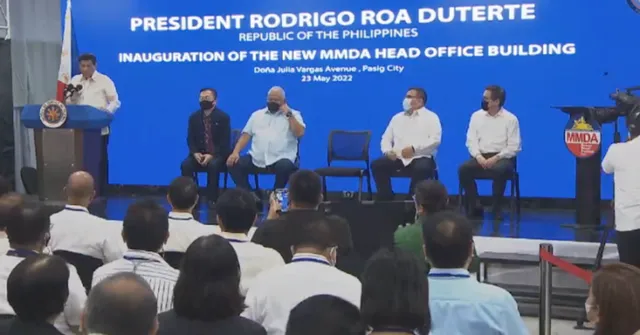
Photo: President Rodrigo Roa Duterte leads the inauguration of the new Metropolitan Manila Development Authority (MMDA) Head Office Building in Barangay Ugong, Pasig City on Monday (May 23, 2022). Duterte enjoined the private and public sectors to invest in safer and responsive infrastructure as these provide a foundation for a strong economy. (Screengrab from RTVM)

President Rodrigo Roa Duterte on Monday enjoined members of the public and private sector to invest in “safer” and “responsive” infrastructure as these provide a foundation for a strong economy.

He made this call during the inauguration of the new Metropolitan Manila Development Authority (MMDA) Head Office Building in Barangay Ugong, Pasig City.

“Whether in the public or private sector, I strongly urge you to invest in safer and responsive infrastructure. I urge all of us to invest in our people and country,” he said in his speech.

Duterte said he is hoping that the new building complex would encourage both officials and employees to continue working hard for a “sustainable, resilient, dynamic, and most of all, people-centered” MMDA.

“In the coming days, we shall see just how helpful this project is in helping the agency achieve its goals. It is my hope that the momentum that we have gained through this project, as well as in our other previous projects, will motivate other government offices and institutions to invest in similar undertakings,” he added.

Meanwhile, he also congratulated the MMDA for the successful completion of its new home, which he said would provide everyone in the organization the space they need to function more efficiently.

He also commended the MMDA for its “tireless” service in addressing the needs of the people.

“As if it was not hard enough, the Covid-19 pandemic made transport management, waste management, disaster prevention and public safety in Metro Manila even more challenging. What makes me proud is that in the past two years, the men and women of the MMDA bravely and wholeheartedly took to their task a genuine service to their fellow Filipinos,” he said.

During the event, Duterte and MMDA Chairman Romando Artes unveiled the building marker, together with Executive Secretary Salvador Medialdea and Senator Christopher Lawrence “Bong” Go.

Artes said the new building complex shows the MMDA’s commitment to strengthening the organization and providing better services to its clientele.

“We started with an idea, and now we stand in the actual building of our lifetime dream – a state-of-the-art government facility, catering to the needs of our employees as well as the clients and partners of Metro Manila. We now have a safe, structurally sound, sustainable, and productive headquarters we can call home,” he said.

The new 20-story MMDA building, with roof deck and helipad, will be certified by the Building for Ecologically Responsive Design Excellence (BERDE) with a one-star accreditation.

BERDE is a tool to assess, measure, monitor, and certify the performance of green building projects.

The conception of the new MMDA building started during the time of the late Chair Danilo Lim in 2018, through the collaboration with the United Architects of the Philippines (UAP)-Makati Chapter, by holding a national design competition for the facility with the theme: "MMDA moving towards a sustainable, resilient, dynamic, and people-centered metropolis."

During the same year, a partnership was forged between the MMDA and the Robinsons Land Corporation (RLC) for the construction of the office.

The winning conceptual design by Architect Daryl John Abaygar, entitled “Solihiya Moderno” was used as an inspiration.

The “Solihiya Moderno” was influenced by the traditional home silhouette and “solihiya” weave pattern.

MMDA employees will start moving into their new building this year.


Article courtesy of the Philippine News Agency

May 23, 2022

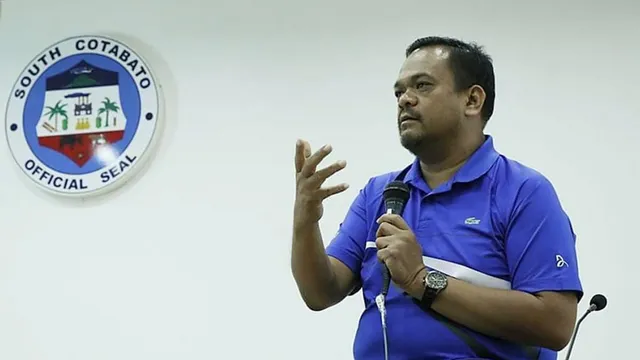
Photo: South Cotabato Gov. Reynaldo Tamayo Jr. Photo from the South Cotabato provincial government Facebook page

The South Cotabato government has created a Technical Working Group (TWG) to study the Sangguniang Panlalawigan's (SP) amendment to the province's environment code that lifted the open-pit mining ban.

In an interview Friday, South Cotabato Governor Reynaldo Tamayo Jr. said his decision on whether to veto or not the lifting of the open-pit mining ban will depend on the TWG’S recommendations

Tamayo said he has yet to receive the amended ordinance.

Within 15 days, the governor can veto or approve the amendments to the province’s environmental code before it lapses into law.

“An Ordinance Providing for the Environment Code of the Province of South Cotabato” was passed on June 9, 2010.

“For now, I cannot say because I don’t want to preempt the decision and findings of the TWG, but I assure you that we are looking at what is good for everybody,” Tamayo said.

In a meeting Thursday with Bishop Cerilo Alan Casicas of the Diocese of Marbel, who supported the open-pit mining ban, the governor said the provincial government must consider several issues and concerns before arriving at a decision.

“Quarrying is part of an open pit, and what the SP approved in Lake Sebu is also an open pit. It will be contradicting if the open-pit mining ban will not be lifted,” Tamayo said.

“We will sit again together with the Bishop and Sagittarius Mines, Inc.  (SMI) to talk about what is right or wrong, and it is important that I can come up with the decision two days before the deadline,” he noted.

Meanwhile, Casicas said he hopes the governor will decide "based on the wisdom of the majority" of South Cotabato residents.

During Thursday's meeting with the governor, the bishop led a group of some 3,000 protesters to the provincial grounds.

“The most important factor is the wisdom of the people more than our voices and SMI,” Casicas said.

Meanwhile, Board Member Ester Marin Catorce, an anti-mining advocate, denied the amended ordinance was recalled by the SP majority group.

On Monday, 11 of 15 SP members approved the measure to lift the 12-year-old open-pit mining ban in the province.

The SMI has been pursuing the Tampakan gold project in the province for years amid stiff opposition, primarily from the local Catholic diocese. By Roel Osano


Article courtesy of the Philippine News Agency

May 20, 2022

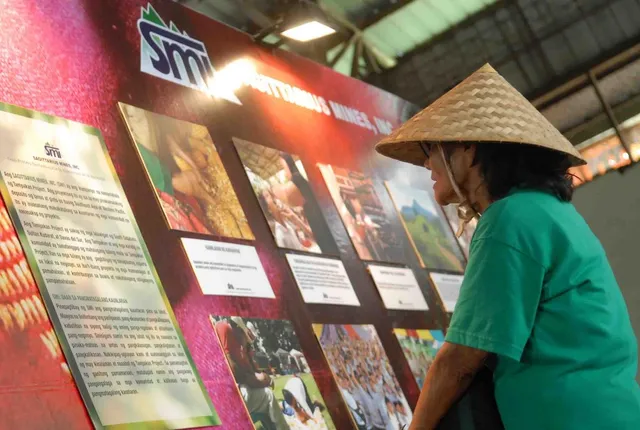
Photo credit: Sagittarius Mines Inc.

Senator Francis Tolentino said the Tampakan copper-gold project being pushed to resume by Sagittarius Mines Inc. (SMI) in Tampakan, South Cotabato will be beneficial to local residents.

Tolentino said on Thursday the Tampakan copper-gold project will be "cost-effective" and safe.

"Cost effective yung extraction ng open-pit mining kasi mababaw lang ang paghuhukay niyan eh, makukuha agad yung mina (The open-pit mining extraction is cost effective because the excavation will be shallow and the mine will be easily extracted)," he said in "Sa Ganang Mamamayan" program of Net25.

Tolentino, however, said the Department of Environment and Natural Resources (DENR) should see to it that the rehabilitation plan will be properly implemented.

"Ang nakikita ko lang dito, ganon din siguro sa mga outlying communities, sundin yung rehabilitation plan kung meron man yung DENR. I-monitor naman ng DENR, huwag pabayaan ng DENR. Dapat nakatutok lagi sila. (What I can see here, just like maybe the outlying communities, follow the rehabilitation plan if DENR has. DENR should monitor, DENR must not ignore. They should always focus)," he said.

After the Tampakan copper-gold project halted four years ago, President Rodrigo Roa Duterte signed in April 2021 the lifting of the moratorium on open-pit mining.

The South Cotabato Provincial Board also lifted its ban on open-pit mining giving the SMI a go-signal to proceed with its stalled USD5.9-billion project.

DENR Acting Secretary Jim Sampulna vowed they will ensure that SMI will comply with its rehabilitation obligations and environmental protection, assuring that the environment will not be sacrificed.

"We will also require SMI to invest in equipment and manpower to ensure mitigation in case of any adverse impacts from the mining operation,” Sampulna said.

According to SMI, the Tampakan project is noted as one of the largest untapped copper and gold minefields in Southeast Asia.

The mining company expects the project to yield an average of 375,000 tons of copper and 360,000 ounces of gold per year. By Wilnard Bacelonia


Article courtesy of the Philippine News Agency

May 19, 2022

Photo credit: The Department of Public Works and Highways

The Department of Public Works and Highways (DPWH) will be assisted by Japanese experts in enhancing capabilities of DPWH engineers with the end in view of applying latest technologies in the Philippines to address road disasters on hazard-prone mountain areas.

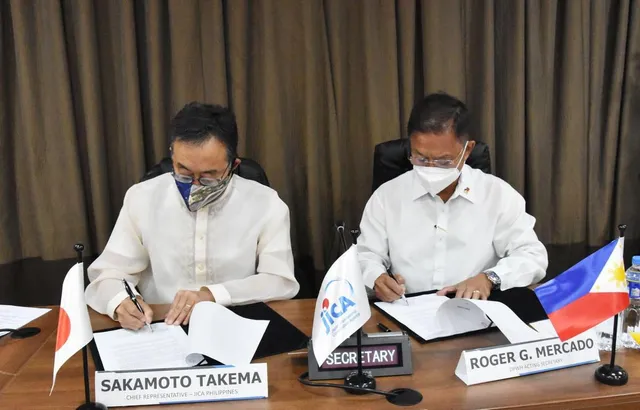
DPWH Secretary Roger G. Mercado and Japan International Cooperation Agency (JICA) Philippines Office Chief Representative Takema Sakamoto signed on Wednesday, May 18, 2022 the Record of Discussions to formally commence a technical cooperation program on road disaster preventions and other countermeasures on mountainous roads.

The signed record of discussions establishes a mutual agreement for implementation of detailed plan for the project to enhance capability on implementation of permanent countermeasure works for slope disaster, emergency response, hazard maps development, and road disaster information management based on road disaster information system.

Earlier, President Rodrigo Roa Duterte issued on April 12, 2022 Special Authority to DPWH Undersecretary and Build Build Build Chief Implementer Emil K. Sadain and Department of Finance (DOF) Undersecretary Mark Dennis Y.C. Joven to negotiate and or facilitate for and on behalf of Government of the Republic of the Philippines and JICA the record of discussions for the ₱178 million JICA grant project.

DPWH has been implementing different strategic infrastructure policies and programs which aims to: a.) to ensure safe and reliable national road system through the rehabilitation/reconstruction of national roads with slips, slope collapse and landslides, b.) to provide safe access to highly vulnerable areas; and c.) to rehabilitate, retrofit and strengthen existing bridges.

The signing event held at DPWH Central Office was also participated by Undersecretary Sadain of DPWH Unified Project Management Office (UPMO) Operations; Undersecretary Maximo L. Carvajal of Technical Services; Acting Undersecretary Constante A. Llanes Jr. of Planning Service; JICA Senior Representative Kenji Kuronuma; and Bureau Directors Ernesto S. Gregorio Jr., Aristarco M. Doroy, Edwin C. Matanguihan, and Reynaldo P. Faustino.

Secretary Mercado said that this latest collaboration program is a new seal in the partnership of DPWH and JICA in building safe, reliable, sustainable and resilient infrastructures resulting in the improvement of the quality of life of millions of Filipinos.

Appropriate road disaster countermeasures against landslides, debris flow, and rock collapse are necessary due to yearly occurrence of strong typhoons and earthquakes in the country which renders many roads unpassable.

With the willingness of Japanese experts to share their effective technologies on landslides and other road disaster mitigation, the DPWH engineers will be able to apply the best methodology in mitigating and preventing road catastrophes, added Secretary Mercado.

Prior to signing of the record of discussions, DPWH Planning Service headed by Acting Undersecretary Llanes held a series of discussions with JICA and other relevant organizations to develop a plan for the project.

The technical cooperation project has a three (3) years and a half reckoned period with the Cordillera Administrative Region and Regions 7 and 11 as pilot sites.


Article courtesy of the Department of Public Works and Highways
May 18, 2022

Photo credit: Apex Mining

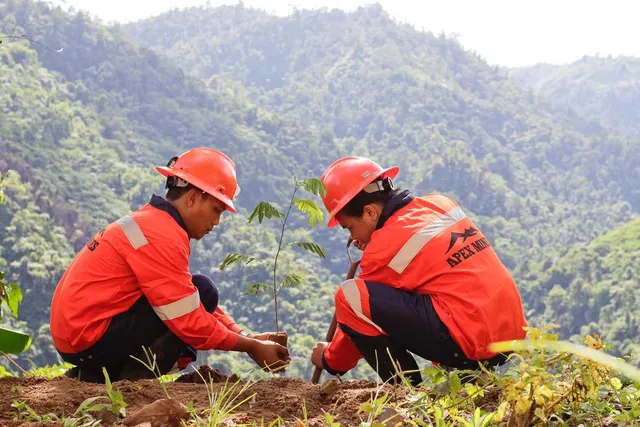
On March 4, 2022, Department of Environment and Natural Resources (DENR) Acting Secretary Jim O. Sampulna signed the DENR Administrative Order (DAO) No. 2022-04 entitled “Enhancing Biodiversity Conservation and Protection in Mining Operations”.

 The Biodiversity Management Bureau (BMB) and the Mines and Geosciences Bureau (MGB) jointly drafted the said policy to provide adequate measures for responsible mining towards ensuring biodiversity conservation and protection including progressive and final rehabilitation of mined-out areas. It also aims to minimize negative impacts on biodiversity, thereby promoting the sustainable development and utilization of the country’s natural and mineral resources for the benefit of present and future generations.

The said policy emanated from the 13th Meeting of the Conference of Parties (CoP) to the Convention on Biological Diversity (CBD) in December 2016, wherein it was identified that aside from agriculture, forestry, fisheries, aquaculture and tourism, other sectors such as energy, urban and regional planning, infrastructure, manufacturing industry and mining also negatively impact biodiversity.  Hence, as a commitment of the Philippines to the CBD and in response to the Strategic Plan for Biodiversity 2011-2020, the country developed various plans such as the Philippine Biodiversity Strategy and Action Plan (PBSAP) and included priority strategies in the Philippine Development Plan (PDP) to address the issue. 

On December 9-10, 2020, the MGB and BMB jointly organized a two-day virtual consultation with large-scale and small-scale mining companies regarding the then-proposed policy. Various stakeholders of the mining industry participated in the said two-day virtual consultation composed of representatives from the Chamber of Mines of the Philippines; Philippine Nickel Industry Association; Philippine National Coalition for Small-scale Mines; DENR Regional Offices, BMB, MGB Central Office, and Regional Offices. A total of 187 and 54 participants attended during the two-day virtual consultation with large-scale and small-scale mines across the country, respectively.

In addition, the said policy goes to a series of deliberation with the BMB, MGB, and DENR Policy Technical Working Group in 2021. 

Accordingly, DAO No. 2022-04 identifies and recommends specific biodiversity-related measures that shall be undertaken in all stages of on-shore and off-shore mining operations.

The following are the salient features of DAO No. 2022-04:

  • Biodiversity measures shall be integrated in all stages of mining operations, including exploration, development, and utilization, and closure, decommissioning, and rehabilitation;
  • Detailed guidelines on integrating biodiversity in small-scale mining shall be jointly prepared by BMB and MGB within one (1) year upon issuance of this Order;
  • Mining companies shall integrate biodiversity conservation and protection in the Social Development and Management Program (SDMP);
  • The Contingent Liability and Rehabilitation Fund Steering Committee (CLRFSC), Mine Rehabilitation Fund Committee (MRFC), and Multipartite Monitoring Team as per DAO No. 2010-21 shall include Biodiversity Management Bureau (BMB) and Ecosystems Research and Development Bureau (ERDB), and their regional counterparts as members;
  • BMB, in consultation with MGB, shall subsequently develop modules and instructional materials on the integration of biodiversity in the mining sector;
  • BMB and the Conservation and Development Division of DENR Regional Offices shall undertake annual monitoring and evaluation using compliance monitoring tools to be developed by BMB; and
  • Mining Contractors, Permit Holders, and Permittees shall include biodiversity measures in their respective Environmental Work Programs, Environment Protection and Enhancement Program, Final Mine Rehabilitation and/or Decommissioning Plan, and Social Development and Management Program.

DAO No. 2022-04 was published in The Manila Times and registered in the Office of National Registry on April 21, 2022. The full version of DAO No. 2022-04 can be accessed through this link: https://apidb.denr.gov.ph/infores/uploads/DAO-2022-04.pdf


Article courtesy of the Department of Environment and Natural Resources
May 18, 2022

Photo credit: The Department of Transportation

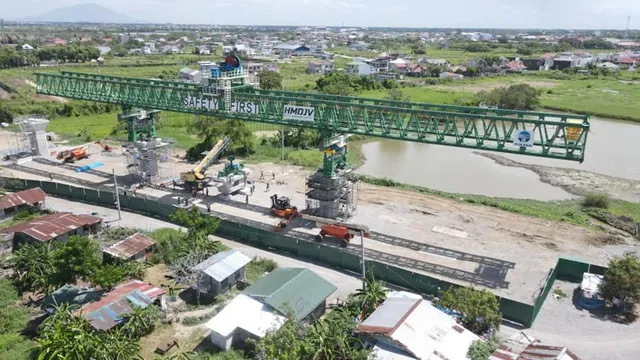
The construction of the North-South Commuter Railway (NSCR) Malolos-Clark segment reached a milestone on Tuesday with its first use of a launching gantry—a special purpose mobile gantry crane used in bridge construction.

The Department of Transportation (DOTr) said the launching gantry—dubbed ‘Luid’ or ‘Mabuhay’ in Kapampangan—represents the first time such equipment was used in Pampanga province.

“Luid will travel 5.5 kilometers between Barangay Lourdes, Minalin in Pampanga and Barangay Gatbuca, Calumpit in Bulacan, and will be utilized to construct the railway viaduct,” the DOTr said on its Facebook post.

The launching gantry will lift 16 35-ton pre-casted segmental box girders and combine them into one 40-meter railway viaduct span.

“In total, Luid will create 140 railway viaduct spans,” the DOTr said.

It said Luid is only one of 11 launching gantries that will be operated in the Malolos-Clark segment of the NSCR system.

The use of launching gantries, it said, is an “internationally recognized method of construction to ensure the safe, efficient, and quality construction of the NSCR.”

It noted that the launching gantries were procured through official development assistance (ODA) loans from the Asian Development Bank (ADB).

The NSCR system—operated by the Philippine National Railways (PNR)—is a mass transport rail system from Clark International Airport (CRK) in Pampanga to Calamba, Laguna.

The DOTr said the NSCR is seen to create “over 47,000 direct jobs and 106,000 indirect jobs” during its construction, contributing to post-Covid-19 and economic growth in Luzon, particularly in Region 3, 4-A, and the National Capital Region. By Raymond Carl Dela Cruz


Article courtesy of the Philippine News Agency

May 17, 2022

Photo credit: San Miguel Corporation

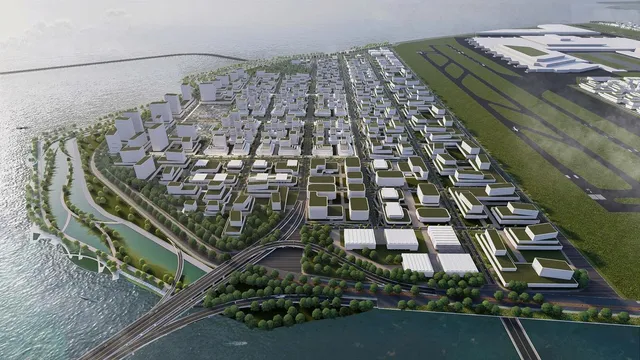
San Miguel Corporation (SMC) has released a conceptual master plan for its massive, green-designed, and future-ready aerocity development in Bulacan province, envisioned as the “pace-setter” and model for green urbanism in the country.  

The project is seen as a major boost to both national and local economies as it will complement SMC’s P740-billion New Manila International Airport (NMIA) project.  

SMC President and Chief Executive Officer Ramon S. Ang said that the designs, prepared by top architecture firm Palafox Associates, reflect the vision of a modern Philippine city that provides built-in solutions to various socio-economic, environmental, and climate issues, and correct the mistakes seen in many urban developments of Metro Manila.  

SMC tapped the firm, headed by the country’s top urban planner and green architect, Felino “Jun” Palafox Jr., to masterplan the airport-driven city concept. 

“These designs presented to us by Arch. Palafox and his team will be close to actual. There will probably be some adjustments by the time we implement, and we will still continue to improve as needed, but in terms of the overall concept, design, and the features, this is it,” SMC president and chief executive officer Ramon S. Ang said.  

“It’s very fortunate that when we sat down with Architect Jun Palafox for this project, we had the same vision that the airport and aerocity projects should be sustainably built, geared towards the future, and address social and environmental concerns that have beset our existing cities, including the country’s major financial districts. With Architect Palafox’s help, all of this can be done,” he added.  

Ang underscored that the Aerocity development addresses many of the problems experienced in Metro Manila today. It is designed, and will be built, with sustainability in mind. It will be properly zoned, with areas dedicated to agriculture and food production, logistics, health and wellness, aeronautics, finance, science and technology, commerce, residences, education, tourism, entertainment, recreation, and government among others. 

It will utilize renewable energy, and will accommodate both traditional and alternative modes of transportation, as well as promote active and healthier lifestyles, he added. 

The airport city design will adopt green architectural and green urbanism guidelines over and above the country’s building and zoning codes, and follow structural codes of other countries similarly situated in earthquake zones like the Philippines.  

The Aerocity project will have ample open spaces and utilize the latest in digital infrastructure.  

It will also feature easily accessible public transport systems, including mass transit systems, bicycle highways, as well as a waterfront area with landscaped walkways and promenades.  

Ang said SMC is fully committed to completing the massive projects, which it will fully-fund with no guarantees or subsidies from government, to help boost the country’s post-pandemic economy and improve the lives of more Filipinos by boosting various industries and creating millions of quality jobs nationwide.  

SMC’s 2,500-hectare NMIA project will initially feature four parallel runways, a world class terminal, and a modern and interlinked infrastructure network that includes expressways and railways.  

“While we need to fast-track the completion of this airport and aerocity to help ease travel congestion and aid in the country’s recovery with more jobs and opportunities for more Filipinos, we are mindful that we need to do this the right way and with a vision for a sustainable future. That is why we tapped Architect Palafox for this project,” he added. 

In his decades of experience as an urban planner, Palafox has advocated and implemented some 1,700 projects that integrate the best practices in green, sustainable, and disaster-resilient architecture in about 45 countries worldwide. 

Palafox earlier pointed out that that country needs 100 new cities by the year 2050 and he agreed to take on the Bulacan Aerocity development to present it as a model and pacesetter for future green and sustainable cities.  

Prior to actual development, the company has committed to restore and rehabilitate the existing mangrove forest cover at the Bulakan coastal areas by planting some 190,000 mangroves, develop and enhance natural habitats of marine and bird species, and clean the rivers surrounding the airport project to help mitigate perennial flooding in the province. 


Article courtesy of San Miguel Corporation

May 17, 2022

Photo credit: San Miguel Corp

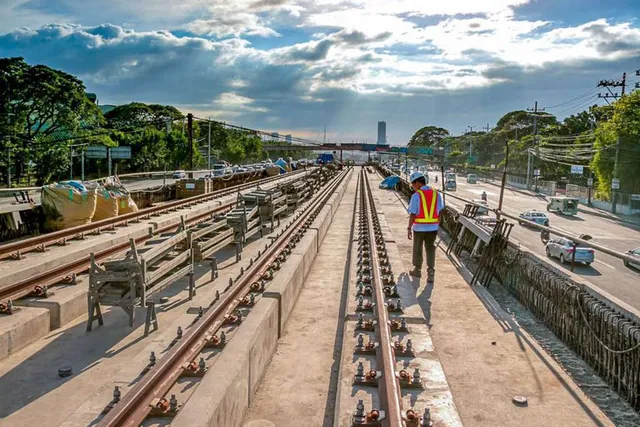
The Metro Rail Transit Line 7 (MRT-7), one of the flagship transportation projects of the Duterte administration, is now 63.35 percent complete, the Department of Transportation (DOTr) said on Monday.

In a Facebook post, the DOTr said the construction of the project continues to accelerate to serve the public as soon as possible.

“Oras na matapos at maging operational ang MRT-7, ang dating 2-3 hours na biyahe ng ating mga kababayan mula North Avenue, Quezon City patungong San Jose del Monte sa Bulacan, ay magiging 35 minutes na lamang (Once the MRT-7 is complete and operational, the previous two to three-hour travel between North Avenue and San Jose del Monte will be reduced to just 35 minutes),” the DOTr said.

The MRT-7, it said, will be capable of serving an average of 300,000 to 500,000 passengers in a single day.

First conceptualized in an unsolicited proposal in August 2001, the MRT-7’s concession agreement was signed on June 8, 2008.

By the beginning of the Duterte administration in 2016, the project had yet to materialize.

“Ni walang poste o isang tren man lang ang kanilang nadatnan. Kaya naman, sinikap ng DOTr at San Miguel Corporation (SMC) na simulan at isakatuparan ang proyekto (There was not a single post or train by then. That’s why the DOTr and SMC strived to start and turn the project into reality),” the DOTr said.

In December last year, President Rodrigo Roa Duterte and Transportation Secretary Arthur Tugade unveiled the first six trains to be used in the MRT-7.


Article courtesy of the Philippine News Agency

May 17, 2022

Eleven of 15 members of the Sangguniang Panlalawigan of South Cotabato approved Monday the lifting of the ban on open-pit mining in Tampakan town. The copper and gold mine project in Tampakan is touted as the largest in Southeast Asia. (Photo courtesy of SP South Cotabato)

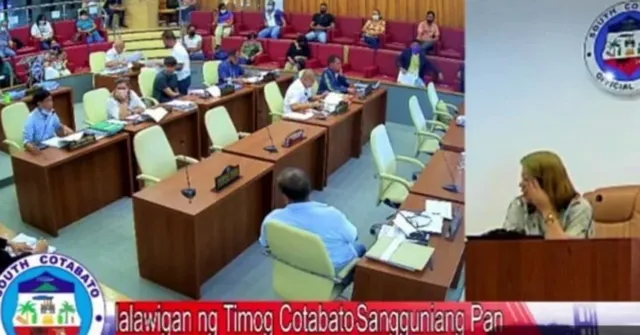
The majority of the Sangguniang Panlalawigan (SP) members approved Monday the amendments to the environment code of South Cotabato province, particularly the provision on the lifting of the ban on open-pit mining in Tampakan town.

Voting for the ban's lifting were SP board members Glezel Trabado, who acted as presiding officer in the absence of Vice Governor Vicente de Jesus, Larry de Pedro VI, chairman of the Environment Committee, Dardanilo Dar, Noel Escobillo, Antonio Fungan, Eamon Gabriel Mati, and Henry Ladot.

Also backing the move were Indigenous Peoples’ Mandatory Representative (IPMR) Edgar Sambong, Sangguniang Kabataan (SK)Federation president Alaisa Marie Fale, Association of Barangay Captains (ABC) president Rolando Malabuyoc, and Philippine Councilors League (PCL) South Cotabato Chapter president Grace Achura.

Board Member Ester Marin Catorce, who opposed the amendment and was designated by the Department of the Interior and Local Government (DILG) as acting governor, was absent during Monday’s regular session.

“None of them objected, as acting governor by the rule of succession I cannot attend the session. Governor Tamayo is out of the country while Vice Governor Vicente De Jesus, who underwent an operation, was not present,” Catorce said.

Catorce said she asked a colleague to defer the deliberation of the amendment because of the many issues that still need discussion. Her request, she said, was not granted.

SP members Ellen Grace Subere-Albios and Jinky Avance-Samodal, who also both opposed the open-pit mining operation, were also absent in the regular session.

Ordinance 04, Series of 2010, entitled “An Ordinance Providing for the Environment Code of the Province of South Cotabato,” was passed on June 9, 2010.

In 2015, SP filed a resolution affirming the open-pit mining ban in the province.

Pro-mining groups earlier said the open-pit mining ban in South Cotabato hampered the development of the copper and gold mine project in Tampakan, touted as the largest in Southeast Asia.

Anti-mining groups, however, said the project endangered not only the environment but also the lives of residents.

Sagittarius Mines Inc. has been pursuing the Tampakan gold project for years. By Roel Osano

May 17, 2022

Photo credit: Weir Minerals

As a leader in materials development and advancement, the team of material scientists at Weir Minerals are always pushing for ways to improve the capabilities of our technology for our customers.

The advanced laboratories at Weir Minerals develop a variety of materials, from natural to synthetic, to polyurethanes and composite materials. One of these materials is the Vulco® mill liner rubber.

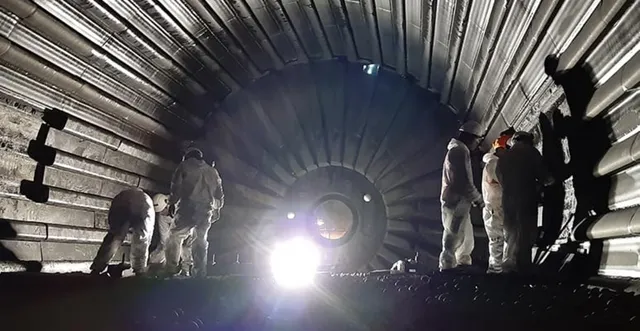
Vulco® rubber is renowned throughout the mining industry for its exceptional wear life and reliability in mill lining systems. These abrasion- and impact-resistant rubber compounds are continuously improved and refined by Weir Minerals’ team of engineers and material scientists to keep them at the forefront of mill lining systems technology.

Having identified a need for higher-wearing rubbers for mill lining systems, the material science experts developed an industry-leading, premium-grade rubber compound with superior wear life and performance in mill lining applications.

The result: Vulco® R67 rubber – an optimum material which is manufactured with proprietary new compounds and innovative methods of processing to deliver outstanding wear life and longer uptime.

This new elastomer material was developed through extensive laboratory testing which was optimised and refined to further improve the material’s properties for aggressive mill system applications. The outcome of these improvements is a rubber compound which delivers an increased wear life of more than 20%, resulting in significant cost savings for our customers.

The Vulco® R67 rubber compound offers a high hardness, elongation, tensile and tear strength, making it suitable for lifter bars, head/shell plates and grates. When used in conjunction with metal cap mill liners, the result is a versatile, economical, and efficient product that weighs up to 50% less than steel alone. The added benefit is a lighter product that’s faster, easier and safer to install, as well as a measurable reduction in mill downtime and reduced maintenance costs.

“The Vulco R67 compound is a significant improvement to extend the wear life of mill linings.  The longer life results in lowering customer’s production costs and also allows more uptime to potentially increase throughput of the plant due to the higher annual mill availability.” – Tony Millar, Weir Minerals Director of Product Management

Produced locally in Australia, as well as North and South America and South Africa, our customers can feel assured that they have a market-leading product that is backed by decades of experience, expertise, and proven effectiveness.

Connect with our mill lining experts today: https://info.global.weir/vulcor67

May 16, 2022

Photo credit: Apex Mining

Apex Mining Co., Inc. finished the first quarter of 2022 with consolidated revenues of P2.2 billion, a growth of 46.11% yoy. The growth comes from increased milling tonnage of 23.3% and increased gold grades of 19.7%, as well as, a 7% increase in selling prices. The ramp up in production volume is part of the planned increase from 2,000 tpd to 3,000 tpd. The mine and mill operation is ahead of budget production rate of 2,250 tpd for the year and has encountered better grades than expected.

Net income for the first quarter stood at P645.5 million, a 131% increase yoy. Translated to earnings per share this is equal to P0.114 vs previous year’s number of P0.049.

Meanwhile, the Mines and Geosciences Bureau Region 11 conferred the Safety Milestone Award to Apex Mining for recording 7,549,768 man-hours without lost time accidents between 11 March 2021 and 20 March 2022. Apex Mining also earned the Compliant Tenement Holder for CY 2021. Both honors were conferred to Apex Mining at the Stakeholders Forum held at the Grand Regal Hotel in Davao de Oro on 08 April 2022. The forum’s theme was, “Harnessing Disaster Resiliency Through Responsible Mining”.

Also in March this year, Apex Mining’s fully owned subsidiary, Itogon-Suyoc Resources, Inc. (ISRI) received the Safety Seal from the Department of Labor and Employment-Cordillera Administrative Region (DOLE-CAR) — the first mining company in CAR to get the seal.


Article courtesy of the Philippine Stock Exchange 

May 13, 2022

Photo credit: Department of Public Works and Highways

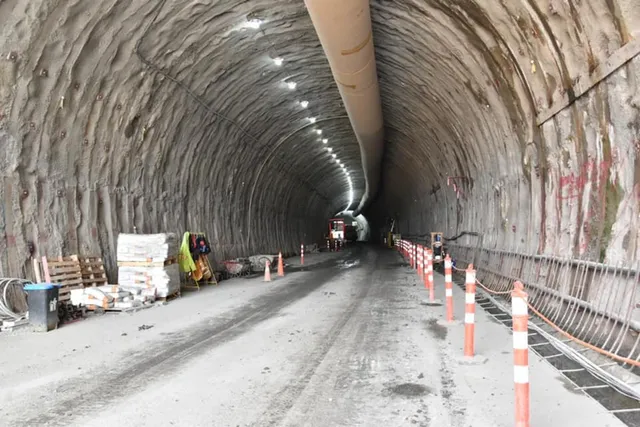
Tunnel boring activity of the Department of Public Works and Highways (DPWH) at south portal of the twin tunnels of Davao City Bypass Construction Project has kicked-off on Thursday, May 12, 2022.

In his report to DPWH Secretary Roger G. Mercado, Undersecretary and Build Build Build Chief Implementer Emil K. Sadain said that the simultaneous tunnel boring activities at north and south portals will result to the speedy construction of the 2.3-kilometer first-ever long distance mountain tunnel in the Philippines.

The kick-off ceremony for the tunnel works on northbound direction of south portal in Barangay Matina Biao, Davao City was attended by Consul General Yoshihisa Ishikawa of the Consular Office of Japan in Davao; DPWH Undersecretary Sadain; Japan International Cooperation Agency (JICA) Chief Representative in the Philippines Takema Sakamoto; and DPWH Assistant Secretary Rolito D. Manalo.

Also witnessing the first excavation on south portal’s northbound direction of the two (2)-tube mountain tunnel project are Project Director Benjamin A. Bautista of DPWH Unified Project Management Office (UPMO) – Roads Management Cluster I (Bilateral); DPWH Region 11 Director Rey Peter B. Gille; Project Managers Joselito B. Reyes and Joweto V. Tulaylay; Davao City District Engineer Richard A. Ragasa; Engr. Earl Nicholas F. Rada; officers of the consultants Nippon Koei Ltd., Katahira & Engineers International, Nippon Engineering Consultants Co., and PhilKoei International Inc.; and other public works officials.

With the simultaneous tunneling works on the north and south portals, the joint venture companies of Shimizu Corporation, Ulticon Builders Inc., and Takenaka Civil Engineering and Construction Company Limited can ramp up their construction towards rapid completion of the project so that people of Mindanao can finally enjoy the convenience and its other benefits, added Undersecretary Sadain.

Designed to have better seismic resiliency by Japanese experts, the tunnel construction activities at the south portal - southbound and northbound directions were earlier started in November 2021 and March 2022, respectively.

Davao City Bypass Construction Project is among the flagship infrastructure projects under the “Build, Build, Build” program implemented by DPWH UPMO Operations headed by Undersecretary Sadain to reduce congestion in Davao City and cut travel time between Toril, Davao City and JP Laurel, Panabo City to 49 minutes from the current one (1) hour and 44 minutes.

The construction of the bypass road will improve transport logistics and mitigate congestion in the Davao City urban center to contribute to the economic and social development of Mindanao.

In his sent message, Presidential son and newly elected Davao City Mayor Sebastian Duterte expressed excitement for the Davao City Bypass Construction Project as it will greatly improve the city's accessibility and traffic condition by the opening of this new road network that will also usher more developments outside the city center.

Undersecretary Sadain said that as the Philippines transitions to a new administration by June 30, DPWH will continue to work hard in delivering the completion of on-going infrastructure flagship projects and is looking forward to build more new pipeline projects towards the next administration to sustain rapid growth, attract investments and attain economic inclusion for all Filipinos.

While construction of the tunnel is the centerpiece of Contract Package 1 - 1, the contract also includes construction of a 7.9 kilometer four (4)-lane road, three (3) pairs of bridges with a total length of 500 meters, two (2) underpasses, two (2) overpasses, a dozen box-culverts (waterways), and four (4) at-grade intersections.

The tunneling activity uses specialized equipment such as drill jumbo, concrete spraying machine and articulated dump hauler to excavate tunnel that has a diameter of 10 meters.

The on-going Contract Package 1-1 costing ₱13.23 Billion is financed by Special Terms for Economic Partnership (STEP) Loan between Philippines and JICA under loan agreement numbers PH-P261 and PH-P273.


Article courtesy of Department of Public Works and Highways
May 11, 2022

Diversified engineering conglomerate DMCI Holdings, Inc. reported a 165-percent increase in first-quarter earnings from P4.3 billion to P11.3 billion, its highest ever for any given quarter.

Its record-setting performance was mainly driven by the robust operating results of its coal, nickel and power businesses amid rallying commodities and electricity spot prices.

Excluding a non-recurring gain of P179 million last year mainly from the deferred tax remeasurement impact of CREATE Act on Maynilad’s service concession asset and a P12 million gain on sale of land of DMCI Homes, consolidated core net income surged by 177 percent from P4.1 billion to P11.3 billion.

“Semirara exceeded our expectations while DMCI Mining and DMCI Power both grew double-digits,” said DMCI Holdings chairman and president Isidro A. Consunji.

“But our construction and real estate businesses are showing signs of slowdown because of knock-on effects of the pandemic and Russia-Ukraine war,” he added.

Net income contribution from Semirara Mining and Power Corporation (SMPC) skyrocketed by 544 percent from P1.3 billion to P8 billion on the back of record-high coal production, shipment and average selling prices, and further boosted by higher spot electricity sales at elevated prices.

DMCI Homes contributed P1.4 billion, a 7-percent decline from P1.5 billion owing to lower construction accomplishments, fewer new accounts that qualified for revenue recognition and higher sales cancellations.

Net income contribution from DMCI Mining grew 20 percent from P415 million to P499 million on higher nickel ore shipment and forex rates.

D.M. Consunji, Inc. recorded a 7-percent drop in net income contribution from P393 million to P367 million mainly due to the absence of a one-time related party transaction for a joint venture infrastructure project.

Maynilad contribution rose by 11 percent from P287 million to P319 million on lower personnel, utilities and interest expenses.

DMCI Power contributed P132 million, a 12-percent upturn from P118 million because of higher generation and sales across all its service areas.

Income from parent and others retraced by 38 percent from P13 million to P8 million on lower interest income.

May 09, 2022

Nickel Asia Corporation recently announced its unaudited financial and operating results for the three-month period ended March 31, 2022 with an attributable net income (net of minority interest) of P1.05 billion, an 80% increase from P584 million net income reported during the same period last year. Earnings before interest, tax, depreciation and amortization (EBITDA) amounted to P2.20 billion, a 30% increase compared to P1.69 billion in the prior year.

“The global nickel industry continues to labor under a record deficit – with an even larger projected deficit this year as compared to the previous year”, remarked Martin Antonio G. Zamora, President and CEO of Nickel Asia Corporation (NAC; PSE: NIKL). “Coupled with continued strong demand for stainless steel and the accelerating trend in demand in the electric vehicle market, these factors have been beneficial to our metals and mining business”, he added.

Although nickel ore sales volume decreased by 10%, from 2.65 million wet metric tons (WMT) in the first quarter last year to 2.39 million WMT in the same period this year, revenue from the sale of nickel ore increased 17% year-on-year, from P2.85 billion in 2021 to P3.32 billion in 2022, as the weighted average realized price of ore sold increased 22% from $22.21 per WMT last year to $27.03 per WMT this year.

Breaking down the ore sales, the Company exported 651 thousand WMT of saprolite and limonite ore to Japanese and Chinese customers at the weighted average price of $46.90 per WMT in the first three months of the year, compared to 845 thousand WMT at $45.60 per WMT in the same period last year. Likewise, the Company delivered 1.74 million WMT of limonite ore to the Coral Bay and Taganito HPAL plants, the prices of which are linked to the LME, and realized an average price of $11.80 per pound of payable nickel. This compares to 1.81 million WMT at $7.96 per pound of payable nickel in 2021. Expressed in US Dollar per WMT, deliveries to the two HPAL plants generated $19.58 and $11.29 in the first quarter of 2022 and 2021, respectively.

Furthermore, as a result of higher LME prices, the Company recognized gain from its equity share in its investments in the two HPAL plants in the amount of P305 million in the first quarter of 2022, a 166% increase compared to P115 million gain in the same period last year.

The realized Peso to U.S. Dollar exchange rate for ore sales was P51.51 compared to P48.38 in the prior year.

Total operating cash costs increased by 8% year-on-year to P1.67 billion from P1.55 billion in 2021. On a per WMT of ore sold basis, total operating cash costs increased to P701 per WMT compared to P583 per WMT last year.

On the Company’s foray into the renewable energy business through Emerging Power, Inc., Mr. Zamora had this to say: “We remain on track to complete Phase 3B of the Subic Solar Project, which would bring its total capacity to 100MW by May of this year, and expect to begin work on Phase 4 towards the latter part of the year, leading to a total capacity of 200MW by 2024. Further, we have made significant headway with respect to our 1,000MW renewable energy pipeline.”

Mr. Zamora added, “We continue to monitor extraneous factors such as the lockdowns in China that may affect the global supply chain and impact our businesses as well.”


Article courtesy of the Philippine Stock Exchange

May 09, 2022

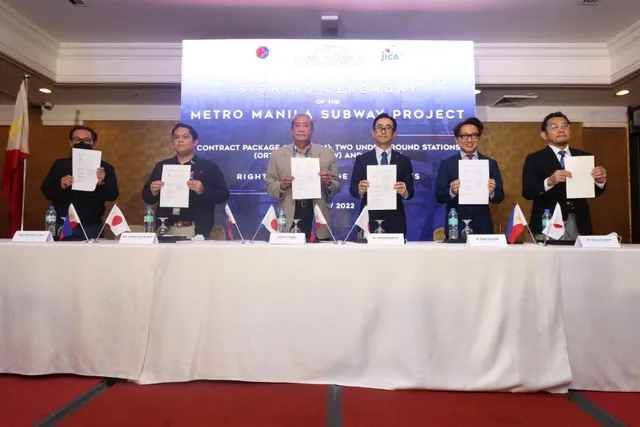
Department of Transportation (DOTr) Secretary Arthur Tugade Thursday signed a contract worth PHP17.75 billion as part of the first phase of the Metro Manila Subway.

The contract package, dubbed CP104 and that was awarded to Tokyu-Tobishima Megawide Joint Venture (TTM-JV), includes the construction of two subway stations and tunnels at Ortigas North and South.

The contract was signed at an event at Edsa Shangri-La in Mandaluyong City between Tugade and executives of the TTM-JV.

During the event, right-of-way usage agreements were also signed between DOTr and partners in the private sector including Blemp Commercials of the Philippines, Megaworld Corporation, Robinsons Land Corporation, and Ortigas & Company Limited Partnership.

In a speech, Japanese Ambassador Koshikawa Kazuhiko congratulated the DOTr and the TTM-JV for the “milestone” in bringing the Metro Manila Subway closer to reality.

Koshikawa noted that Tokyu construction, head of the TTM-JV, is “well-known for their significant expertise in the construction of railways and its related developments.”

“I am confident that they certainly will apply Japan's cutting-edge technology and knowledge to the Metro Manila Subway’s best advantage,” Koshikawa said.

The Metro Manila Subway is part of the Duterte Administration’s ‘Build, Build, Build’ program and is seen to be partially operational by 2025.

Primarily funded through grants and loans from the Japanese government, the 35-kilometer subway will run from Valenzuela City to the Ninoy Aquino International Airport (NAIA) Terminal 3.

It will consist of 15 subway stations, can serve up to one million passengers daily, and is seen to reduce travel time between NAIA and Quezon City from 70 minutes to 35 minutes.

May 04, 2022

Photo credit: Bilyonaryo

OceanaGold Corporation reported its financial and operational results for the quarter ended March 31, 2022. Details of the consolidated financial statements and the Management Discussion and Analysis are available on the Company’s website.

Gerard Bond, President and CEO of OceanaGold, said “OceanaGold has started the year strongly with the first quarter safely delivering record quarterly revenue and EBITDA and significant Free Cash Flow. This strong Free Cash Flow generation allowed us to achieve a 29% reduction in net debt and reduce our leverage ratio to 0.40 times. Our stronger balance sheet puts us in a solid financial position from which we can invest in attractive growth projects to create value for our shareholders.”

“This quarter’s performance was underpinned by record quarterly gold production at our Haile operation in the United States and a very strong first quarter of full production at our Didipio operations in the Philippines. At Haile, we are continuing to see the benefits of operational and productivity improvements that began in mid2021. At Didipio, the operation achieved full underground mining rates at the end of the first quarter, ahead of schedule by nearly one quarter.”

“Though there is a lot to celebrate in the quarterly results, we also know that there is a lot of work ahead of us to fully optimise the potential of the business. At Waihi, poor grade reconciliation at Martha underground had an impact on its quarterly performance. A grade control drill programme is currently underway to deliver improved resource definition and allow for more optimal mine planning and stope sequencing, which we expect will improve the performance of this orebody and mining operation overall.”

“We also have a pipeline of organic growth projects that have the potential to create additional value for shareholders. Once we commence development of the underground mine at Haile, we believe we will begin to unlock the true upside potential of this orebody. Looking further ahead, Wharekirauponga (“WKP”) has the potential to be a significant, high-grade mine within our portfolio.”

“We remain focused on safely and responsibly delivering on our production guidance for 2022, maximising Free Cash Flow generation and progressing the attractive growth options in our portfolio.” said Mr Bond.

Operations

The Company produced 134,035 ounces of gold and 3,510 tonnes of copper in the first quarter of 2022, representing a 26% increase in gold production compared to the previous quarter and a 61% increase when compared to the first quarter of 2021. The stronger quarterly production was driven by record quarterly production at Haile and a solid quarter of production at Didipio, partially offset by decreased production at Waihi.

On a consolidated basis, the Company recorded an AISC of $1,084 per ounce on gold sales of 129,191 ounces and copper sales of 3,711 tonnes. AISC was 18% lower quarter-on-quarter with the benefits from a full quarter of operations at Didipio partially offset by increased sustaining capital investments. The Company’s AISC decreased 14% when compared to the first quarter of 2021, also due primarily to the inclusion of a full quarter of operations at Didipio.

Haile delivered 60,249 ounces of gold, representing a record quarter for production. This represents an increase of 42% quarter-on-quarter and was mainly driven by increased mill feed, higher head grade and better gold recoveries. Year-on-year, this represents a 36% increase in production, resulting from higher mill feed, grade, and recovery. The higher grades were driven by ore sourced from Ledbetter Phase 1. First quarter AISC at Haile was $1,070 and cash costs were $567 per ounce sold.

The Company expects the Supplemental Environmental Impact Statement (‘SEIS’) Final Record of Decision and receipt of subsequent operating permits to occur in the second quarter of 2022. The permits are necessary to allow underground mine development and expansion of the operating footprint to accommodate the construction of future PAG waste storage facilities and to allow increased water discharge rates. As previously guided, the ongoing delay in the receipt of the SEIS decision and associated permits continues to impact productivity at Haile, where mining rates are limited by additional material and water re-handling, reducing output and increasing costs. Upon receipt of the necessary permits, the Company expects an improvement in operational efficiencies and lower mining unit costs to be delivered progressively over a two-year period. An updated National Instrument (“NI”) 43-101 Technical Report for Haile was released 31 March 2022. The recently completed technical review assumed receipt of the necessary permits related to the SEIS by the end of the second quarter of 2022.

Didipio produced 29,446 ounces of gold and 3,510 tonnes of copper, reflecting a 98% increase in gold production and 51% increase in copper production quarter-on-quarter. This represents the first full quarter of operations since the restart of production in November 2021. The underground mine achieved full mining rates at the end of the first quarter, ahead of schedule. Didipio’s first quarter AISC and cash costs were $40 per ounce sold and $26 per ounce sold respectively. An updated NI 43-101 Technical Report for Didipio was released 31 March 2022.

Macraes produced 37,588 ounces of gold in the first quarter, a slight increase quarter-on-quarter and a 9% increase from the first quarter of 2021. Relative to the prior quarter, production increased on higher average head grade that was partially offset by lower mill feed and reduced gold recoveries. Macraes’ first quarter AISC and cash costs were $1,394 and $1,005 per ounce sold respectively.

Waihi produced 6,752 ounces of gold in the first quarter, 43% lower quarter-on-quarter and 56% higher than the first quarter of 2021. The quarter-on-quarter decrease in production was attributed to lower ore tonnes and grade mined from Martha Underground, where mining was in areas of the resource with low resource definition and under-reconciled to the resource model in both grade and tonnes of ore. The Company estimates the under reconciliation accounted for approximately half of the negative impact during the quarter, with poor ground conditions in parts of the orebody and reduced workforce availability due to COVID-19 isolations also contributing factors. Results from the accelerated grade control drill program continued to update the resource models currently being used for mine planning. Grade control drilling to support mining for the remainder of 2022 and 2023 is expected to be completed progressively across the second and third quarters of 2022. This program is expected to better inform the detailed mine planning and design process, optimise the stoping sequence, reduce ore loss and deliver improved performance.

Preparation for the lodgement of a consent application for the Waihi North Project, inclusive of WKP, continued to progress with environmental assessments nearing completion. The Company expects to lodge its formal consenting application, inclusive of stakeholder feedback, in the second quarter of 2022. The critical path for first production from the Waihi North Project remains the consenting process.

Financial

The Company reported record quarterly revenue of $285.7 million, reflecting a 37% increase quarter-on-quarter. The Company reported record quarterly EBITDA in the first quarter of $158 million, reflecting a 78% increase quarter-on-quarter on stronger gold sales volumes from Haile, Didipio and Macraes and higher average gold and copper prices received and lower unit costs, partially offset by lower sales at Waihi. First quarter 2022 EBITDA was 155% higher than the first quarter of 2021 related to resumption of operations at Didipio and increased gold prices.

First quarter 2022 adjusted earnings after tax were $81.8 million or $0.11 per share which compared to $29.3 million in the fourth quarter of 2021 and $17.3 million in the first quarter of 2021.

Cash flows from operating activities for the first quarter of $143.8 million exceeded the comparative quarters, driven by stronger EBITDA though partially offset by unfavourable working capital movements. Operating cash flow per share before working capital movements was $0.22 in the first quarter.

The Company generated $63.2 million in free cash flow during the first quarter. As at the end of the first quarter Net Debt including equipment leases was $168.4m, which was $69.5m or 29% lower than at the end of December 2021. The Company had immediately available liquidity of $224.7 million, including $194.7 million in cash.


Article courtesy of Oceanagold Corporation

May 04, 2022

Photo credit: Bilyonaryo

Atlas Consolidated Mining and Development Corporation (“Atlas Mining”) reported another record net income of Php1.22 billion for the first quarter of 2022 compared to the net income of Php420 million for the same period in 2021. Higher production and higher metal prices sustained the strong performance of Atlas Mining.

The increase in metal prices continued in the first quarter this year where copper price increased by 16% from $3.93/lb to $4.56/lb and gold price from USD1,797/ounce to USD1,885/ounce compared to the same period last year.

Atlas Mining’s wholly-owned subsidiary, Carmen Copper Corporation, reported higher copper production and shipments in the first quarter of the year compared to the same period last year due to higher tonnes of ore milled and higher realized grades. In the first quarter of 2022, copper metal production increased by 26% from 15.93 million pounds to 20.01 million pounds, due mainly to the 8% increase in milling tonnage from 4.22 million tonnes to 4.57 million tonnes and the increase in copper grades by 12% from 0.215% to 0.241%. Gold production increased quarteron-quarter by 22% from 5,346 ounces to 6,015 ounces while gold grades decreased from 5.77 grams/dmt to 5.34 grams/dmt. Accordingly, shipments were higher by 27% from 17.02 million pounds of copper metal in 2021 to 21.69 million pounds in 2022.

Higher production and shipments supported by higher prices, pushed revenues to soar by 54% to Php5.49 billion from Ph3.57 billion.

Cash costs increased by 50% from Php1.97 billion to Php2.94 billion, due to the increase in volume of shipments and production. Earnings before interest, tax, depreciation and amortization (EBITDA) was Php2.60 billion, 55% higher compared to Php1.68 billion in the same period of 2021. Core income was Php992 million in the first quarter of 2022 compared to Php579 million, 71% higher compared to the first quarter of 2021.

Cash generated from operations enabled additional repayment of debt of US$45 million in the first quarter. With the partial repayment of certain loan, an accounting gain of Php464 million was recognized in the first quarter.

According to Atlas Mining President, Adrian Ramos, “With sustained production, Atlas Mining continues to benefit from a strong metals market. We remain focused on keeping our operations resilient and efficient to ensure sustained and optimized earnings even under emerging challenging situations.”


Article courtesy of the Philippine Stock Exchange

May 04, 2022

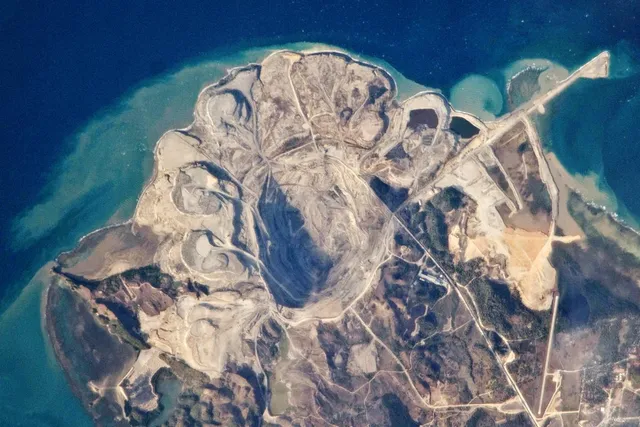
Integrated energy company Semirara Mining and Power Corporation (SMPC) has completed its backfilling operations in Panian, once the largest open-pit mine in the Philippines.

SMPC spent 11.5 million man-hours to fill the pit with over 452 million bank cubic meters (bcm) of earth material, which is enough to fill 217,000 Olympic-size swimming pools.

“We are mindful of our twin role as stewards and government contractor. What we accomplished in Panian is proof of that,” said SMPC president and COO Maria Cristina C. Gotianun.

Located in Semirara Island, Panian mine spans 400 hectares with topographic elevations that ranged from 300 meters below sea level (mbsl) to 30 meters above sea level (masl) during its mine life. 300 meters is roughly the height of a 90-story building.

SMPC fully covered the pit in six years, way ahead of the original 10-year mine rehabilitation plan. Mine rehabilitation refers to the repair of land that was disturbed by mining activities.

The company is now developing a science-based plan to reforest and restore the biodiversity in the area.

Panian had a mine life of 16 years and generated P12.7 billion in royalties for the government and SMPC host communities.

Of the total amount, P7.6 billion went to the national government while the Municipality of Caluya and Brgy. Semirara received P2.3 billion and P1.8 billion, respectively. P1 billion went to the Province of Antique.

In September 2021, SMPC won in the ASEAN Energy Awards (Special Submission category) for its accelerated rehabilitation of South Panian pit, which is considered as the fastest of its kind and scale in the Philippines.

SMPC completely filled North Panian with earth material last January, four months ahead of its committed date to the Department of Energy.

May 02, 2022

Photo: 

Philex Mining Corporation (the “Company” or “Philex”), one of the oldest and largest gold and copper producers in Southeast Asia, and a leader in right and principled mining, generated Php676 million Core Net Income and EBITDA of Php1.182 billion for 1Q2022 due to higher operating revenues on account of higher sustaining Gold and Copper realized prices, stable production and managed operating cost and expenses.

Production level in 1Q2022 was within plan and, coupled with higher realized prices for Gold and Copper, lifted operating revenues to Php2.720 billion, higher by 7.5% versus the same period in 2021. Blended realized Gold and Copper prices peaked in March at $1,887 per ounce and $4.59 per pound respectively, driving operating revenues in March to Php1.075 billion, the highest since January. Operating costs were almost the same level as in 1Q2021 at Php1.655 billion.

Production

Tonnage milled for 1Q2021 was 10% lower at 1.822 million tonnes from 2.025 million tonnes in 1Q2021 mainly attributed to unscheduled breakdown of mill equipment. Ore grades for Gold continue to be at the same level as in 1Q2021 while ore grades for Copper showed improvement over the same period in 1Q2021, mitigating the impact of lower tonnage in Copper production. Gold output for 1Q2022 was 9.8% lower at 12,097 ounces versus 13,413 ounces in 1Q2021. On the other hand, Copper output for 1Q2022 was 8.7% lower at 6.18 million pounds versus 6.77 million pounds in 1Q2021.

Operating expenses and ebitda

Total operating costs and expenses for 1Q2022 at Php1.655 billion were almost at the same level for the same period in 1Q2021 at Php1.647 billion. The increases in the purchase costs of materials and supplies as well as equipment parts were offset by the continued implementation of work programs in operations, leading to efficiencies in the usage of power and supplies.

EBITDA generated for 1Q2022 at Php1.182 billion was 17% higher than the Php1.011 billion in 1Q2021. The Company continue to accumulate cash surplus at a level programmed to partly finance the development of Silangan project by way of additional and fresh cash equity infusion into its wholly owned subsidiary, Silangan Mindanao Mining Co. Inc.

Outlook

The current global commodity outlook points to sustained prices of Gold and Copper in the near to medium term. These sustained metal prices provide the Company with the ability to implement exploration and studies geared towards funding additional mineral resources/reserves within the current ore body and vicinity of the Padcal Mine.

The Company continues to work with its financial advisors for the completion of the fund raising exercise to start the Silangan Project, subject to approval of relevant government and /or capital market regulators. The successful and timely conclusion of the funding exercise will pave the way for the timely development and start of commercial operations of the Silangan project by early 2025. The Company is set to actively commence the development of Silangan as soon as the funding sources would have been finalized and completed, which will be in the form of a rights offer, possibly debt and fresh capital infusion out of the cash reserves of the Company.

“The first quarter of the year bore much promise that the mining industry, like the economy, was well on its way to full recovery with the tapering off of the global threat of COVID-19 and the relaxation of stringent quarantine and lockdown guidelines,” according to Philex president and CEO Eulalio B. Austin Jr. “The country, it seemed, was back in business and Philex continued to ride on the strength of sustained production and revenue levels, and took full advantage of the wave of increase in global metal prices. However, the current situation in Ukraine and its impact on the global supply chain and commodity markets makes us tread cautiously towards the remaining months of the year. We are still hopeful that the conflict in Europe will end soon enough. We move with caution and continue to assess and re-assess our plans and our strategies.”

“We view the current global situation with guarded optimism,” according to Philex Chairman Manuel V. Pangilinan. “Though there are gains to be realized with the spike in the prices of gold, copper, and even nickel, the current tension that is unfolding in Ukraine might impact the country’s and the industry’s pursuit of recovery post-pandemic. If the conflict pushes inflation upward, it could affect the country’s economic growth.”


Article courtesy of the Philippine Stock Exchange

May 02, 2022

Mactan Island will soon become home to Cebu’s biggest power plant after the San Miguel Corporation (SMC) signified its intention to invest in a liquefied natural gas (LNG)-powered plant in the city of Lapu-Lapu, Mayor Junard Chan on Thursday said.

“Dako nakong pasalamat nga aduna na poy laing kadaugan nga makab-ot ang atong syudad nga mao ang intensyon sa San Miguel Corporation nga mo-invest og usa sa pinakadakong power plant diri sa Cebu gamit ang LNG kon liquified natural gas (I am very thankful for another victory that our city will achieve soon as the San Miguel Corporation signified to invest in one of the largest power plants here in Cebu using LNG or liquified natural gas),” Chan said in a statement posted on his social media account.

He said SMC will invest PHP60 billion in the construction of the 600-megawatt power plant.

Chan did not mention where in Lapu-Lapu City the power plant will be built but he posted a proposed site development plan for the plant.

According to the E-Connect Energy website, transforming gas into electric power is made possible through the thermodynamic process of converting the chemical energy stored in the natural gas to thermal energy through mechanical energy to electrical energy.

Chan said SMC’s entry into the power sector in Lapu-Lapu City where it intends to pour its investment for its first-ever LNG-propelled power plant, is also expected to help solve electric power supply woes which are not only experienced in Mactan Island but the entire Cebu province.

Chan said it will give jobs to the residents of Mactan Island.

“Dili na usab makasinati puhon ang mga Oponganon og problema sa kuryente lakip na ang silinganang mga dakbayan (Oponganons will no longer experience power problems, including in neighboring cities),” he said.

Oponganons refer to the residents of Mactan Island.

Chan said the city government’s effort to tap investors is bearing fruit now that the SMC, the country’s largest and most diversified conglomerates, showed interest in investing in a business venture in the city.

“Nagpasabot lang kini nga ang atong administrasyon karon duolonon gayud sa mga investors o dagkong mga mamuhonan kay dako ang ilang pagsalig sa atong pagdumala ug pagpangga sa mga katawhang Oponganon (It simply means that our current administration is really close to investors or big investors because they have a lot of confidence in our management and care for the Oponganon people),” he said.

Chan said more big businessmen informed him of their intention to invest and contribute to the economic growth in Lapu-Lapu City.

Lapu-Lapu City, including the island villages of Olango Group of Islands and the municipality of Cordova, is under the distribution franchise area of Mactan Electric Company.

It sourced its electric power distributed to the households and its industrial clients like the Mactan-Cebu International Airport and the Mactan Export Processing Zone from the Kepco-SPC in Naga City in southern Cebu.