Category:




KOREA EXIMBANK OFFERS TO FUND DPWH NEW PIPELINE INFRASTRUCTURE PROJECTS
Photo credit: Department of Public Works and Highways
The Korea Eximbank (KEXIM) Manila Representative Office, implementing agency of the Korean Government’s Economic Development Cooperation Fund (EDCF) Official Development Assistance (ODA) program in the Philippines, is keen on levelling up funding support to infrastructure development priorities of the Department of Public Works and Highways (DPWH).
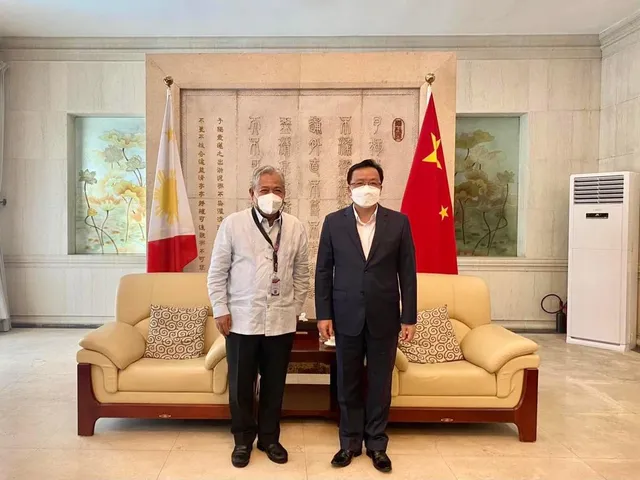
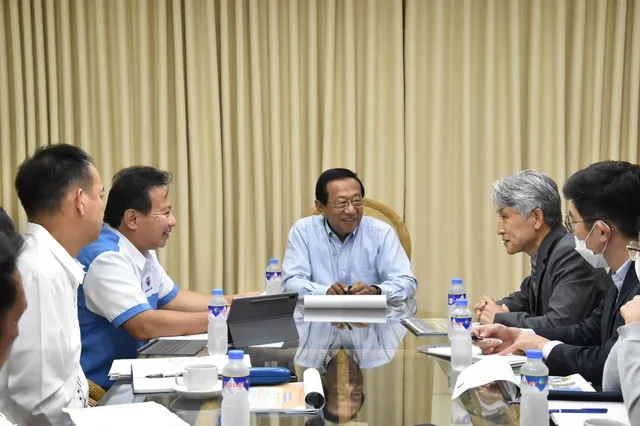
In his meeting with DPWH Secretary Manuel M. Bonoan and Senior Undersecretary Emil K. Sadain, KEXIM-EDCF Country Director and Chief Representative Jaejeong Moon expressed interest to support DPWH pipeline new projects to ‘Build Better More’, with the leaders of the two (2) agencies discussing ways of further strengthening the cooperation between Philippines and South Korea.
The Korean Government intends to further increase the EDCF concessional loan assistance to the Philippines to fund development projects under the President Ferdinand Romualdez Marcos Jr. administration.
The EDCF provides assistance to DPWH-implemented flood control, roads and bridges and flood control projects managed by the Unified Project Management Office (UPMO).
According to Senior Undersecretary Sadain, in-charge of ODA-funded projects, three (3) EDCF projects are on-going namely Samar Pacific Coastal Road Project in Northern Samar, Panguil Bay Bridge Project in Northern Mindanao, and Integrated Disaster Risk Reduction and Climate Change Adaptation Measures in the Low-Lying Areas of Pampanga in Central Luzon.
Early this year, the Philippine government has also secured loan from South Korea to cover funds for the engineering services of the Panay-Guimaras-Negros Island Bridges Project, an interisland bridges project that will entails the construction of two sea-crossing, four (4)-lane bridges totaling 32.47 kilometers — including connecting roads and interchanges — to connect the islands of Panay, Guimaras and Negros in Western Visayas, added Senior Undersecretary Sadain.
The EDCF also provided a grant for the recently completed feasibility study of the Samar Pacific Coastal Road Project Phase II, which aims to construct two (2) bridges namely Laoang 2 Bridge (360-meter) and Calomotan Bridge (630-meter) including the upgrading of about 12.5-kilometer existing road from Laoang-Palapag Road Junction to Catarman-Laoang Road Junction that will connect the island of Laoang to mainland Northern Samar.
DPWH is looking forward to the approval of submitted final feasibility study report to National Economic and Development Authority (NEDA) Board and the subsequent endorsement of the project to KEXIM for funding of the detailed engineering design and civil works for its construction.
Other Korea-funded ODA feasibility studies discussed during the meeting includes Philippines-Korea Project Preparation Facility for Lubao-Guagua-Sasmuan-Minalin-Santo Tomas Bypass Road (30 km), Mount Kitanglad Range Belt Road (108 km), Capas-Botolan Road (38.4km), and Lubao-Guagua-Sasmuan-Minalin-Santo Tomas Bypass Rd., Section 4: Minalin (Bulac)-Sasmuan Viaduct (7 km); Maasin City Coastal Bypass Road; Iconic Bohol-Leyte Bridge Project; and Integrated Flood Management Master Plan of Lower Pampanga River Basin covering Pampanga Delta Development Project Phase II and Central Luzon-Pampanga River Floodway Flood Control Project.
The meeting held August 12, 2022 at the DPWH Central Office was also participated by UPMO Project Directors Ramon A. Arriola III, Sharif Madsmo H. Hasim, and Benjamin A. Bautista; UPMO Project Manager Teresita V. Bauzon; and KEXIM Deputy Director Yunhak Lee and Program Officer Ana Labella.
Article courtesy of The Department of Public Works and Highways

Further shallow copper mineralisation identified at MCB
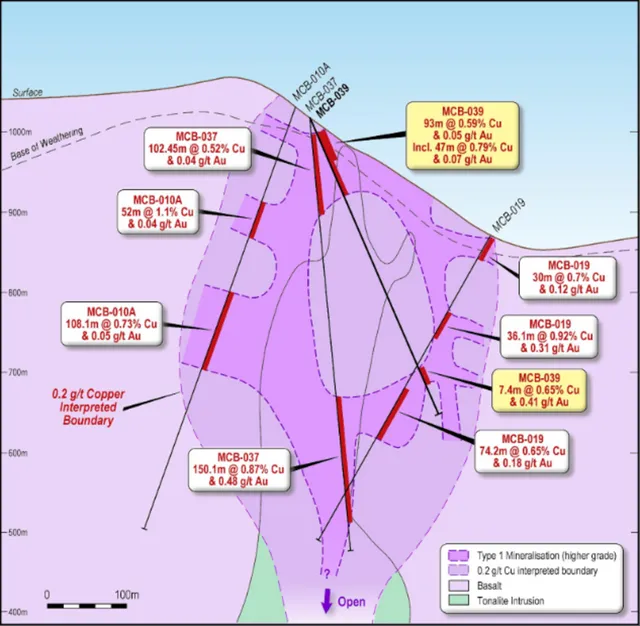
Figure 3. Cross section of drill hole MCB-039 relative to the interpreted geology and significant assay results.
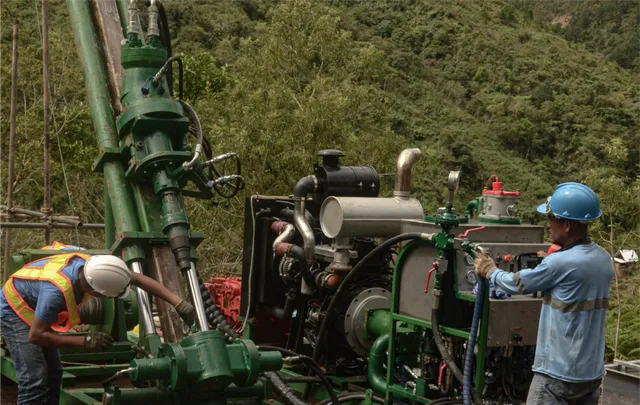
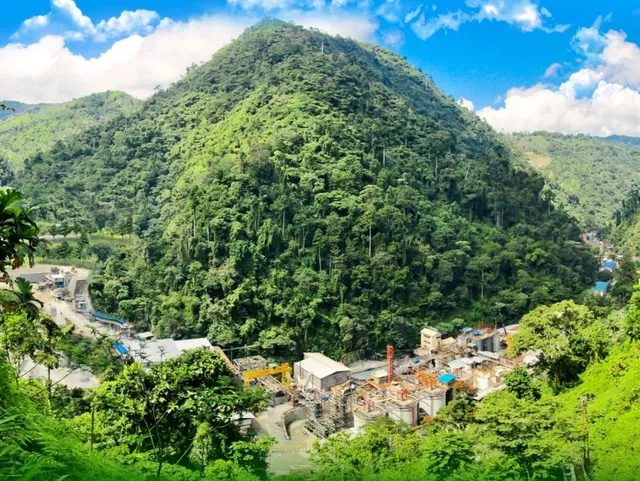
We (Celsius Resources) are pleased to announce we have received further shallow and high-grade copper assay results from the ongoing drilling program at our flagship MCB copper-gold project, held under our Philippine subsidiary Makilala Mining Company, Inc. (“MMCI”).
The results continue to identify new positions of shallow mineralisation which are in line with other recent drilling results from holes MCB-036, MCB-037 and MCB-038 (see CLA announcements dated 13 December 2021, 23 May 2022 and 4 July 2022 respectively) confirming the presence of an extensive shallow higher-grade position.
The results from MCB-039 were designed to further expand the size of the shallow higher-grade copper zones which are considered to have an important positive impact on early mining options at MCB. The current drill hole in progress (MCB-040) is similarly designed to further expand the higher-grade copper mineralisation leading to potential improvements to the economics of the already positive Scoping Study at MCB as reported by Celsius on 1 December 2021.
“The results from MCB are continuing to grow the size of the shallow higher-grade copper zones,” said Country Operations Director, Peter Hume.
“We are getting much better definition now on the various high-grade zones, which are important for the optimisation of the MCB mine plan. We can see many good high-grade intersections coming together to expand on the earlier understanding of these high-grade zones. Where we get multiple high-grade zones staked on top of each other, we can achieve outstanding results, as recently announced from hole MCB-038 which intersected 611.4m @ 1.39% copper and 0.75g/t gold from 32.5m.”
RESULTS FROM MCB-039
Drill hole MCB-039 was drilled to further confirm the interpretation that further shallow high-grade positions exist as a relatively flat body extending into the surrounding host rocks (see Figures 2 and 3).
This drill hole was more specifically targeted to fill a gap in the drilling information where there was previously defined lower grade copper mineralisation.
The results from MCB-039 have confirmed the further extensions to the higher-grade copper mineralisation as part of a series of relatively flat lying, high-grade zones which are extending away from vertically orientated feeder structures which are all closely related to an intrusive Tonalite rock (Figure 3).

A large broader envelope of copper mineralisation at a lower cut-off grade at approximately 0.2% copper also continues to be better defined, highlighting the very large scale of the copper-gold mineralisation at the MCB deposit.

Article courtesy of Celsius Resources. Full press release can be found HERE