



August 25, 2021

Photo Credit: Department of Public Works and Highways

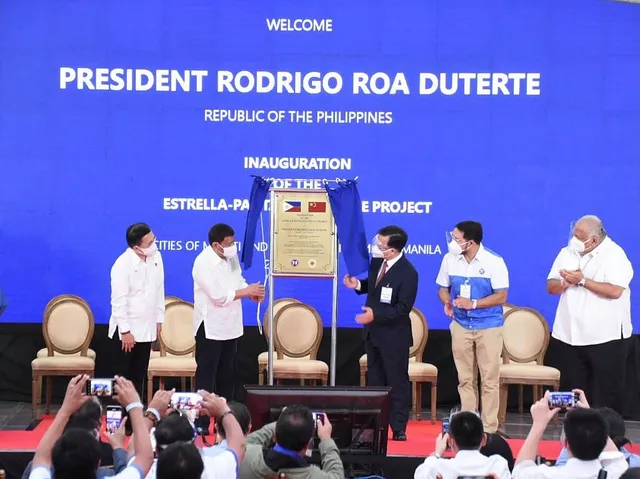
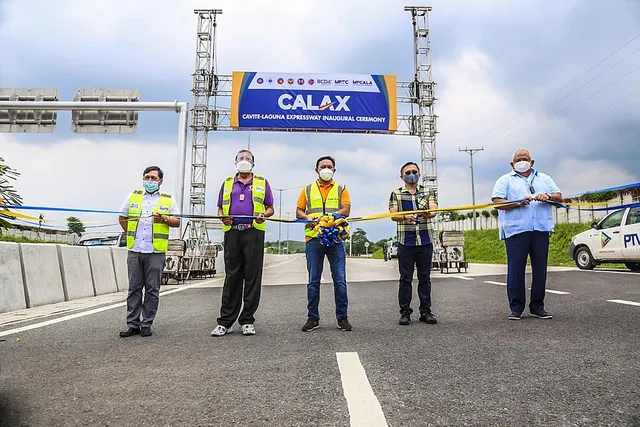
Public Works and Highways Secretary Mark Villar on Tuesday led the ceremonial opening of the Cavite-Laguna Expressway (CALAx) Sub-section 5 from Silang East Interchange to Sta Rosa-Tagaytay Interchange in Cavite.

“While this pandemic may have slowed down and disrupted the implementation of projects, the Sub-section 5 or 5.14 kilometers Silang East Interchange to Sta. Rosa-Tagaytay Interchange component of Cavite Laguna Expressway or CALAX Project was completed and will be now opened to public use,” said Secretary Villar during the event.

“The opening of Sub-section 5 will be able to cater to around 5,000 motorists daily, adding to the roughly 10,000 users of the already opened CALAx subsections 6, 7, and 8 from Sta. Rosa to Mamplasan,” said Secretary Villar.

According to Secretary Villar, ongoing subsections are also being fast-tracked by concessionaire MPCALA Holdings to be able to fully-open the entire 45-kilometer CALAx connecting CAVITEX in Kawit, Cavite and South Luzon Expressway-Mamplasan Interchange in Biñan, Laguna.

Once fully-completed, CALAx will significantly reduce travel time between CAVITEX and SLEX to only 45 minutes, reducing traffic congestion particularly in Governor’s Drive, Aguinaldo Highway and Sta. Rosa-Tagaytay Road which are heavily congested and supporting national development policy and provide efficient transport facilities for the Eco-zones in Cavite and Laguna Provinces.

“More than providing efficient transportation links, the CALAX project under public-private partnership arrangement with the MPCALA Holdings - a unit of the Metro Pacific Investments Corporation, will help hasten economic recovery by providing jobs and promote the Calabarzon as a preferred destination for investment and growth,” added Secretary Villar.

The P35.68 Billion Cavite-Laguna Expressway which began construction in July 2017 is part of a bigger Build, Build, Build Program of the government.


Article courtesy of the Department of Public Works and Highways

August 23, 2021

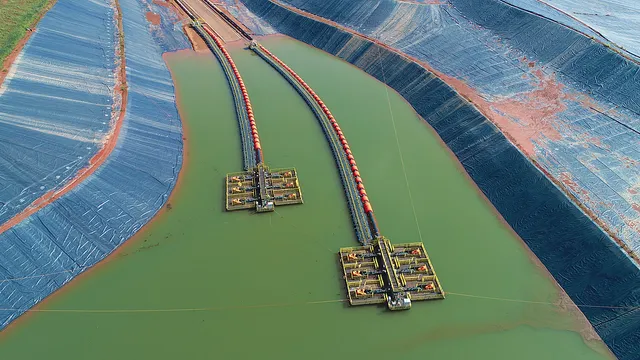
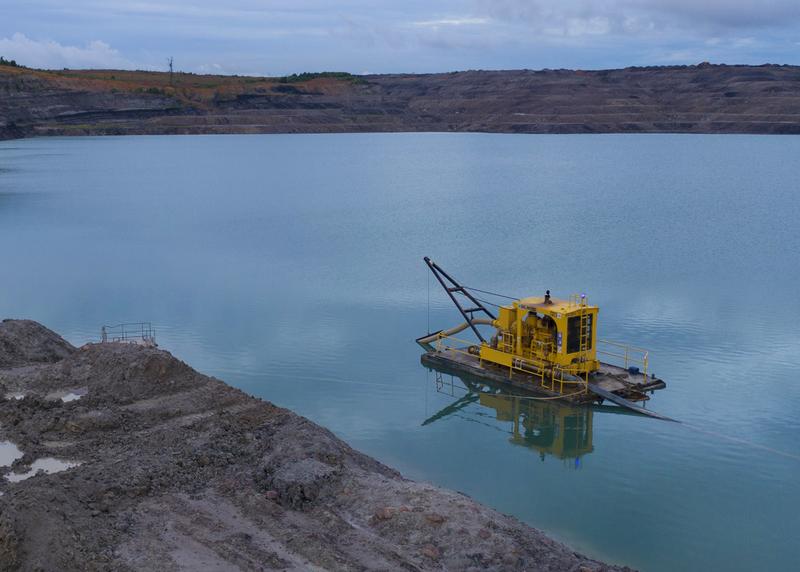
Photo: Multiflo® mega barges on site in Brazil

Dewatering is critical to a mine’s operations and more resources are being allocated to its optimisation. Traditionally, there’s been a tendency among some mine and quarry operations to view dewatering as something to be avoided at all costs – until it can’t be. Therefore, cost minimisation has been the primary focus when it comes to implementing a dewatering or fluid management solution. However, with dewatering becoming increasingly necessary, operators are approaching these challenges in more sophisticated and methodical ways.

The trends informing dewatering practices mirror many of those that are observable across all mining processes: a focus on sustainability and the efficient use of energy and other resources; customised, holistic solutions based on each sites unique geological and climatic conditions; and the emergence of new technologies, with a particular focus on real-time monitoring.

Dewatering solutions that are carefully designed and implemented have the potential to reduce energy usage, CO2 emissions and significantly lower OPEX over the life of the mine. The overall efficiency is affected by individual elements, but also by how these elements interact and operate with one another.

The renewed focus on pumping efficiency requires a significant shift in how many operators have previously approached dewatering and fluid management on site. Because most dewatering programs have been designed with the singular focus of lowering groundwater levels as quickly as possible, they often have excess pumping capacity and oversized pipes and pumps operating at only a fraction of their capacity – a process that’s inherently inefficient. This needs to change to accommodate the increased focus on efficient use of energy and water, which is critical to maintaining a social licence to operate.

Multiflo® MF pump unit on site in Indonesia

Improving pump efficiency begins with effective monitoring. There have been enormous improvements in electronic control and communication systems in the last few decades. Real time reporting and control of pumping systems can now be an economic reality for almost any mine site. The more visibility you have over your fluid management on site – flow rates, operating pressures, groundwater level, water quality, system relocations, alternate drive solutions, equipment selections to reduce maintenance and repair cycles, etc. – the better placed you will be to install the most appropriate equipment. The industry is moving towards customised solutions and there’s a growing awareness that no two sites are the same, which means a one-size-fits-all approach to dewatering is neither cost effective nor sustainable.

Weir Minerals has a global team of dewatering experts who partner with mine operators to assess their specific requirements and provide integrated solutions. With a long and proud history of innovative engineering, Weir Minerals has a team of process and design engineers armed with the latest technology, specific process knowledge and site experience to optimise your dewatering management processes. We take advantage of our global capabilities and engineering skills to provide our customers with the best solution as quickly as possible.

With an extensive global network and the ability to service on-site or at one of our 130 dedicated service centres, we are always there when you need us - no matter how remote your operation is.

August 23, 2021

​

Making good its promise to take drastic action against illegal settlers in the mineral-rich Barangay Runruno in the town of Quezon, Nueva Vizcaya, the Mines and Geosciences Bureau (MGB) has led an operation leading to the dismantling and confiscation of illegally operating ball-mills, a device used by traditional miners to process gold ore.

“The operation came in as a surprise. Even the members of the local media took days to find out,” says Leander Domingo of Manila Times, who rushed to the scene with local journalists and Philippine Information Agency staff stationed in Bayombong.

It was only when social media posts began spreading that houses are allegedly being demolished in Runruno in the last days of July 2021 that newsmen learned about the operation. The MGB involved the National Bureau of Investigation, the Philippine National Police, and the Philippine Army to assist them.

Cagayan Valley Regional Executive Director Gwendolyn Bambalan of DENR was quick to dispel the rumour, citing that it is only the illegal ball-mills that were dismantled during the operation.

“These areas were classified as high-risk geo-hazard zones, so we are encouraging them to vacate the area. If needed, we will file appropriate charges just to enforce the law,” she said.

In violation of Presidential Decree 705, 32 lawsuits were filed by the DENR against those occupying the prohibited zones, most of them are operators and workers who owned the confiscated illegal gold mining and processing equipment.

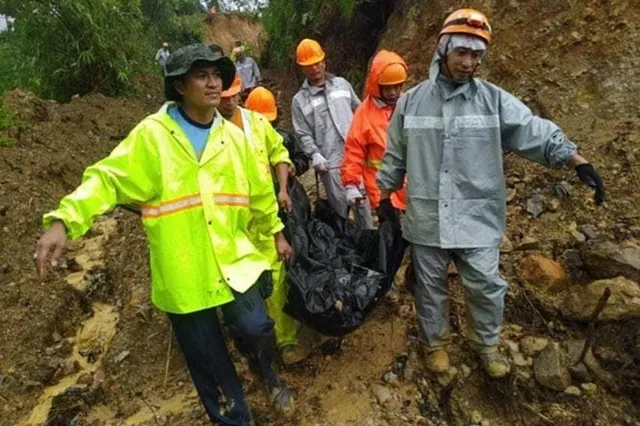
The sub-villages of Bit-ang and Balcony in Runruno have long history of unreported deaths due to landslides and caving-in of make-shift tunnels. “Although there was no official confirmation, reports of deaths due to cave-ins and premature explosions as well as the use of deadly chemicals from small scale mining operations have been taking place in these villages,” a 2011 news report of the Philippine Star reads.

In November last year, Typhoon Ulysses brought the largest number of casualties in a single incident. The reported death of 10 people at the aftermath of Typhoon Ulysses alarmed authorities, and even Malacañang Palace issued an order creating the Build Back Better Task Force.

ILLEGAL MINING BUSTED. Regional Executive Director Gwendolyn Bambalan of DENR Cagayan Valley (in green shirt) personally inspected the dismantled and confiscated gold processing equipment in Barangay Runruno, Quezon, Nueva Vizcaya. Regional Director Mario Ancheta of the MGB (in blue shirt), PENRO Edgar Martin (second from left, front row) and CENRO Giovanni Magat (extreme left, front row) joined in the inspection. (Photo Credits: Benjamin Moses Ebreo, PIA Nueva Vizcaya)

The ‘Minahang Bayan’ as a National Strategy

DENR has long advised that there are legal ways for traditional artisanal miners to benefit from the country’s mineral resources.

“We can find appropriate places to establish a Minahang Bayan, just approach the MGB. You can look for Director Mario Ancheta,” she told Runruno residents in a video-taped interview with the Philippine Information Agency.

Last May, DENR Undersecretary Jonas Leones told the Philippine Daily Inquirer that creating Minahang Bayan sites will generate more jobs in the countryside and fuel economic growth.

Republic Act 7076 established the people’s small-scale mining program. It seeks to achieve an orderly, systematic, and rational scheme for the small-scale development and utilization of mineral resources.

According to RA 7076, small-scale mining “refers to mining activities which rely heavily on manual labour using simple implements and methods and do not use explosives or heavy mining equipment.”

DENR Assistant Secretary Nonita Caguioa, however, clarified that small-scale mining is applicable to gold, silver, and chromite only, and cited a restriction on extracting metallic minerals.

The Minahang Bayan is the only area where small-scale miners can operate legally according to the law. In this way, government can better monitor and regulate extractive activities.  The safety of the mine workers, protection of the environment, and generation revenues for the government could be tracked along this set-up.

“It is difficult to monitor small-scale miners if they are operating outside Minahang Bayan areas,” MGB Small-Scale Mining Development Section chief Joel Natividad.

As of May 2021, there are 39 operating Minahang Bayan in the country, almost twice more than the 20 recorded in 2018. MGB has targeted 150 Minahang Bayan to be established by 2022.

“Our crackdown on illegal miners continues as we also put up more Minahang Bayan areas. This is to ensure that mining will be concentrated in one area where the DENR can regulate and monitor small-scale operations,” Leones said.

Emerging Clean Mining Technology

In the Philippines, Executive Order 79 series of 2012 has already prohibited the use of mercury in small-scale mining, yet almost all artisanal miners continue to use it.

Since 2019, MGB Acting Director Wilfredo Moncano has been collaborating with a Global Environment Facility-funded USD11.70-million project to help eliminate the use of mercury in artisanal and small-scale gold mining sectors in the country and Mongolia.

The long-awaited substitute for mercury and cyanide finally came out very recently. Clean Earth Technologies now owns a technology that was tested at Barrick Goldstrike mine by CSIRO. This technology is being expanded to cover other types of ore.

Last 18 June 2021, Kevin Fell, Executive Director and CEO of Clean Mining Technologies made a presentation before a webinar with the Philippine Mining Club. His strategy for the Philippine market is founded on favourable environment where the authorities are now embracing more sustainable and environmentally friendly mining processes and opening up to approving licenses that benefit the community and economy.

Fell also believes that foreign Investment is now more palatable with stability and governance which assures tenure.

As the CML is the “only available genuine, non-toxic solution that meets all the needs of government authorities and mining communities,” Clean Mining Technologies throws its full support and collaboration with Artisanal Gold Council in the creation of community hubs to process gold extracted by artisanal miners, which is basically the same as the Minahang Bayan.

“We are very excited about this opportunity which will set world first standards in the artisanal space which accounts for over 25% of the worlds gold production,” said Fell.

As to how quick the government and mining stakeholders can put this technology to work is an interesting research subject in the coming years.

​

August 23, 2021

A month after Australian-Canadian miner OceanaGold Corporation (OGC) announced that the company hurdled a breakthrough after more than two years of operational stand-by in Didipio, jobseekers virtually flocked to the company’s local social media page.

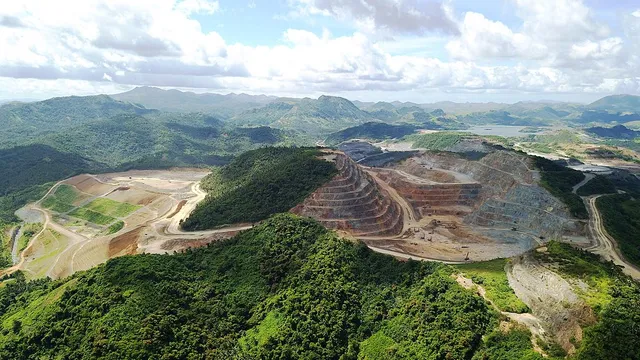
Didipio mine is OGC’s major asset in the Philippines located 364 kilometres north of Manila. It is under the Financial and/or Technical Assistance Agreement (FTAA) scheme provided by the Philippine Mining Act of 1995 which was renewed for another 25 years after Pres. Rodrigo Duterte signed the agreement, its effectivity commencing June 19, 2021.

The social media page “Didipio Mine” has made its following jump to 18,264 with 17,159 likes after a month when job openings were posted.

At least 174 job openings were recently announced. OceanaGold Philippines, Inc. (OGPI), the company’s local subsidiary and holder of the FTAA, has 141 positions open as announced in various social media posts from July 21 to August 4.

Its homegrown contractor, DiCorp, also announced 19 vacancies. SGS Philippines, its assay laboratory contractor, has two jobs open while Delta Earthmoving has 12 vacancies announced recently.

The Didipio Mine page has pledged to abide by the Data Privacy Act to assure applicants that any sensitive information they passed to the hiring department will be treated with strict confidentiality.

“Didipio Mine employees work on a family-friendly roster schedule (10 days on/5 days off; 14 days on/7 days off; 20 days on/10 days off and 28 days on/14 days off) and working 11- hour shifts.  Meals and accommodations are provided for non Didipio residents in the mine’s camp facilities,” the job offer reads.

As new jobs are generated, the government hopes for an economic rebound from the effects of lockdowns last year. Income taxes paid by Didipio mine employees alone has made the Bureau of Internal Revenue district here as a top achiever in terms of collection since 2013.

Locals First Policy

One of the demands raised by residents when they opted to endorse the first FTAA in 1994 is to have the right to priority employment. As this is easier said than done, OGPI explored many options to abide by this commitment of its predecessor companies.

OGPI’s most notable innovation is the creation of DiCorp, a local company established by long-time residents whose lands were affected during the construction of the Didipio mine. Since the mine needs a variety of services such as laundry, housekeeping, food catering and transport, OGPI encouraged those compensated with large sums of money for their lands to invest in DiCorp.

DiCorp was established before Didipio mine commenced commercial operation in 2013. It has played a major role in the operation of the mine since then.

“Today and onwards, we see a brighter future, better opportunities and hopefully a stronger DiCorp in terms of dedicated, sensible and responsible staff, improved income, and credibility,” said Simplicia D. Ananayo, who was then serving at the Community Relations Office when DiCorp was established 10 years ago.

Ananayo has retired after reaching the mandatory age serving at the Community Relations Office of OGPI. She is now part of DiCorp’s top management since she had acquired some of the company stocks when it was established.

Hope in Pandemic Times

The resumption of Didipio mine’s operation will certainly boost the country’s economic survival amidst pandemic times. As hundreds of companies went broke or were forced to close, and even Filipinos gainfully employed oversees came home, Didipio mine is a good choice of employment.

Furthermore, the new FTAA widened the scope of its Social Development Management Plan (SDMP). The company explained that the FTAA was renewed on substantially the same terms and conditions and includes the following modifications:

  • The equivalent of an additional 1.5% of gross revenue to be allocated to community development.
  • Reclassification of Net Smelter Return to be an allowable deduction and shared 60%/40% rather than wholly included in government share.
  • Listing of at least 10% of the common shares in OceanaGold Philippines Inc. (“OGPI”), the Company’s Philippine operating subsidiary and holder of the FTAA, on the Philippine Stock Exchange within the next three years.
  • OGPI shall offer for purchase by the Philippine Central Bank not less than 25% of its annual gold doré production at fair market price and mutually agreed upon terms.
  • Transfer of OGPI’s principal office to a host province within the next two years.

“The additional 1.5% allocated to community development will take the form of increased contributions to communities in the region and provincial development projects. While the existing fund for Social Development and Management Program will continue to be provided for the host and neighbouring communities, 1.0% of the additional 1.5% will be allocated to community development for additional communities and 0.5% to the host Provinces of Nueva Vizcaya and Quirino,” OGC explained in a press statement. 

August 23, 2021

Photo Credit: Carmen Copper - With its health and safety protocols already in place, Carmen Copper Corporations was able to maintain full operations throughout 2020.

While millions of jobs were lost last year across most sectors following the lockdowns put in place to contain the Covid-19 pandemic, employment in the Philippine mining industry remains largely unaffected.  This is due mainly to the resilience of the minerals development sector and the efforts of mining firms to keep their workers employed.

According to the Philippine Statistics Authority, the country’s unemployment rate was 8.7% in April 2021, an improvement from the 10.4% posted at the end of 2020 – the highest in 15 years.  In terms of magnitude, the April figures translate to a total of 4.14 million unemployed individuals who are 15 years old and above.

The Asian Development Bank’s (ADB) estimates the Philippines’ total job losses at 2.1 million in 2020, around 500,000 of which were in construction and another 100,000 in manufacturing, with the steepest decline in employment in the services sector reliant on tourism.  ADB pegs the job losses north of 500,000 in wholesale and retail; 265,000 in accommodation and food; and a drop of about 100,000 jobs in transport, public administration, and other services.

Meanwhile, the Mines and Geosciences Bureau says the mining and quarrying sectors even posted a slight increase in employment numbers, from 182,000 in 2019 to 184,000 in 2020.  In April 2021, however, employment in mining and quarrying dropped by 7,000, which can be attributed to the temporary closure of some operations due to local government directives. Nevertheless, this figure is expected to improve particularly in the large-scale metallic sector with the resumption of OceanaGold Phils. Inc.’s Didipio Project operations soon following the renewal of its mining agreement with the Philippine government.

Quick response

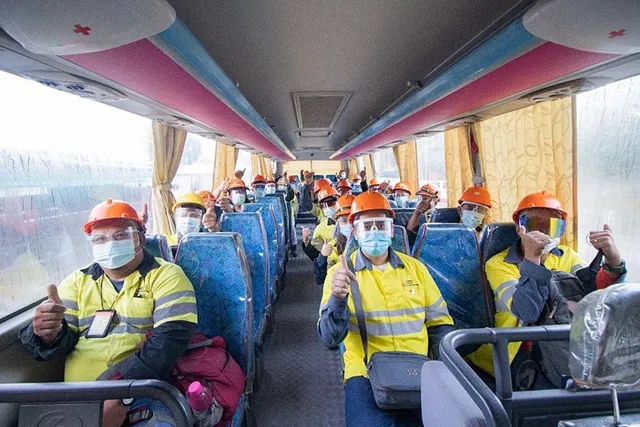
Members of the Chamber of Mines of the Philippines (COMP) – composed primarily of the country’s largest metallic mines –  responded early to the pandemic, enabling them to effectively mitigate the risks of infection within and around their mines.  In Carmen Copper Corporation’s (CCC) mine in Toledo City, Cebu, for instance, the company secured its employees’ livelihood by assuring continued salaries, providing assistance to protect their health, and setting up precautionary measures to reduce infection risks. CCC instituted flexible work arrangements, such as work-from-home options for non-critical employees and accommodations for workers directly involved in the mine and mill operations. The company also provided free service buses for commuting personnel as public transportation was halted during the lockdowns.

Health and safety measures were strictly implemented in the workplace such as social distancing and mandatory wearing of personal protective equipment. CCC also conducted regular disinfection and housekeeping of work areas and facilities.

CCC followed the “Trace, Test and Treat” strategy in managing the Covid-19 pandemic. The company’s emergency responders and medical teams meticulously traced contacts people exposed to persons positive with Covid-19 and provided regular testing. It also established quarantine areas inside the mine site and provided nutritious meals, vitamins and supplements for workers who have been exposed to positive patients.

Thankful

CCC’s efforts to secure jobs and keep employees safe are being replicated by COMP member-firms across the country.  These efforts have not gone unnoticed by their workforce. 

“During the onset of the pandemic, we did not report for work for 15 days,” recalls Jordan Zamuco, a company driver at Philex Mining Corp.’s Padcal Operations in Tuba, Benguet.  “We were on on-call duty since there were company volunteer programs where our assistance to transport donations to our host and neighboring communities were needed. After 15 days, we were back on track; our work has been continuous since. There were instances when the skeletal workforce arrangement was necessary in our department but we were well compensated. We received our daily salary. What I am most thankful for are the continued benefits from the company that we received without delay.”

“I am grateful to this company for continuing to provide benefits for us employees,” says Mine Operations Group manager Benedict Gapongli.  “Despite this situation we are all facing, the company even gave us bonuses and salary increases.”

None of Philex Padcal Mine’s nearly 1,900 employees – majority of whom are from the Cordillera Administrative Region (CAR), which posted a 25% unemployment rate at the start of the pandemic – were separated since the start of the pandemic.  Same with the company’s corporate offices in Mandaluyong, where some 80 employees are posted.

New Philex Mining Corp. (PMC) HR Senior Supervisor Luzbele Roxas, hired during the pandemic.  PMC is part of the MVP Group of Companies.

“In Philex, I can feel how agile the company is in adapting to the pandemic,” shares Human Resources senior supervisor Luzbele Roxas.  “The work-from-home setup and laptop subsidy keep me safe and make me productive at the same time. One of my key functions in HR is recruitment. I’m well equipped to handle challenges in this function with the aid of digital solutions. Moreover, with De Los Santos Medical Center, Cardinal Santos Medical Center, and other MVP partner medical institutions on my speed dial, I can confidently take care of our existing and prospective employees on their health needs. The work environment here in Philex is family oriented.  Perhaps that’s the reason why we have many long-tenured employees.”

“My work during this pandemic period has been most rewarding,” says Keith Conrad Fabros, a shop clerk and tool keeper at Padcal’s Mobile Equipment Department. “I may have additional workload, but I am quite able to cope with it. I am thankful that despite this pandemic, I still have a steady job and my family and I are healthy. The company provides free medical benefits to employees, such as the random swab tests. This makes us and our families protected from the virus.”

“There are so many things to be thankful about being part of this wonderful company, of course with the directives and supervision of our beloved president, Mr. Eules Austin,” says Irish Distor of Philex Mining Corp.’s Information Technology Department. “Thank you very much, Sir! Mabuhay po kayo!”

“During these difficult times a lot of people lost their jobs. That is why I am most thankful to Philex for ensuring that I keep my job and bring food on the table, and for helping keep our families safe,” says Irish Distor from Philex’s Corporate Office. “We were given the tools we need to do our jobs and the flexibility to work from home. Philex  also showed us how much they care for their employees when we were given flu and Covid-19 vaccines.”

Lucky

Benguet Corporation (BC), for its part, managed to secure the jobs of 1,433 employees in the company’s head office and various projects. The company’s gold operation in Itogon, Benguet managed to remain open even with the drastic decrease in the attendance of contract miners by 56%. Despite lower production, BC retained its 475 employees in its Baguio Gold Operation and is currently hiring for newly vacant positions.

“As the coronavirus continues to rapidly spread across the world, it is causing a considerable degree of anxiety, fear, and concern to all,” says Mark Gallo, Human Resources assistant at BC’s head office.  “Having this in mind, the company has safeguarded the welfare of its employees by providing flexible working hours, shuttle services, regular RT PCR screening tests, vaccines, quarantine facilities, and other safety essentials to protect them from the infection. We are lucky.”

The company’s subsidiary, BenguetCorp Nickel Mines Inc (BNMI) greatly contributed to the increase of employment in Sta. Cruz, Zambales when it resumed mining last year. Since October 2020, BNMI contracted additional 704 employees for it nickel mining operation.

“Hearing news of unemployment in the country and closing down of many businesses in different industries, makes me realize to be grateful that I still have a secured job I can count on during these trying times to provide for my family,” Gallo adds.

Roy Cale and 200 of his fellow workers and contractors at Sagittarius Mines Inc. (SMI) were able to keep their jobs despite the pandemic.  With his job secured, he and his nine teammates in the firm’s Mine Environmental Protection and Enhancement Team aim to produce up to 120,000 seedlings that SMI will then grow, propagate, plant, or distribute to community members in Tampakan, South Cotabato.

Roy Cale is one of the nine contractual workers under the Mine Environmental Protection and Enhancement Team (MEPE) of Sagittarius Mines Inc. (SMI).  As a nursery aide, he brings to life various seedlings that SMI will then grow, propagate, plant or distribute to community members.  This year, Cale and his other teammates aim to produce up to 120,000 seedlings of various tree species.

Cale is a resident of Barangay Tablu in Tampakan, South Cotabato. He joined the SMI MEPE Team in 2017 and has since helped produce more than half a million seedlings.

During the onset of COVID-19 pandemic last year, Cale was thankful that his workspace is in the great outdoors, making him feel safe from possible workplace infection. Cale was also thankful that, despite job losses that other industries suffered due to lockdowns and economic downturns, SMI immediately activated its crisis management and business continuity plans that allowed him to keep his job. Some 200 other SMI staff and contractors were able to keep their jobs as well.

‘Malasakit’

The pandemic served as an opportunity for Berong Nickel Corporation (BNC) in Quezon, Palawan to assuage its employees that no challenge is too difficult if they focus on their work and on showing their “malasakit” – or concern – for both the company and each other.

“Initially we were afraid that we will lose our jobs like what happened in other companies, Jay Dionisio, an artist at BNC’s Safety Department. “We were fetched from our homes by our company and made to stay in the mine to protect us from the virus.  This arrangement allowed us to work unhampered, thus ensuring our income kept coming and our families won’t go hungry.”

(Clockwise from top left) Rolando Sajot, Jaypee dela Cruz, Florita Mutas, and Jay Dionisio all showed “malasakit” for Berong Nickel Corp. and fellow employees, which helped the company to overcome the challenges posed by the pandemic.

Rolando Sajot, BNC Safety superintendent, says the strict enforcement of Health Protocols in the mine enabled the company to keep all its 778 employees safe.  “We managed to maintain our Safety Performance Indicator at ‘0’ – meaning there were no recorded accidents from 2019 to December 2020,” he points out.  “We posted 4 million man-hours of no lost time accident, and 25 million man-hours of no fatality since 2007.”

“Our efforts to care for and protect the forest and seas continued amid the pandemic,” says BNC Mine Environmental Protection and Enhancement officer Jaypee dela Cruz.  “One of the most important elements of our reforestation initiatives is our Nursery operations, manned by people like Mrs. Florita Mutas who, at 43, still sends seven of her children to school.”

“With God’s grace, we were able to continue our work here, which gave me the means to feed and provide for all the needs of my children,” Mutas relates.

Happy and Contented

While other companies have shut down their businesses due to the pandemic, exploration and community development work in and around TVI Resource Development Philippines Inc.’s (TVIRD) Balabag Project in Bayog, Zamboanga del Sur has not stopped, says Julito Bate, a carpenter and father of seven children.  “TVIRD values its workers, especially those who are honest in doing their work.”

Marvin Edal, a former illegal small-scale miner in this town, says working with TVIRD is his “dream come true”.  A member of the Subanen tribe, Edal was able to fulfill his wish of serving his community, especially in times of calamity and disaster, as part of the company’s exploration team.  On top of that, he now earns a lot more compared to the meager P20 he received per day in his old back-breaking job of carrying sacks of gold ore to his boss’ makeshift processing plant. 

The pandemic has not prevented him from helping his townmates and those in neighboring villages owing to the company’s continued operations.  “My only wish is for TVIRD to start its mining operations soon so we can further spread the benefits of responsible mining,” he says.

The chief’s grandson. Despite his lineage, Marvin Edal is described as “warm, approachable and hard-working – one of the best employees of TVIRD’s Community Relations group.”  Photo shows Marvin (in light blue) assisting his grandfather, Timuay Casiano Edal, in managing administrative duties for the Subanen tribe.

Edal’s sentiment is shared by Dionel Barut, an Administration assistant and in-charge of TVIRD’s kitchen staff, as well as the purchase of supplies for the kitchen, mess hall, and accommodation facilities in Balabag.  “I like working here because the company takes good care of its employees,” he relates.  “Besides the good pay, much importance is given to our health and safety.”

Barut worked once in a 5-star hotel at the Bonifacio Global City in Taguig but left and joined TVIRD in 2020.  He has no plans of leaving anytime soon.  “We are happy and contented here, especially whenever we see our fellow workers delighted with the food we serve – and then receive ‘thank-yous’ from them. Makes one forget there is a pandemic wreaking havoc all around,” he adds.

Manpower reduction never an option

Being in an export-oriented industry, Lepanto Consolidated Mining Company (LCMC) continued to operate albeit in a limited capacity and with due observance of the regulations set by the Inter-Agency Task Force for the Management of Emerging Infectious Diseases or IATF.  Manpower reduction was never an option for the company. Instead, LCMC opted to manage the employees’ earned leave credits not merely as a cost control measure, but more so to conform with the IATF protocols for companies allowed to operate and to help stem the spread of the virus in the work place.

“The good thing here is that even with the Covid-19 pandemic, Lepanto didn’t stop operating,” says Mauricio Bangngayon, a Mine Shift Boss at LCMC’s Mankayan, Benguet mine.  A high school undergraduate, Bangngayon left his village in Tanudan, Kalinga 10 years ago and found a job here, initially as a mucker, then as an LHD operator 3 years later, until he was promoted to his current post. 

“The company continues to fight, and I am still here,” he stresses.  “The thing I like most is that I am with my family here.  My wife doesn’t need to work abroad because I can provide them a decent living because of my job.”

Mauricio Bangngayon (center), flanked by the Uyod brothers Abelard (left) and Samel (right) are thankful that their company, Lepanto Consolidated Mining Co., continues to fight to keep their jobs at the firm’s Mine Division in Mankayan, Benguet.

The company put the welfare of its employees above anything else by providing them with the necessary personal protective equipment, vitamin C especially for the frontliners, shuttle services to ferry the employees to work and back home, and disinfectants for offices, to name a few.

Lepanto also conducted massive testing for all the mine site employees. Those who tested positive were sent to quarantine facilities with free meals. The Lepanto Hospital continues to give free medical services to all the Lepanto employees and dependents. With Lepanto’s good relationship with the Mankayan Local Government Unit, getting its employees vaccinated was never a problem.

Like Bangngayon, Abelard and Samel Uyod, both from Tadian, Mt. Province, found their luck in Lepanto, Mine Division.  Both of them are third generation employees, as their father and grandfather used to work for the company as lead miners.  The Uyod brothers are grateful for the opportunities given to them my LCMC even with their lack of college degrees. 

Abelard started working as a security guard in 2001 and eventually became a security officer, because of his dedication and excellent performance being an underground patrol.

“My being able to continue working here despite the pandemic is really a great help,” Abelard relates.  “My children are still studying – two of them are now in college – and we need to fund their tuition fees.  We don’t know any other income source that’s why my brother and I are so fortunate that we’re still here.”

His older brother Samel started as a mucker in 2004, then became a lead miner, and was promoted to LHD operator, until he bagged the senior surface safety inspector position in 2010. He says: “Our families’ primary source of livelihood – our salaries – wasn’t affected that’s why our standard of living remains steady even with Covid-19 wreaking havoc everywhere.  We are able to withstand the pandemic because we still have our jobs and for that we are most thankful.”

Solidarity in the time of Covid-19

Back in Toledo City, Carmen Copper Corporation (CCC) saw recently the signing of a Collective Bargaining Agreement (CBA) between management and workers.  Of CCC’s 2,365 employees, 1,916 or 81% are rank-and-file employees.

President and CEO Roy Deveraturda says the signing is a symbol of solidarity, regardless if you’re a union member, the management, a service provider, or contractor.  A key factor to the swift and peaceful CBA signing is the professionalism shown by the officers of the union, whom he described as "men of integrity and purpose."

Carmen Copper Corp. President and CEO Roy Deveraturda (right) shares a light moment with labor union president Herbert Cabaluna during the signing of the new CBA between the firm and its employees.

"They know that they also have responsibility because I believe they understand that before the wage earners can receive their share of the fruits of their labor, the wage giver must have the capability to give it to them. I salute the honesty, dedication and professionalism of the union members toward the common good," Deveraturda says.

After the first three years, another negotiation will be made to deliberate on the next salary increase for the last two years of the CBA, he adds. “In a scenario wherein the general situation, brought about by the current pandemic, talks of furlough, layoffs and retrenchments from other companies, CCC is talking about salary increases and enhancing the welfare of its employees.".

Union president Herbert Cabaluna, who described the CBA signing as a "very important" development, agrees: "Despite the pandemic and its effect to the economy, our CBA managed to increase and improve economic benefits like wages, benefits, allowances, bonus and programs. Aside from economic benefits, the CBA also institutionalized job security and protection of workers' rights."

As CCC continues to strive for its goals amid the pandemic, Deveraturda urged all employees to do what they can for the company: "We must all love the company, show your commitment, cooperation and of course, your competence in the performance of your assigned tasks."


Article Courtesy of the Chamber of Mines of the Philippines

August 23, 2021

Photo Credit: Victor Roman

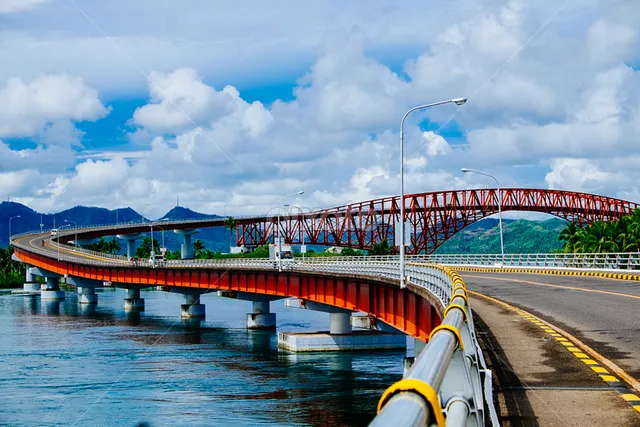
The rehabilitation of the San Juanico Bridge has further delayed its much-awaited lighting project, a Department of Tourism (DOT) official said on Friday.

In an interview, DOT Eastern Visayas regional director Karina Rosa Tiopes said the completion of the lighting project will be pushed to early 2022 to give way to the repair of the 50-year-old bridge.

Tiopes said officials of the Department of Public Works and Highways (DPWH), bridge rehab contractor, and lighting project contractor Amigo Entertainment Technologies Inc., and others concerned agencies will meet regularly to resolve issues causing the delay of the tourism project.

Citing discussions in a recent meeting, Tiopes told the Philippine News Agency (PNA) that the DPWH contractor, M. G. Lualhati Construction Corp., unintentionally removed some of the bulbs and its fiber optics in their attempt to replace bridge bolts and install scaffoldings.

“Each bulb is linked to an address. Imagine how many bulbs were installed and each of these is interconnected to each other. If one is removed, other bulbs are affected,” Tiopes added.

The DOT regional office is tasked to monitor the project funded by the Tourism Infrastructure and Enterprise Authority (TIEZA), an attached agency of the tourism department.

Toribio Odtuhan, head of the DPWH San Juanico Bridge Task Force, said Amigo was informed about the rehabilitation plan, but the latter failed to follow the recommendations on where to specifically install the bulbs.

“Our contractor is willing to pay the cost of damage. We will meet again with the DOT contractor and the Samar provincial government to resolve the problem,” Odtuhan told PNA.

The PHP96.25 million major bridge repair projects include structural steel painting, tightening and replacement of bolts, and general scaffolding.

This is the first initiative to tighten and replace bolts since the bridge was built in 1969.

The bridge repair will be done in December this year, moving the lighting project completion to the first quarter of 2022.

The PHP80-million San Juanico Aesthetic Lighting project was approved in 2018, with bidding that started in 2019, and groundworks that began in the same year.

It was initially targeted for completion in the second quarter of 2020 but was affected by the restriction due to the coronavirus disease 2019 (Covid-19) pandemic, pushing the revised completion date to December last year.

However, during the test run, it was found that the power supply from a substation supplying electricity to the bridge was unstable. Major issues were addressed and officials revised the full completion date to Aug. 11, 2021 in time for the 180th Samar Day celebration.

“The entire project was 95 percent done when the DPWH started the bridge repair works. With this problem, there’s more work to be done again,” Tiopes added.

Under Amigo’s initial plan, the lighting will be in the default position for 45 minutes per hour in white and strobe lights. There will be a 10-minute light show six times nightly.

The colors may also depend on the occasion, such as red for Valentine's, red and green for Christmas, and violet for Lent.

Officials assured that lights will not distract traffic flow at the bridge that forms part of the country’s longest highway that links Luzon to Mindanao.

Aesthetic lights are not visible to motorists passing the bridge, according to the contractor.

The bridge’s transformation would be a new attraction under the Spark Samar, a branding campaign of the local government that was launched in 2015.

The San Juanico Bridge, which spans 2.162 kilometers, was built as part of the Pan-Philippine Highway now called the Maharlika Highway, a network of roads, bridges, and sea routes that connect the islands of Luzon, Samar, Leyte, and Mindanao. - By Sarwell Meniano


Article Courtesy of Philippine News Agency

August 21, 2021

When Indonesia announced the reimposition of their nickel export ban in 2019, why were many key players in the Philippine mining industry optimistic about this? Was their optimism based on the belief that Indonesia is out of the game due to their nickel export ban? Did the Philippines really benefit from Indonesia’s export ban on laterite nickel ores?

What actually happened is that during the years when Indonesia halted their laterite nickel ore exports to the world, outsiders still got their nickel supply from Indonesia by investing in the country, thus giving them internal access to Indonesia’s nickel. This investment strategy brought a win-win situation to both Indonesia and their foreign investors. This is an angle of the Indonesian nickel export ban story which is disadvantageous to the Philippine nickel industry. But are the industry players in the Philippines aware of this?

To give an in-depth analysis on what really happened to the Philippine nickel industry while Indonesia was implementing their nickel export ban, top Australian mining executive and CEO of Electric Metals Limited, George Bujtor shares his thorough research about the matter. 

For background, George Bujtor has extensive work experience in technical, financial and commercial aspects of mining operations. He is one of the authors of a paper titled “A Guide to the Understanding of Ore Reserves Estimation”.[1] The paper was published by the Australasian Institute of Mining and Metallurgy in March 1982 and was the basis for the development of the JORC Mineral Code used worldwide today. This study is a remarkable peer-reviewed journal and significant reference of most international mining studies and academic research in relation to JORC studies and Mineral Reporting Code.[2]

His career is notable as past General Manager and Managing Director during his 22 years in Rio Tinto, Australia, and as former CEO of Aldoga Aluminum, Australia. On his first years in the Philippines, he developed the Berong Nickel mines in Palawan as CEO of Berong Nickel Corporation. Following this, he became the CEO of Carmen Copper Corporation/Atlas Mining where he successfully raised over US$200M in bond issue for the expansion of the mine and processing operations.


He held numerous Board positions and is a Fellow of the Australasian Institute of Mining and Metallurgy, and is a Competent Person as defined by the JORC & NI 43-101 codes (Australasian Joint Ore Reserves Committee).


Here’s an extensive report, analysis and forecast by George Bujtor about the current situation of the Philippine nickel industry.

August 18, 2021

DMCI Mining shipped 1.24 million wet metric tons (WMT) of nickel ore from January to June, an all-time high for the company and 45 percent higher compared to the 853,000 MWT shipped during the same period last year.

Of the total shipments, 718,000 WMT came from Berong Nickel Corporation (BNC) while Zambales Diversified Metals Corporation (ZDMC) contributed 522,000 WMT.

“This is the first time that both our mining assets are operating at full capacity. We expect shipments to remain strong in the second half since we were able to extend Berong’s mine life from June until Q3 this year,” said DMCI Mining president Tulsi Das C. Reyes.

Average nickel grade of the shipped nickel dropped from 1.37% to 1.39% while average selling price per metric ton rallied 57 percent from USD28 to USD44 owing to China’s surging stainless steel production, strong demand for electric vehicles and the continuing Indonesian nickel ore export ban.

“The uptrend in nickel prices is likely to continue in the coming months because of production-consumption gaps. Major nickel producers are seeing lower output because of COVID-19 lockdowns and various operating issues but industrial manufacturing is still ramping up,” Reyes added.

DMCI Mining revenues in the first half grew 123 percent from P1.2 billion to P2.7 billion. Including a nonrecurring income of P247 million mainly due to deferred tax liability remeasurement and 2020 income tax adjustment under CREATE Act, its standalone net income soared 409 percent from P241 million to P1.2 billion.

Nickel is mainly used in stainless steelmaking, but is also a vital ingredient for the lithium-ion batteries used to power electric vehicles (EV). The International Energy Agency estimates that global EVs will grow 14 times to 145 million by 2030.

August 18, 2021

Photo Credit: The Department of Public Works and Highways

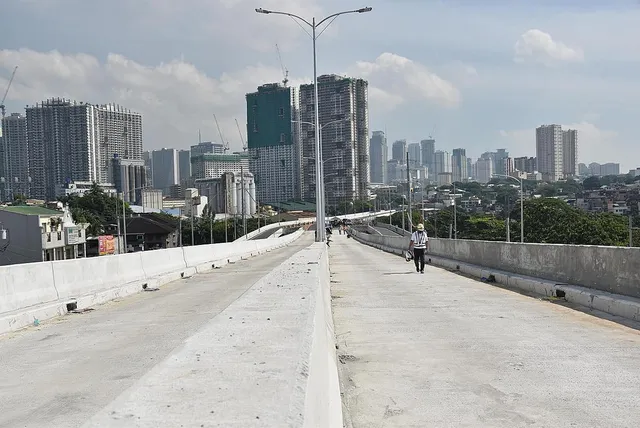
The Department of Public Works and Highways (DPWH) is on track to deliver the Lawton Avenue to Global City viaduct section of the Bonifacio Global City (BGC)-Ortigas Center Road Link Project by end of 3rd Quarter this year.

Secretary Mark Villar said that construction of viaduct and approach 3 along BGC’s 8th Avenue is now at an accelerated pace to meet the September completion target.

This project will soon provide motorists a much different travel experience between Ortigas and BGC, added Secretary Villar.

Secretary Villar together with Undersecretary for Unified Project Management Office (UPMO) Operations Emil K. Sadain and UPMO-Roads Management Cluster 1 (Bilateral) Project Director Benjamin Bautista and Project Manager Ricarte S. Mañalac made an inspection of the project on Tuesday, August 17, 2021.

According to Undersecretary Sadain, DPWH has already completed the deck slab of main viaduct from pier 13 to pier 22 while installation of deck slab reinforcements at pier 22 to abutment 3 including median, sidewalk and parapet reinforcements are on-going.

Although community quarantine is in place, DPWH and contractor Persan Construction Inc. has continued the work along the stretch of 8th Avenue from the Kalayaan Avenue intersection taking into consideration the construction health and safety protocols, said Undersecretary Sadain.

Construction of retaining and MSE wall for the 155 meter approach 3 are also on-going with the underground utilities of Meralco along 8th Avenue already relocated.

Once the Lawton Avenue to the Global City Viaduct section is fully completed, it will provide direct access from Ortigas Center heading towards the Kalayaan Bridge to Bonifacio Global City.

The entire 1.481-kilometer BGC-Ortigas Road Link Project, composed of the Kalayaan Bridge which was opened last June 12 and the improvements at Brixton and Fairlane Streets, and the Lawton Avenue – Global City Viaduct, is expected to reduce travel time between BGC and Ortigas Center from a one-hour trip to 12 minutes.


Article Courtesy of the Department of Public Works and Highways

August 17, 2021

Global Ferronickel Holdings, Inc. (FNI), the country’s second-largest nickel ore producer, recorded H1 net income of P640.8 million against the P195.8 million it posted during the same period last year. Revenues are up by 68.9% to P2.61 billion compared to P1.54 billion during the same period last year mainly due to higher nickel ore prices and increased shipment volume.

“We garnered more favorable results this year as the market experienced a big jump in the price of low-grade nickel ore. We did not experience a stoppage of operations as what happened in April last year,” said FNI President Dante R. Bravo.

The Group completed 32 nickel ore shipments in H1 2021 against 23 shipments during the same period last year resulting in a 38.3% increase in shipment volume to 1.740 million WMT against the 1.258 million WMT in 2020. These were 100% exported to China and consisted of 1.465 million WMT low-grade nickel ore and 0.275 million WMT medium-grade nickel ore. The resulting sales mix is 84% low-grade ore and 16% medium-grade ore in 2021 compared to 52% low-grade ore and 48% medium-grade ore in the previous year.

The overall average realized nickel ore price for the period ending 30 June 2021 was USD 31.10/WMT compared to USD 24.38/WMT for the period ending 30 June 2020, higher by USD 6.72/WMT or 27.6%. The price of low-grade ore went up by 61.7% to USD 31.01/WMT in 2021 against the 2020 price of USD 19.18/ WMT. Medium-grade ore, on the other hand, was USD 31.58/WMT or 5.2% higher than the 2020 price of USD 30.03/WMT.

To date, FNI has spent over 35 million pesos on its COVID-19 response. It works closely with various local government units in helping the local communities combat the spread of the virus and providing relief during this time of need. It has donated PPE supplies, test kits, disinfectants, vitamins, medical equipment, medical services, rice and other essential goods, and participated in building a molecular laboratory in Surigao and a COVID-19 test center in Palawan.

August 17, 2021

CAGDIANAO, Dinagat Islands -- Stress is a word that many people are not a friend of. In fact, never-ending problems or worries arise because of constant stress, dubbing it as the number one enemy of our existence.

In the world of the Blue Zone, we can find that most centenarians enjoy their prime years avoiding stress. Their healthy lifestyles take care of their physique and mental stability.

In our work environment, stress disrupts people from doing their best. The long tiring jobs drain them physically and mentally. Some may get involved to join drinking buddies to relieve stress -- only to find out that their health suffers as a consequence.

Some may even spend more overtime to get their jobs done, only worsening their physical conditions as they already are overworking. It is unproductive and unsafe.

Continuous stressful work for longer periods will cause fatigue, resulting in eye strain, back pains, and other maladies.

Many companies have created many ways to get their workers to embrace a healthy lifestyle, and Cagdianao Mining Corporation (CMC) is one of them.

At the heart of the campsite lies a large room stuffed with weights and training equipment, the humble FITNESS GYM.

CMC Fitness Gym’s history goes back a decade ago. It was a suggestion from a local Fire Brigade to build an indoor venue for the CMC workers to exercise for health reasons and at the same time, to boost up their morale.

There was no fitness equipment at that time yet, so some workers improvised a bench press made from used campsite lumber, and dumbbells and the barbell weights were made from junk humungous dump truck metal gears.

Currently, some employees go out from the campsite and hit the road for a bicycle ride, a hike, or even jogging a few kilometers and back. Some may play at a half-courted basketball ground.

In the past, the company had a program called “Shape-up CMC,” which introduced the exercise regimens like Zumba (which gradually dissolved), but nothing can beat the camaraderie inside the Fitness Gym (still going active and improving).

Inside the gym, you can already sweat out what you can do running by using the thread mill. The thread mill can be digitally programmed according to your needs like setting up how many minutes you want to run or walk. You can also program a steeper incline to increase difficulty and challenge yourself more. You can try other training equipment for the muscle that you preferred to get toned.

Exercising outside the camp premises could mean a higher possibility of injury (e.g. dog bites, sweltering heat of the sun, dust, sprains, knee tendonitis, dangerous slippery roads and the like). Inside the gym, you may encounter minor injuries, too, but thanks to the constant presence of the CMC work-out buddies, you are guarded.

These work-out buddies are employees from different departments who love to sweat their stresses out.

It may sound strange, but the more they sweat, the more that they are having fun. In the scientific world, this is called… feeling good brain chemicals -- endorphins, dopamine, norepinephrine, and serotonin are released to create a cocktail of enjoyable sensational experiences.  

Although the repetitive physical movements and weight resistance is tiring, the mood is converted into something positive through a healthy transformation of body cells, muscles, and brain tissues.  

After the workout, you will feel exhausted but that exhaustion will give you a better sleeping cycle. Once you have a good night's sleep, in the morning the feeling of soreness prevails but it’s a signal that your body is transforming into a better and healthier one.

“When I started in the field of fitness, I thought I needed to be healthy and physically strong under the influence of a best friend, I saw in him the dedication and motivation that pushed me to start going to the fitness gym and work out. And there I proved to myself that my decision was right from the advice of my close friend to enter the field of fitness, it also led to my diet discipline to eat healthy and nutritious foods that help me become strong, have a healthy body and mind. Time and health are two precious assets that we don't recognize and appreciate until they have been depleted.” – Junelan P. Petilo (CMC ERT Coordinator / Safety Inspector)

Hitting the fitness gym can also help build new friends inside the company that works at other departments. The CMC work-out buddies are also encouraging other co-employees to join them especially those that are too dependent on Medical Care benefits and living a sedentary lifestyle.

You cannot be healthy by just wishing about it: you have to take action; do it and live by it.  

Most of the CMC work-out buddies’ interests and conversations are focused on the well-being of every individual. You can enjoy physical stimulation through working out while having social stimulation as well.
 

“Am happy that I belong to a company that consider its employees’ health as a fundamental key to achieving goals, believing that a person’s well-being is second to none in terms of productivity. In-house fitness facility is convenient and time saving, of course, the camaraderie and friendship is priceless. Taking care of one’s self is a no brainer as Jim Rohn famously quoted ‘Take care of your body, it’s the only place you have to live’.” – Mcdodd Baylon (CMC Ship Loading Supervisor)


CMC also improved its employees’ health and wellness by catering them a healthy meal from nutritious recipes provided by their very own Dr. Alvin Pura (CMC Company Head Physician).  
 

This healthy lifestyle is crucial to the success of the company, as Papa Bear (John-Eric S. Taburada) always says: “I don’t want to be a liability to the company, and a great start would be, engaging in constructive habits -- starting with my HEALTH.”

August 12, 2021

The World of Safety and Security Expo (WOSAS) is a platform to showcase the latest variety of products and services that play a crucial role in commercial or public safety and security.  This event is brought to you by Worldbex Services International, a leading event organizer in the country.

WOSAS marks its milestone as it launches its very first online activity, WOSAS WIRED, on  August  18-20  2021.  This online activity will entirely focus on SECUCON, our very own webinar series, which aims to present timely and engaging topics to  our target audience through our social media assets.  This is our responsive take on the WOSAS SECUCON which has been a staple component of the on-ground expo through the years. 

In this interactive and informative platform,  timely topics will be tackled by the following industry personages:

WOSAS SECUCON 2021

August 18, 2021 (HEALTH AND WELLNESS)

Dr. Anna Karmela O. So

Vice President and Medical Director Head of Medical Services Department Cocolife Healthcare

Topic: SAFE SPACE: Discover Ways to Protect your Holistic Health

Mr. Richard Caballero

Founder and CEO Healthy Mind Solutions (HMS)

Topic: Pandemic Impact on FIlipino Health

Mr. Michael Angelo R. Datuin

Chairman & National President of the Campus Security & Safety Management Alliance of the Philippines

Topic: The Changing Role of Security in this Pandemic

August 19, 2021 (DISASTER MANAGEMENT)

Dr. Francis Aldrine Uy

Founder and President USHER Technologies Inc. Dean, School of Civil, Environmental and Geological Engineering of Mapua University

Topic: USHERing a Safer and more Resilient World with Advanced Disaster Risk Reduction Technologies

Mr. Agustiyanto Zheng and Mr. Michael Wong

Dräger Singapore Pte. Ltd in partnership with Macrovista

Topic: Smart and Safe Buildings

August 20, 2021 (DATA SECURITY)

Mr. Art Samaniego

Tech Editor of Manila Bulletin, Google IT Support Specialist, & Cybersecurity Analyst

Topic: Securing your Accounts: Cybersecurity Threats and Trends

Atty. Joan Therese Medalla

Attorney at the Enforcement Division of the National Privacy Commission

Topic: Data Privacy in the Time of Digital Transformation

WOSAS SECUCON Webinar registration here https://wosas.ph/wosas-wired-secucon-2021

E-certificates will be provided to participants after attending the webinar. 

Interested parties may call Worldbex Services International at telephone 8656-9239 or email at inquire@worldbexevents.com. For more details, visit https://wosas.ph/


August 09, 2021

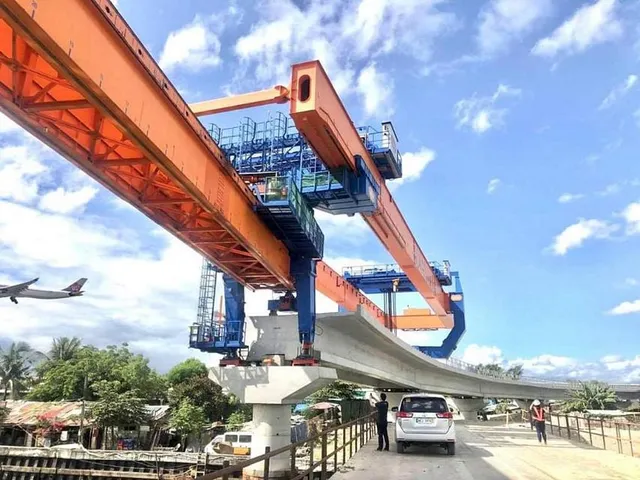
Public Works and Highways Secretary Mark Villar announced that the on-going works for the Panguil Bay Bridge Project stays on track within the target completion of December 2023.

Secretary Villar said that progress of works for the Northern Mindanao’s mega inter-island connection is now at 22 percent as major equipment intensifies preparation of the bridge foundation.

In an inspection report to Secretary Villar, Undersecretary for Unified Project Management Office (UPMO) Operations Emil K. Sadain said that 15 bored piles out of 54 for Panguil Bay Bridge sub-structure were completed to date at a depth ranging 30 to 50 meters.

Undersecretary Sadain together with Project Director Sharif Madsmo Hasim of UPMO Roads Management Cluster 2 conducted work performance assessment on Thursday, August 5, 2021 of the off-shore construction activities by Korean joint venture contractor Namkwang-Kukdong-Gumwang.

Based on the extensive detailed engineering design, the 3.169 kilometer Panguil Bay Bridge will require 54 bored piles intended for the 32 piers, two (2) for abutments at Tangub City, Misamis Occidental and Tubod, Lanao Del Norte side, and two (2) for pylon of the main bridge.

Bored piles 3 meter diameter are completed using reverse circulation drilling machines on barges to prepare the bore holes followed by the launching of 23 millimeter thick permanent steel casing using revolving crane barges and vibro pile hammers, and until final pouring with two (2) land and sea-based batching plants each capable of supplying 120 cubic meter of ready-mixed concrete per hour.

With an average of six (6) to seven (7) holes prepared per month, 74 percent or 40 of the 54 bored holes is targetted for completion towards end of December 2021 with the remaining 26 percent or 14 bored holes to be finished by February 2022.

In order to ensure quality of works, the completed bored piles are subjected to checking using cross hole sonic logging test after 7 to 14 days of concrete placement in order to assess the integrity of concrete in the cast-in-site pile and will also undergo pile loading test to determine the safety factor, Undersecretary Sadain reported.

Considered as the biggest and boldest infrastructure project in Northern Mindanao, the P7.375 Billion project to connect Tangub City and Tubod across Panguil Bay in just seven (7) minutes is funded by a loan agreement between Government of the Philippines (GOP) and Korean Export-Import Bank (Korea Eximbank).

August 06, 2021

President Rodrigo Duterte has signed a law establishing the Philippine Energy Research and Policy Institute to enhance the country’s capability for energy research and policy development.

Republic Act 11572, signed by Duterte on July 30, establishes the institute as an independent agency attached to the University of the Philippines (UP) with a separate budget from the premier university.

Under the new law, an executive director to head the institute shall be a recognized expert in energy research and policy development with at least three years experience in the energy sector and shall have a strong organizational management background.

The executive director, appointed by the UP President upon recommendation of the Executive Board, shall serve in full-time capacity for a term of five years which may be renewed.

The institute’s Executive Board shall be composed of seven members comprised of the UP President as the ex-officio chairperson, and at least one representative from the fields of engineering, law, science, statistics, economics, social science, and public health, either from the academe or the private sector.

Four members shall come from the academe, two members shall come from the private sector, while each representative shall come from different fields.

Other members of the Executive Board shall be chosen by the UP President. Each member shall have a term of three years, which can be renewed for two more terms.

The first two appointees from the academe and the first appointee from the private sector shall have a term of two years, which can be renewed for two more terms.

The Executive Board may invite the secretaries of various government agencies as well as legitimate consumer and advocacy groups as resource persons during its meetings and deliberations.

The institute shall support further education and training for its officers and employees to include advanced degree studies, short-term programs, online courses, and participation in conferences.

Research papers, data, and other resources shall be made available to the public through its website.

However, proprietary or confidential data and other resources cannot be posted or disclosed unless prior consent of the source or owner of such data and resources has been obtained by the requesting party.

A Special Account in the General Fund (SAGP) for energy research, which shall be maintained and managed by the Bureau of Treasury, shall be established to support the research undertaken by the institute.

The SAGF for energy research shall recognize and accept grants, contributions, and donations collected for energy research.

A total of PHP200 million will be appropriated out of the General Appropriations Act (GAA) for the initial operating fund of the institute.

Such amounts necessary for the sustainable operations of the institute shall be appropriated from the GAA based on the annual financial plan approved by the Executive Board and submitted to the Department of Budget and Management.

Government agencies concerned are authorized to include in their respective annual budgets such necessary amounts as their contribution to the funding of certain research activities in the institute.

Within 90 calendar days from the effectivity of the act, the UP, in consultation with the members of the academe, and other public and private stakeholders shall promulgate the necessary implementing rules and regulations of the act subject to the approval of the UP Board of Regents.

August 06, 2021

Nickel Asia Corporation announced its unaudited financial and operating results for the six-month period ended June 30, 2021 with an attributable net income (net of minority interest) of P2.73 billion, a 579% increase from P401.4 million reported during the same period last year. Earnings before interest, tax, depreciation, and amortization (EBITDA) amounted to P5.34 billion, a 157% increase compared to P2.08 billion in the prior year.

The higher net income was the result of higher ore sales prices and volume. The Company sold a total of 8.3 million wet metric tons (WMT) at the weighted average realized price of $25.47 per WMT in the first half of 2021 compared to 7.3 million WMT at $16.02 per WMT in the same period last year.

Breaking down the ore sales, the Company exported 4.56 million WMT of saprolite and limonite ore at the average price of $37.50 per WMT in the first six months of 2021 compared to 3.28 million WMT at $26.03 per WMT in the same period last year. Likewise, the Company delivered 3.74 million WMT of limonite ore to Coral Bay and Taganito HPAL plants, the prices of which are linked to the LME, and realized an average price of $7.92 per pound of payable nickel. This compares to 4.02 million WMT at $5.68 per pound of payable nickel in 2020.

Furthermore, owing to higher LME prices, the Company recognized gain from its equity share in its investments in the two HPAL plants in the combined amount of P244.1 million in the first half of 2021 compared to a loss of P70.6 million in the same period last year.

The realized Peso to U.S. Dollar exchange rate for ore sales was P48.26 compared to P50.49 in the prior year. However, the exchange rate at the end of first half of 2021 stood higher at P48.80 compared to when it started the year at P48.02, thus the Company reported net foreign exchange gains of P190.6 million. This compares to the net foreign exchange losses of P101.7 million reported in the first half of last year.

Total operating cash costs increased by 26% year-on-year to P5.15 billion from P4.10 billion in 2020. On a per WMT sold basis, total operating cash costs increased to P621 per WMT compared to P562 per WMT in 2020.

“Demand for nickel remains strong due to surging stainless steel output, driven by the recovery of the construction, manufacturing, and oil and gas sectors, and accelerating demand from the EV battery industry,” said Martin Antonio G. Zamora, President and CEO of the Company. “Further, nickel supply disruptions, due in large part to the Indonesian ore export ban and COVID-19 related lockdowns, provide additional support to the price of nickel,” Mr. Zamora added.


Article Courtesy of The Philippine Stock Exchange

August 03, 2021

OceanaGold Corporation reported its financial and operational results for the quarter ended June 30, 2021. Michael Holmes, President and CEO of OceanaGold said, “I am very pleased with the operational and financial performance of the business in the second quarter 2021. Haile delivered a record quarter of gold production and is well on-track to deliver on the full year production guidance. Waihi plant upgrades were completed, and we 2 commenced continuous milling late in the second quarter which is a tremendous outcome as we continue to ramp-up underground operations.”

“Based on year-to-date performance we have refined our expectations for the full year. We currently expect consolidated production of 350,000 to 370,000 gold ounces at AISC of $1,200 to $1,250 per gold ounce sold at cash costs of $825 to $875 per ounce sold. Strong first half performance at Haile has put us firmly on track to deliver ahead of 160,000 gold ounces for the full year at moderately higher AISC, largely driven by an increased proportion of mining costs capitalised as pre-strip plus higher than expected mining costs incurred. On the other hand, a softer first half at Macraes is driving production to the lower end of guidance of 155,000 to 165,000 gold ounces for the full year at consequently higher AISC. Waihi is firmly on-track and production guidance remains unchanged but at improved costs. We expect to provide updated consolidated guidance in-line with the staged restart of Didipio over the coming weeks.”

“Renewal of the FTAA at Didipio was one of our key priorities this year, and I’m extremely proud to say we delivered. The staged restart of the asset is underway with the current focus on the rehire and training of our skilled Philippine workforce. We expect to restart processing well prior to year-end, initially sourcing mill feed from existing stockpiles at site. Our expectation is to also transport and sell approximately 18,500 gold ounces and 3,500 tonnes of copper in concentrate on site by early fourth quarter. The rehire and retraining of the workforce, as well as the ongoing risks associated with the COVID-19 pandemic, could impact the timeline associated with returning to full underground production of 1.6Mtpa, which could take up to 12 months.

Operations

In the first half of the year, the Company produced 177,039 ounces of gold, a 27% increase over the same period in 2020 due to record production at Haile in the second quarter, resumption of campaign processing at Waihi, and limited impacts from COVID-19. Second quarter gold production of 93,848 ounces of gold reflects record production at Haile of 57,240 ounces.

Consolidated AISC of $1,227 per ounce sold YTD and $1,226 per ounce sold in the second quarter were relatively flat over the prior year and previous quarter. Cash costs for the first half of the year of $734 per gold ounce and $764 per ounce in the second quarter, decreased 22% and 11%, respectively. The improvement in cash costs primarily reflects lower operating costs at Haile from productivity improvements made year-over-year

Haile, USA

Haile delivered a record second quarter of 57,240 gold ounces resulting in 101,581 gold ounces produced in the first half of the year. AISC and cash costs improved significantly, benefitting from higher gold sales and lower overall cash costs from productivity improvements. AISC and cash costs for the second quarter were $922 and $615 per ounce, a decrease of 7% and 22%, respectively, quarter-on-quarter. YTD AISC and cash costs were $953 per ounce and $684 per ounce, respectively, down approximately 36% over the prior year period.

Unit mining and milling cost decreased quarter-on-quarter, and increased 9% and 36%, respectively, YTD over the prior year period. Second quarter decreases reflect lower maintenance activities on the mining fleet and higher mill feed following milling disruptions from the first quarter; YTD increases are attributable to higher maintenance costs and an unplanned mill disruption from blocked crusher chutes in the first quarter that have since been resolved. The decrease in site G&A quarter-on-quarter reflects the increase mill feed and lower costs during the period.

Confirmed COVID-19 cases at site increased from 111 at the end of the first quarter to 120 by the end of the second quarter, a decrease in positive cases from 48 in the first quarter to nine in the second quarter. Looking ahead, the Company expects to transition to ore mining of lower grades at Ledbetter Phase 1 and commence stripping of Ledbetter Phase 2, resulting in materially lower production and higher AISC in the second half of this year. The Company has refined its full year production guidance for Haile to 160,000 to 170,000 gold ounces at site AISC of $1,100 to $1,150 per ounce sold, including cash costs of $850 to $900 per ounce sold. The higher AISC and cash costs reflect higher mining costs incurred plus incremental sustaining capital expenditures related to open pit pre-stripping.

Waihi, New Zealand

Waihi produced 3,939 gold ounces in the second quarter and 8,276 gold ounces YTD. Second quarter activities at Waihi primarily focussed on the development of Martha Underground and replacement of the semi-autogenous grinding (“SAG”) mill. Approximately 2,665 metres of underground development were completed during the second quarter and 5,210 metres YTD. Sustained milling recommenced in late June following the successful replacement of Waihi’s SAG mill.

AISC and cash costs for the second quarter were $1,223 and $1,215 per ounce sold, respectively, and increased quarter-on-quarter with higher operating costs associated with limited early production, partly offset by moderately higher gold sales. YTD AISC and cash costs were $1,099 per ounce and $976 per ounce, respectively, increases over the prior year period with the ramp-up of production at Martha Underground as expected.

Unit mining costs were relatively unchanged quarter-on-quarter with mining of narrow vein ore at Correnso and early production from Martha Underground in both quarters. YTD mining costs reflect early production from Martha Underground relative to the prior year. Processing cost and site G&A increases in the second quarter reflect the planned shutdown for replacement of the SAG mill and resultant lower mill feed. Lower site G&A YTD over the prior year reflects normal operations relative to 2020 which included impacts from COVID-19-related shutdowns.

Full year 2021 production guidance at Waihi remains unchanged while cost guidance has improved. The Company expects to produce 35,000 to 45,000 ounces at lower gold cash cost of $900 to $950 per ounce and site AISC of $1,300 to $1,350 per ounce sold. The Company anticipates ramp-up of production over the course of the second half with the highest quarter of production for the year expected in the fourth quarter.

Macraes, New Zealand

Macraes produced 32,669 gold ounces in the second quarter and 67,182 gold ounces in the first half of 2021. Lower than expected production in the second quarter reflects geotechnical impacts at the Coronation North open pit that slowed mining rates reducing access to higher grade ore zones, as well as a delayed re-start from the planned shut during the quarter to address out-of-scope maintenance requirements

Second quarter AISC and cash costs were $1,524 and $897 per ounces sold, respectively. YTD AISC and cash costs were $1,428 and $857 per ounce sold, respectively. Cash costs increased approximately 10% quarter-onquarter and YTD over the prior year period, reflecting the lower ounces, a net drawdown in inventory and additional contractor costs to fill workforce vacancies. Similar increases in AISC also reflect the higher sustaining capital spend related to increased pre-stripping at Deepdell North and waste movements in the quarter and first half.

Unit mining costs were 6% and 28% higher quarter-on-quarter and YTD over the prior year period, respectively, as a result of reduced trucking productivity from inclement weather which saturated haul roads, flooded active open pit mining areas, and rendered the underground inaccessible for a two-week period in the first quarter. Mining efforts were subsequently re-directed to increased waste mining and pre-stripping at Deepdell North open pit through the first half. Processing unit costs also increased over comparable periods, reflecting the one-off mill motor outage in the first quarter and extended mill shutdown during the second quarter.

Due to the lower-than-expected production in the first half, the Company expects Macraes full year production to be in the lower end of the guidance range of 155,000 to 165,000 gold ounces at cash costs of $800 to $850 per ounce and increased site AISC to $1,200 to $1,250 per ounce sold over the full year, primarily driven by increased sustaining capital spend related to pre-stripping at Deepdell North and additional underground development. Production is still expected to increase in the third quarter and be higher overall in the fourth quarter of 2021.

Didipio, Philippines

There was no production from Didipio in the second quarter and first half due to the suspension of operations. The Company expensed $5.5 million in the second quarter and $10.0 million YTD of holding costs as part of consolidated Corporate General and Administration, which relates to maintaining Didipio in a state of operational standby.

Subsequent to second quarter end, the Government of the Philippines renewed the Didipio FTAA for a further 25 years. The Company’s primary focus is the safe and responsible start-up of operations, which includes recruitment and training of the workforce and the transport of approximately 15,000 tonnes of copper-gold concentrate produced prior to the shutdown of operations.

The Company expects to progressively ramp-up to full underground mining rates of 1.6 Mtpa within the next twelve months, depending on workforce rehiring and recruitment efforts. Ore from the underground will incrementally and steadily offset mill feed from stockpiled ore of which there is currently 19 million tonnes.

Since March 2020, 72 positive COVID-19 cases have been managed at Didipio, 63 of which occurred in the second quarter of 2021. The Company experienced a significant increase in COVID-19-positive cases early in the second quarter, consistent with the spread of COVID-19 in the local and surrounding communities. The site continues to follow strict health and safety protocols to prevent the ongoing transmission of the virus at site.

Financial

In the first half of the year, the Company generated $331.5 million in revenue, a 42% increase from the prior year period due to record production at Haile, improved average gold price and early production at Waihi with the development of Martha Underground. Quarter-on-quarter revenue increased 23% with record production from Haile, partly offset by lower sales from Macraes where production was impacted by geotechnical issues that rendered higher grade ore zones of the open pit inaccessible.

First half adjusted EBITDA (excluding Didipio carrying costs) of $161.9 million nearly tripled year-on-year, reflecting improved revenues on higher gold prices and record production at Haile at improved cash costs, as compared to the first half of 2020 which included impacts related to COVID-19 shutdowns. Quarter-on-quarter adjusted EBITDA of $95.4 million increased 43%, benefitting from record production at Haile at improved operating costs, partly offset by lower sales from Macraes.

Adjusted net profit was $36.9 million or $0.05 per share on a fully diluted basis in the second quarter and $58.7 million or $0.08 per share on a fully diluted basis YTD. The quarter-on-quarter and year-over-year increases were mainly a function of the higher revenue from increased sales volumes. The increases were partly offset by income tax expense of $15.8 million in the second quarter and $21.5 million YTD due to the operational profits in the USA and New Zealand. Additionally, there were no potential tax benefits recognised associated with the costs incurred to maintain Didipio in a state of operational readiness.

Operating cash flows YTD were $83.4 million, a decrease year-over-year given the $79.0 million received from the gold presale in the first quarter of 2020. Excluding working capital adjustments, fully-diluted cash flow per share was $0.22 YTD and $0.13 for the second quarter.

First half investing cash flows of $152.8 million were significantly higher than the prior year period, primarily due to higher growth capital expenditures at Haile related to the expansion of waste storage facilities, increased prestripping at Macraes and the ongoing development of Martha Underground at Waihi.

As at June 30, 2021, the Company’s cash balance stood at $92.3 million, and net debt increased quarter-onquarter to $224.8 million, mainly reflecting the lower cash balance. The Company’s total debt facilities stood at $250 million of which $50 million remains undrawn as at 30 June 2021.

August 02, 2021

Albay Rep. Joey Sarte Salceda has called for the passage of the proposed fiscal regime for the mining industry, saying the industry is a potential job creator in the post-COVID future.

Salceda, chairman of the House committee on ways and means, emphasized the natural wealth potential of the Philippines, but observed "key deficiencies in the country’s extractive industry governance framework," some of which can be resolved by a “coherent tax regime.”

“The country is the fifth most mineral-rich country in the world for gold, nickel, copper, and chromite. It is also home to the largest copper-gold deposit in the world. Estimates suggest that up to 840 billion dollars of untapped mineral wealth is in Philippine soil,”

Salceda said in his keynote speech during the Extractive Industry Transparency Initiative (PH-EITI) National Conference on Thursday.

“This is not to mention the 17.1 billion barrels of oil deposits that China’s Ministry of Geology and Mineral Resources estimates to be in the Spratlys, or the 190 trillion cubic feet of natural gas that the US Energy Information Administration believes to be in the area.

“These resources, if extracted and managed properly, could make the Philippines one of the richest countries in the world,” Salceda added.

Salceda noted that although the issuance of Executive Order 130, amending Section 4 of Executive Order No. 79 s. 2012, lifted the moratorium imposed by the latter on new mining agreements, the Executive Order still has areas for improvement.

“First, neither Congress nor the Department of Finance, the country’s fiscal policymakers and fiscal administrators respectively, are given a specific role in this process by the new EO,” Salceda said.

Salceda also observed that the EO delegates some powers that are not supported by law, including the power of the Department of Environment and Natural Resources (DENR) to negotiate tax agreements with miners.

Salceda also said it is the DOF that has the experience in financial management and should therefore negotiate revenue sharing agreements on the government’s behalf.

Salceda, however, emphasized the high potential of the mining sector post-pandemic.

“As the world shifts towards electric-powered transport, and as the digital economy continues its ascent, the global economy will require more minerals, especially nickel and copper, which we abound in.

Nickel prices are once again in 5-year high levels. So is copper and cobalt, elements needed for e-vehicle batteries,” Salceda said.

“Regardless of the grade of minerals we produce, demand is high across the board. It can only mean well for our mining industry’s bottom lines in the medium-term,” Salceda added.

Salceda stressed the revenue-generating potential of the industry if a tax regime is enacted.

“The tax revenues are also crucial for economic recovery. The proposed regime will generate P7.2 billion in incremental revenues on the first year and P37.9 billion over the next 5 years. These are closed-group estimates.

“They are probably conservative, as more mining agreements are made and as mineral prices continue to boom. So, these revenues will play an important role in helping stabilize our fiscal situation,” Salceda said.

The industry could create well-paying jobs post-pandemic but stressed the need for a mining trust fund supported by tax revenues from mining as a “rainy day fund” for when mineral prices are low.

“Of course, that’s [high prices] not forever. Manufacturers will find ways to reduce metallic content when the metals get too expensive.

When that happens, prices will inevitably fall. We must be ready. The tax regime is not everything, but it’s a necessary step we cannot skip,” Salceda said.

August 02, 2021

Photo Credit: Redjie Melvic Cawis

Philex Mining Corporation announced that the Company achieved another new high in its revenues and core net income for 2Q2021. Philex recorded a Core Net Income of Php610 million for the 2nd quarter. In addition to the Php540 million core net income it already recorded in 1Q2021, Philex registered a new high core net income for the first half of the year at Php1.149 billion. Satisfactory execution of the mining plan resulted in sustained level of metal output, and optimum operating cost and expenses delivered the higher core net income for the quarter and year-todate ended June 30, 2021. The Company reported a Net Income of Php600 million for 2Q2021 versus the reported Net Income of Php322 million for the same period in 2020, an 86% increase.

Production and Revenues

The Company milled slightly lower tonnage than the first quarter of 2021 resulting in slightly lower copper output for 2Q2021. Despite the slightly lower copper output, the Company generated higher revenues for 2Q2021 at Php2.377 billion, higher by 21% over the same period in 2020. This brings 1H2021 revenues to Php4.747 billion, ahead by 29% over the same period in 2020, with revenues only at Php3.680 billion. The higher revenues are due mainly to the sustained higher realized metal prices for both Gold and Copper at $1,807 per ounce and $4.21 per pound, respectively.

The satisfactory execution of the mining plan and mill operations resulted in the production of 13,612 ounces of Gold and 6.435 million pounds of Copper for 2Q2021, bringing the 1H2021 total metal output at 27,025 ounces of Gold and 13.205 million pounds of Copper.

Operating Costs and Expenses Core and Net Income

Operating costs and expenses for 2Q2021 at Php1.593 billion are higher than those of 2Q2020 at Php1.552 billion due to slightly higher production expenses and higher excise taxes and royalties attributable to higher revenues. The slight increase was tempered by lower non-cash production costs in 2Q2021 amounting to Php271 million compared with non-cash production costs in 2Q2020 amounting to Php330 million. This brings the 1H2021 operating costs and expenses to P3.240 billion, higher by Php136 million compared with 1H2020. The increase is attributable to increasing production cost brought about by the effects of the pandemic to the supply chain, including logistics and Covid-19 response undertaken by the Company.

Reported Net Income for 2Q2021 increased by 86% to Php600 million from Php322 million in 2Q2020 This brings the Company’s 1H2021 reported Net Income to Php1.159 billion from Php425 million of 1H2020.

Core Net Income for 2Q2021 reached Php610 million to close the 1H2021 Core Net Income at Php1.149 billion, higher by 186% versus the Core Net Income of Php402 million in 1H2020.

The Company generated EBITDA of Php1.016 billion for the 2Q2021 versus Php708 million in 2Q2020, a 44% increase. This brings the 1H2021 EBITDA to Php2.027 billion versus Php1.127 billion in 1H2020, an increase of 80%

COVID 2019

Despite our strict implementation of the IATF-DOH mandated health protocols, the Company was not spared by the spread of the Covid19 virus. Several employees and their dependents were infected by the virus but the infection was immediately contained, preventing widespread transmission, and ensuring the continued operation of both the mine and mill plant. The Company adopted and implemented regular surveillance and contact tracing activities to further strengthen its defense against any transmission to its employees and their dependents.

Silangan Project

The Board of Directors of Philex has approved the In-Phase development of Silangan and the Company will be appointing a financial advisor to assist in the fund raising that will commence as soon as practicable. With the In-Phase development of Silangan, the capital expenditure requirement will be made in stages, and can be funded from a variety of potential resources including internally-generated cash and potentially through equity and debt from investors and creditors. The Company is confident that Silangan development will start by Q22022 with the target of commencing commercial operations in January 2025.

“We will be working with our financial advisor to immediately implement the fund raising activity for the InPhase development of Silangan. We believe that the recent government pronouncements related to the mining industry will increase the level of interest and confidence of investors and lenders to mining companies. The launch of Silangan will be very timely.”, emphasized Eulalio B Austin, Jr, Philex President and CEO.

“The global outlook for metal prices continue to be positive and Philex is poised to benefit as we emphasize on excellent execution of plans in light of the current volatile environment brought about by this pandemic. In the next couple of months, we set to launch our Silangan Project under an In-Phase Development approach. Silangan will be an exciting project for Philex.”, concluded Manuel V. Pangilinan, Philex Chairman.


Article Courtesy of The Philippine Stock Exchange

August 02, 2021

President Rodrigo Roa Duterte inaugurated on Thursday, July 29, 2021 the Estrella - Pantaleon Bridge, a modern bridge that will connect the cities of Mandaluyong and Makati within five (5) minutes.

The President was joined by Chinese Ambassador to the Philippines Huang Xilian, Department of Public Works and Highways (DPWH) Secretary Mark Villar, Senator Christopher Lawrence Bong Go, and Executive Secretary Salvador Medialdea in the symbolic unveiling of bridge marker at Rockwell, Makati City.

The event was also attended by Transportation Secretary Arthur Tugade, Finance Secretary Carlos Dominguez, MMDA Chairman Benhur Abalos, DPWH Undersecretary Emil K. Sadain, and Mandaluyong City Mayor Carmelita Abalos.

Built at a cost of P1.46 Billion, the Estrella - Pantaleon Bridge Project is one of the two (2) bridges funded by a grant of the People’s Republic of China — the other one is Binondo-Intramuros Bridge in Manila expected to be finished at the end of the year.

The President expressed his appreciation to the Chinese government’s generosity in funding the construction of this new bridge that has not only improved mobility and connectivity but also enhanced the resilience against natural disasters.

Secretary Villar said that this modern bridge across Pasig River is expected to accommodate about 50,000 vehicles daily and is among the projects under the Metro Manila Logistics Improvement Network to address traffic congestion including that of EDSA.

Construction of 506.46 meters bridge began on January 2019 under the implementation of DPWH Unified Project Management Office (UPMO) Operations headed by Undersecretary

Sadain, who together with Secretary Villar were at the forefront of ensuring the quality completion despite the challenges of this project under the Build Build Build program.

While this pandemic may slowed down and disrupted the implementation of this bridge project, the DPWH UPMO Roads Management Cluster 1 Team headed by Project Director Benjamin Bautista, former Project Director Virgilio Castillo and Project Manager Melchor Kabiling and with the contractor China Road and Bridge Corporation have worked double time, added Secretary Villar.

This new four (4)-lane bridge with added aesthetic value of V-shaped piers is made of pre-stressed concrete rigid frame with corrugated steel webs, replacing the temporary two-lane box truss bridge dismantled in 2019.

Compared to the old bridge made of temporary modular steel components, the new bridge has two (2) lanes on each direction and with wider sidewalk component.

Estrella - Pantaleon Bridge has a 50.5 meters approach road on Estrella Street, 66 meters Makati approach bridge made of pre-stressed continuous girder, 146 meters main bridge and 243.96 meters approach road at Barangka Drive connected to Pantaleon Street in Mandaluyong City.

Other miscellaneous works include thermoplastic pavement markings, protective barrier and railings along both sides of the bridge, pipes for the storm water, drainage structure, and lightings.

August 02, 2021

The Department of Public Works and Highways aims to complete and open the other half of the work for the BGC-Ortigas Center Link Road Project toward the end of this third quarter.

Secretary Mark Villar said that since the bridge component of new Sta Monica-Lawton Bridge now known as Kalayaan Bridge was opened on June 12 connecting the cities of Makati, Pasig, and Mandaluyong, DPWH has continued working the viaduct segment across Kalayaan Avenue, Makati City towards Bonifacio Global City’s 8th Avenue.

The DPWH Unified Project Management Office (UPMO) Operations have hastened work as we targets to fully complete the BGC-Ortigas Center Link Road Project in this third quarter of the year, added Secretary Villar.

In his report to Secretary Villar, Undersecretary for UPMO Operations Emil K. Sadain said that piers on bored piles for the elevated structure along 8th Avenue were already constructed.

Undersecretary Sadain together with UPMO Roads Management Cluster 1 Project Director Benjamin Bautista and Project Manager Ricarte Mañalac inspected the on-going works for the viaduct now in full swing with some of the pre-fabricated girders or the horizontal support structure of the slabs already installed on top of piers.

The contractor Persan Construction has also started with the construction of lean concrete retaining wall for the approach ramp at 8th Avenue, Undersecretary Sadain reported.

DPWH has been in close coordination with the service utility providers including Meralco for the necessary relocation activities to prepare the area that may get affected by the construction of ramp.

The P5.72 Billion BGC-Ortigas Center Link Road Project involves the construction of 440-meter 4-lane Kalayaan Bridge, rehabilitation and widening of 362 meter Brixton (corner Reliance St.) to Fairlane Street, and 565 meter viaduct structure traversing Lawton Avenue onwards to the entrance of Bonifacio Global City.

Once fully completed, travel time between Bonifacio Global City and Ortigas Central Business District will be reduced to 12 minutes.
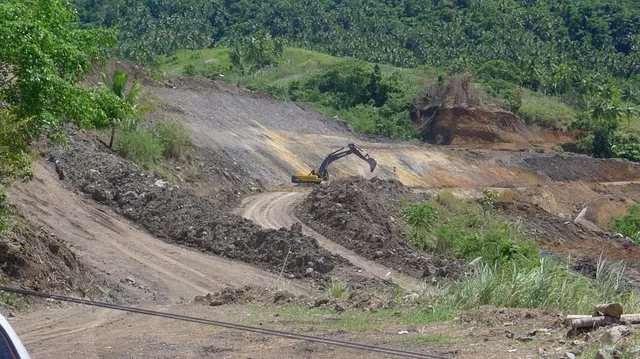
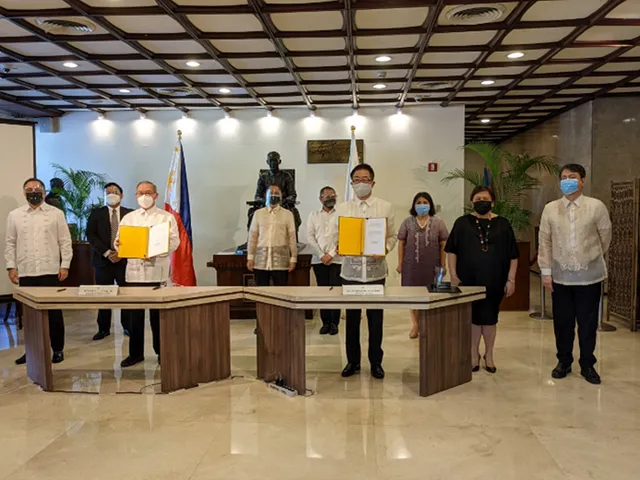
July 29, 2021

Photo Credit: Delta Earth Moving

Binding Agreement to divest the Siana Gold Project to TVI Resource Development (Phils.) Inc.

  • • US$19 million cash payable upon completion
  • • Net Smelter Return royalty of 3.25% payable for up to 619,000 ounces of gold, with an estimated future face value of US$36 million (based on a US$1,800/oz gold price) (Royalty)1
  • • TVI Resource Development (Phils.) Inc. is in the advanced stages of securing funding to restart the Siana Gold Project, which is expected to re-commence operations in the first half of 2023

Red 5 Limited advises that it has entered into a binding agreement with TVI Resource Development (Phils.) Inc. (TVIRD) to divest its interests in Philippine company Greenstone Resources Corporation (GRC), which holds both the Siana Gold Project (Siana) and the Mapawa Gold Project in the Philippines (Agreement).

TVIRD is the Philippine affiliate of the Canadian-listed TVI Pacific Inc (TSX-V:TVI). TVIRD has two operating mines and a number of other development projects in the Philippines with interests in gold, nickel and copper. Through its major shareholder, Prime Resource Holdings Inc., TVIRD has advised that funding to restart Siana is expected to be sourced from existing operating cash flows and debt funding if required, and is targeting a restart of operations in the first half of 2023.

Red 5, GRC and TVIRD are committed to ensuring an orderly transition of ownership at Siana. TVIRD will become the 100% owner of GRC and therefore the divestment includes the process plant and all other infrastructure at Siana. The Royalty of 3.25% payable for up to 619,000 ounces of gold will be payable from first gold from the restart of the Siana processing plant. The Parties will now progress towards prompt completion of the Agreement. Upon completion of all closing conditions, which include certain Philippine regulatory approvals expected to be satisfied during the September 2021 quarter, Red 5 will receive gross proceeds of US$19 million through the repayment of outstanding shareholder advances due from its Philippine-affiliated company, Red 5 Asia Inc, which is a shareholder of GRC.

Since the suspension of mining operations at the Siana project in 2017 and after considering various options for the project, the divestment of its interests in Siana is consistent with Red 5’s strategy to focus on its King of the Hills and Darlot gold mines in Western Australia, with the aim of becoming a substantial mid-tier Australian gold producer.

PCF Capital acted as Financial Advisor to Red 5. HopgoodGanim Lawyers and SyCipLaw Center have acted as Legal Advisors to Red 5.

Commenting on the transaction, Red 5 Managing Director, Mark Williams, said:

“The Company has had a long history in the Philippines as a gold explorer, developer and ultimately, successful operator of the Siana Gold Project for a number of years through its Philippines affiliates and partners. Following the challenges we experienced in FY17, mining operations at Siana were suspended and we have since successfully pivoted to Australia through our dual acquisition of the Darlot and King of the Hills gold mines, which was completed in October 2017.

“We are now well established on our growth trajectory in the Australian gold sector with the construction of the King of the Hills gold mine now in full swing and first gold production on track for the June Quarter 2022, complementing our nearby existing production base at Darlot.

“I am proud of the excellent job the Philippines team has done in maintaining the asset during the period of suspension of mining activities and ensuring that strong community relations programs have continued. I am confident that TVIRD will build on these strong foundations as they move forward and bring the mine back into production for the benefit of all key stakeholders in the region.

“From a Red 5 perspective, the transaction streamlines our portfolio, removes the annual holding cost of approximately A$6 million and crystallises a combination of cash value for our shareholders while maintaining future exposure to the upside at Siana via a capped Net Smelter Return Royalty of 3.25%. I would like to thank everyone who has been involved in assisting us with the transaction.”